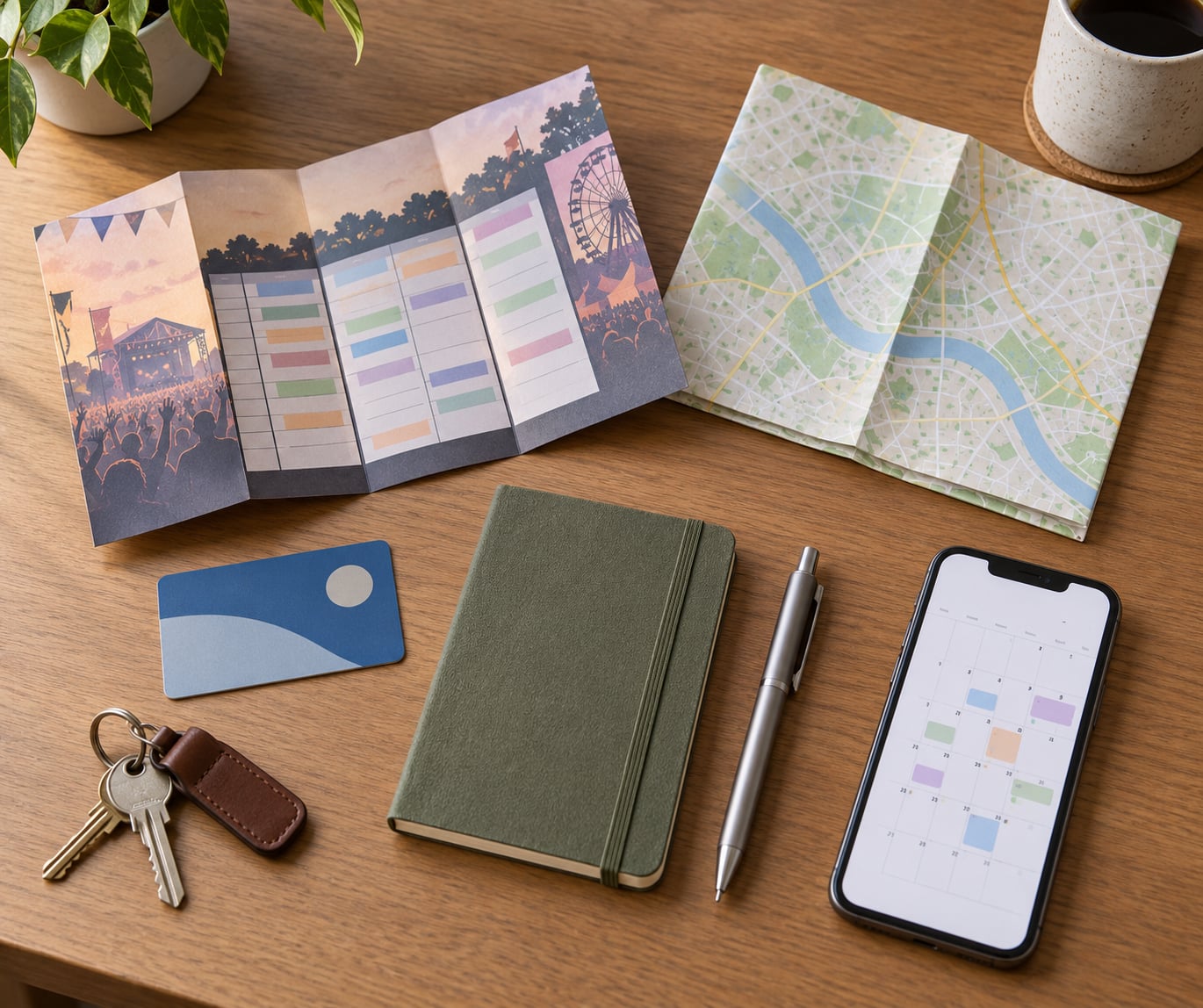
You plan a trip around a festival without crowds by treating the schedule, not the sightseeing list, as the starting point: arrive the night before or on a shoulder day, sleep outside the busiest core, and move through the site on side paths and shoulder hours. People who do this typically spend a fraction of the time standing in dense crowd than the ones who show up at midday on the headline day.
It takes about two to three weeks of research for a solid plan and roughly a day of booking once the dates are fixed. The whole thing is not complicated, it is just front-loaded.
The reason it works is that festival crowds are remarkably predictable. They peak at the gates, at the headliner, and in the middle of a hot afternoon. They thin out early in the morning, late in the evening, and on the days either side of the main event. Regulars have known this for years and it is barely discussed anywhere in the official guides, which still describe arrival in cheerful terms like arriving early.
Table of Contents›
- What You Need
- Step-by-Step: How to Plan a Trip Around a Festival Without Crowds
- 1. Define the festival experience you want
- 2. Map the festival calendar against local demand
- 3. Choose a base outside the busiest center
- 4. Reserve accommodation and transport early
- 5. Schedule quieter days around the festival
- 6. Build a flexible daily route
- 7. Use shoulder times and side stages to plan a trip around a festival without crowds
- 8. Set crowd-control rules for the day
- Common Mistakes
- Frequently Asked Questions
- How far in advance should I book a trip around a festival?
- Is it worth staying outside the festival center?
- How do I handle sold-out events while traveling?
- What should I plan for children or limited mobility?
- How do I adapt when crowds are worse than expected?
- Conclusion
What You Need
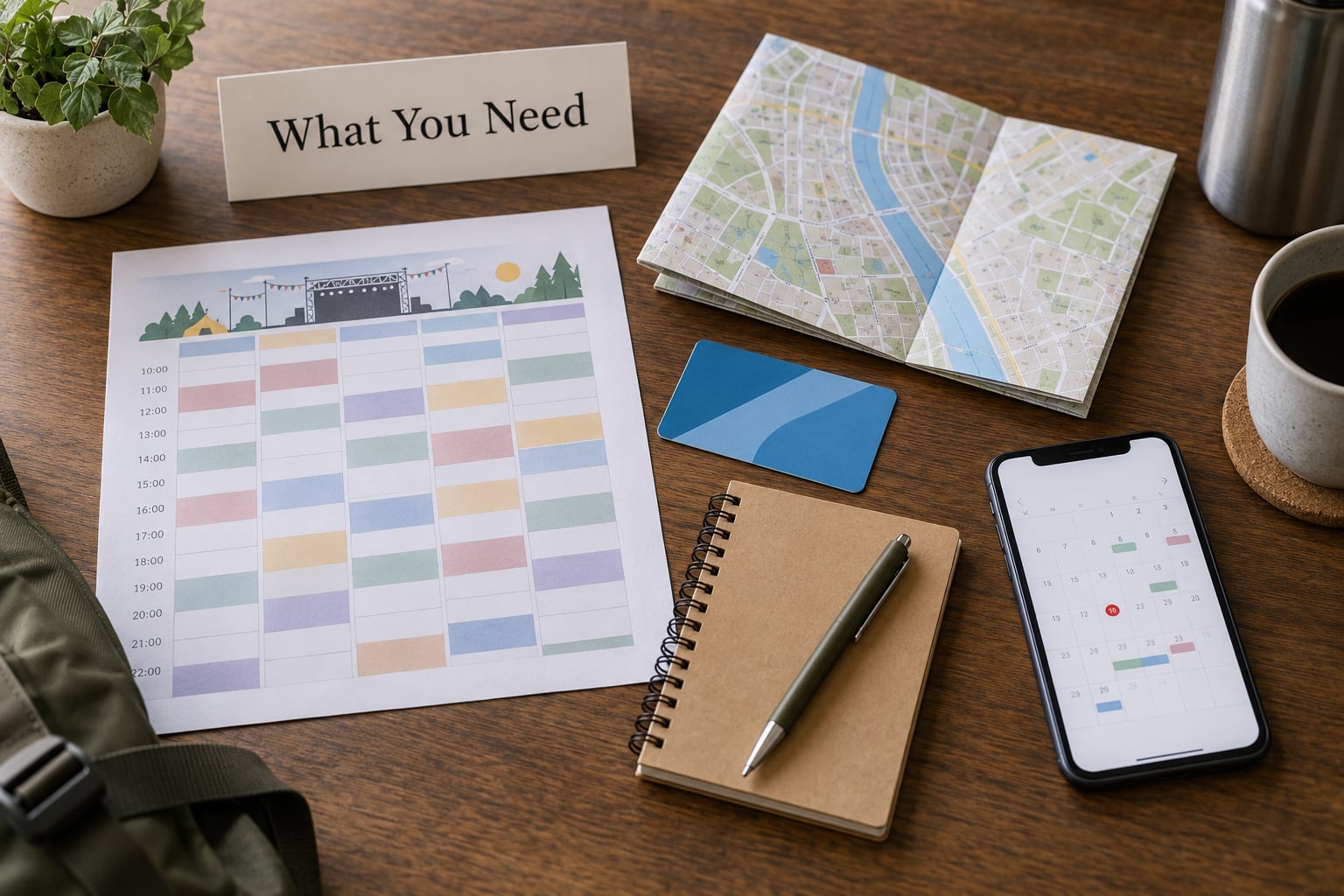
Six things need to be in place before you book anything. Get these right and the rest of the trip takes an afternoon to assemble.
The exact festival schedule. Full set times, gate opening hours, curfew, and the day the car park or camp opens. Set times for side stages are usually published weeks ahead of the main lineup details, so check twice.
A flexible base. Somewhere to sleep that is not the festival itself. That might be a town two stops from the gates, a guesthouse in the neighbouring village, or a campsite outside the main camping zone. The word to search on is the transport interchange, not the festival name, because that is where the towns actually are.
Transport information. Shuttle timetables and their last departure, the number of services per hour, whether you need a pre-booked seat, and the real drive time to the car park on a busy evening. Festival shuttles usually run a tight loop between a town centre and the site, and they are the difference between a comfortable exit and a two-hour crawl. Travellers report post-headliner journeys of over two hours when no plan was made in advance.
Accommodation requirements. Parking at the property, whether it is inside a low-emission or restricted zone, whether festival reentry rules let you leave and come back on the same wristband, and how late reception stays open.
A budget ceiling. Decide what the whole trip covers before looking at rooms. Accommodation in festival towns typically costs two to four times its usual level for the event weekend, and that premium sits almost entirely on the Friday and Saturday nights. A Sunday-to-Monday booking or a Wednesday arrival costs a fraction of it.
Offline tools. The site map downloaded to your phone, the tickets and order confirmations in a wallet app, a shared note with your travel details, and a screenshot of your accommodation address. Festival signal is frequently poor, so anything that lives only in a browser tab is a risk.
Step-by-Step: How to Plan a Trip Around a Festival Without Crowds
The order matters here. Most people start with a destination and work backwards to the festival, and that is exactly how they end up in the middle of it. Start with the festival schedule instead, then build outward.
1. Define the festival experience you want
Write down two things: the one act you would be genuinely sad to miss, and the general feel you are after. Two artists who matter, one atmosphere word, and a rough number of hours you want on site.
Everything else is optional. This matters because the people who suffer most are the ones who scheduled a full weekend around a headline they cannot physically get close to. They spend three days trying to see everything and remember none of it.
Regulars consistently say the same thing about crowd density: it matters more than the lineup. The same bill can be a great weekend or a miserable one depending on the hours you chose.
2. Map the festival calendar against local demand
Pull the full run of events over a two-hour radius and mark which days are quiet. City festivals in a seaside town during the same week are a different proposition from the same festival in a small village in the middle of nowhere.
Check the local events calendar for the week as well as the festival programme. A trade show, a football fixture or a half-term school break can turn an otherwise calm festival day into the busiest one of the weekend.
For a low-crowd experience, the days that work best are the ones before the gates open to the public, and the one after the last act. Attendance grows as the event gains momentum, so the back half of a running festival is busier than the front.
3. Choose a base outside the busiest center
This is the decision with the biggest effect and the most second-guessing. The useful way to think about it is travel time versus exposure.
Staying inside the festival core means a short walk but hours inside the busiest zone, plus inflated rates and traffic on your doorstep. Staying far out means more travel time but an empty, normal town at the end of the night.
Most people land well with a base 20 to 40 minutes from the gates by shuttle or train, in a place with a proper high street, late food and parking. Enough of a commute that you are not sleeping in the queue, short enough that the return journey is not a project.
One extra night either side of the festival is worth more than any other single booking. It removes the arrival rush and gives you somewhere to sit down on the morning after, which regulars call the single best advice in festival planning.
4. Reserve accommodation and transport early
Book cancellable rooms first, then the transport. Flexible terms let you reposition your base later once you understand the geography, and festival towns fill up on the best-rated properties months ahead.
Three to six months ahead is a reasonable window for a weekend in a festival town with a good shuttle link. Going earlier mainly buys you choice of property and a room you can cancel. Waiting until a few weeks out usually means a hostel or a room above a bar.
After the room, book the parts of the journey with fixed capacity: shuttle returns, train tickets with reserved seating, airport parking, the coach from the station if one exists. On the last evening, most festival shuttles leave within an hour of the headliner ending, so check the return schedule before you assume you can get one late.
5. Schedule quieter days around the festival
If you have any flexibility, this is where it pays. The day before the gates open is usually a different festival town entirely: no queues, no temporary road closures, ordinary cafes, and a fraction of the pressure. A lot of people who come early say the atmosphere the night before is better than the one they paid for.
Use the quiet days for the wider area, too. The coastal path, the market in the next town, the vineyard, the castle, the long walk nobody does because everyone is on the bus to the site. On the days you are on site, aim to be there when the acts start and to be in your base eating dinner at the point where the queue would be forty deep.
Campers should add a day. A night before pitching means an empty pitch, a slow setup and no queue at the shower block. The trade-off is carrying everything an extra day, which is manageable if you are travelling light.
6. Build a flexible daily route
Group activities by geography, not by excitement. Two stages you have to walk between, then a rest, then one more, beats four stages scattered across the site that means a long march every time.
Leave buffer between blocks. A fifteen-minute walk across a festival site in the sun is closer to half an hour in practice, and a fixed itinerary with no slack turns one small delay into a ruined afternoon.
Plan one adjustable item per day. It should be something you are happy to drop, drop early, or swap for an alternative venue nearby, and it should be the most ambitious thing on the list. That way the day still works when the weather turns, an act is moved, or a stage closes for overcapacity.
7. Use shoulder times and side stages to plan a trip around a festival without crowds
The quietest windows on a festival site are early morning, late afternoon before the temperature drops, and the last hour or two after the big sets finish. Midday heat genuinely thins crowds; people sit in the shade, drink and wait it out. That is a free hour if you plan around it rather than against it.
On stage choice, the pattern holds across every large festival: the biggest stage is the most crowded, the second stage is busy for the acts it shares a lineup with, and the smaller stages are calmest for everything else. Forum regulars agree that side stages and less known acts give you room to actually see the act rather than a screen above heads.
One useful technique is to hold back on the side stages during the biggest sets, then move during the changeover when the main field empties out. If you are there for a specific act, arriving 45 to 60 minutes early for a mid-size stage is plenty. Save the raiding and multi-hour waits for the very front of the very biggest show, and only if you want that specific spot.
Look for the smaller things on site: the comedy tent, the craft market, the record stall, the film screening, the workshops, the sound art installation. They are part of the atmosphere and rarely have the density of the music fields.
8. Set crowd-control rules for the day
Decide the rules before you are inside. A few simple ones work:
- A maximum wait. If a queue passes 25 minutes, leave it. Half the time the act is not what you expected anyway, and you get the slot back.
- A backup for every popular act. If your target artist is on, a second stage with a different sound is twenty minutes away. Write it down.
- Meetup rules for groups. Agree on one landmark everyone can find, a time window rather than an exact minute, and how long someone waits before moving on. Ten minutes is the usual figure.
- An exit plan. Know your two ways out and your transport home before the headliner starts, not during the crush.
- Water and shade on a schedule. Drink before you are thirsty and break for shade in the hottest hours, which is also the most sensible time to be off the main field.
On the exit, this is worth planning properly. Almost every complaint about festival travel is about leaving: shuttle queues, full car parks and long drives. Know when the last shuttle leaves, take the first one that runs rather than the one you planned, and if you are driving, leave before the final act rather than immediately after it.
Common Mistakes
Staying in the middle of the festival. It is convenient and it is the busiest place to be. Fix: pick a base one step out, on a shuttle or train line, in a town with somewhere to sit down.
Booking only the headline acts. A trip built around three big names means three queue fights and a lot of standing in fields. Fix: pick one must-see, then build around the side stages and the smaller programme.
Scheduling every hour. Festival timings slip constantly, and a rigid plan produces a day of stress. Fix: two firm commitments per day, everything else negotiable.
Ignoring the transport gaps. Checking there is a shuttle in the morning and none at night is a very common mistake. Fix: confirm the last return in both directions before booking the room.
Overpacking. Festival bag policies are clear and enforced, and anything extra gets refused or checked. Fix: check the policy on the official site, pack to it, and add nothing.
Assuming a festival behaves like a normal day. Everything is slower, further away and more crowded than the map suggests, and that is the pattern on a quiet day. Fix: build in a 50 percent margin on walking and queuing times and you will still be ahead.
Trying to do the whole run of the event. The longer you stay at a large festival, the more you are inside dense crowds, and the more people treat it as a normal day rather than a special occasion. Fix: take a single day or use a shoulder day, then spend the rest of the week nearby.
Worth adding for anyone going with children, an older relative or anyone with limited mobility: check accessibility information and viewing platforms on the festival’s own site well ahead, ask for a viewing area ticket if one is offered, and plan the day around a fixed rest point rather than finding one when someone is exhausted.
Frequently Asked Questions
How far in advance should I book a trip around a festival?
For a festival town with good transport links, three to six months ahead is a sensible window. That gives you a choice of properties and the option to book anything cancellable. Earlier mainly buys flexibility, later usually means hostel rooms and rooms above bars. Always book the return transport first, since shuttle and rail services have fixed capacity that runs out well before rooms do.
Is it worth staying outside the festival center?
For most people, yes. A base 20 to 40 minutes from the gates on a shuttle or train line gives you an ordinary town to come back to, which matters most after the headliner when the festival itself is a crush of people and closed roads. The tradeoff is a longer daily commute. It pays off most when you are on site for more than one day or travelling with children.
How do I handle sold-out events while traveling?
Assume nothing sells out until it does, and keep a second option written down for every act you care about. Lineups change, stages get rescheduled and added sets appear on the day. Download the official app at the start of the festival so updates arrive even when the site signal is poor, and check the notice boards near the entrances, where changes are posted fastest.
What should I plan for children or limited mobility?
Front-of-stage fields are the hardest part of a festival to navigate, whatever your age or mobility. Most large festivals run accessibility services, viewing platforms and welfare points, and the details are on the official site. Arrive before gates, use the welfare route rather than the pedestrian one, and schedule a fixed rest point into each day so the plan does not depend on finding one when someone is tired.
How do I adapt when crowds are worse than expected?
Drop the act, not the day. Head for a side stage, a workshop, the market or a nearby café and come back later, because crowds ease noticeably between sets. Avoid the changeover rush across the main field, and keep your maximum wait rule in force, because a fixed 25-minute cutoff stops a bad queue turning into a wasted evening.
Conclusion
Pick the one headline event you would regret missing, and let the rest of the trip follow it. Then choose a base one step outside the busiest center on a transport line, book it with cancellable terms three to six months ahead along with the return journey, and spend the days either side of the event somewhere quieter.
On site, keep two firm commitments a day, use the early morning and the last hour or two when the crowd thins, learn the side stages properly, and agree your exit plan before the headliner sets begin. That is the whole method, and it costs nothing beyond a little planning done early.