To use a travel credit card without overspending, treat it as a payment rail rather than extra money. Work out what the trip can genuinely cost, route only the expenses you already planned through the card, turn on alerts so nothing arrives as a surprise, and clear the statement balance in full every month. A rewards card changes how you pay and what you get back, never how much the trip costs. Setting that up takes about an hour before you book, plus two minutes at checkout.
That is the whole idea, and it is worth stating plainly because the alternative is how most vacation balances happen. A card separates the purchase from the payment by weeks, so an unaffordable trip looks completely affordable at the moment you tap. Add a foreign exchange markup on the card you did not notice, a sign-up bonus you are chasing, and a run of small purchases that never felt worth budgeting, and the balance usually outlives the holiday.
This one is written for people travelling alone, who carry the whole cost of a trip themselves with nobody to split the bill with. If you ever do, the per-day number is entirely yours, and a two-day overrun is not half as bad as it would have been with a companion.
A note on scope: this is general information about budgeting habits, not financial advice. Fees, interest rates, reward terms and bonus rules vary by card and issuer and change over time, so confirm your current terms with your issuer before you rely on any figure here. This guide was written in October 2026 and reviewed since.
Table of Contents›
- What You Need Before You Use the Card
- Step-by-Step: How to Use a Travel Credit Card Without Overspending
- How to Use a Travel Credit Card Without Overspending: Set a Hard Trip Budget
- Create a Separate Travel Envelope
- Check the Card Before You Book
- Set Issuer Alerts and Spending Guardrails
- Use a Three-Part Purchase Test
- Pay the Balance in Full Every Month
- Reconcile Charges and Adjust the Rest of the Trip
- Common Mistakes: What to Avoid While Using a Travel Credit Card
- Check the Total Cost, Not Just the Rewards
- Do Not Treat a Credit Limit as a Budget
- Separate Essential From Optional Spending
- Frequently Asked Questions
- What is the best way to use a travel credit card?
- What is a good way to avoid overspending on your credit card?
- What are the downsides of travel credit cards?
- Should I pay off my credit card before I travel?
- Is it bad to carry a travel credit card balance?
- What is the 2/3/4 rule for credit cards?
- Conclusion
What You Need Before You Use the Card
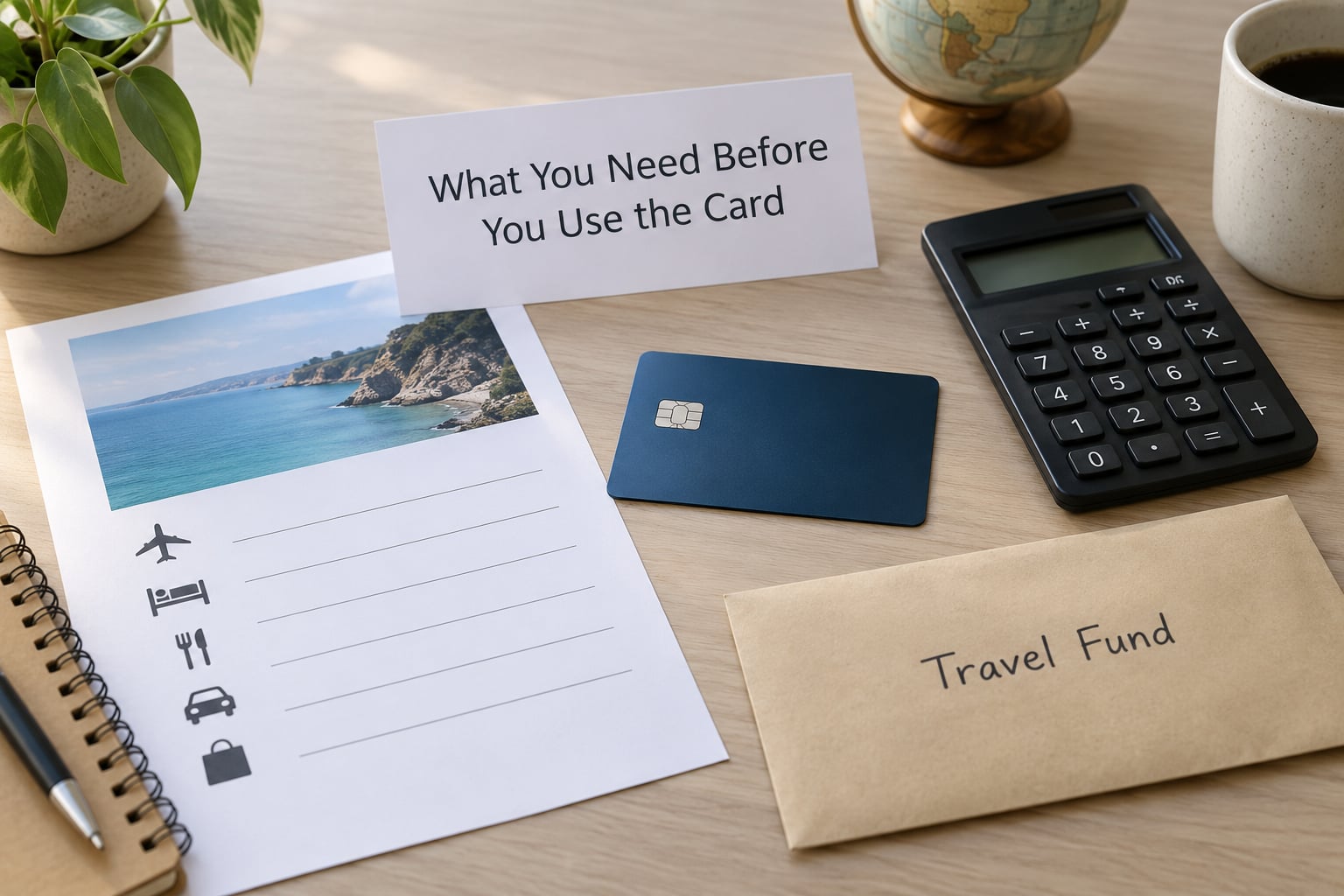
Five minutes of preparation is the difference between a card that funds your discipline and a card that quietly funds your impulses. Get these items in front of you first.
- A written trip budget. A total figure and category caps, not a vague sense of what you can afford. A number on paper behaves very differently from a feeling in your head.
- A separate travel envelope. A dedicated bank balance, a cash envelope, or a named category in your budgeting app that nothing else can touch.
- An emergency fund that is not part of the trip. The buffer that absorbs a missed connection, a broken shoe or a clinic visit must sit outside your travel money.
- Your current card balance and credit limit. Both numbers change the arithmetic on every purchase you are about to make.
- The card’s current terms. APR, annual fee, foreign transaction fee, any foreign exchange markup, and the payment and credit terms in your current disclosure schedule.
- The rewards rules. Bonus categories, excluded purchases, redemption values, and any minimum spend requirement attached to a welcome bonus.
- A spending tracker and alerts. The app where your accounts already live, plus transaction alerts switched on before you leave.
Most of that list is free and already inside apps you use every day. The point is not to buy anything. The point is that the system only works if every part exists before the first charge, not after the first surprise.
Step-by-Step: How to Use a Travel Credit Card Without Overspending
Seven steps, run before the trip, during the bookings, before every purchase, and after the statement closes. Each one has a check that tells you it worked, because a system you cannot verify is just a habit you hope is holding.
How to Use a Travel Credit Card Without Overspending: Set a Hard Trip Budget
Start with one total figure for the trip, covering flights or trains, lodging, food, activities, local transport, insurance, shopping and a contingency. Scope it from the moment you leave home to the moment you return. Then split that total into category caps and divide each cap by the number of days to get a daily allowance you are willing to commit to.
A workable split is roughly a third for transport, a third for lodging, a fifth for food, a tenth for activities, and a tenth held back for anything unexpected. Solo travellers can shift more toward transport and less toward activities, because there is no second fare and no shared rental to pay for.
The check: every planned purchase has to fit inside a category cap before it happens, and every category cap has to fit inside the total. If a charge cannot be traced back to a line in the budget, it is not a budgeted purchase, regardless of how good the price is.
Create a Separate Travel Envelope
Isolate the money for the trip in a place the card cannot quietly borrow from. A high-yield savings account is the cleanest version, but any separate balance or named budgeting category works, and plenty of travellers use a plain envelope in a drawer.
Move money into it gradually rather than one lump sum right before departure. A weekly automatic transfer that matches the trip date is easier to live with than a single large hit, and it keeps the money in your everyday account lower in the weeks when you are most likely to spend carelessly.
Once the money is in the envelope, the card becomes how you pay for the trip, not a way to reach further into credit you have not saved yet. That single reframe does most of the work.
The check: the balance in the travel envelope is greater than or equal to the trip budget you set, and nothing outside the trip is drawing on it.
Check the Card Before You Book
Read the current terms, not the summary you remember from when you applied. Look at the APR and how interest accrues, the annual fee, the foreign transaction fee or any foreign exchange markup, the credit limit, the payment due date and minimum payment, which purchases do not earn rewards, and any minimum spend requirement attached to a welcome bonus.
If you are travelling abroad, the foreign transaction fee is the single number that matters most. Cards that charge one typically apply it on top of the network exchange rate, so a three per cent fee becomes a real cost on every transaction rather than a rounding error. Refusing the fee by using a no-fee card changes the math of the whole trip.
Confirm current terms directly with the issuer, because schedules change and terms in your mailbox are more accurate than anything a blog can tell you. Then check whether the card earns anything on the purchases you actually make, and whether its benefits justify its cost for your specific trip.
The check: you can say out loud what this card costs you annually and what it gives back, and the answer is not something you would rather avoid saying.
Set Issuer Alerts and Spending Guardrails
Almost every issuer app lets you switch on alerts for each transaction, for balance thresholds, for approaching payment due dates, and for unusual activity. Turn all of them on before you leave and set the thresholds below what you would be annoyed about, not above it. A low single-transaction threshold works better than a high monthly one, because the daily leak is what adds up.
Look for a way to cap spending on the card itself, whether that is a per-transaction lock, a spending limit in the app, or a temporary freeze you can toggle. A card you have to unlock each morning before you leave the hotel is a budget check you cannot forget.
Two habits worth setting up 48 hours before departure: save the issuer’s international phone number in your phone, and download the app rather than relying on the browser when a connection is poor.
Alerts do not stop you spending, and no setting does. They shorten the gap between the charge and your knowledge of it, which is the gap that lets a bad pattern survive until the statement arrives.
The check: a test charge or a low-value purchase triggers a notification within a few minutes, and you know where that number is saved.
Use a Three-Part Purchase Test
Before checkout, ask three questions. Is this charge already sitting in the trip budget? Is it something I actually needed or deliberately planned, rather than something that caught my eye? And if I pay it off by the due date, does the cash stay in my emergency fund and my savings intact?
All three need a clear yes. One maybe is a no. This test takes about ten seconds and it does something your spending history cannot: it separates the purchase you chose from the purchase that happened to you.
It also handles the awkward category cleanly. A hotel upgrade you genuinely planned and can afford passes. An upgrade that only looks affordable because the card will let you spread it across two months fails the third question, because paying in full is the requirement, not the aspiration.
The check: you can name the budget line every charge in the past week came from.
Pay the Balance in Full Every Month
This is the rule the whole system exists to protect. Rewards are earned on the spending, but they are never a substitute for paying the balance. Interest does not care how many points you collected, a late fee does not care either, and a statement you pay down slowly costs you far more than the points are worth.
Schedule payment for the full statement balance from the travel envelope rather than leaving it to be remembered. Then actually open the account and confirm the payment posted, rather than trusting the reminder that it is scheduled. That verification step is the difference between intending to pay and having paid.
Never count a reward you have not redeemed, an expected reimbursement, or a refund still pending as spendable cash. Points are a small discount on a trip you can afford. They are not a down payment.
The check: on your last statement, the balance cleared and there was no interest charge on it.
Reconcile Charges and Adjust the Rest of the Trip
Once a week while you are away, spend fifteen minutes matching card transactions against your receipts and against the budget itself. Three numbers matter: the amount budgeted for the category, the amount spent so far, and how many days remain. Divide the difference by the days remaining and you have your new daily allowance.
If the daily allowance turns negative, discretionary spending is what adjusts first. Eat where you planned to eat, take the museum you budgeted for rather than the one that appears on the way, and defer the shopping you did not budget until the trip is over. That is not a failure; it is the system doing exactly its job early rather than late.
Investigate any charge you do not recognise straight away rather than hoping it sorts itself out. Time matters when a charge turns out to be a hold rather than a real transaction, or when something on a statement is not yours at all.
One thing to expect: holds. A rental car deposit or a hotel may place a preauthorization that takes a slice of your available credit and can take several days to drop off. Check the card’s terms so you are not surprised by available credit that seems to have evaporated for a reason nobody explained.
The check: at the end of every week, the remaining days have a positive allowance in every discretionary category. When that number is negative, adjust the plan instead of pretending.
Common Mistakes: What to Avoid While Using a Travel Credit Card
Almost every rewards problem traces back to the same handful of behaviours. Each of these has a correction that is simpler than it sounds.
- Chasing points. The correction: rewards reduce the cost of a trip you already budgeted for. They never justify a trip you could not afford.
- Booking while carrying a credit balance. Starting a new charge while an old one is unpaid is how one trip’s overspend becomes the next trip’s problem.
- Spending to meet a sign-up bonus minimum. The consensus on card forums is blunt: skip the card if meeting the requirement means spending money you would not otherwise spend.
- Treating points as cash. A reward you have not redeemed is not money in your account.
- Mixing trip and everyday spending. One card for everything makes the trip invisible in your statements and impossible to reconcile.
- Carrying a balance for the points. At current card APRs, interest charges outrun any reasonable point value.
- Ignoring the foreign transaction fee. Check it before the trip, not at the till, and choose to be charged in the local currency when a terminal offers to convert for you.
Check the Total Cost, Not Just the Rewards
That last point deserves its own explanation because it catches people abroad. A terminal abroad may offer to convert the charge into your home currency at a rate set by the terminal operator rather than the network. That dynamic currency conversion almost always looks convenient and almost always applies a poor rate with a hidden markup baked in.
Say no to it and let the transaction settle in the local currency at the network rate, then check what your issuer adds. If your card has no foreign transaction fee, the network rate is essentially the real cost, which makes the maths far easier to plan.
Do Not Treat a Credit Limit as a Budget
A large available credit limit is not extra money. It is an amount someone was willing to lend you, which is a fact about their risk assessment rather than about your budget.
Set your spending limits from your income, your savings and your actual trip budget, not from the maximum an issuer will approve. The most dangerous sentence in this whole topic is the one that sounds reasonable in the moment: I have the available credit, so I will take the better room.
Separate Essential From Optional Spending
When money runs short, decide in advance which expenses are protected and which are the first to go. Transport home, lodging, food and insurance are usually non-negotiable. Upgrades, nicer dining, shopping and the extra excursion are not.
Write that order down before you leave, because a budget under pressure is a terrible time to make value judgments. When you have the list, cutting becomes mechanical rather than emotional, and the trip stops feeling like a series of small betrayals.
One more worth naming: for many travellers the overspend is not about the card at all, it is about trip ambition. A shorter trip, a closer destination or a few days instead of two weeks costs less in every category at once, and it keeps the buffer intact for next time.
Frequently Asked Questions
What is the best way to use a travel credit card?
The best way to use a travel credit card is to budget the trip first, then route only planned expenses through the card, then pay the statement balance in full every month. The card works in one direction: it changes how you pay and what you earn back, never how much the trip costs. Anyone who wants to know how to use a travel credit card without overspending should decide the total and the category caps before booking anything.
What is a good way to avoid overspending on your credit card?
Give the card a job rather than letting it cover everything. Set a trip total, split it into category caps, move the money into a separate travel envelope, and turn on transaction alerts before you leave. Before each purchase ask whether the charge is already in the budget, whether you truly needed it, and whether paying it in full leaves your emergency fund intact. Three yes answers or the purchase waits.
What are the downsides of travel credit cards?
The main downsides are the annual fee, a foreign transaction fee that adds a markup to every purchase abroad, and the minimum spend requirement attached to a welcome bonus, which can push you into spending you did not plan. Points are also easy to overestimate and useless once interest accrues. Preauthorization holds on car rentals and hotels can temporarily reduce your available credit, and cards get lost or cloned overseas.
Should I pay off my credit card before I travel?
Pay any existing balance in full before you travel, and never book on a card that already carries a balance. Arriving with money owed makes every trip expense harder to refuse, because the previous trip’s cost is still sitting on the statement. Better still, clear the travel card from the trip’s funding so the balance arrives with nothing left owing on it.
Is it bad to carry a travel credit card balance?
Yes. Interest compounds monthly and quickly outweighs anything you earned in points on that same spending, which means carrying a balance converts your rewards into a loss. Set up an automatic payment for the full statement balance from the travel envelope and confirm it posted in your account. If you cannot pay a statement in full, do not put the trip on the card.
What is the 2/3/4 rule for credit cards?
The two-three-four rule is not a credit card rule at all. It comes from a savings and investing framework that splits income roughly into two per cent for living costs, three per cent toward goals and three per cent toward retirement savings. It has nothing to do with paying a card off. For travel spending, the framework on this page is a simpler one: budget the trip, cap each category, pay the statement in full.
Conclusion
Start with the total. Work out what the trip genuinely costs from leaving home to coming back, split it into category caps, and move that amount into a travel envelope before you book anything. Then read your card’s current APR, annual fee, foreign transaction fee and bonus terms, because those numbers decide whether the card helps or quietly costs you.
Pay the statement in full, every month, without exception. That single habit is what keeps the rewards instead of turning them into interest, and it is what allows a travel credit card to be a tool rather than a trap.
General information only, not financial advice. Rates, fees and reward terms vary by card and issuer and change over time, so confirm the current terms with your issuer before you travel. Written in October 2026.