Leaving room for nothing means writing empty blocks into your travel schedule on purpose, so unscheduled time becomes part of the plan instead of the gap between two bookings. The method is short: confirm about 70% of your time, name one clearly blank block every day, and defend it the same way you would defend a reservation. Here is how to leave room for nothing in a travel schedule without turning the rest of the trip into chaos.
Editing an itinerary this way takes about twenty minutes, and ten if you are starting from a blank page. The hard part is not the method. It is the discomfort of an empty square in a document, which feels like wasted time right up until day four of a wet trip with nothing booked and nowhere to be.
This is not an argument for planning less. Transport, accommodation, timed tickets and any work you have to fit in still get locked down first. The blank goes around those things, not over them.
Table of Contents›
- What You Need to Leave Room for Nothing
- Step-by-Step: How to Leave Room for Nothing in Your Travel Schedule
- Start with the non-negotiables
- Choose one or two anchors per day
- Build in transition time
- Group activities by place and energy
- Name the blank: how to leave room for nothing without filling it back in
- Test the plan before you travel
- The rule for a day that runs late
- Common Mistakes That Fill the Gaps Back In
- Frequently Asked Questions
- How much free time should I leave in a trip?
- Is it bad to have an empty day on a trip?
- What is travel dysmorphia?
- How do I travel without a plan?
- What if the person I am travelling with wants to do everything?
- How do I stick to a travel itinerary without it feeling rigid?
- Start With One Blank Afternoon
What You Need to Leave Room for Nothing
You need five things before you start cutting things out, and none of them is a particular app. Paper, a note on your phone and a shared doc all work, provided the blank gets written down somewhere you will actually see it.
- Your fixed spine: transport, accommodation and any reservation already booked.
- Real travel times between those things, not the optimistic number in the search bar.
- A realistic ceiling for how much you can manage in a day, after travel, jet lag or a bad night.
- Two or three true must-sees for the whole trip, not three per day.
- One place to write the plan, empty parts included.
On travel times, people underestimate constantly. A journey that looks like twenty minutes usually includes waiting for the platform, the walk to it, and the wait at the far end. Add half again to anything with a change in it.
On energy, the honest number is usually lower than the one you wrote at midnight. Think about the first day after a flight rather than the third day once you are settled.
And count your usable days. Land at eleven at night on Friday and fly out at six the next Monday and you have one good day, not three.
Step-by-Step: How to Leave Room for Nothing in Your Travel Schedule
Six edits, in this order. Doing them out of sequence usually produces a day that looks calm on paper and falls apart at two in the afternoon.
Start with the non-negotiables
Write down everything that is already fixed before you decide anything is optional. That list is short: transport and long-distance travel, check-in and check-out days, reservations with a booking reference, work calls and deadlines, and your two or three genuine must-sees.
Then give every item one of three labels. Confirmed means it is booked, fixed and cannot move. On-spot means you could still buy a ticket or a table that morning. Skipped means it is the first thing to go when a day compresses.
Those five labels are most of what makes an itinerary work. Nothing marked Confirmed ever gets rearranged to make room for something nicer you found while scrolling at midnight.
Choose one or two anchors per day
An anchor is the one thing you would be sorry to skip. One or two a day is plenty, because anchors are what you protect when everything else gets dropped.
Here is the arithmetic most people skip. A packed day might look like this: museum 10:00 to 12:30, lunch 13:00 to 14:00, a walking tour 15:00 to 17:00, dinner booked for 19:30. That is 8 hours 45 minutes of commitment across a 14-hour waking day, and the four transit legs between them add roughly 1 hour 45 that never appears on the plan.
| Time | Packed version | After dropping the tour |
|---|---|---|
| 10:00 to 12:30 | Museum (anchor) | Museum (anchor) |
| 13:00 to 14:00 | Lunch | Lunch |
| 14:00 to 15:00 | Walk to the old town | Blank, nothing booked |
| 15:00 to 17:00 | Guided walking tour | Blank, nothing booked |
| 17:00 to 18:00 | Tram back | Blank, nothing booked |
| 19:30 to 21:00 | Dinner reservation | Dinner reservation |
Drop one item and the day commits 6 hours 30 instead of 8 hours 45, transit shrinks with it, and you end up with a four-hour block that belongs to you. Same trip, same bookings, ten hours less rushing.
Build in transition time
Every plan is wrong about time, so budget for being wrong. About 90 minutes of flex on a day with travel in it, and more between cities, keeps one late meal from cascading into a day spent checking the clock.
| Buffer | Blank | |
|---|---|---|
| What it is for | Absorbing a delay | Belonging to you |
| Used when | Something runs late | Nothing goes wrong |
| Typical size | 30 to 90 minutes a day | 2 to 4 hours a day, one half-day a week |
| If it fills up | The day still works | The trip got fuller, which is allowed |
You need both. A trip with blanks and no buffers collapses at the first delayed dinner. A trip with buffers and no blanks runs on time and barely registers afterwards.
Transit is the part that actually drains you. On r/JapanTravel the complaint that comes up again and again is not too many temples, it is too much bouncing between them. Time in transit is the first thing to cut when a day gets tight.
Group activities by place and energy
Cluster what you have planned so it does not zigzag. One neighbourhood per stop, or one area per half-day, means less time in transit and more time actually standing in the place you came to see.
Match the demanding outings to the days when you have energy. A hike, a long museum and a late dinner in the same day is fine once, not three times in a week. Varying the daily pace is also what stops a trip from feeling like a conveyor belt.
Every open block is a decision you have to make, and decision fatigue is real. The fewer choices a day contains, the more of your attention is left over for the parts you actually wanted to be there for.
Name the blank: how to leave room for nothing without filling it back in
The core rule is 70/30. Confirm roughly 70% of your time, including transport, accommodation and must-see tickets, and leave 30% open. A common variant is one completely unplanned half-day per week, which on a two-week trip means two full half-days with nothing in them.
This is how to leave room for nothing in a travel schedule in practice: write the blank into the document. In the slot, type the words blank, nothing booked. It sounds trivial and it is the whole trick, because an unnamed gap reads as an oversight and gets filled by guilt the first quiet hour you have.
That guilt has a name in the research and a name in the culture. Travel dysmorphia is the feeling that you are not really travelling unless you are seeing everything, and it is what turns a free afternoon into a failure. The opposite idea has its own label too, JOMO, the joy of missing out, and it is a much better fit for a day you planned to leave open.
A recurring theme in r/solotravel threads is telling yourself to slow down and then ending up more rushed than at home. The fix is structural, not motivational. A traveller with a month left in Asia described sitting in a café and sketching as the thing that reliably produced the slow day they wanted. Nothing about that required planning more.
When a block comes up, pick something with low expectations and no entry fee:
- A café with a window seat and no laptop.
- Reading the book you carried with you.
- Sitting in a market and browsing without buying.
- Sketching whatever happens to be in front of you.
- Walking one neighbourhood with no destination.
- Finding a bench and staying on it for twenty minutes.
- A long lunch with no stopwatch on it.
- Going back to the street where lunch was good and seeing it in the evening.
- Laundry, a shower, a coffee, and nothing else on the list.
- Messaging someone who is not on the trip.
On a solo trip, put the phone on Do Not Disturb for the block. Turning off location sharing and geotagging while you are somewhere new also does two jobs at once, since it is what makes sitting still alone feel safe rather than exposed.
Test the plan before you travel
Read the itinerary against a clock rather than against your hopes. Add the transit legs, add lunch, add the hour it takes to get back to the hotel, and see whether the day still fits.
Arrival and departure days are the easiest place to start, because the transport already fills them. Keep them light and let them be the blank that proves the method works.
Anything outdoors gets a named indoor alternative, not a vague intention. In Iceland, where the weather decides the day for you, the advice that keeps coming up on r/VisitingIceland is to drop items in real time rather than pushing them into the evening. Same rule, same reason: a dropped item costs you nothing, a squeezed-in item costs you the evening.
The rule for a day that runs late
When a day starts slipping, drop the lowest-priority item on it. Do not reschedule it. Moving an attraction from 3pm to 7pm usually means a rushed dinner and a walk back in the dark, and it leaves you with a full day and nothing gained.
Common Mistakes That Fill the Gaps Back In
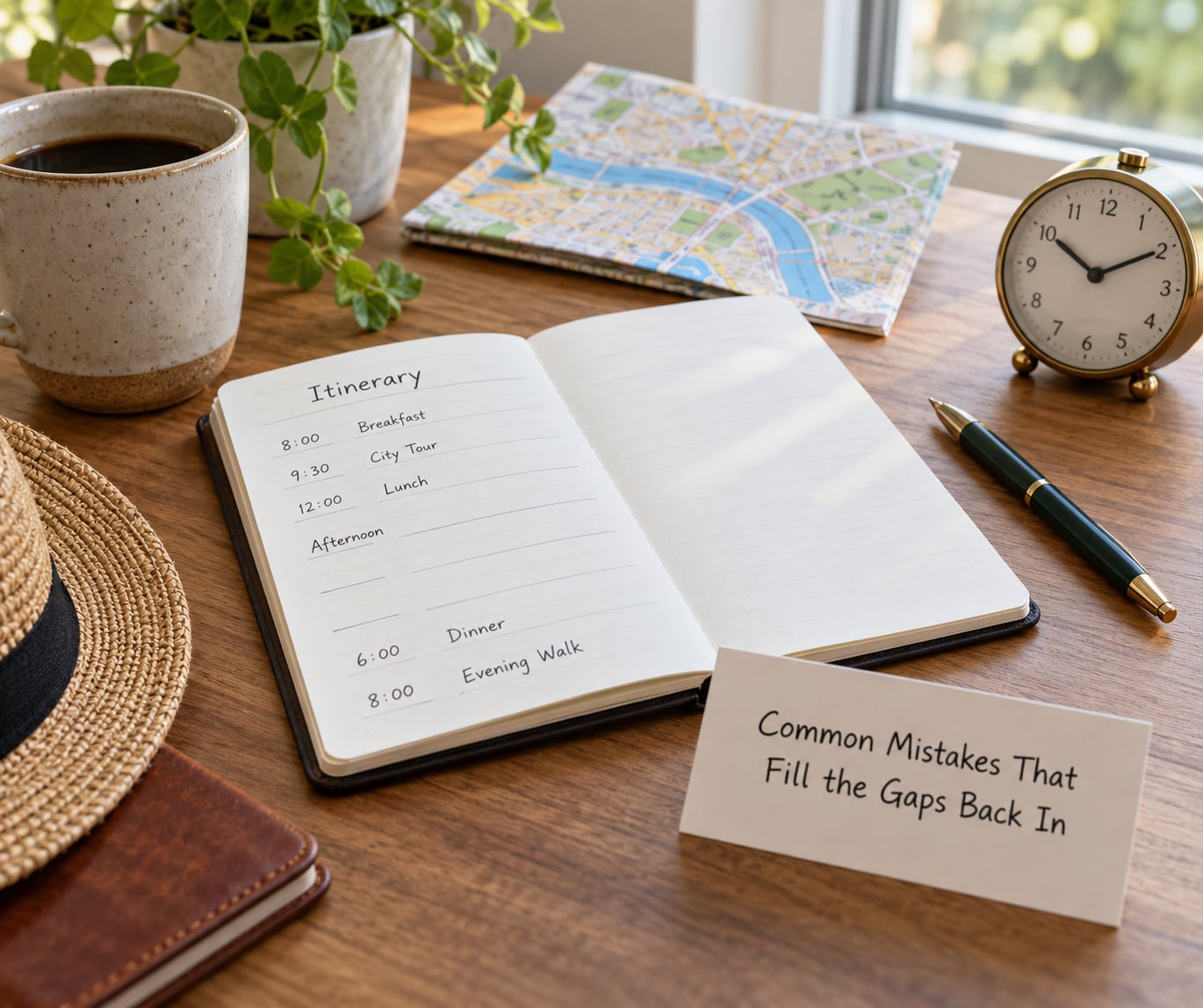
Most over-packed trips are not built by people who wanted an over-packed trip. They are built by a series of small, reasonable additions. Each one has a fix.
- Planning every hour as if it were productive. The fix is a blank you wrote down. An unnamed gap gets spent on something tedious within a day or two.
- Booking lunch and dinner every single day. Leave one meal unplanned. You will usually find somewhere better within ten minutes of walking.
- Believing the travel time the map gave you. Measure one real journey, door to door, including the waiting, then apply it to everything else.
- Running the same pace every day. Alternate demanding days with easy ones, and put the hardest outing where you are freshest.
- Confusing an open itinerary with a disorganized one. An open itinerary still has a fixed spine, labelled anchors and named blanks. You can describe any day in it in one sentence.
- Leaving the blank unnamed. Write blank, nothing booked in the slot, so it reads as a decision instead of a gap in your admin.
- Rescheduling instead of dropping. When a day runs late, remove the lowest-priority item. Re-adding it later turns one delay into a whole ruined evening.
- No weather alternative. Pair every outdoor plan with a named indoor version, decided in advance, so you are not choosing in the rain.
One last trap is assuming the blank only counts if you do something memorable in it. It does not. Most people remember the trip where a long lunch ran past three o’clock and they sat outside afterwards doing nothing at all.
Frequently Asked Questions
How much free time should I leave in a trip?
Aim for roughly 30% of your trip to be unbooked, which usually means one clearly blank block of two to four hours every day plus one whole unplanned half-day per week. On a two-week trip that is four half-days. Arrival and departure days are the easiest place to start, because the transport already occupies them.
Is it bad to have an empty day on a trip?
No. An empty day that you planned is one of the things people most often say they remember. The version that goes wrong is an empty day created by a cancelled plan, because it arrives with disappointment attached. Put one full free day in a week, decide in advance that it is a day, and stop treating it as a slot waiting to be filled.
What is travel dysmorphia?
Travel dysmorphia is the persistent feeling that you are not travelling properly unless you are seeing as much as possible, even when you are the one holding the itinerary. It shows up as guilt over unscheduled time and as a need to tick off attractions. The usual fix is structural rather than motivational: name the blank in your plan so it cannot be read as a failure.
How do I travel without a plan?
You travel without a plan by having a fixed spine and open edges. Transport, accommodation and one or two anchors per day stay confirmed, and the rest gets decided when you arrive. That is unplanned travel rather than no planning, and it holds up far better than a loose trip with nothing locked down at all.
What if the person I am travelling with wants to do everything?
Split the day before you go, not during it. Agree a start time and one shared anchor each day, then let each person keep the rest separate. If you are the one who needs more space, book your blank as firmly as you would book dinner and say what it is out loud, so it becomes part of the plan rather than a private escape.
How do I stick to a travel itinerary without it feeling rigid?
Label every item instead of just listing it: confirmed, on-spot or skipped. Confirmed items are fixed, on-spot ones can be sorted on the day, and skipped ones are your release valve. A document with those three labels tells you what is genuinely immovable and what can move, which is what makes a plan feel dependable rather than rigid.
Start With One Blank Afternoon
If you do nothing else, open the itinerary tonight, find the busiest afternoon, delete the lowest-priority item on it and write blank, nothing booked in its place. One block, named, defended.
That is how to leave room for nothing in a travel schedule. Keep the transport, the accommodation and the two things you would be sad to miss. Hand the rest of the afternoon back to yourself, on paper, before guilt gets a pen.