Most travelers do not get cheated by clever criminals in the craft markets. They get overpayed by sellers who have simply repriced the same mass-produced blanket four times over, or by a stall where every wooden bowl is identical because they came from one factory. Knowing how to buy local crafts without getting ripped off comes down to six checks, and none of them need more than a phone and ten quiet minutes.
The good news is that the checks are simple. Ask who made it, look at the seams and the glaze, compare three stalls before you commit, and keep the receipt. Do those things and the tourist trap stops being a trap.
Table of Contents›
- What You Need to Buy Local Crafts Without Getting Ripped Off
- Six Checks Before You Buy a Craft
- Step 1: Research the Craft and Normal Prices Before You Go
- Step 2: Choose Sellers Who Explain Their Work
- Step 3: Inspect Craftsmanship and Authenticity Up Close
- Step 4: Compare the Price and the Value Across Sellers
- Step 5: Negotiate Without Getting Ripped Off or Offending the Maker
- Step 6: Pay Safely and Keep Proof of Purchase
- Common Mistakes and the Fix for Each
- Frequently Asked Questions
- How can I tell whether a local craft is handmade?
- Is it rude to negotiate when buying crafts from an independent maker?
- Why are handmade crafts more expensive in tourist markets?
- Should I buy local crafts at a market or directly from a workshop?
- What payment method is safest when shopping abroad?
- How can I verify that a craft was actually made in the country where I am visiting?
- Conclusion
What You Need to Buy Local Crafts Without Getting Ripped Off
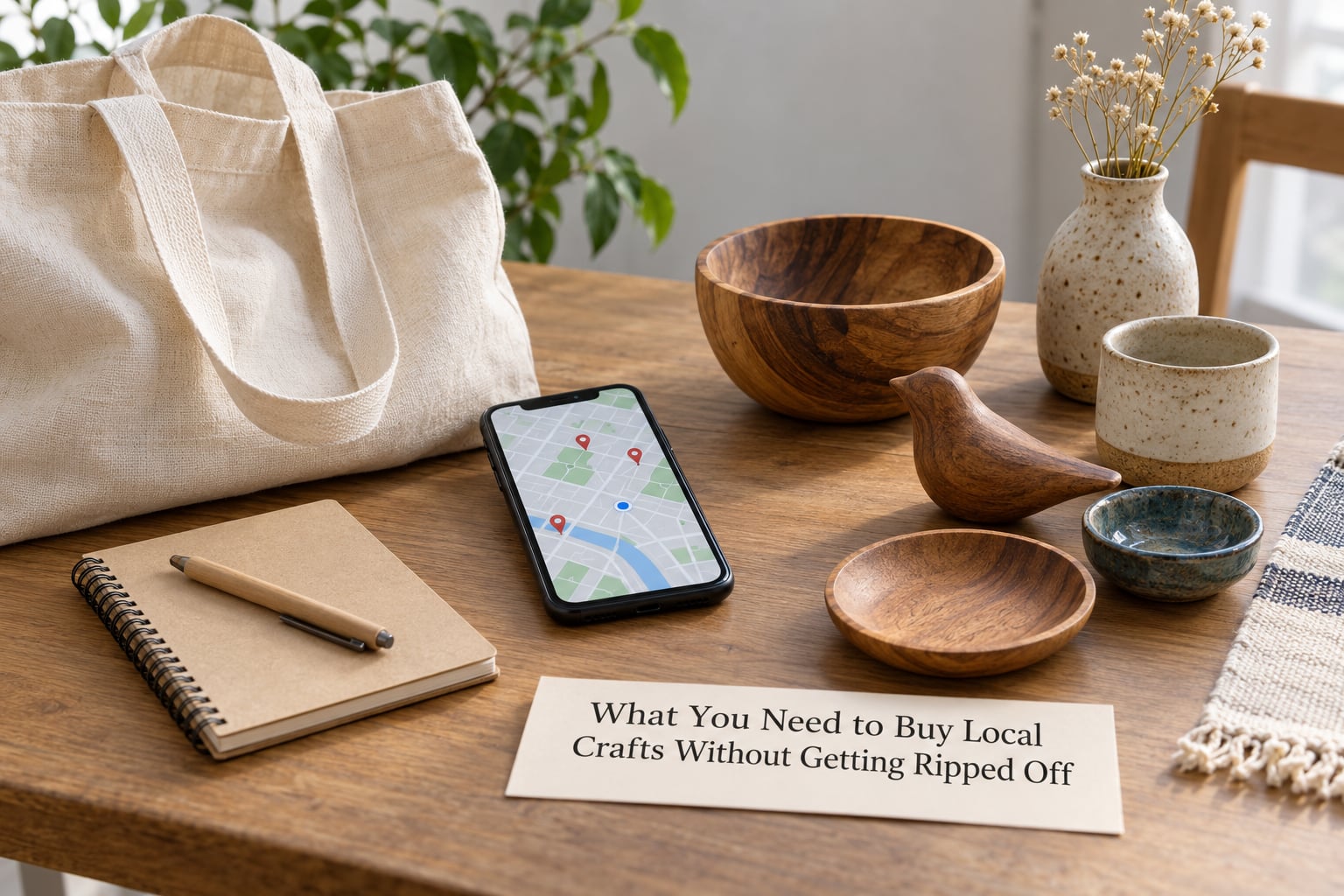
You need five things, and none of them cost much. Most trips go wrong because people shop with a full day and an empty head, buying the first thing that looks interesting.
- A rough spending figure. Decide what you are willing to spend on crafts for the whole trip, then split it by day. A hard ceiling makes haggling unnecessary.
- A reusable bag. Folding canvas totes nest inside a daypack and keep purchases separate from everything else.
- A phone with data. Useful for translation, for looking up what a craft should cost, and for photographing the piece before you commit to it.
- A small notebook. Write down prices as you walk. Stall 1 felt like a deal until stall 5 quoted half as much for the same thing.
- Time. Comparing two or three sellers takes twenty minutes. Rushing to a commission-based tour stop takes ten and costs you the afternoon.
Six Checks Before You Buy a Craft
Step 1: Research the Craft and Normal Prices Before You Go
Look up the craft before you reach the market, not while you are standing in it. Ten minutes of reading gives you a rough price range, the traditional materials, and the production method the region is known for.
That research does two things. It gives you an anchor, so a seller’s number stops feeling like the only number in your head. And it tells you which details actually distinguish good work from cheap work, so you are not inspecting a bowl for a signature when the real tell is the glaze.
Step 2: Choose Sellers Who Explain Their Work
Favor the seller who can name the maker, the materials, the process, and how to care for the piece without getting defensive. That is the whole test.
Tourists on travel forums repeat a simple rule: never accept anything handed to you for free. A bracelet fastened to your wrist or a name carved into a wooden plaque without your agreement creates a debt the seller expects to collect at a price you did not agree to.
Watch the scene, not the pitch. A workshop where you can see someone working removes most risk on its own. A table of identical items in twenty consecutive stalls does not.
Step 3: Inspect Craftsmanship and Authenticity Up Close
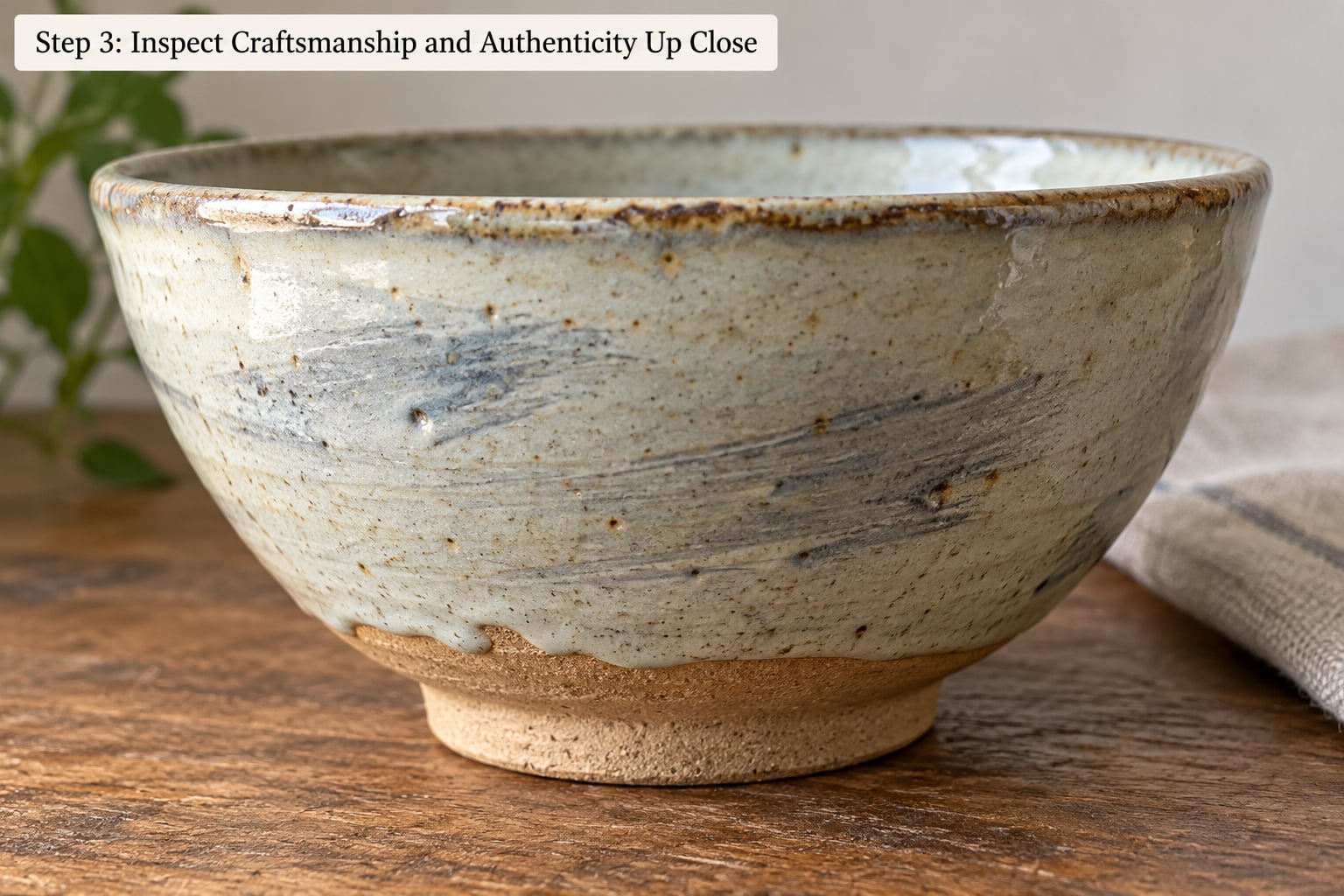
Pick the piece up and turn it over. On textiles, look at the reverse: hand-woven cloth shows irregular thread thickness and a slightly uneven selvedge, while power-loom cloth lies perfectly flat and repeats identical motifs across the width.
On ceramics, a genuine piece usually shows a slightly uneven glaze edge, a base ring that was left unglazed so it does not weld to the kiln shelf, and small variations in brush marks. Mold-made reproductions tend to be identical in every detail, including the ones that should differ.
On metalwork, hand-hammered surfaces keep small dents and waves that a machine-polished copy loses. On wood, look for a joined base and tool marks that vary, not a single moulded blank with a printed grain.
Labels matter more than sellers think. A seller who writes down 100 percent cashmere and hands you a receipt is telling you something different from one who says it feels like cashmere. Forum advice is blunt here: a dedicated fibre shop is where real pashmina lives, street stalls almost never are.
Step 4: Compare the Price and the Value Across Sellers
You cannot judge a price from a single stall. Walk three. Note what the same category of item costs at each, and what changes between them: material, size, technique, finish.
A higher number is fine when real materials, hours of labor, a named designer or a piece small enough to be genuinely rare explain it. A higher number is a problem when the seller answers every question about it with something about the shipping or the airport.
One useful check is to compare the same item later at the airport or in a fixed-price cooperative shop. If the airport version of the same bowl runs three times the market rate, that tells you what the markup was all along.
Step 5: Negotiate Without Getting Ripped Off or Offending the Maker
Bargaining is normal in some markets and insulting in others, and the difference is not something you can read off a price tag. Cooperative and fair-trade shops run fixed prices, and trying to talk those down is the fastest way to look rude.
Where bargaining is expected, make a real offer rather than a lowball, and expect a counter. If a seller names a price and then moves to their final number quickly, you have probably reached the real one. Sellers who invented the price are the ones who refuse to come down at all.
The ethical side is simpler than travelers expect. The labor is the value, so an offer that undercuts the hours of work is not a clever bargain, it is just the tourist premium taken home by the buyer.
Step 6: Pay Safely and Keep Proof of Purchase
Buy in established shops and cooperatives before you buy from a roadside pitch. Those sellers have an address, a fixed price and something to lose, which is exactly what a temporary stall does not.
Use a card or a well-known mobile payment where it is accepted. Carry some small notes for cash-only markets, count the change yourself, and keep the receipt with the maker’s name, the workshop address, and a contact for shipping.
Before you leave, wrap anything fragile properly, photograph the piece with its receipt, and check whether your country asks you to declare it at customs. Antique claims and certain materials, including some worked ivory, tortoiseshell and coral, are restricted in many places, and the rule you break on the way home is yours, not the seller’s.
Common Mistakes and the Fix for Each
Almost every traveler complaint I have read comes back to one of these.
- Buying from the first seller. Fix: walk the full market before buying anything small. The same bowl usually appears at three stalls.
- Treating decorative goods as local production. Fix: ask where it was made, not what it is called. A regional style can be printed anywhere.
- Declining the receipt. Fix: always take one. Without it you have no proof of what you paid or who made it.
- Following tour stops to commission-based shops. Fix: a guide who earns a cut is not showing you the best value. Travel forums warn about “artisan studio” stops specifically for this reason.
- Letting artificial urgency decide. Fix: last one in the shop, closing time, airport price. Leave and come back if the story holds up.
- Accepting something handed to you. Fix: nothing leaves your hands before you have agreed on what it costs.
- Paying for custom work without agreeing the price first. Fix: settle the number before any carving, painting or hemming starts.
- Assuming expensive means authentic. Fix: price alone tells you nothing. Run the same inspections at a higher-priced stall.
Frequently Asked Questions
How can I tell whether a local craft is handmade?
Look for irregularity in the places a machine would make things uniform. Handwoven textiles vary in thread thickness, hand-thrown pottery shows brush marks and a slightly uneven glaze edge, and hand-hammered metal keeps small dents. Turn the piece over and inspect the back, the base and the joins. Then ask the seller to name the maker and the materials, and see whether they answer directly.
Is it rude to negotiate when buying crafts from an independent maker?
Sometimes, yes. Cooperative and fair-trade shops use fixed prices, and pushing those down reads as ignoring the system that sets them. In markets where bargaining is normal, a polite counter-offer is fine. The line is about the labour: an offer that ignores how many hours went into the piece is not a bargain, and it rarely leaves you feeling good afterwards.
Why are handmade crafts more expensive in tourist markets?
Partly because the rent is higher near landmarks, and partly because sellers know visitors have a fixed holiday budget and no local reference price. Airport and hotel gift shops add duty and handling on top. None of that means a high price is fake, but it does mean the number tells you about the location more than about the craft. Compare the same item in three places before you accept it.
Should I buy local crafts at a market or directly from a workshop?
A workshop, whenever one is open to visitors. Watching a piece being made is the strongest authenticity check there is, it fixes the price without haggling, and the maker often handles shipping for larger items. Markets are fine for smaller objects and for comparing, as long as you run the same checks in more than one stall and ask who made the piece.
What payment method is safest when shopping abroad?
A card or a widely used mobile payment option at an established shop gives you a record and usually a dispute route. In cash-only markets, carry small notes, count the change before you leave the stall, and never hand over a large bill without getting change immediately. Keep every receipt, and photograph purchases with the receipt beside them before you pack them away.
How can I verify that a craft was actually made in the country where I am visiting?
Ask who made it and where the materials came from, then follow the answer. A workshop tour, a workshop address on the receipt, a maker stamp or a photograph of the piece being worked on all count. Be cautious with items described as antique, and with any piece made from restricted materials, because declaring or carrying those can create real problems at a border.
Conclusion
Start with ten minutes of research before the trip, so you walk in with a price range instead of an open mind. Then compare two or three sellers, ask who made the piece and what it is made of, inspect the back and the base, and keep the receipt.
That is the whole method. It works in 2026 exactly as it worked the last time you went, and it puts the money closer to the person who made the thing.