To make a short trip feel longer, do less per hour, not more days. Pick one neighborhood as your base, choose two or three anchors instead of a checklist, protect one unplanned hour a day, put the phone away for part of each day, and let ordinary moments count. A 45-minute method, free, no gear.
Short trips fail in a specific way. You fly in, squeeze eleven things into two days, spend a third of the weekend in transit queues, and get home tired and oddly disappointed. Nothing stuck.
The fix is not a longer holiday. It is a change in how densely each hour is lived. People remember trips by detail, not by hours logged, and a day walked at street level holds far more detail than a day spent crossing a city between four attractions.
Table of Contents›
- What You Need
- Step-by-Step: How to Make a Short Trip Feel Longer
- Choose One Neighborhood as Your Base
- Build a Rhythm Instead of a Packed Schedule
- Leave Room for an Unscripted Hour
- Make Ordinary Moments Deliberate
- Use Fewer, Better Anchors
- Adapt the Plan When Something Changes
- Common Mistakes
- Frequently Asked Questions
- Can a two-day trip feel relaxed?
- How do I stop feeling rushed when my trip is short?
- What should I do with an unplanned free hour?
- How can I make a weekend trip feel meaningful without adding activities?
- What if the weather disrupts my itinerary?
- How do I slow down when traveling with children or other people?
- Conclusion
What You Need
None of this requires equipment, a special budget, or a long booking window. It requires four small decisions before you go.
- One or two neighborhood anchors. Not a list of hotels. One district you can reach on foot, with a coffee place, a market, and a couple of streets you would enjoy being lost on.
- A loose daily rhythm. One meaningful anchor per half-day, plus the assumption that you will do nothing much in between.
- A realistic transport plan. Written down, with the slower option chosen on purpose rather than by default. Check published timetables before you assume a route runs when you want it to.
- At least one unscheduled period. A block of time with no booking attached to it, ideally on your first full day.
That is the whole kit. Everything else in this guide is a way of protecting those four things once you arrive.
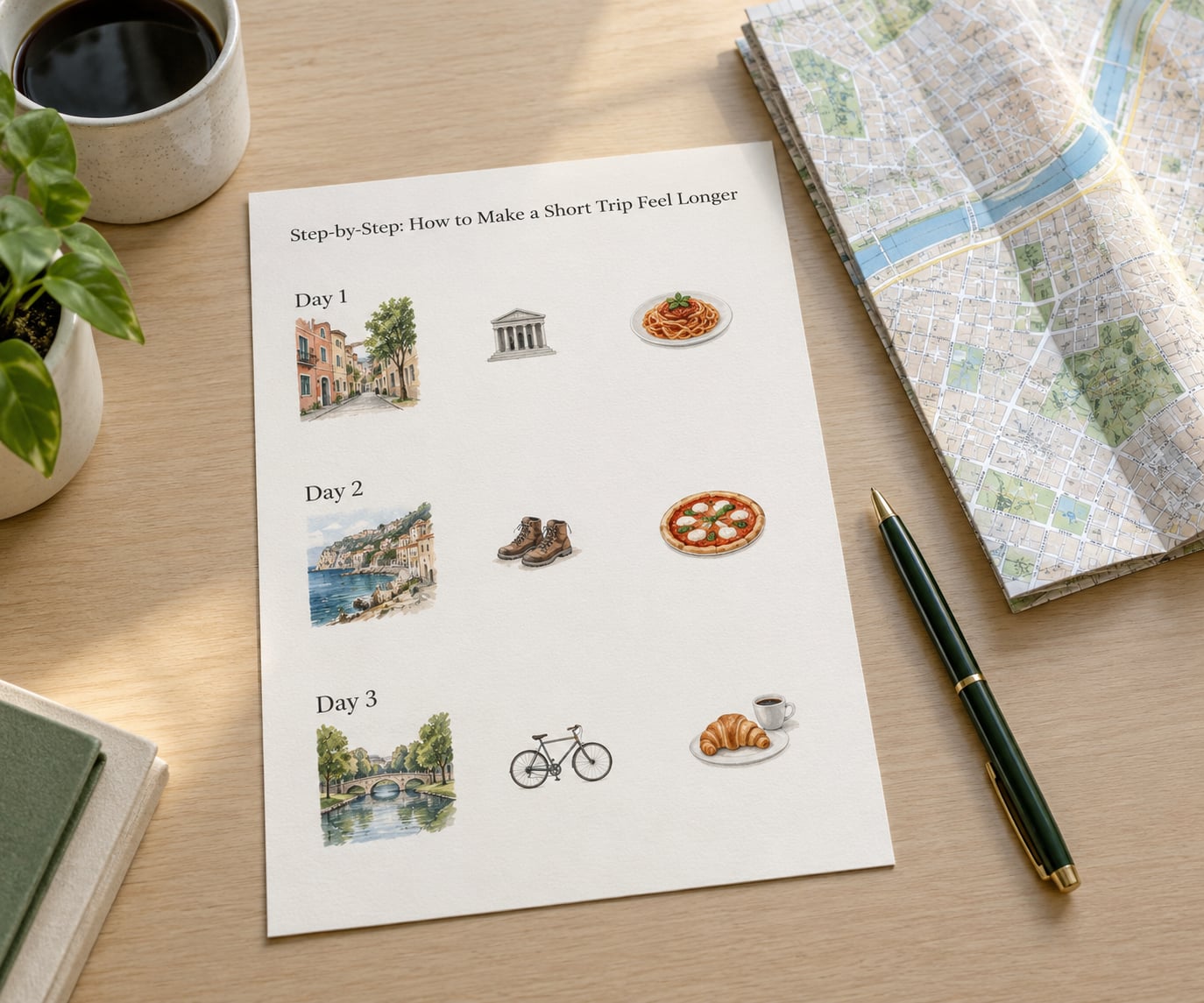
Step-by-Step: How to Make a Short Trip Feel Longer
Choose One Neighborhood as Your Base
Staying in one walkable district is the single highest-leverage change, because it converts travel time into being there. Every cross-city transfer costs you roughly 90 minutes of door-to-door in most cities, and those 90 minutes are the lowest-density part of the whole trip.
Say you have 48 hours in a city you have never visited. Pick a neighborhood with a market, a small park, and a mix of cafés. Sleep there all three nights, take your meals there, and allow one excursion outside it, maybe one museum or one landmark. That is it.
You will end up knowing where the bakery with the queue out the door is, which square catches the late afternoon sun, and which back street has the good secondhand shop. On a checklist trip you would have seen none of that, because you were passing through.
Build a Rhythm Instead of a Packed Schedule
A rhythm is a repeating shape, not a checklist. Breakfast somewhere regular, a walk with no destination, one anchor in the afternoon, an evening with nothing booked. Repeat it two or three times and your days start to feel like they belong to a place instead of a to-do list.
A three-day version might look like this:
- Day one, arrival. Check in, walk the neighborhood slowly, eat somewhere local with no reservation pressure, nothing else.
- Day two, morning. One fixed thing. Afternoon left open for wandering, a book, a long coffee.
- Day three, morning. Market or a second walk through a different part of the same district. Afternoon is travel time, used for nothing.
You can tell the rhythm is working when you start predicting your own day without feeling boxed in. If every hour is spoken for, nothing is left for the thing that actually makes a place memorable, which is usually unplanned.
Leave Room for an Unscripted Hour
Pick one hour and refuse to give it a job. On a short trip I plan one per day, and the best version is the hour right after a big stop, when your attention has nothing queued behind it.
What fills it is never what I would have booked. It has been a hardware store where the owner explained how to sharpen a knife properly, an hour on a bench watching a school let out, and a secondhand bookshop that ended with me talking to the owner for twenty minutes about her town.
That is not luck. It is available time, and availability is the part most itineraries throw away.
Make Ordinary Moments Deliberate
The transition points are where a short trip quietly collapses. Breakfast eaten while scrolling, lunch refuelled at a counter, a walk taken as dead time between two bookings. Nothing registers, and you arrive home unable to place any of it.
Slowing down at those four or five daily transition points changes the perceived pace without adding a single hour to the trip. Have breakfast sitting down. Buy groceries from a shop rather than a station store, and cook or eat them slowly. Take a bath after the walking is done. Let coffee take twenty minutes.
Ordinary rituals are also how you start to feel like a local rather than a visitor, and that feeling is what people describe when they say a trip was good rather than impressive.
Use Fewer, Better Anchors
Two or three anchors per two-day trip, three or four per three-day trip. Anything more and you are running, not travelling.
An anchor should be something that genuinely belongs to this specific place. One market, one museum, one stretch of neighbourhood worth walking end to end, one seasonal activity. Then combine them geographically so they stack into the same afternoon rather than scattering across the map.
The trade-off is real, so I will name it: you will see fewer sights. That is not a compromise, it is the mechanism. A week of ticking off attractions blurs into a single grey smear, and a smaller list with time at each one gives you memory to match.
Adapt the Plan When Something Changes
Rain, fatigue, a closure, a missed train. Short trips have no slack by default, so build the decision rule before you need it.
When a plan breaks, swap outward, not across. Keep the same neighborhood as the base and replace the failed stop with something within roughly fifteen minutes walk or one short transit ride: a café, a bookshop, a covered market, a viewpoint, a second museum you skipped.
A quick test before you commit to a replacement: would you be content to be there for two hours? If the answer is no, keep walking. Most of the best recovery from a bad plan involves no plan at all.
Common Mistakes
Almost every short trip that feels rushed makes at least one of these five mistakes.
Over-planning. Ten bookings in two days is a schedule, not a trip. Fix: cut the list in half and put the removed items in a maybes folder you never open unless the day goes well.
Constant transit. Every hour spent moving is an hour you do not remember. Fix: keep the base fixed and cap excursions at one per day.
Starting late and finishing late. Skipping the arrival and departure days throws away the two halves of the trip where you have the most room and the fewest expectations. Fix: treat the first and last half-days as real time, travel at a normal hour, and do one thing nearby before you get on a train or plane.
Photographing instead of looking. Constantly framing a place means watching it through a screen. Fix: put the phone in a pocket for one block at a time, and take fewer photos of the things you can describe instead.
Copying a longer itinerary. A seven-day list forced into three days produces three days of running. Fix: cut to what fits the actual days, then add slack rather than more items.
Three slow-travel tips that fix most of the above at once: keep one regular spot per trip, like a café you return to, so you have somewhere that is yours; take the slower transport option deliberately, because the train window or the long walk is part of the trip; and give yourself permission to be unproductive. Sitting in a café with a book for an hour is not wasted time, it is the trip.
Frequently Asked Questions
Can a two-day trip feel relaxed?
Yes, as long as you plan one neighborhood and one anchor per half-day rather than a checklist. A 48-hour trip runs short only when it is scheduled like a week. Pick a single walkable district, choose two or three things worth your time, and leave at least one hour a day completely open.
How do I stop feeling rushed when my trip is short?
Reduce the number of decisions you make per day. Rush comes from moving between bookings, not from limited days. Fix it by fixing one base, capping it at one excursion, sitting down for meals, and keeping one hour with nothing attached to it. Doing less well-planned is what makes a short trip feel unhurried.
What should I do with an unplanned free hour?
Nothing scheduled. Walk without a destination, sit in a square, read in a café, or walk into the first small shop that catches your eye. The hour works because it is not being optimized. In practice it tends to produce the conversations and details people describe months later, which is exactly what a packed itinerary cannot buy.
How can I make a weekend trip feel meaningful without adding activities?
Meaning on a short trip comes from depth, not volume. Return to the same café, walk one street slowly twice, cook or buy food from a shop rather than a counter. Repetition builds familiarity, and familiarity is what makes a place register. Two days spent this way usually outlast two days spent chasing landmarks.
What if the weather disrupts my itinerary?
Plan for it rather than against it. Check what is covered, indoors or walkable, in your chosen neighborhood before you arrive, and keep one as a wet-weather option. When weather cancels something, swap outward rather than across: stay in the same district and replace the stop with a café, bookshop, market or nearby museum.
How do I slow down when traveling with children or other people?
Start small rather than asking for a full pace change. Suggest one shared slow block, like a long breakfast or a park hour, and leave the rest of the day as they planned it. People usually accept a slower start more readily than a slower whole day. Keep at least one anchor that suits children and build the free hour around everyone, not around you.
Conclusion
A short trip feels short when its hours are thin. Transit, queues, and context switching eat the time, and what is left registers as a blur you remember badly. Slow travel is the correction: one base, two or three real anchors, one unplanned hour, ordinary moments taken seriously, and attention spent in one place at a time.
The honest cost is that you will see fewer sights. In exchange you will actually be there, and you will come home with detail instead of a list.
Start now, before you book anything. Choose one neighborhood, pick two or three anchors, and block one unscheduled hour in the itinerary. Everything else on this list is a variation on those three decisions, and 2026 is a perfectly good year to try it.