How to save for a big trip in one year comes down to three moves: work out what the trip really costs, divide that total by 12, and automate the result into a savings account you do not touch from the outside. Add a monthly check-in and a rule for booking flights and beds, and an expensive dream trip turns into a line in your budget instead of a someday idea.
It takes maybe an hour of setup, then ten minutes a month. That is genuinely all it asks of you.
Last updated: October 2026
Table of Contents›
- What You Need Before You Start
- Step-by-Step: How to Save for a Big Trip in One Year
- Step 1: Define the trip and set a travel date
- Step 2: Estimate the full cost of the trip
- Step 3: The Monthly Savings Target — How to Save for a Big Trip in One Year
- Step 4: Open a separate trip savings account
- Step 5: Automate the savings you can
- Step 6: Find realistic ways to save more each month
- Step 7: Review the plan every month
- Step 8: Book strategically and protect the savings
- Common Mistakes That Derail a One-Year Travel Fund
- Frequently Asked Questions
- How much should I save per month for a trip?
- How can I save 10,000 in one year?
- Should travel money go in my emergency fund or a separate account?
- What can I do if I fall behind on my savings target?
- Is 50,000 enough to travel for a year?
- When should I book flights for a trip next year?
- Conclusion: Start With Your First Transfer Today
What You Need Before You Start
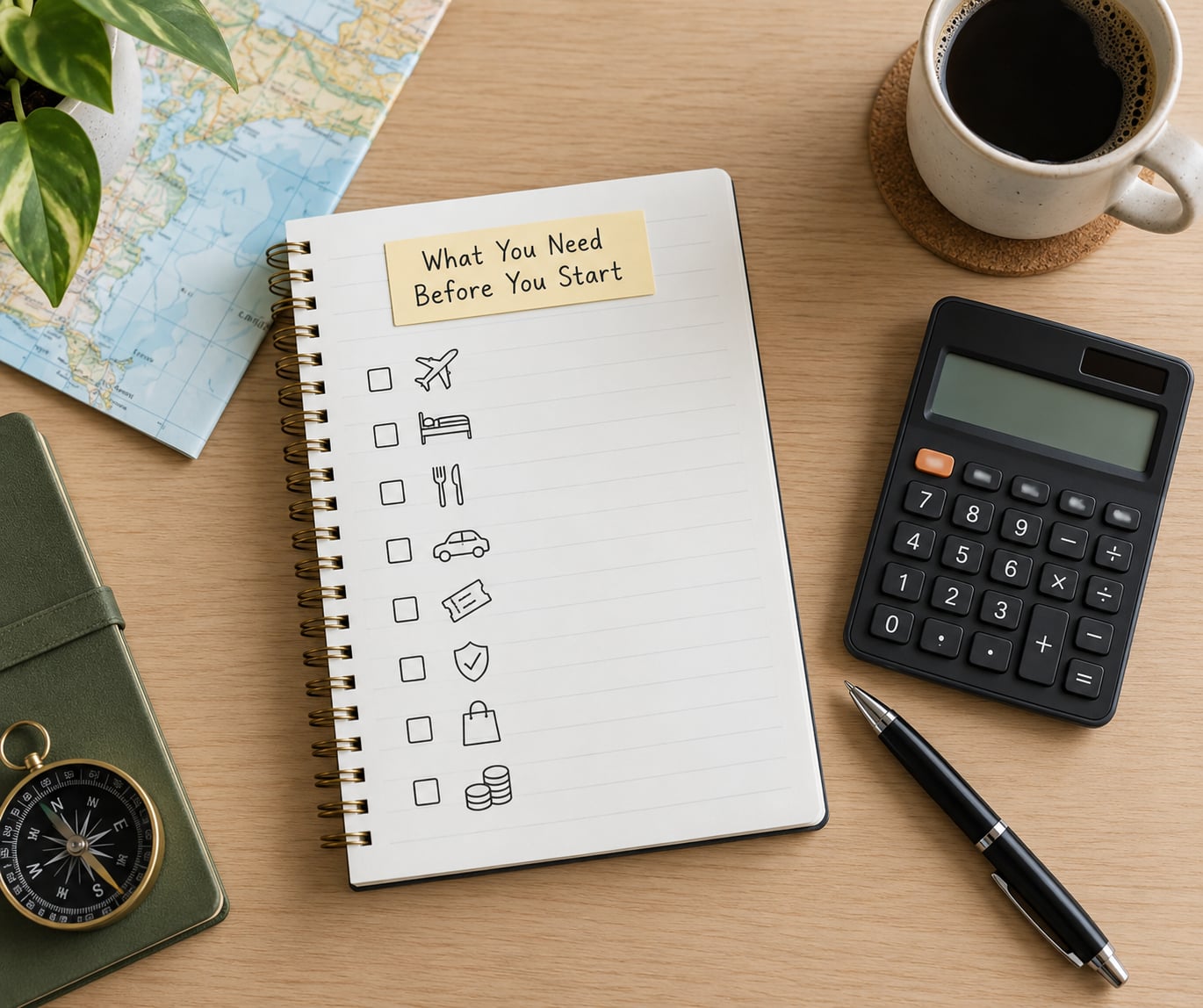
You need five things before any saving happens, and four of them take an afternoon to put together. The fifth, a realistic trip estimate, is the one most people skip, and it is the reason so many travel funds miss their mark.
- A realistic trip estimate. A real number with categories, not a vague sense of expensive.
- A target date. A month and year, ideally twelve months out, with a buffer month in front of it.
- An emergency fund that already exists. Saving for a holiday only works if a car repair cannot wipe it out.
- A separate savings account or fund. A second account, a labelled sub-account, or a savings pot you track on its own.
- A simple monthly tracking method. A note, a spreadsheet column, or an app check that takes under a minute.
One distinction matters more than the others. Some travel costs are fixed: flights, accommodation, travel insurance, and any visa or entry fees. You pay them whether you economise or not, and they are usually booked in one or two payments. The rest are flexible: food, local transport, activities, shopping, and the coffee you buy on the way to the train. Fixed costs set your floor. Flexible costs are where your daily decisions actually change the total.
Get the fixed costs estimated first, because they are the part you cannot argue with later.
Step-by-Step: How to Save for a Big Trip in One Year
Step 1: Define the trip and set a travel date
Turn the vague idea into a specific goal: where, when, how long, and what kind of trip. Two weeks in shoulder season is a different financial problem from three weeks in peak season, even to the same country.
Write down four things in a single sentence — destination, season, trip length, and travel style. Then list the two or three experiences you would not skip, such as a specific museum, a hike, or a night in a place you have wanted to see for years. Those non-negotiables are what protect the trip from being quietly downgraded when costs climb.
Pick a departure month, not just a year, then add a buffer month before it. Flights, rental rooms, and time off all peak in the same weeks, and the buffer is what keeps a bad week in November from destroying a plan built in January. You now have a deadline, which is the single thing that turns a wish into a savings plan.
Step 2: Estimate the full cost of the trip
Build the estimate as a line-item budget, then total it. The categories that get forgotten are the expensive ones: insurance, local transport, and the arrival-night accommodation when you land too late to have booked anything properly.
Use ranges and check them against your own research rather than trusting a single figure. A realistic two-week international trip often lands somewhere like this:
- Return flights: 700 to 1,100
- Accommodation, 14 nights: 600 to 1,000
- Food and drink: 350 to 500
- Activities and entries: 200 to 350
- Local transport and transfers: 120 to 200
- Travel insurance: 60 to 90
- Shopping, gifts, and small surprises: 100 to 200
- Contingency reserve at 10 percent: roughly 300
That mid-range comes to a little over 3,000, and the spread between the top and bottom of those ranges is close to 1,500. That spread is why you plan against the middle of your range, not the floor. If you plan for the cheapest version of your trip, the first surprise erases your margin.
Never travel without the contingency reserve. A cancelled flight, a broken phone, or three nights in a place where your booking fell through will happen, and the reserve is the only reason it does not mean a home loan of travel debt.
Step 3: The Monthly Savings Target — How to Save for a Big Trip in One Year
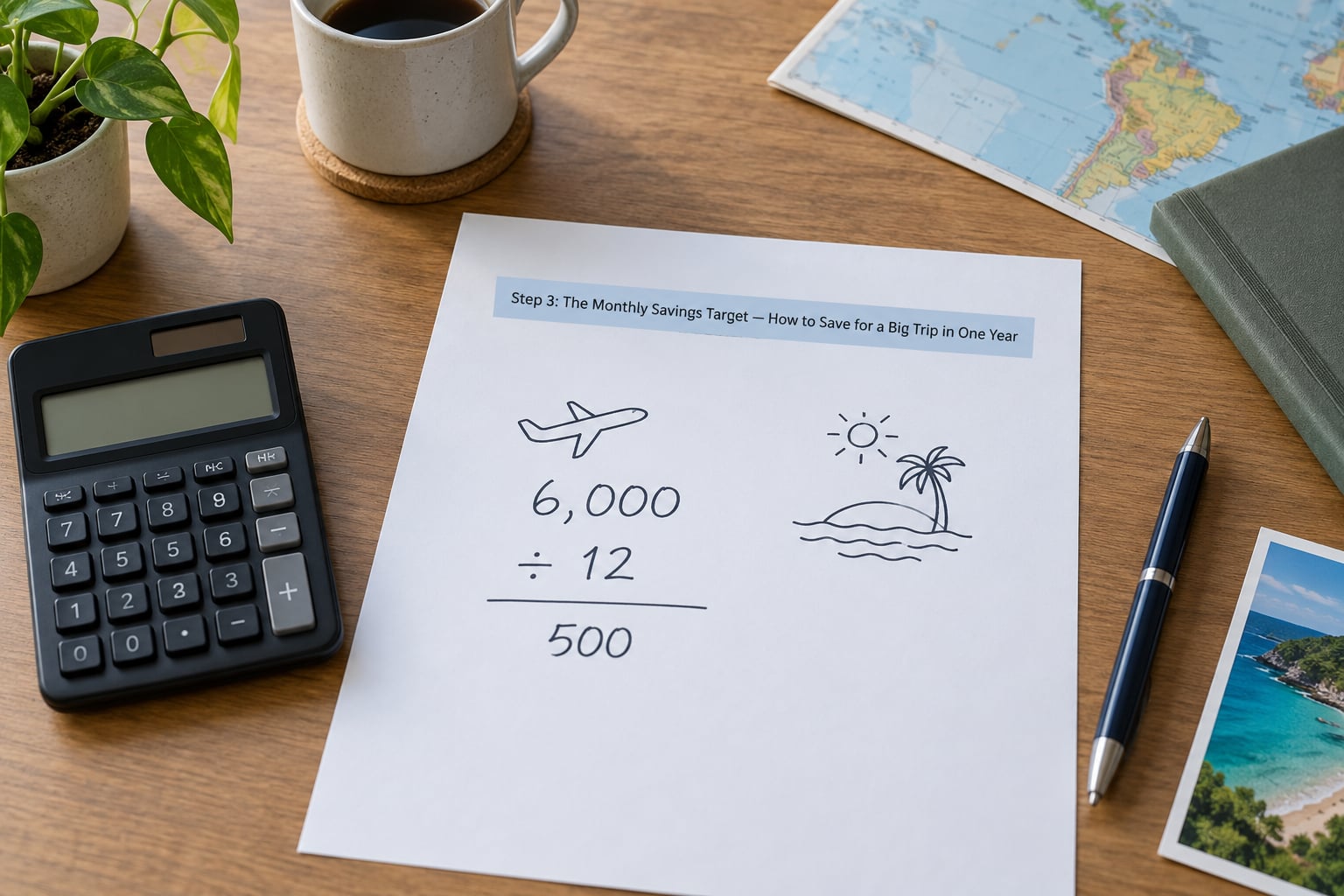
Divide your realistic total by the number of months remaining. That gives your base target, and every other number you work with comes from it.
Then set three versions of it. A minimum target is the floor you protect no matter what, usually 70 to 80 percent of the base. A comfortable target is the base number, and this is the one you automate. An accelerated target applies in months when extra money shows up, like a bonus, a tax refund, or a month you simply spent less.
Here is what a 12-month target looks like at common trip totals, in US dollars:
| Trip total | Monthly target over 12 months | Weekly equivalent | Daily allowance on a 14-day trip |
|---|---|---|---|
| 1,500 | 125 | 29 | 107 |
| 3,000 | 250 | 58 | 214 |
| 5,000 | 417 | 96 | 357 |
| 10,000 | 833 | 192 | 714 |
The daily allowance column is the one people find sobering, and it is the one that stops overspending before departure rather than during the trip. Nobody reaches a destination intending to overspend; they simply never decided what a day costs.
Different trip shapes need very different totals, so it helps to have a range in mind before you commit to a target:
| Trip type | Typical total per person | Monthly saving over 12 months |
|---|---|---|
| Domestic long weekend, 3 to 4 days | 600 to 1,200 | 50 to 100 |
| Two-week international trip | 2,500 to 4,500 | 210 to 375 |
| One month abroad, mid-range | 4,500 to 7,500 | 375 to 625 |
| Working holiday of 3 to 6 months | 8,000 to 20,000 | 670 to 1,670 |
These are typical US ranges that vary a lot by region, season, and how you travel. Treat them as starting points for your own research, not quotes. Saving 300 a month is a different kind of promise from saving 1,200, and only one of them survives a bad month.
Step 4: Open a separate trip savings account
Keep the travel money separate from your everyday spending, and the reason is not tidiness. It is that a balance you can see every time you open your banking app gets spent without a decision being made.
Three options work well. A dedicated savings account at the bank you already use is the easiest to start and the easiest to set up automatically. A high-yield savings account earns more on the balance over a 12-month horizon, though rates change regularly so check what is actually being paid now. A labelled sub-account or savings pot inside your existing account keeps things simple when you want everything in one place. Compare the options at your own institution rather than chasing a specific one.
Name the account something you will recognise, like a destination and a year. It sounds trivial. It matters in month five when the balance is 400 and you are trying to remember what that was for.
And keep it apart from the emergency fund. An emergency fund covers a broken boiler, a gap between jobs, or a medical bill, and it must not be spent because a trip feels more appealing than a bad month. Savers on r/personalfinance and r/ynab describe the same pattern: a travel fund that sits separately from the emergency fund, funded on a schedule, survives contact with real life. A merged pot does not. If your emergency fund is not yet in place, build that first and delay the trip date rather than the reverse.
Step 5: Automate the savings you can
Set the transfer so it happens without you deciding to do it. Manual saving fails on ordinary weeks, and ordinary weeks are most of the year.
The three reliable triggers are: the day your salary lands, the day after a fixed bill leaves, or the day a card balance clears. Pick the one that never coincides with a shortage, and schedule the comfortable target from step 3 as a standing instruction between accounts. Many banks let you set this once and leave it.
Add a second rule for the money you cannot plan: anything above your account’s balance at the end of the month moves to the travel fund. That single habit quietly rescues months when you forget to save.
On irregular income, a fixed monthly transfer is the wrong instrument. Instead, transfer a set percentage of each payment the moment it lands — 20 percent of a good month, 10 percent of a thin one. The habit survives; the amount flexes. Set the percentage low enough that a slow month does not make you borrow to complete it, and turn the standing instruction off if it ever does.
Step 6: Find realistic ways to save more each month
The target from step 3 has to come from somewhere. Some of it comes out of spending, some comes in as extra income, and the mix that lasts is the one that does not feel like punishment.
Audit the subscriptions first. List everything billed automatically and cancel what you have not used in the last two months. It is the fastest money available and the only fix that requires no lifestyle change at all.
Shift one meal a week to home cooking. A single takeaway a week redirected into the travel fund is a meaningful monthly contribution, and it is sustainable indefinitely, unlike a six-week austerity diet.
Set a travel cash ceiling rather than a ban. Decide what you will spend on non-trip things this month and stop there. A ceiling keeps you in the plan; a total ban usually ends it.
Sell what you are not using. Old electronics, camera gear, books, work clothes, and equipment you replaced months ago. One realistic weekend of selling can cover a month or two of your target.
Route windfalls to the fund first. Bonuses, tax refunds, and unexpected payments go into the travel account before they touch everyday spending. This is the single biggest accelerator available to someone on a normal salary.
Add income when the target is far away. For big trips, short-term freelance work, seasonal hours, or paid teaching in your own language usually beat trying to cut another 40 a month. It also compounds: the extra work happens in the phase where nothing is on the trip yet.
Give any card rewards or points strategy the standard warning: pay the balance in full every month. Interest on a carried balance will outrun any points you earn, every time.
Step 7: Review the plan every month
Ten minutes a month is enough. Compare what you planned to contribute with what actually went in, and update the trip estimate if prices or your plans have moved.
Three numbers tell you everything: the balance, the gap to target, and the number of months remaining. Divide the gap by the months remaining and you have your new monthly figure. Nothing else needs recalculating.
A simple 12-month shape looks like this:
- Month 1: account open, transfer running, estimate written down.
- Month 2: first real cost check on flights and rooms, so the total is honest.
- Month 3: first quarter review, cancel unused subscriptions, sell one batch of things.
- Month 4: confirm travel insurance and entry requirements, which are cheap now and awkward later.
- Month 5: decision month for the trip style — comfort, mid-range, or budget — and a matching per-day number.
- Month 6: halfway checkpoint. Either the balance is on target or the trip gets smaller, cheaper, or later.
- Month 7: begin watching flight and room prices for your dates, without committing yet.
- Month 8: first booking window opens. Book refundable options now.
- Month 9: convert the remaining balance into a per-day budget and a cash ceiling.
- Month 10: confirm bookings, check documents, and stop adding to the fund.
- Month 11: final check, no new spending decisions about the trip.
- Month 12: travel.
Month 6 is the one that matters. A plan that is behind at the halfway mark is fixable; a plan you discover is behind in month 11 is not. Decide then whether the trip changes or the timeline does.
Step 8: Book strategically and protect the savings
Your booking threshold is the point at which the fund has enough to cover a purchase without dipping into everyday money. For most trips, that is when the balance covers the return flights plus the first few nights of accommodation. Cross it, then book.
Prefer refundable or flexible reservations for the big items. The fee for flexibility is usually small next to the cost of a change made weeks later, and it is your insurance against a date that moves.
Compare prices across a few booking sites before you commit, and check whether the fare includes a bag, a seat, or a change fee that the headline price hides. Those add-ons are what turn a cheap fare into an expensive one.
Do not book in a panic at the last minute to protect a deadline you set yourself. Rushed decisions cost more than the money you saved by delaying. And do not raid the fund for a nicer hotel once you arrive — the month of saving you spent to get there stops being a holiday the day the savings pay for an upgrade.
One last thing: decide your daily budget before you fly. Divide the flexible portion of the fund by the number of days, round down, and treat that as a hard ceiling. Reviewers and forum regulars who set a per-day number in advance report the same thing: the trip goes better, not worse.
Common Mistakes That Derail a One-Year Travel Fund
Underestimating the total. Almost always missing insurance, arrival-night accommodation, local transport, and a contingency reserve. Fix: add 10 percent for contingency and estimate every fixed cost before optimising anything.
Setting a target that hurts. If your monthly number makes you resent every payday, you will abandon it by month three. Fix: automate the comfortable target, treat the minimum as your true floor, and find the extra from income rather than from more cutting.
Saving without a deadline. A vague future trip never reaches a number, because there is always a reason to wait. Fix: name a month and a year, and accept that changing the date costs you a month of savings.
Merging the trip fund with the emergency fund. The trip money then becomes available for exactly the things it was saved to avoid. Fix: separate accounts, separate names, separate rules.
Booking far too early or far too late. The earliest fares are often not the best value, and the last few weeks carry the risk of a trip that costs more than it saves. Fix: book when your booking threshold is met, use flexible fares, and price-check a few times.
Group trips with mismatched timelines. One friend’s savings date rarely matches another’s, and the group pressure is the most common reason a fund gets raided. Fix: decide individually which costs you are splitting and which you are not, before anyone books anything.
Two habits keep the whole plan alive. Put a standing monthly check on your calendar, and remember that a plan which survives a bad month is worth more than a plan that only works in good ones.
Frequently Asked Questions
How much should I save per month for a trip?
Work backward from the trip’s full cost rather than picking a number that feels manageable. Add up flights, accommodation, food, activities, local transport, insurance, and a 10 percent contingency, then divide that total by the months remaining. A 3,000 trip over 12 months is 250 a month; over six months it is 500. Automate the figure you can sustain, not the one you wish applied.
How can I save 10,000 in one year?
10,000 over 12 months is about 833 a month, or 192 a week. That is achievable when the money is automated and found rather than squeezed. A subscription audit and a few hundred from selling unused things can cover a large share of it, and bonuses or tax refunds routed straight to the fund do most of the rest. The plans that work check the balance monthly instead of assuming the transfer happened.
Should travel money go in my emergency fund or a separate account?
A separate account, every time. Your emergency fund exists for a lost job, a medical bill, or a broken boiler, and a holiday is not an emergency. Keeping trip money separate also stops the slow leak where a savings balance quietly funds ordinary spending. Savers who use a labelled travel account alongside an untouched emergency fund report that the two habits reinforce each other rather than competing.
What can I do if I fall behind on my savings target?
Recalculate rather than quit: subtract the current balance from the total, divide by the months that remain, and make that the new monthly target. If the new figure is impossible, pick one of three honest options: shrink the trip, push the date back a few months, or raise income for a defined period. Cutting a trip short of its goal is normal. Abandoning the plan entirely is the expensive choice.
Is 50,000 enough to travel for a year?
It depends entirely on where you go and how you live there. In high-cost countries, 50,000 spread over 12 months is comfortable and could include several flights. In cheaper regions it funds a much more relaxed pace, or a longer stay with private rooms and slow travel. Build a monthly per-country cost first, multiply by 12, and add flights and insurance before deciding. The number is only meaningful once it has a place attached.
When should I book flights for a trip next year?
Once your travel fund reaches your booking threshold, which for most trips is the return flights plus the first few nights of accommodation. For a trip twelve months out, that often lands in months 5 to 8, once the fund and the research both have substance. Watch prices from month 7, book flexible fares, and price-check across a few sites before committing. Avoid both the earliest possible booking and the last few weeks.
Conclusion: Start With Your First Transfer Today
Four things, in this order: choose a destination and a month, build a line-item estimate of the real trip cost, divide it by the months you have left, and open a separate account with an automatic transfer for that amount.
Do the first two today, even roughly. A rough destination and a rough number are enough to set the transfer running, and the estimate gets sharper as you research. The account does not need to be perfect, and neither does the budget. It only needs to exist, with a date attached to it, before the months start passing.