A flexible daily itinerary isn’t an empty page. It’s a day with two or three fixed anchors and plenty of unassigned time between them, so a late train or a closed museum doesn’t wreck the whole thing. Learning how to build a flexible daily itinerary takes about fifteen minutes once your trip priorities are written down, and most of the work is deciding what to leave blank.
The part I like most is the split: fix the spine, open the days. Long-term travelers on r/solotravel describe it plainly — they book lodging and the cities in order, then leave the actual days open. The r/solotravel wiki suggests having a concrete plan for the first few days of a trip and nothing firmer after that.
Here’s the whole method before the detail. Pick two or three anchors that genuinely can’t move. Write them as time frames, not clock times. Add twenty to thirty minutes of buffer between everything. Leave at least one long block with nothing in it. And check the weather the night before so you’re not researching in the rain.
Table of Contents›
- What You Need to Build a Flexible Daily Itinerary
- Step-by-Step: Six Steps to a Flexible Daily Itinerary
- Choose Two or Three Anchors
- Map the Route and Add Realistic Buffer Time
- Create Morning, Lunch, and Evening Anchors
- Build a Go-If-the-Weather-Allows Backup
- Add Small Pleasures and Open Space
- Run a Final Realistic Check
- Common Mistakes That Ruin a Loose Itinerary
- Fix the Over-Planned Day by Cutting One Anchor
- Fix Fake Precision by Using Time Frames Instead of Clock Times
- Fix the Day With No Anchor by Adding One Fixed Thing
- Fix the No-Buffer Plan by Adding Twenty Minutes Between Every Stop
- Fix the Plan With No Backup by Writing the Alternative Next to the Anchor
- Frequently Asked Questions
- How many hours a day should I actually plan?
- How do I avoid overplanning a trip?
- What does a loose itinerary actually mean?
- What should I book in advance and what can I leave open?
- How flexible should an itinerary be with kids or a group?
- Is it okay to use a detailed itinerary once I’m traveling?
What You Need to Build a Flexible Daily Itinerary
Not much, and none of it expensive. Most of it you can gather on your phone in an evening, which is exactly when you should do it — tired planning beats tired improvising.
- Your dates and nights per place. How many days you actually have decides how ambitious anything can be.
- Rough geography. Which neighborhoods sit near each other, and roughly how far apart the things you care about are.
- Opening hours and closure days. Check the two or three places that might become anchors, not all forty saved posts.
- A forecast. Check it the night before and again over breakfast. Day-before forecasts for a specific hour are worth very little.
- Realistic travel times. The route time plus the faff — station to street, finding the entrance, a bag drop.
- Reservation details. Confirmation numbers, times, and whether you can eat before or have to arrive early.
- One place to keep it. A note on your phone is fine. So is a shared sheet. What’s missing is a spot where priorities and backups live together.
Skip the research rabbit hole. A saved folder with sixty tabs in it is a stress inventory, not a plan.
Step-by-Step: Six Steps to a Flexible Daily Itinerary
Six steps, in order. Most people can run the whole thing in fifteen minutes per day of the trip.
Choose Two or Three Anchors
An anchor is anything that cannot move without a cost: a tour you booked, a dinner reservation, a train you have to catch, a museum that’s shut on Mondays. Two or three is the cap.
Test each candidate with one question: if this moved by two hours, would anything break or cost money? If yes, it’s an anchor. If no, it goes on the maybe list, not the schedule.
Space them out before you commit. Drop your two or three picks on a map and look at the gaps. Two anchors on opposite sides of a city with a five-hour gap between them is a commute, not a day out. Keep the ones that cluster, cut the odd one out.
You know it worked when you can say each anchor in one sentence, and you know the constraint that pins it in place. “The 2pm walking tour, non-refundable” is an anchor. “Should see the cathedral eventually” is not.
Map the Route and Add Realistic Buffer Time
Now lay the anchors in order and estimate the travel between them. Then add a quarter to a half again on top, because you haven’t walked this city before and neither has the person who just gave you directions.
A kilometer takes longer than you think with a coffee, a wrong turn, and a photo of a building you like. Trains add platform time and the walk on both ends. If one leg is over thirty minutes, ask whether swapping two anchors shortens the day before you accept the commute.
Buffer goes in three places. Twenty to thirty minutes between any two anchors covers a slow walk or a queue. Forty-five minutes before something with a fixed start time covers finding the place at all. And one longer buffer — forty-five minutes to an hour — floats around the middle of the day so a good stop can expand without eating your evening.
Write the day in time frames: morning, early afternoon, before dinner. Clock times pretend a precision the day won’t have, and when a train is twenty minutes late, a loose line on the page absorbs it while 10:15 does not.
How do you know the routing is right? Read it top to bottom and check whether the day still works if every leg takes twenty-five percent longer than you estimated. If it collapses, cut an anchor rather than shrinking buffers.
Create Morning, Lunch, and Evening Anchors
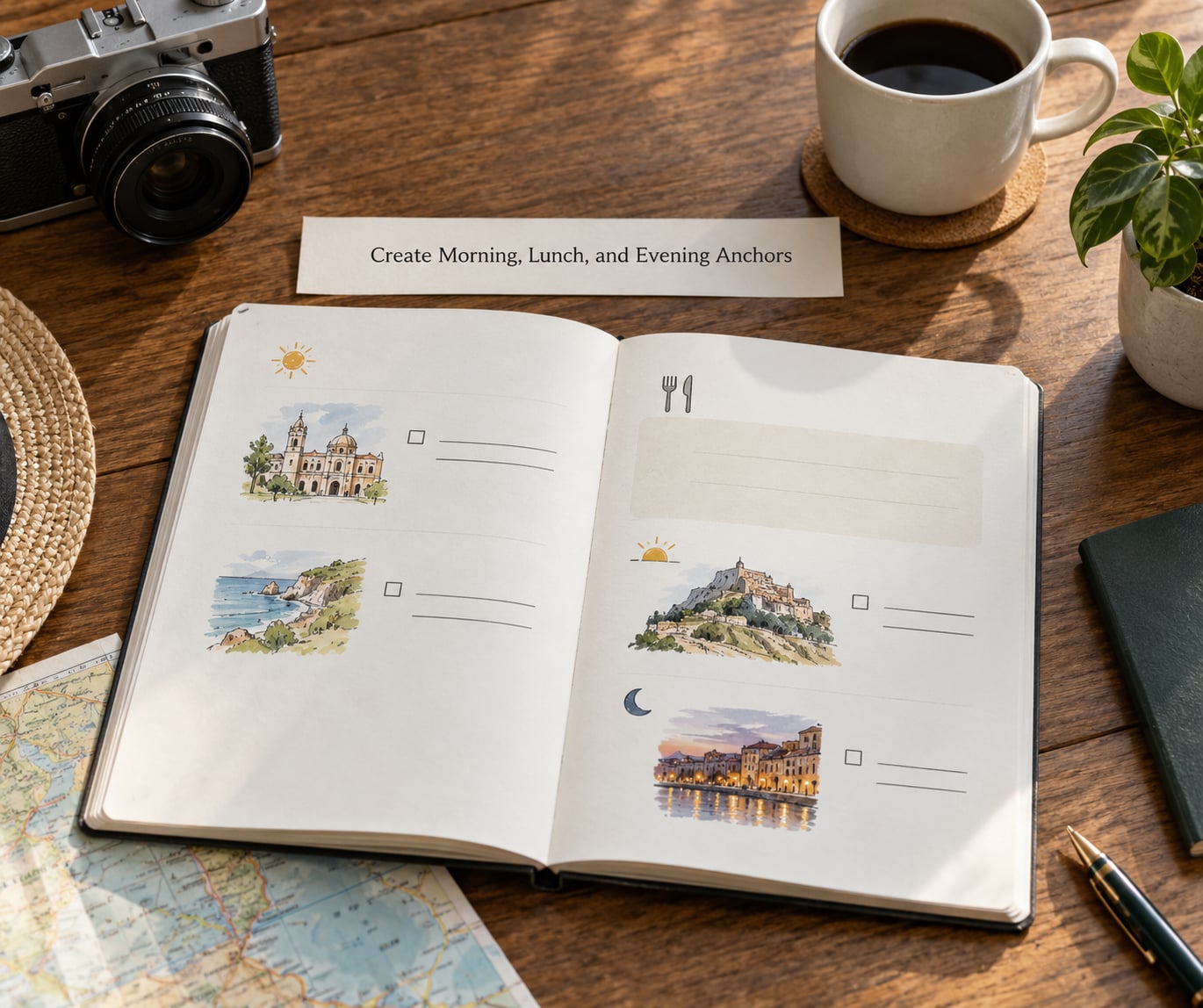
Spread your anchors across the day so they frame it rather than stack it. One in the morning, one in the middle, one in the evening, with air between them.
Mornings are the most flexible slot most days, which is why a market, a bakery, or a neighborhood walk works well there. Put the one thing with the hardest time constraint in the middle of the day, where a delay has room to grow. Save dinners and anything evening-lit for last, because that’s when a day usually wants to end well.
Keep lunch open unless it’s the reason you’re there. A fixed two-hour lunch with an hour of walking on either side is how days fall apart. Find the anchor’s actual duration — most guides give you a generous range — and reserve the extra rather than filling it.
After a flight, a red-eye, or a night of bad sleep, drop to one anchor and call it a light day. That’s not a wasted day, and treating it as one is how people end up resenting their own trip.
Build a Go-If-the-Weather-Allows Backup
Pair every outdoor anchor with an indoor alternative no more than fifteen minutes away on foot or one short ride. Museums, bookshops, long lunches, a covered market, a bathhouse, a cafe with a table you can lose an hour at.
Then set a decision deadline and stick to it. Check the forecast the night before and once more at breakfast. By the time you walk out the door, you should already know whether the outdoor plan is live. Deciding over breakfast takes two minutes; deciding in the rain with a phone and a map of a city you don’t know takes forty.
Write the backup directly next to the anchor. A backup living in a different app, a different note, or your head is not a backup — it’s a small research project you’d rather not be doing at 8am.
Add Small Pleasures and Open Space
Choose two or three optional stops that sit near anchors you’re already at. Things that take twenty minutes and don’t need a booking: a bakery, a covered market, a viewpoint, a bench in a square.
These are the flexible layer. They absorb a delay, they fill a gap when a museum runs long, and they cost you nothing when you skip them.
Now leave one block genuinely empty. Two to three hours in the middle of the afternoon with nothing written in it. This is the part people cut and later wish they hadn’t — in one r/solotravel thread, travelers who stuck rigidly to their plans talked about regret for the things they’d researched and never reached.
Somewhere to be is not a plan. A neighborhood you like, a museum district, or a market street gives your wandering somewhere to land without a destination.
Run a Final Realistic Check
Read the finished day against reality once. Opening hours against the day of the week. Travel times against what the map says plus your buffer. Meals — do you actually get to eat, or did the schedule assume you skip lunch? Energy: is the hardest thing in your sharpest hour, or your last one?
Count your scheduled hours. Four to six hours of real activity fills a travel day comfortably. Beyond that you’re queuing at things, and queuing is the thing most people mean when they say they over-planned the trip.
Check the number of stops too. More than four in a day means the day has no rhythm, because you spend the walk between them getting to them.
If anything feels rushed, cut one thing. Cutting is cheap; the day still works. A packed day that runs late feels like a failure, and a loose one that runs long just becomes the day you actually remember.
Night before, do the ninety-second version: check the forecast, confirm today’s one or two reservations, glance at whether any anchor is closed tomorrow. Then put the phone down.
Common Mistakes That Ruin a Loose Itinerary
Fix the Over-Planned Day by Cutting One Anchor
Most overscheduling comes from trying to keep every saved idea. Deciding not to cut is the mistake; the day isn’t sacred. Travelers on r/solotravel keep describing the same regret — researching hard, then rushing through and missing the thing they’d come for.
Count your anchors. If it’s four, remove the weakest one before the trip rather than on the day.
Fix Fake Precision by Using Time Frames Instead of Clock Times
Writing 9:00, 11:30, 2:00 turns a guide into a contract, and the day breaks the contract. Time frames absorb delay; clock times just record it as failure.
Keep exact times only for things that genuinely have them: train departures, booked tours, dinner reservations.
Fix the Day With No Anchor by Adding One Fixed Thing
The opposite mistake is a day so open it never becomes a day. Travelers who plan nothing report drifting, overspending in cafes, and feeling behind people who had a plan.
Give every day one anchor that can’t move. The rest can stay soft; that one thing is what turns a day into a day.
Fix the No-Buffer Plan by Adding Twenty Minutes Between Every Stop
A plan where every leg lands exactly on time is a plan that fails at 2pm. Buffer isn’t wasted time — it’s the reason a delayed afternoon doesn’t eat your evening.
Twenty minutes between anchors, forty-five before anything with a fixed start.
Fix the Plan With No Backup by Writing the Alternative Next to the Anchor
A loose itinerary without a fallback isn’t flexible, it’s unprotected. Rain, a sold-out venue, a holiday closure — the day needs a second option that requires no research.
Write the backup on the same line as the anchor, and set the hour you’ll commit to it.
A few habits worth keeping: pick the first night of a trip as the one you plan in most detail, because knowing your arrival area kills a lot of day-one stress. Photograph reservation confirmations, so a language barrier or a dead phone doesn’t strand you. And keep one full day in a longer trip with no anchors at all.
Frequently Asked Questions
How many hours a day should I actually plan?
Four to six hours of scheduled activity fills a travel day well. Beyond that you spend it queuing and rushing between stops, which is the thing most travelers mean when they say they over-planned. Keep one anchor per half-day at most, leave lunch open, and treat a day after a flight or a bad night as a single-anchor day without regret.
How do I avoid overplanning a trip?
Cap every day at two or three anchors, write them as time frames rather than clock times, and leave one long afternoon block completely empty. Review your saved ideas the night before and cut the weakest one rather than trying to fit them all. If a day reads as rushed on paper, it will feel rushed on the ground, so cut early and carry the spare time.
What does a loose itinerary actually mean?
A loose itinerary still has structure — your lodging, transport between places, and one or two booked commitments are fixed. Everything inside a day stays movable. You write time frames instead of exact times, leave buffer between stops, and keep a backup for anything outdoors. The result is a day with a shape that survives a late train or a closed museum.
What should I book in advance and what can I leave open?
Book anything with a fixed start time, limited capacity, or a refund deadline: trains with luggage, tours, dinner reservations, and accommodation for the first and last nights. Leave open anything within walking distance, anything outdoors, and anything you’d happily swap for a better option. Check opening days for anything that might become an anchor, since closure days catch people out more often than prices do.
How flexible should an itinerary be with kids or a group?
Less flexible than you travel solo, but not rigid. Fix the start of each day and the one activity that has to happen, then leave the middle open, because tired children and slow lunches rewrite the schedule anyway. Build in a real break after each activity, and agree in advance on the one thing the group will drop first if the day runs late.
Is it okay to use a detailed itinerary once I’m traveling?
Yes, as long as the detail is reference rather than obligation. Download maps for offline use and keep the plan readable on paper or a shared sheet, then use it to orient rather than to check off. If you’re following it hour by hour, you’ve built a rigid plan and lost the flexibility you set out wanting — keep the anchors and let the middle go.
Start with tonight. Pick the two or three things on this trip that genuinely can’t move, write them as time frames, and leave the rest of the day blank. That’s how to build a flexible daily itinerary — the plan gets you to the right neighborhood and the open hours do the rest.