Packing cubes only save space when you pack them tight, assign each one a job, and fill the gaps around them. Used loosely, they do the opposite: a bulky, half-empty cube is a soft brick that leaves dead air in every corner of the bag. Here is the system I use to fill a carry-on properly, in six steps, without buying anything you do not need.
The whole thing takes about 15 minutes once you have done it a few times. Most of that time is not packing, it is deciding what comes in before anything touches the bag.
Table of Contents›
- What You Need
- Lightweight cubes versus bulky structured ones
- Step-by-Step
- 1. Measure Your Bag and Set a Capacity Limit
- 2. Choose Cubes by Function, Not Just Category
- 3. How to Use Packing Cubes Without Wasting Space in a Carry-On
- 4. Pack Large or Bulky Items First
- 5. Fill Gaps Instead of Forcing Cubes Closed
- 6. Do a Final Compression and Access Check
- Common Mistakes
- Quick Packing Tips
- Frequently Asked Questions
- Do packing cubes actually save space?
- How many packing cubes should I take for a week?
- Are compression packing cubes better than regular packing cubes?
- What is the best way to organize packing cubes in a suitcase?
- Can packing cubes make overpacking easier?
- Conclusion
What You Need
You need three or four cubes in sizes that are different from each other. Identical cubes waste space on their own, because nothing nests inside a smaller square block.
- A large cube for jackets, sweaters and the bulk of your clothing.
- A medium cube for shirts and everyday layers.
- A small cube for underwear, socks and accessories.
- A flat or slim cube for travel-day items you need in the airport.
- A compression cube if you mostly pack bulky fabrics: sweaters, jeans, towels.
- A packing checklist listing actual item counts, not clothing types.
- Your bag’s interior dimensions, so you know the real ceiling.
What you do not need is a second bag, or a cube for every category you own. The number of cubes should follow the trip, not a checklist of product features.
Lightweight cubes versus bulky structured ones
This is the part most people miss. The cube itself takes up room. A soft, unstructured ripstop cube collapses flat when empty and costs almost nothing in volume, while a heavily padded or stiff-walled cube keeps its shape in an empty suitcase and steals the space it was bought to organize.
Travelers who have posted their gear lists on r/onebag and the Tom Bihn forums consistently describe lightweight, unstructured cubes as losing essentially zero space, and padded cubes as losing a noticeable amount. If you already own two or three soft cubes, that is genuinely enough.
Step-by-Step
1. Measure Your Bag and Set a Capacity Limit
Measure the interior length, width and depth of your bag, then subtract the wheels, the handle housing and any built-in organizer. Most cabin bags measure roughly 55 by 40 by 23 cm, and the usable interior is smaller than the printed outside dimensions suggest.
Multiply that interior volume to get a rough ceiling in liters, then set an item limit well under it. A practical rule from a lot of carry-on-only travelers is about one clothing item per hour of the trip, plus shoes, plus toiletries.
You will know the bag is full by three signals, and any one of them is enough: the zipper pulls around the curve without strain, the bag closes on the first try rather than the third, and you can lift it overhead into the bin yourself. If you cannot do the last one, you are overpacked no matter how good the cubes look.
2. Choose Cubes by Function, Not Just Category
Sorting by garment type, one cube of shirts and one cube of trousers, means you still dig through everything to find what you need. Assigning cubes by function means each one can be pulled out whole.
A typical four-cube setup for a week: a layering cube, an underwear and socks cube, a workout or swim cube, and a travel-day cube holding your bra, socks, underwear and chargers. Dressier clothes for one dinner go in with the layering cube.
The payoff shows up on day three. You need a swimsuit before breakfast, so the swim cube comes out. Nothing else gets disturbed, and repacking that cube at the end of the day takes ten seconds because nothing in it is mixed.
3. How to Use Packing Cubes Without Wasting Space in a Carry-On
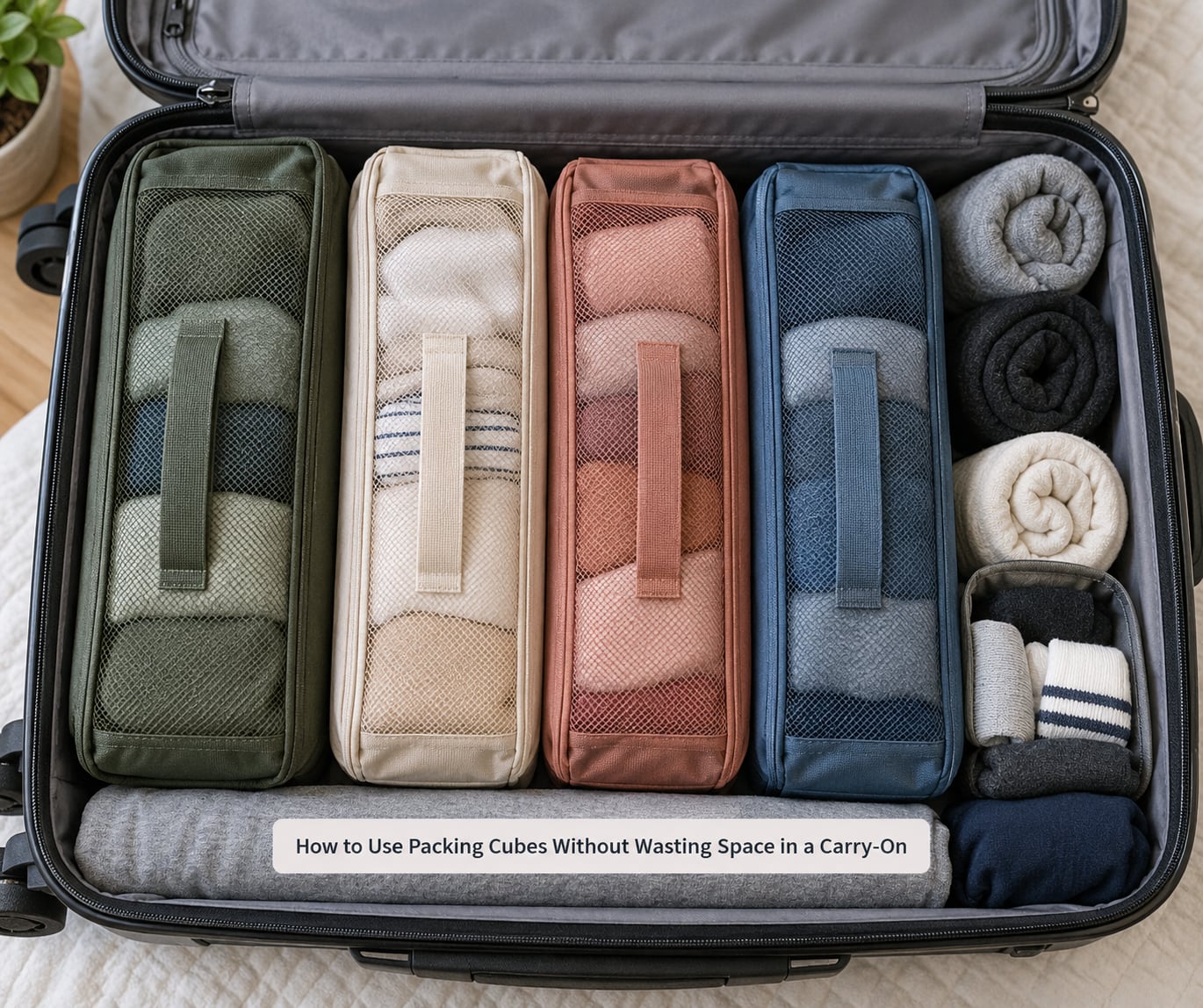
Roll anything that has no crisp finish: tees, leggings, jeans, trousers, underwear, socks. Fold only what creases badly or has structure: button-downs, blouses, structured jackets, anything you would not want wrinkled.
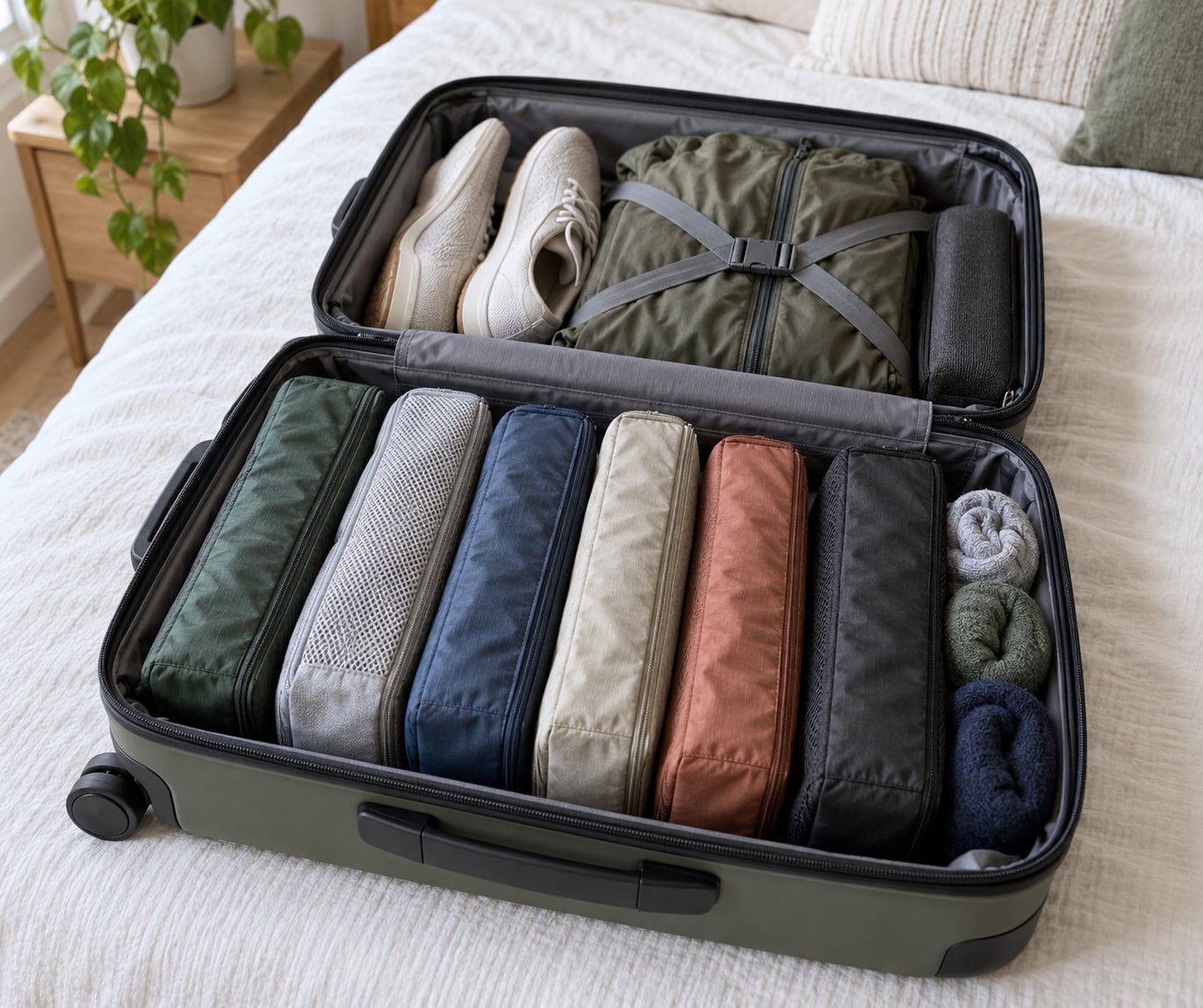
Stand each cube upright on its base rather than laying it flat on its face. Upright cubes present their whole footprint to the bag floor, so they settle into corners. A flat cube presents only its edge, which creates a shelf the next cube cannot fill.
A correctly packed cube looks almost overstuffed. You should not be able to slide a flat hand down the side without resistance. If a cube is genuinely three-quarters full and closed flat, that is the community consensus ceiling, and going past it means the cube puffs up and stops fitting anywhere useful.
Fill the internal gaps inside the cube first, before you move on. Shirts have loose shoulders and hollow chests, and a rolled sock or a soft scarf tucks into each of those spaces. Those internal gaps are the cheapest volume in the entire bag.
4. Pack Large or Bulky Items First
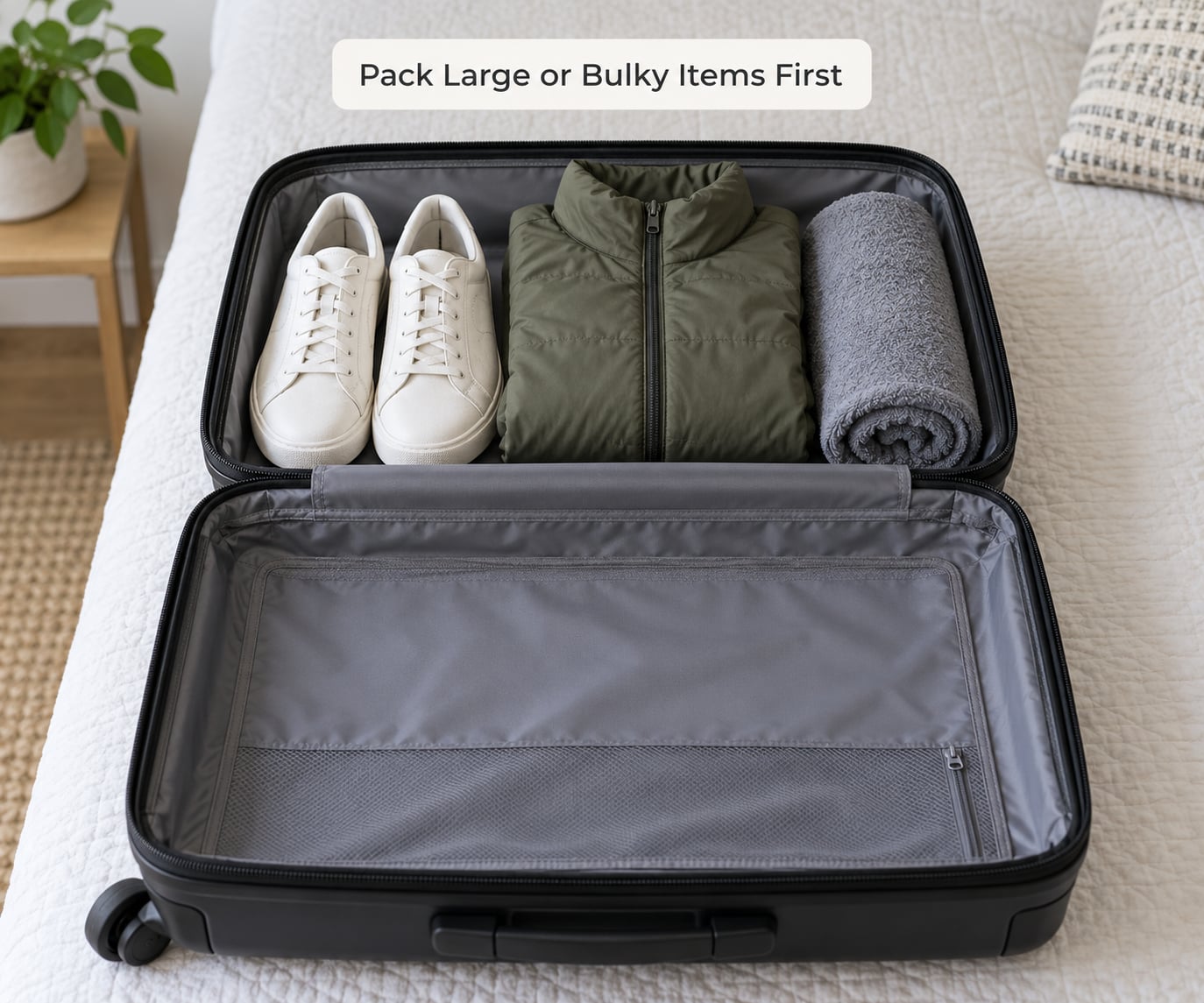
Empty space is easiest to fill while it is still shaped like the bag. Shoes, a jacket, a towel and a laptop all go in first, laid along the hinge end where the shell gives you a full-width surface.
Work outward from there. Put shoes in the far corner with socks stuffed inside them, run bulky items along the long wall, and let the cubes take whatever is left. Doing it the other way round means you are trying to fit a shoe into the leftover strip beside an overpacked cube.
A hard-sided roller is the hardest case for this. Its shell does not flex, so any space the cubes do not fill is simply lost. Starting with the bulkiest, least compressible items keeps the main compartment rectangular, which is the only shape that packs well.
5. Fill Gaps Instead of Forcing Cubes Closed
Run your hand along the seams and corners after each cube goes in. Narrow channels appear where a lid seam curves away from a bag wall, and beside the handle housing, and along the wheel end.
Those channels take rolled socks, soft scarves, chargers, a neck pillow, a paperback, or a plastic folder of documents, all of which would otherwise sit loose and get crushed. Build the Tetris pattern: cubes for the big rectangles, rolls for the odd shapes.
Loose gaps are why a bag can be technically full and still feel badly packed. If you can slide a flat hand anywhere in the suitcase without touching fabric, you have found a pocket worth filling.
6. Do a Final Compression and Access Check
Close every cube fully, then open the compression zipper on the bulky ones and squeeze until the fabric goes quiet and flat. Compression cubes earn their extra zipper on sweaters, puffy jackets and towels, and they do very little for thin cotton.
Then redistribute rather than add. Anything that does not have a home goes back into a cube with spare room, or comes out of the bag entirely. The hard part of packing is deciding what to remove, and it usually takes one item out of the bag to make the rest fit.
Finally, confirm your access layer. The travel-day cube and anything you need while walking through security should sit on top and pull out without lifting anything else. Test the whole bag on the floor: handles, zipper path around every corner, and weight in one hand.
Common Mistakes
Overpacking. The most common one, and it has nothing to do with cubes. Set the item limit before you start and treat the list as fixed.
Several cubes of the same size. Identical squares cannot nest. Swap one for a slim or a narrow cube so the shapes interlock.
Packing by clothing type alone. One shirt cube means digging. Give each cube a use, and pulling it out whole becomes possible.
Leaving cubes half empty. A loose cube slides, shifts and creates air pockets around itself. Fill to the point of resistance, or fill with smaller items you need anyway.
Forcing the main compartment shut. If the zipper needs two hands and a knee, you have a cube that is too big for the space it is in. Move it to a smaller cube or pull one item out.
Putting daily items at the bottom. You will unpack the whole bag on the first morning. Travel-day items go on top, always.
Quick Packing Tips
Label cubes with a luggage strap or a strip of tape if your trip moves between several destinations.
Keep a small emergency cube with a change of underwear, a charger and any medication, and never put it in checked luggage.
Run a one-in, one-out rule on your travel wardrobe. Every trip where you add something tends to become the trip where something does not fit.
Use a mesh top or a clear window on at least one cube so you can see contents without opening anything.
Carry an empty stuff sack or two for dirty laundry. Hand-washing a few items every few days keeps the dirty pile from becoming a fifth cube.
Reuse cubes at the destination instead of unpacking into drawers one item at a time. Lift the whole cube in, set it on the shelf, done.
Frequently Asked Questions
Do packing cubes actually save space?
Only partly, and the honest answer matters. Cubes themselves add a small amount of fabric and sometimes a stiff structure that takes up room. What they genuinely save is dead air: grouping rolled clothing into consistent blocks stops items shifting into hollow pockets, and compression cubes push trapped air out of bulky fabrics. Packed loose in a bag, cubes make it worse. Packed tight, they typically let you fit noticeably more than loose folded clothing.
How many packing cubes should I take for a week?
Three or four is enough for most people: one large cube for clothing, one medium for layers, one small for underwear and socks, and a slim one for travel-day items. Two works if you plan to hand-wash and repack mid-trip, since a third cube absorbs dirty laundry. Five or more is usually over-packing rather than smart packing. Match the number of cubes to the trip, not to the size of the set you happen to own.
Are compression packing cubes better than regular packing cubes?
They are better for specific fabrics and worse for others. Compression zippers genuinely flatten sweaters, puffy jackets, towels and jeans by pushing out trapped air. They do almost nothing for thin cotton, and over-compressing a delicate or lined garment can set deep wrinkles that do not come out on arrival. For winter trips or gear-heavy packing, one compression cube is worth it. For a summer trip in a carry-on, plain cubes do the same job.
What is the best way to organize packing cubes in a suitcase?
Pack the bulkiest, least compressible items first, along the hinge end of the bag, then stand the cubes upright in tight rows and fill the leftover channels with rolled socks and soft accessories. Give each cube a function such as layering, underwear, workout or travel-day items so you can pull one out whole. Keep the cube you need in transit on top, and check every seam and corner for gaps before you close the bag.
Can packing cubes make overpacking easier?
They can, and they do it by hiding the evidence. A neatly organized bag full of too much feels efficient, so it is easy to ignore the fact that one cube too many is why the zipper will not close. Set an item limit before you start and treat it as fixed. If a bag will not zip, removing a single item is usually enough, and that is easier to do while packing than at the airport counter.
Conclusion
Measure the bag and set an item limit before anything goes in. Pack shoes, jackets and towels first, along the hinge end. Assign each cube one job, roll anything that has no crisp finish, stand the cubes upright, and fill every corner and seam you can find. Then close the compression zippers, keep the travel-day cube on top, and take one item out if the zipper needs persuading. That sequence is the whole difference between a bag that packs more and a bag that just looks organized.