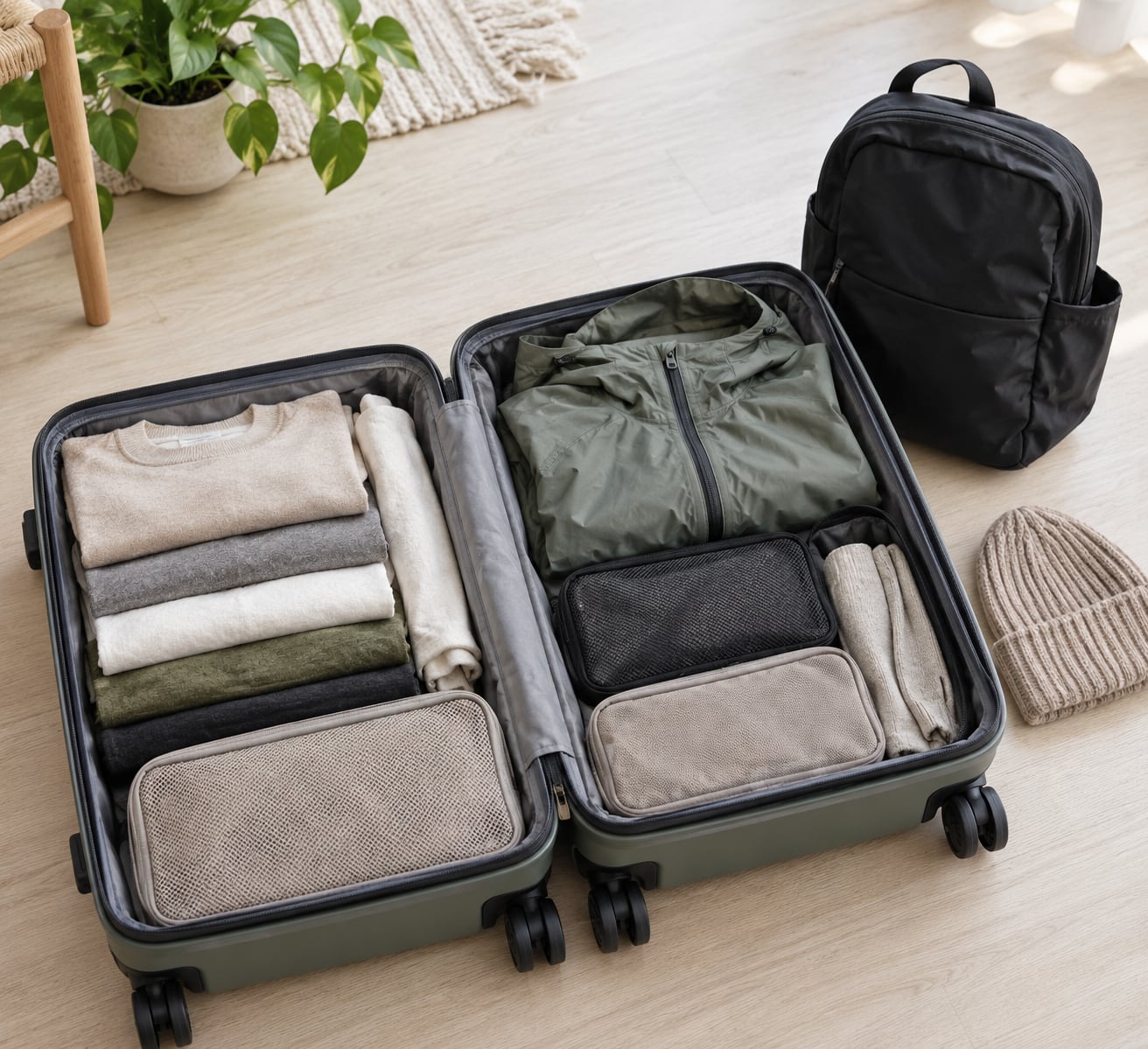
To pack light for a trip with cold mornings and hot afternoons, build one bag from thin, removable layers instead of one warm coat: a breathable base layer, a light insulating middle, and a packable weatherproof shell. Add a small pair of accessories, wear your bulkiest pieces on the plane, and the same handful of clothes covers a 15 to 20 degree swing from dawn to mid-afternoon.
Most packing lists fail on swing-weather trips because they are written for a single temperature. You either carry a heavy jacket and bake at noon, or leave it at home and freeze at a 6 a.m. start. The fix is not more clothes. It is thinner clothes.
This guide covers the whole system: reading a forecast properly, choosing fabrics, picking shoes, sorting a bag by time of day, and the handful of mistakes that undo all of it. Re-checked for 2026.
Table of Contents›
- What You Need for This Packing System
- How to Pack Light for a Trip with Cold Mornings and Hot Afternoons: Step-by-Step
- Check the Forecast for the Coldest and Warmest Parts of the Day
- Build a Small Capsule Wardrobe Around Three Layers
- Choose Fabrics That Work When the Temperature Changes
- Pack One Pair of Shoes That Handles Both Conditions
- Use Accessories for Fast Temperature Adjustments
- Use Packing Cubes to Separate Layers by Time of Day
- Wear the Bulkiest Items During Transit
- How to Pack Light for Cold Mornings and Hot Afternoons: A One-Minute Comfort and Weight Check
- Common Mistakes When Packing for Big Temperature Swings
- Frequently Asked Questions
- How do I pack for temperatures that change by 20 degrees in one day?
- Should I pack a fleece or a lightweight jacket for variable weather?
- What is the best carry-on packing method for changing temperatures?
- Do I need different shoes for cold mornings and hot afternoons?
- How can laundry help me pack light for a multi-day trip?
- What should I do if rain is possible during my trip?
- Start With the Three-Layer System
What You Need for This Packing System
You need five things, and none of them is a specific brand.
- Forecast access that shows hourly detail, not a single high and low. A phone weather app set to hourly is enough.
- A capsule wardrobe built from pieces that all work together, in two or three colours.
- One day bag, ideally a small backpack or a crossbody that holds the layer you will be putting on and taking off most.
- Packing cubes, enough to separate a morning kit from an afternoon kit from a wet-weather kit.
- A packable outer layer that folds into its own pocket or a pouch.
The goal here is adaptability, not one outfit per temperature. If a piece only works at one temperature, it is the first thing to cut.
How to Pack Light for a Trip with Cold Mornings and Hot Afternoons: Step-by-Step
Check the Forecast for the Coldest and Warmest Parts of the Day
Most people read the high, pack for it, and get caught at both ends of the day. Instead, write down four numbers: the dawn low, the mid-afternoon high, the overnight low, and the chance of rain or wind.
Then look at the hourly curve, not the headline. A 7 degree morning with a 26 degree afternoon and a 5 degree evening is a different packing problem from a steady 18 degrees all day, even though the high is identical.
Add the extras that change how clothes feel. Strong sun on a cold morning makes a thin shell feel warmer than the number suggests, and a cold wind does the opposite. Air-conditioned trains and overheated restaurants sit at the other end of the scale, so indoor comfort matters as much as outdoor comfort.
Worked example: if the spread between your coldest and warmest part of the day is 10 degrees or more, pack in layers. If it is under about 8 degrees, a mid layer and a light jacket are probably enough.
Build a Small Capsule Wardrobe Around Three Layers
Three layers cover nearly every swing-weather trip, and each one has a job.
- Base layer: a long-sleeve top in merino wool or a synthetic blend, plus breathable underwear and socks. This is the layer that touches your skin, so it matters most.
- Mid layer: a lightweight fleece, a fine-gauge wool sweater, or a thin cardigan. This is what actually holds warmth.
- Shell: a lightweight waterproof or windproof jacket that folds small. It blocks wind and rain, and it is the layer that solves a cold morning even when the air temperature is mild.
Put all three on together at 6 a.m. and you are comfortable. Peel them off one at a time as the day warms, and you are comfortable at every point in between. That peeling is the whole system.
A five-day version of this capsule: three base layer tops, two mid layers, one shell, four or five bottoms, and two pairs of sleepwear shorts or trousers. Everything in two or three colours so any combination still looks deliberate.
Choose Fabrics That Work When the Temperature Changes
Fabric choice is what separates layering that works from layering that makes you sweat. Thin, breathable, quick-drying fabrics let you wear a mid layer at 8 degrees without cooking at 24.
Merino wool base layers are the most-recommended single item for swing trips. They are warm, breathable, odour-resistant, and can be worn more than once without smelling, which matters a lot on a trip without daily laundry.
Synthetic layers pack down smaller and dry faster, which is why they are common for hiking and travel. The trade-off is odour over several days, so wear them close to the body rather than over a base layer.
Cotton is the one to leave out of the system. Once it gets wet it stays cold, and it dries slowly, so a damp cotton layer can undo an entire day of layering. Heavy denim has the same problem in reverse: it is too warm by noon and too stiff to pack small.
A quick selection test: check the weight per square metre on the label if it is listed, then ask four questions. Does it breathe, does it dry fast, is it light enough to fold into a cube, and can you wear it under another layer without bulking up? Merino base layers usually run 150 to 200 gsm, mid layers 200 to 300 gsm. Thinner than that stops insulating; much thicker and you will be carrying dead weight.
Pack One Pair of Shoes That Handles Both Conditions
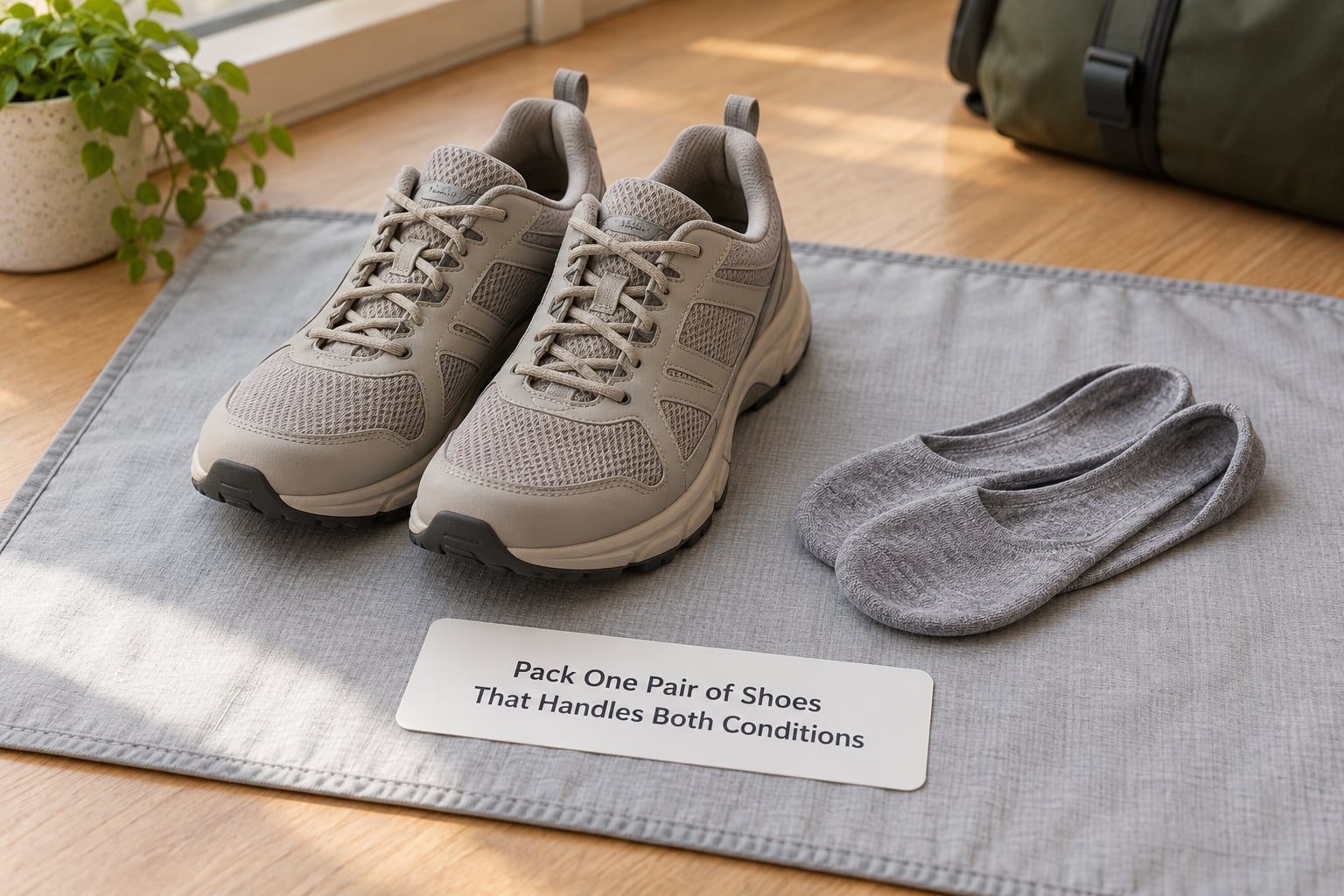
Supportive, breathable shoes with decent grip handle both ends of the day. A closed-toe trail shoe or walking shoe works at a chilly start and stays fine at midday heat; open sandals do the opposite and fail at 7 degrees.
Test them before the trip, not on the trip. Wear the exact pair you intend to pack for a full day, with the socks you plan to bring. Check for hot spots at the heel and the ball of the foot, because those are the blisters that ruin a walking day.
Add a second pair only when the itinerary truly requires it. A light sandal that folds flat takes almost no room and covers the hot afternoon; a dressier shoe is worth carrying only if you have an evening that calls for it.
One more detail: thin liners or a spare pair of socks in the day bag. Changing socks at midday resets your whole comfort level for almost no weight.
Use Accessories for Fast Temperature Adjustments
Accessories are the cheapest way to stretch a small wardrobe across a wide temperature range. They cost almost nothing in bag space and they change your effective temperature more than another sweater would.
- Light beanie: carry it if mornings sit near or below 10 degrees, especially with wind. It packs into nothing.
- Neck gaiter or thin scarf: the single most versatile item for a big swing. It works as a neck warmer at dawn, face covering in wind, and shade cover at altitude.
- Compact gloves: thin ones, only if you genuinely run cold. They slide off into a pocket once the sun is up.
- Sunglasses: pack them every time. Strong sun on a cool morning is a real heat source, and at altitude it is stronger still.
- Compact umbrella: small enough to live in a day bag permanently, and it beats a rain jacket for keeping other layers dry.
Leave the bulky versions at home. A thick wool hat that takes up a quarter of a packing cube is worse than a thin one plus a layer you can shed.
Use Packing Cubes to Separate Layers by Time of Day
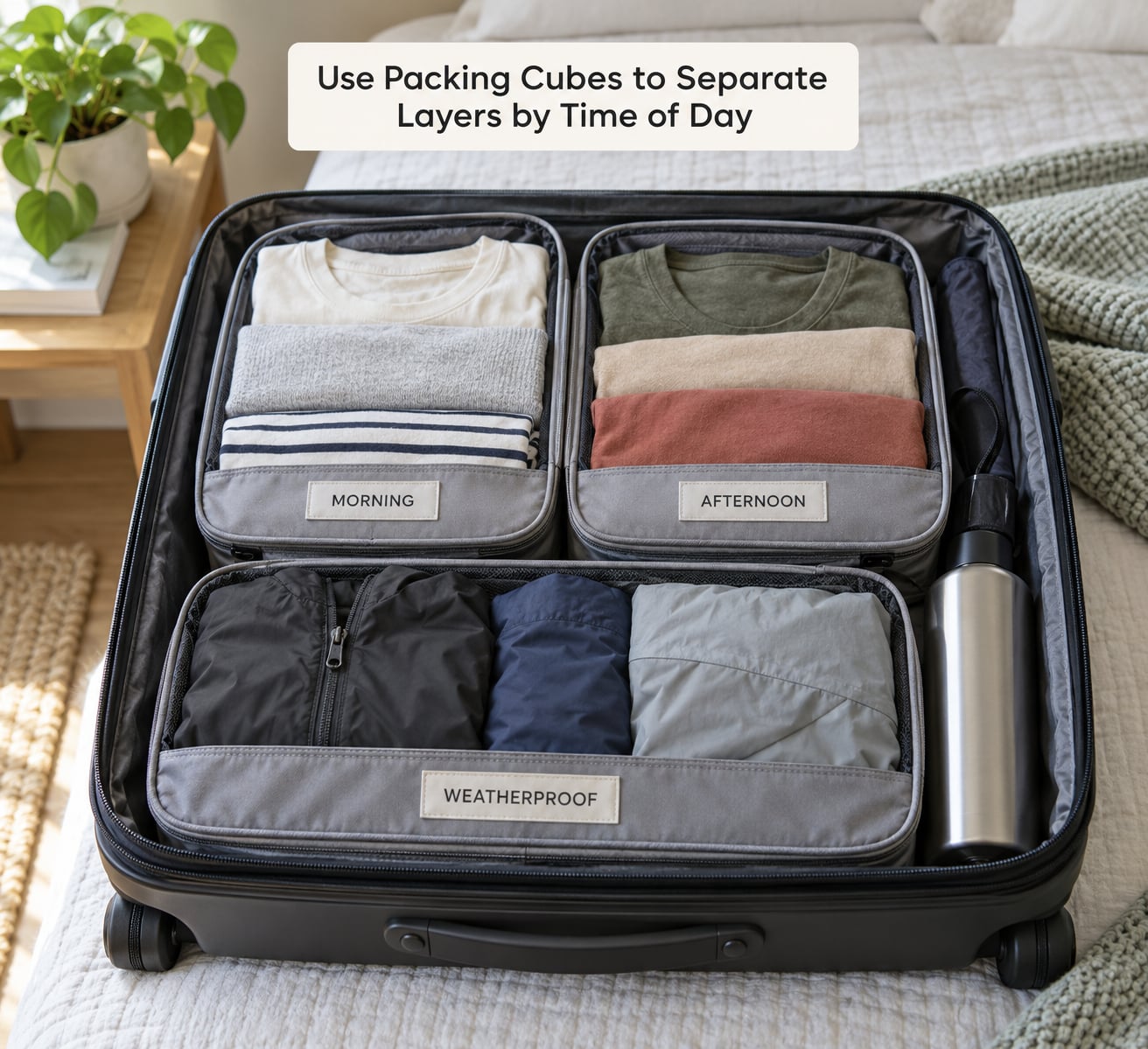
Sort by time of day and adjustments take seconds instead of a bag excavation. Put the cold-morning kit in one cube, the warm-afternoon base in a second, and the weatherproof shell somewhere you can reach it without unpacking anything.
A workable day bag for a swing-weather day: the shell, the mid layer, a base layer for changing after a sweaty walk, a neck gaiter, sunglasses, and one change of socks. Everything you need between dawn and dusk fits in a small daypack.
Compression cubes save space but can crush loft and trap moisture in a shell or a fleece. Use compression for flat items like trousers and tees, and skip it for anything insulating. If a cube has to be unzipped and dug through to find a sweater, the system has already failed.
Keep the shell outside the cubes entirely. It is the piece you will need most often and the one you never want to hunt for.
Wear the Bulkiest Items During Transit
A jacket, a heavier sweater, and your sturdy shoes can all live on your body instead of in the bag. That is free volume.
Check four things before committing to this. Security is fine for a jacket, but leave your belt and anything metal-heavy in your bag. Weather at the airport or station can be colder than home, so keep the mid layer within reach rather than checked. Mobility matters: bulky boots are miserable through a long terminal walk, so pack those and wear the lighter pair. And comfort still counts, since you will be in transit for hours.
Do this only when it does not make the journey worse. Wearing a stiff boot to save an inch of bag space is a bad trade.
How to Pack Light for Cold Mornings and Hot Afternoons: A One-Minute Comfort and Weight Check
Before you close the bag, run the actual morning-to-afternoon sequence: start in base plus mid plus shell, walk for ten minutes, then peel layers in the order shell, mid, base.
Ask four questions. Can every layer be worn together without a seam pulling or a collar fighting your chin? Is each one reachable without emptying the bag? Are your shoes still comfortable after a full day in them? Is anything in there doing the same job as something else?
Success feels like this: you can get from a cold start to a hot afternoon without touching anything you cannot see, and the bag is light enough that you are not thinking about it. If adjustments make you kneel on the floor and dig, the packing order is wrong.
Re-read the forecast the night before and the morning you leave. Swap the mid layer for a lighter one if a warm front moved in, or add the insulating piece if it did not. Adjusting at the margins is far cheaper than rebuilding a bag.
Common Mistakes When Packing for Big Temperature Swings
Mistake 1: Packing for both extremes at once. You bring a heavy winter coat and a summer wardrobe because you are trying to cover every possible temperature with dedicated clothing. The correction is to cover the range with combinations. Three thin layers give you more usable outfits than one warm coat and one t-shirt.
Mistake 2: Relying on a single heavy jacket. It handles the cold morning but cannot be worn at 25 degrees, so it spends most of the day folded in your day bag. A thin shell plus a mid layer you can remove covers far more hours of the day.
Mistake 3: Choosing fabrics that do not breathe. Cotton and heavy denim trap sweat and hold cold when damp. Synthetic or merino blends move moisture away and dry faster, which is what makes layering possible in the first place.
Mistake 4: Packing too many shoes. Three or four pairs eat more bag volume than most clothing. One pair that handles both ends of the day, plus one flat pair if the itinerary needs it, is enough for most trips.
Mistake 5: Not rechecking the forecast. A packing list built three weeks out is a guess. Check again a few days before departure and again on the morning you leave, and swap pieces rather than adding new ones.
A few shorter tips that help: choose two or three colours so everything mixes; plan one laundry stop if the trip runs past five days; and rent bulky items such as skis, snow gear, or trekking equipment at the destination instead of carrying them across the world.
Frequently Asked Questions
How do I pack for temperatures that change by 20 degrees in one day?
Use three thin layers instead of one warm coat: a breathable base layer, a light insulating mid layer, and a packable weatherproof shell. Wear all three at dawn, then shed them one at a time as the day warms. The same three pieces cover a 20-degree swing without adding bulk to your bag.
Should I pack a fleece or a lightweight jacket for variable weather?
Pack the fleece as your mid layer and the lightweight jacket as your shell. A fleece supplies warmth but does not block wind, and a light jacket blocks wind and rain but usually lacks insulation. Together they cover cold mornings and heavy rain, and both can be removed quickly once the afternoon warms up.
What is the best carry-on packing method for changing temperatures?
Sort your cubes by time of day: a morning kit, a warm-afternoon kit, and a weatherproof layer kept outside the cubes for fast access. Keep the shell, mid layer, a fresh base layer, and socks in your day bag. That way you adjust for the temperature all day without unpacking your carry-on.
Do I need different shoes for cold mornings and hot afternoons?
Usually one pair is enough. A breathable closed-toe walking or trail shoe with good grip works at a cool start and stays comfortable in afternoon heat. Add a second pair only if your itinerary truly requires it, such as a dressier evening shoe, and choose sandals that fold flat rather than bulky shoes.
How can laundry help me pack light for a multi-day trip?
A single laundry stop lets you carry fewer pieces, especially socks and base layers. Pick accommodation with a washer or dryer and plan one wash mid-trip, then dry synthetics overnight since they dry fastest. Merino base layers can be reworn between washes, which keeps a small bag functional for longer.
What should I do if rain is possible during my trip?
Carry a lightweight waterproof shell and a compact umbrella in your day bag rather than a rainproof coat. Keep cotton out of your layering system, because wet cotton stays cold, and pack a dry base layer so you can change after a soaked walk. Shoes matter most, so choose a pair that tolerates puddles.
Start With the Three-Layer System
If you do one thing, build the three layers before you pack anything else: a breathable base layer, a mid layer that holds warmth, and a compact weatherproof shell. Check the hourly forecast, pick fabrics that breathe and dry quickly, and confirm all three can be worn together at dawn.
Everything else follows from that. Sort the bag by time of day, keep the shell in your day bag, wear the bulkiest items in transit, and re-check the forecast before you leave. Small adaptable choices are what make a light bag possible without leaving you stuck in a coat at 25 degrees or shivering at 6 a.m.