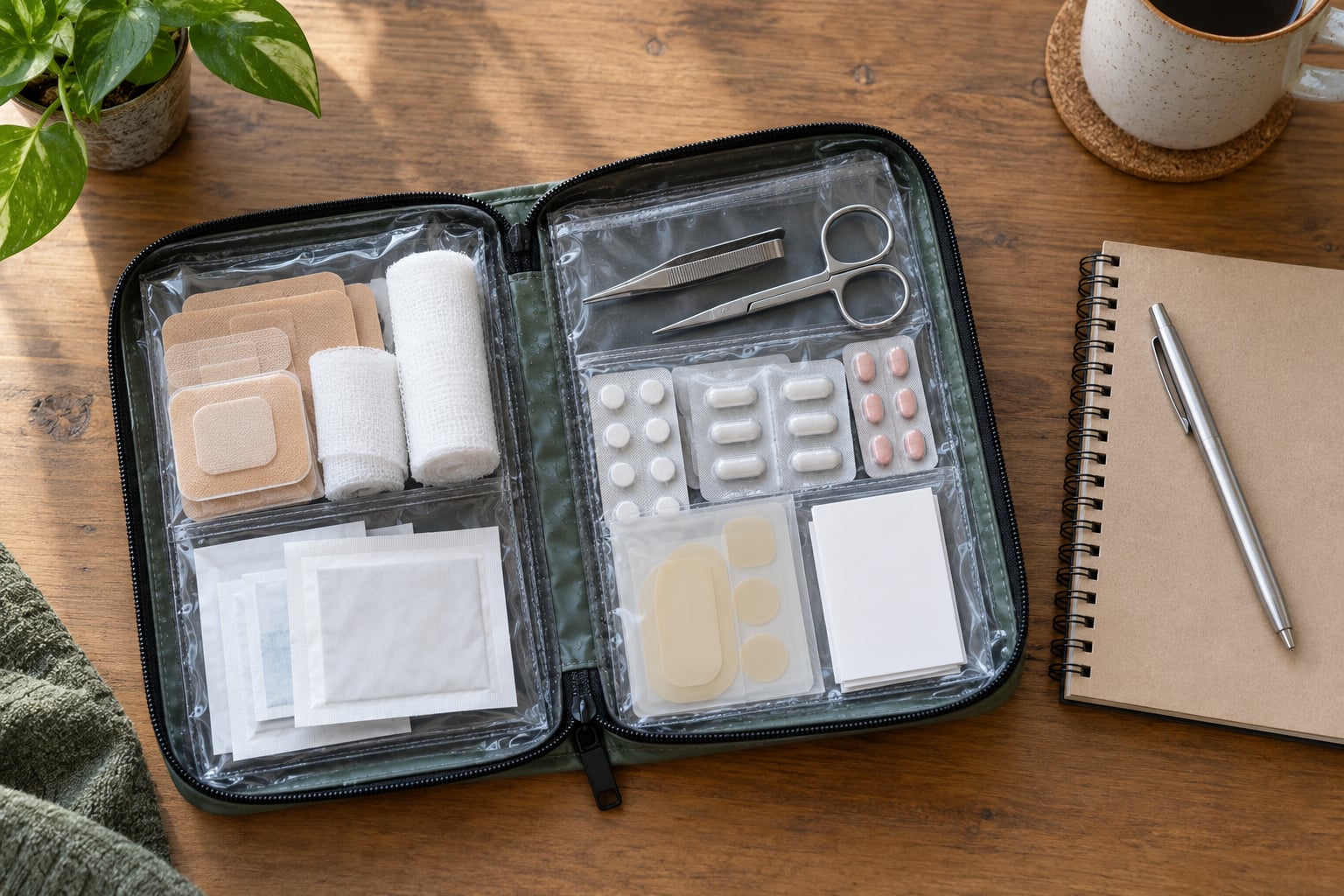
How to build a travel first aid kit: pick a waterproof zip-seal pouch, add a fixed core of wound-care supplies and the over-the-counter medicines you already know you tolerate, then layer on items for your destination, your health and the people travelling with you. It takes about 30 minutes, it costs less than a single pharmacy visit abroad, and you will not find one for sale at the airport when you need it at midnight.
Most guides bury the important part. They list forty products and leave you to work out which ten actually matter for a four-day trip in Portugal.
The fix is a tiered build. The core stays the same on every trip; only the quantities and the destination layer change. Here is how I build one, and what I leave out.
Table of Contents›
- What You Need to Build Your Travel First Aid Kit
- Step-by-Step
- How to build a travel first aid kit for different trip lengths: keep the same core and scale what goes in it
- Start with a small first-aid foundation
- Pack medications and personal health items
- Add tools and information for the destination
- Pack for weather, activities, and access
- Check, label, and store the kit safely
- Common Mistakes
- Frequently Asked Questions
- What should I put in a travel first aid kit?
- How many days of medication should I take on a trip?
- Can I take a travel first aid kit and medication in my carry-on?
- What should I include in a travel first aid kit for hiking?
- How do I travel with medication that needs refrigeration?
- What should I do if I run out of a medicine while traveling?
- Final Checklist
What You Need to Build Your Travel First Aid Kit
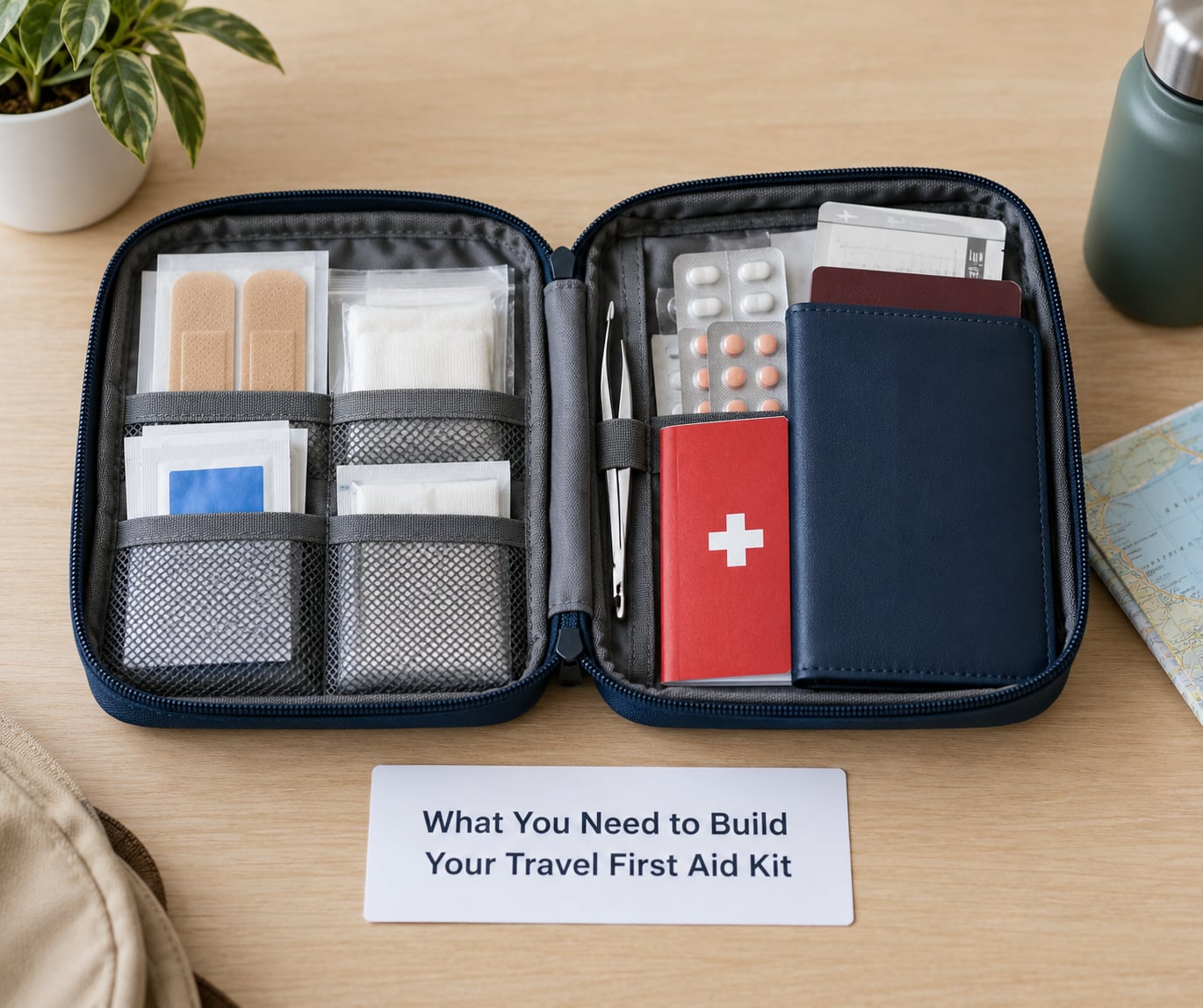
You need three categories of stuff: the supplies core, your own prescription medicines and documents, and a small set of items chosen for where you are going.
The supplies core is the part almost everyone under-packs. Adhesive plasters in two sizes, sterile gauze pads, a roll of medical tape, an elastic wrap, antiseptic wipes, a few packets of oral rehydration salts, disposable nitrile gloves, tweezers, small scissors, safety pins, and a digital thermometer.
Then your personal layer. Every prescription medicine you take, plus a couple of extra days of each, in the original labelled packaging, plus a folded sheet listing generic (INN) drug names, doses, your allergies and the prescriber’s contact details.
Andrew Skurka’s field-tested system, borrowed by most serious backpackers, sorts everything into Critical, Suggested, Optional, Contingent and Unnecessary tiers. It works well for travel kits too, because it stops you buying a blister pad, a CPR mask and a snake bite kit for a city break.
Before you buy anything, check the official travel health guidance for your destination and ask your doctor or pharmacist to review the list. Medicine import rules differ by country, and a few common drugs are restricted in places you would never guess.
Step-by-Step
How to build a travel first aid kit for different trip lengths: keep the same core and scale what goes in it
A day trip needs a handful of plasters, antiseptic wipes, painkillers, antihistamine tablets and a bottle of water. That is genuinely it. Everything else is dead weight in a daypack.
A weekend escape adds a change of dressings, rehydration salts, a thermometer, antihistamine, motion sickness tablets if you are a bad passenger, and blister pads if you are walking more than usual.
For a multi-week trip, scale quantities by days rather than doubling everything. Two people travelling together can carry one shared kit; a solo traveller should assume there is no spare pouch when something tears.
Outdoor trips and travel with children change the list more than trip length does. Hiking days add blister management, ankle support and tick tools. Children add paediatric doses of anything you pack, plus the specific complaints of whatever age they are.
Start with a small first-aid foundation
Wound care is where a travel kit earns its keep. Antiseptic wipes or a small bottle of antiseptic solution clean the skin before a dressing goes on; sterile gauze pads cover a cut once cleaned; medical tape fixes the gauze in place; an elastic wrap handles sprains and strains.
Adhesive plasters come in a mix of sizes, because a large one on a heel defeats itself. Pack fabric-backed ones for anything sweaty or hairy and clear film ones for minor cuts that need to stay clean.
Blister pads and moleskin are the two items most people leave behind and most regret. They cost almost nothing and turn a ruined walking day into an ordinary one.
Nitrile gloves, tweezers, small scissors and safety pins round out the foundation. On the Rick Steves travel forum, an infectious-disease physician listed eleven items he considered essential for any tourist’s kit, and gloves, tweezers and dressings were among them.
Pack medications and personal health items
Bring what you actually use. The rule people should follow, and rarely do, is to take only medicines you have already taken and tolerated, so you know how your body reacts.
Typical over-the-counter choices: pain relief, an antihistamine for bites and allergic reactions, oral rehydration salts, a stomach remedy, motion sickness tablets, saline nasal spray for long flights, and antiseptic cream. Ask your doctor or pharmacist before adding anything, especially if you take regular medication, are pregnant, or have a chronic condition.
Write the generic (INN) name of each drug on your medication sheet, not just the brand. The same medicine is sold under a different name in most countries, and the generic name is what a pharmacist abroad will understand.
Carry enough for the trip plus a few extra days. On the r/onebag subreddit, travellers who split their medicines between a carry-on and a personal item keep working when a checked bag arrives late or never does.
Add tools and information for the destination
Tools are small and get used. Tweezers handle splinters and ticks, small blunt-tip scissors cut tape and dressings without a blade, safety pins hold a sling or a popped shoulder strap, and gloves matter more than people expect in places where taps run cold and sanitation is uncertain.
Information matters just as much. Put these on one folded card: local emergency numbers, your insurer’s assistance line and policy number, your blood group if you know it, your regular doctor’s contact, and a list of known allergies.
Keep a copy of that card in the kit pouch and a second copy somewhere outside your luggage. A card in a bag that gets stolen in a hostel does not help you.
Pack for weather, activities, and access
Match the extras to conditions rather than to a checklist of everywhere.
Hot, humid or mosquito-heavy destinations: insect repellent containing DEET or picaridin, long sleeves, a lightweight mosquito net, sunscreen and after-sun, and a tick check routine. On r/CampingandHiking, travellers argue about DEET versus picaridin constantly, with picaridin preferred for synthetics and some reporting irritation from DEET. Covering up is the part nobody argues with.
Cold and snow: an instant cold pack, extra blister and chafing protection, and lip balm. A cold pack also earns its place in summer for sprains and swelling.
Water and heat: rehydration salts are the single most-used item on long-haul trips according to forum threads, and they matter more in a heatwave. A whistling thermoflask doubles as a wound-irrigation vessel.
Remote areas where the nearest pharmacy is hours away: add a triangular bandage for slings, more dressings than feels sensible, and enough medication to cover a delayed return.
Leave snake bite kits at home. Wilderness first aid instructors repeatedly recommend against them, and they are close to useless without proper training.
Check, label, and store the kit safely
Do an inventory pass with the pouch on the table, not in a bag. Write the expiry date on the outside of each medicine with a pen or a small sticker, so the audit next trip takes a minute.
Separate sharp tools. Scissors and tweezers sit in the main compartment and can slice open everything else when a bag shifts. Use elastic bands or a dedicated pocket.
Store the kit cool and dry and out of direct sunlight. A parked car in summer will degrade medicines and make adhesive useless. Zip-seal bags are not a substitute for a proper waterproof pouch, and moisture is what ruins tablets.
Carry it in your hand luggage, not checked baggage. Liquids above 100 ml are normally restricted through airport security, so keep any antiseptic liquid small enough to clear the 3-1-1 rule, or buy it after you land. Medicines in original labelled packaging are generally treated more favourably than loose tablets, and rules vary by country, so check with your departure airport and your airline.
For solo and long-haul travel, split medicines across two bags and carry the medical card with you at all times.
Common Mistakes
Overpacking. Fix: tier everything as Critical, Suggested or Optional, and only the Critical tier goes in. A kit you can find in the dark beats a comprehensive one you cannot.
Loose pills in an unlabelled bottle. Fix: keep prescription medicines in original labelled packaging and carry a typed list with generic names. Unlabelled tablets are also a problem at customs.
Forgetting your own instructions. Fix: one folded card with drug, generic name, dose, frequency, allergies and prescriber contact. It takes four minutes to write and it is what a foreign hospital reads first.
Carrying remedies that are unsafe or restricted. Fix: check your destination’s import rules before departure, and never pack opioid painkillers, sleeping pills or anything containing codeine without confirming legality in that country.
Buying a pre-made kit and trusting it. Fix: pre-made kits are often criticised on forums for cheap, useless contents and wasted space. If you buy one, use it as the foundation and strip out what you will never use.
Strong-smelling items in the cabin. Fix: menthol concentrates and heavy off-the-shelf salves can bother fellow passengers. Travel with small, mild formulations instead.
Frequently Asked Questions
What should I put in a travel first aid kit?
Aim for a core of wound care and personal needs first: adhesive plasters in two sizes, sterile gauze, medical tape, an elastic wrap, antiseptic wipes, nitrile gloves, tweezers, small scissors, safety pins and a thermometer. Then add your prescription medicines in original packaging, basic pain relief, an antihistamine, oral rehydration salts, and a card with emergency contacts and generic drug names.
How many days of medication should I take on a trip?
Most travel health guidance suggests taking enough for the trip plus a few extra days, which covers delays, cancellations and a missed connection. Keep it in the original labelled packaging, split between two bags, and ask your doctor or pharmacist before you travel, especially for controlled drugs, injections or anything needing refrigeration.
Can I take a travel first aid kit and medication in my carry-on?
Yes, and you should. Medicines in original labelled packaging are generally the easiest option through security. Liquids are the catch: antiseptic washes and eye drops over 100 ml fall under the 3-1-1 liquids rule, so buy those after you land. Emergency treatment medication declared at the checkpoint is usually fine, and rules vary by country, so check your departure airport.
What should I include in a travel first aid kit for hiking?
Add blister pads and moleskin, an elastic ankle support, a triangular bandage, tick tweezers, antihistamine tablets for bites, a head torch, a whistle, and a spare pair of blister-prone footwear liners. Increase dressing quantities rather than medicine. Skip snake bite kits, which first aid instructors advise against, and remember a kit does not replace training.
How do I travel with medication that needs refrigeration?
Ask your pharmacist before you leave, because they can tell you whether a specific product genuinely needs a cold chain or is stable at room temperature for the trip length. If it does need cooling, a small insulated medication travel case with gel packs usually meets airline cabin rules, but you must tell the airline in advance and keep the packaging and prescription with you.
What should I do if I run out of a medicine while traveling?
Ask any local pharmacy for the generic (INN) name rather than the brand name you know, and bring your medication card with the dose and the prescriber contact. Your insurer’s assistance line can usually find an English-speaking clinician or arrange a repeat prescription. For controlled drugs or anything unusual, contact your own doctor before you travel for a contingency plan.
Final Checklist
Start with a short, trip-specific inventory rather than a shopping spree. Write down what you take regularly, add one week of over-the-counter basics and a wound-care core, and mark everything Critical, Suggested or Optional.
Then add the personal layer: medicines in original packaging, the folded card with generic names and emergency contacts, and a second copy of that card in a different bag.
Last, check your destination’s health guidance and medicine import rules, and run an expiry-date pass on the pouch. A Red Cross or Wilderness First Aid course takes a weekend and makes the kit twice as useful.