
To find a local salon or talk event as a visitor, decide first which “salon” you mean: a hair salon you book, or a hosted salon or talk you attend. For a hair appointment, search map listings for walk-ins and check the booking tool for same-day slots. For a talk, skip the ticketed platforms and go straight to open-to-the-public sources: university lecture series, library and museum programmes, hotel guest talks, and neighbourhood groups.
The word causes most of the confusion. Search engines read “salon” and hand you a Yelp local pack for hair, while people in the French and Francophone sense mean a small hosted conversation, a salon in the older tradition where a dozen people and one speaker sit in a room and talk. I have wanted both in the same trip and found them in completely unrelated places.
A salon in that older sense is worth knowing about, because it explains a lot of naming you’ll see on posters. In much of Europe the word still carries that meaning, and “salon” or “Salon” on a flyer can mean an evening discussion with a guest author, a researcher or a local figure. It is not a beauty appointment. If you walk in expecting a haircut, you will have a funny afternoon.
Everything below assumes you are a visitor with a few nights, no car, no local contacts and possibly no second language. It also assumes you would rather walk into something free than buy a ticket you are unsure about.
Table of Contents›
- What You Need Before You Search for a Local Salon or Talk Event
- Step-by-Step: Finding One From Arrival to Attendance
- 1. Decide What Kind of Event You Want
- 2. Search With Local-Language Event Terms
- 3. Check Official Venue and Cultural-Space Listings
- 4. Look Beyond English-Language Searches to Find a Local Salon or Talk Event
- 5. Confirm the Format, Language, and Audience
- 6. Check Practical Details Before You Go
- 7. Attend with Respectful Visitor Etiquette
- Common Mistakes
- Frequently Asked Questions
- Can I attend a local talk without speaking the local language?
- How do I know whether a salon or talk is open to visitors?
- What should I do if an event listing has conflicting information?
- Can I find cultural talks outside a city’s main tourist areas?
- Should I contact the organiser before attending?
- How early should I arrive for a salon or talk event?
- Conclusion
What You Need Before You Search for a Local Salon or Talk Event
You need six things, and five of them are free.
A destination and a date range. Narrower is better. “Talks in Paris” returns noise; “talks in the 5th arrondissement, next Tuesday evening” returns actual events.
A translation method. Your phone’s camera-based translation will carry you through most listings. Keep it installed and learn to point it at a poster.
Two or three event platforms installed before you fly. Meetup and Luma cover interest-based local groups, Eventbrite covers bigger ticketed events. Setting them up on airport wifi wastes an evening you could have spent in a talk.
A map and transit tool that work offline. Download the area before you arrive. Cell data roaming is expensive and sometimes simply unavailable, and walking into the wrong neighbourhood at night because a map would not load is a bad night.
A little flexibility. Plenty of good talks move, change rooms or need you to register two days ahead. A rigid itinerary turns a movable event into a missed one.
Payment and a data plan. Some venues are cash only, and some registration pages want a card you do not have. Check before you need them.
Step-by-Step: Finding One From Arrival to Attendance
1. Decide What Kind of Event You Want
Start by naming the format out loud, because the words pull up different listings.
A salon or Salon is a small hosted conversation, usually recurring, usually free, usually seated in a circle rather than rows. A talk or conference is a speaker with an audience, and it may be ticketed. A lecture is usually academic and seated. A panel is several speakers, so there is often a question period where you can speak. A workshop requires registration and often costs something. Community gathering, discussion evening and roundtable are the loose, friendly formats most worth finding alone.
Also decide whether you want to talk or listen. A panel with a question period lets you say one thing out loud. A lecture does not. Knowing this in advance saves you from picking something that plays to your nerves on a tired evening.
2. Search With Local-Language Event Terms
Translate the concept, not just the word. This is the single biggest difference between visitors who find events and visitors who don’t.
Search for the format in the local language: conférence, conférence grand public, cycle de conférences, table ronde, rencontre, soirée d’échange, atelier, conférence ouverte au public. Where you see those words, you are looking at the category, not just one event.
Take the same care with the salon meaning. If you want a hair appointment, search the local word for hairdresser or barber, plus sur rendez-vous or its opposite, sans rendez-vous, which is the walk-in phrase. Translating “salon” alone will drag you back to beauty.
Literal translation misleads more than it helps. Conference, symposium, colloquium and colloquie can overlap or differ by institution, and a word for “conference” sometimes means a private business meeting. When a term feels off, check it against the venue’s own calendar and see what else they call things.
One more caution: some machine translations turn “salon” into a beauty parlour when the source text is talking about a discussion. If a listing suddenly mentions colour treatments, you are on the wrong page.
3. Check Official Venue and Cultural-Space Listings
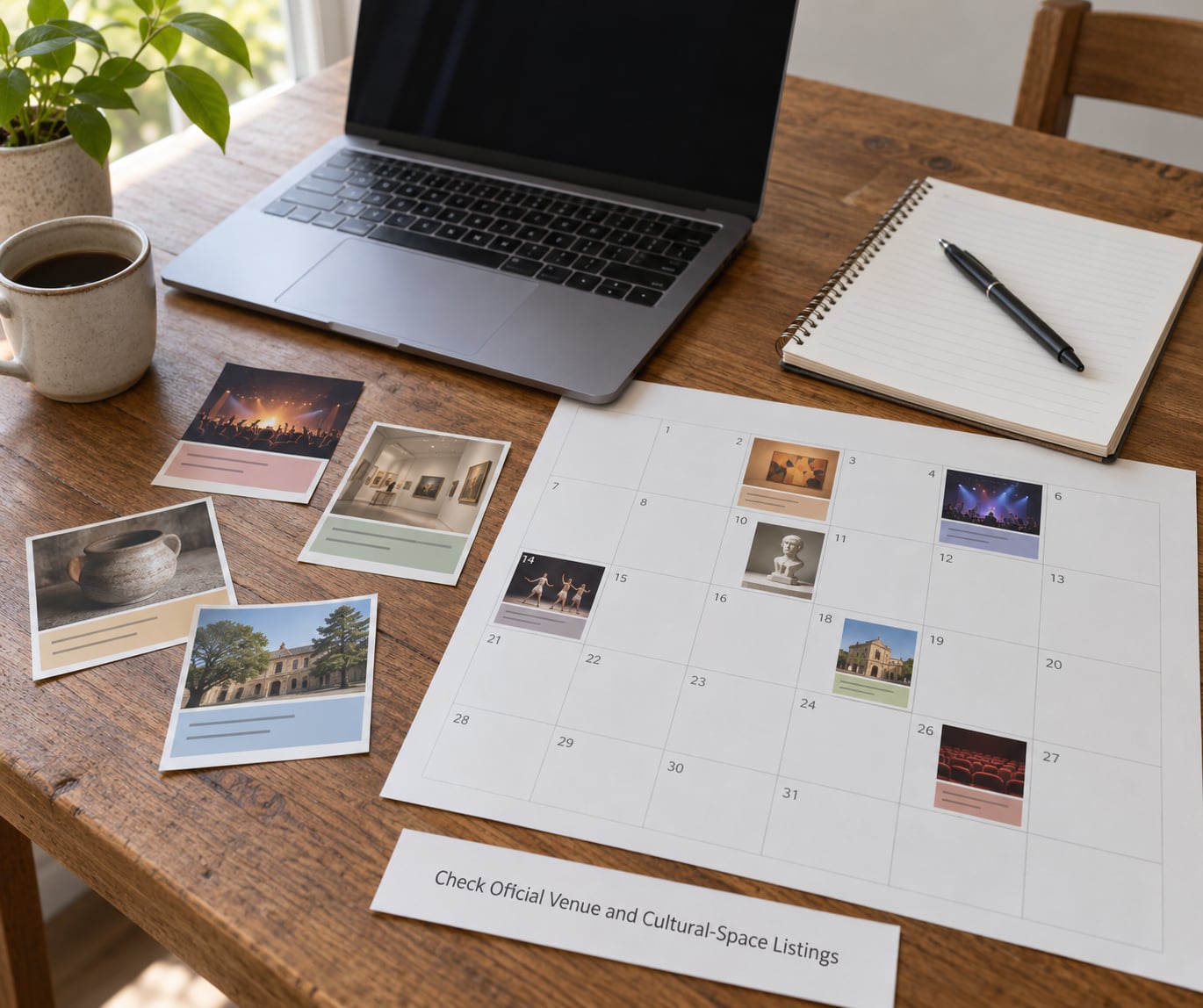
This is where the genuinely walk-in events live, and no app lists them well.
Start with independent bookshops, which host author evenings and readings that are almost always free and rarely sold out. Then museums and galleries, where curator talks and late openings are normal programming. Libraries run free talks and language exchanges, and their calendars are public even when you are not a member. Cultural centres — Goethe-Institut, British Council, Alliance Française and their equivalents — run language exchanges and talks aimed squarely at visitors who do not speak the local language natively.
Universities are the biggest underused source. Public lecture series are advertised as open to the public precisely because the law or the institution requires it. Search the faculty or department name plus the lecture-series phrase in the local language. Hotels run guest talks in their lobbies, which are usually free to anyone who walks in. Cafés and bookshops host recurring discussion evenings that never appear on a ticketing site.
What to look for: a current date, a start time, a room, and a link to register. Listings from six months ago are decoration. Every good venue calendar has one line at the top with the season’s programme.
4. Look Beyond English-Language Searches to Find a Local Salon or Talk Event
English-language search finds what the English-speaking crowd already knows about. You want the local layer underneath.
Search the local-language social platforms rather than the English ones, and look for neighbourhood groups and community accounts. A local bookseller’s account posting tomorrow’s reading is your best single source of same-day cultural programming. Local-language event directories and community notice boards work the same way: they are updated by the people running the events, not by aggregators.
Newsletters are underrated. A neighbourhood newsletter, a cultural-centre mailing list or a venue’s monthly mail carries recurring programmes a search engine never indexed. Sign up for one the first week and the listings arrive on their own.
Learn to tell an organiser’s post from an aggregator’s. An organiser names the speaker, the room and usually the price, and the account’s phone number or address is a real venue. An aggregator lists forty events in a grid, links out for registration and never answers a message. Trust the first and treat the second as a starting point for research.
5. Confirm the Format, Language, and Audience
Before you plan your evening around it, answer five questions from the listing.
In person or online? A hybrid event gives you a fallback if transit fails.
Is interpretation available? Look for words like interpretation, simultaneous translation or headset system. Some universities provide free earphones at the door; you collect them at the welcome desk, which is also the easiest possible way to walk in with no explanation needed.
Is it open to the public? Words like open door, public lecture or free entry mean anyone can attend. Reserved or by invitation means members only. Closed working groups usually say nothing at all, which means assume not.
Ticket or RSVP? Free events with an RSVP often cap numbers for fire-code reasons and keep a waitlist. Registering costs you one form and guarantees a seat. Registering wrongly, as in a name that isn’t yours, gets you removed.
Specialists or beginners? A research seminar assumes you know the field. A public lecture does not. One is a bad evening alone; the other is exactly right.
If the listing answers none of these, contact the organiser. That message is the topic of the next section.
6. Check Practical Details Before You Go
Most failed evenings are logistics failures, not interest failures.
Confirm the date and start time on the organiser’s own page, not on an aggregator, and check whether doors open before the start. Confirm the entrance. Buildings with several street doors send visitors to a different one, and the person who points you there may not exist at seven in the evening.
Check the neighbourhood and how you get there. Look at the transit map before you leave rather than at the station. Note the last departure time, since a talk that ends at nine can finish with a long conversation and the metro does not wait.
Confirm admission, whether seating is limited or first-come-first-served, whether the room is step-free with accessible toilets, and whether you need to leave a bag somewhere. Then re-read the organiser’s most recent post the day before, because rooms and times change more often than people expect.
Arrive fifteen minutes early. It is the difference between choosing a seat and standing at the back, and standing at the back is exactly the position that makes a solo visitor feel like an intruder.
7. Attend with Respectful Visitor Etiquette
Arrive on time, or slightly early. Opening a door during someone else’s introduction is a small thing that lands badly.
Use headphones for translation where the room allows it, and keep the phone face down. Never record a speaker, a panel or an audience without explicit permission, and never photograph people in the room unless the organiser has invited it. If you want a photo of the speaker, ask the host first.
Stay for the whole session unless you leave during a break. Question periods are the only part where you speak, and the usual form is your name or city, a short question, then the microphone back. Do not interrupt a speaker to translate, ask for the microphone, or hand your phone to someone to interpret mid-sentence; that turns your question into a small performance for forty strangers.
Follow local norms for discussion. Silence while someone speaks, short answers, and the greeting before the question all vary, but nobody is offended by a visitor who watches the room first and copies what others do.
Afterwards, stay for the coffee if there is one. That is where salons actually happen — the same room, the same people, a conversation instead of a schedule. If nobody approaches you, mention what you came for and ask the speaker one real question. That is usually the whole mechanic.
Common Mistakes
Searching in English only. You get the international expat circuit, which is fine, and you miss everything local. Fix: run one search in the local language for the event format.
Translating “salon” and landing in a beauty parlour, or missing the salon event entirely because you searched for haircuts. Fix: decide the meaning before you search, and search the local word for hairdresser or barber if you mean hair.
Trusting a stale listing. A page that still shows a spring programme in autumn is decoration. Fix: check the organiser’s own site or newest post, and treat everything else as a lead rather than a fact.
Assuming everything is walk-in. Some events are open door, some are RSVP-only, and capacity limits are real. Fix: register when registration exists. It takes a minute and it removes the worst case, standing outside with nowhere to go.
Ignoring the language level. A specialist seminar in a language you do not have is an hour of being stuck. Fix: look for public lecture series, cultural-centre events and interpretation.
Skipping registration because it feels presumptuous. It is the opposite. Fix: sign up, use your own name, and cancel if you cannot make it so someone on the waitlist can.
Turning up at the wrong entrance, on the wrong day, at the wrong time. Fix: check the door, the calendar and the last transit home before you leave.
One more worth naming: booking the whole evening around a listing you haven’t confirmed. If a talk is unconfirmed, make it the plan for one night, not two.
Frequently Asked Questions
Can I attend a local talk without speaking the local language?
Yes, more often than most visitors expect. Public lecture series are designed for a general audience, and cultural institutes, libraries and museums frequently run interpretation, sometimes free with earphones collected at the door. Look for the words interpretation, public lecture or open door on the listing. A language-exchange evening is even easier, since half the room is there for the same reason you are.
How do I know whether a salon or talk is open to visitors?
The listing will usually say so, and the wording is consistent. Open to the public, public lecture or free entry means anyone may attend. Open door is the same promise. Reserved, by invitation or members means you need a connection. Closed working groups often say nothing at all, so assume not and ask the organiser. If you cannot tell, send one short message asking whether a visitor without a local contact can attend.
What should I do if an event listing has conflicting information?
Treat the organiser’s own channel as the source of truth: their website, their newest social post, or the address in the venue footer. Aggregators and search results are often months behind. Check two sources, and if the organiser’s page and their newest post disagree, believe the newest post. If you are already on the way, a quick message to the venue asking which entrance and which room is faster than guessing.
Can I find cultural talks outside a city’s main tourist areas?
Most of them are there, and that is where you will find the ones that still have a local audience. University lecture series, public libraries, independent bookshops, cultural centres and neighbourhood cafés all hold regular programmes well outside the tourist core. Search the local language for the format rather than for a venue name, and check what the venues in a residential district near your accommodation have on this week.
Should I contact the organiser before attending?
Yes, if anything is unclear, and yes even if you feel awkward. A short message with your name, where you are visiting from and one question about entry or registration is entirely normal and often answered the same day. Ask about language support, whether a walk-in is possible, or whether the event is still on. If the listing is clear and the event is open door, you can simply turn up.
How early should I arrive for a salon or talk event?
Fifteen minutes for a talk or lecture, and a little more if you want a good seat or expect a queue for registration. Doors usually open before the stated start time and first-come-first-served seating is common. For a hair appointment, arrive five to ten minutes early so there is time to describe what you want. If you arrive at the start of a talk, you may have to stand at the back.
Conclusion
The reliable version takes one search term, one venue calendar and one message. Before you travel, pick a single local-language word for the format you want, open the calendar of a university, library or cultural centre near where you are staying, and check that entry is open to the public and that the language is workable. Ten minutes of that turns a wasted half day into an evening you will still be talking about next trip.