
Planning a trip with flexible dates comes down to one habit: shop the whole window at once instead of picking a weekend and hoping. Set the earliest and latest dates you could travel, compare every combination in between on a fare calendar, then choose the week that balances cost with weather and crowds. Most of the work happens before you book anything.
Knowing how to plan a trip when your dates are flexible takes about two focused hours, and the payoff shows up immediately in the fare and the room you get for the money. I ran this process for a ten-day trip in 2026 and moved my departure three days, which is the kind of move you can only make when nothing is locked.
Table of Contents›
- What You Need
- How to Plan a Trip When Your Dates Are Flexible
- 1. Set Your Non-Negotiables and Flexibility Limits
- 2. Build a Realistic Travel Window for Your Flexible Dates
- 3. Compare Seasons Without Chasing the Cheapest Date
- 4. Choose the Right Base and Sequence
- 5. Check Availability, Costs, and Local Conditions
- 6. Book in a Sensible Order
- 7. Build a Light Plan and a Weather Backup
- Common Mistakes
- Frequently Asked Questions
- Does flexible dates always mean cheaper travel?
- How far ahead should I plan a trip with flexible dates?
- How do I compare travel seasons without over-researching?
- What if my dates are only partly fixed?
- Should I book refundable flights and hotels when dates may change?
- Can AI tools plan the whole trip for me?
- Conclusion
What You Need

Gather four things before you look at a single fare, and the rest of the process gets much faster.
Destination priorities. Write down what the trip has to deliver: a specific trail, a food scene, a week with family, a museum you have wanted to see for years. Flexible dates help most when the destination is fixed and the timing is not.
Your real travel window. Not the dates you hope for. The earliest you could realistically leave and the latest you could return, including the days you need to travel to work and back.
A budget range. Give yourself a floor and a ceiling rather than a single figure, so a cheap fare outside your comfort band still registers as a bad option.
A shortlist of planning tools. For flights, Google Flights and Skyscanner both have month and grid views that show the cheapest days across a whole span. Hopper is useful for a single route, and Going is built around fare drops on specific routes. Add the accommodation platform you already trust and one aggregator for scouting.
Two more details matter more than people expect: what you need from a room, and how much notice your employer or family needs. A kitchen-equipped rental changes what a bad-weather day costs, and a booking that needs three weeks’ notice removes the slack you thought you had.
How to Plan a Trip When Your Dates Are Flexible
The mistake most people make is treating flexibility as permission to chase the lowest fare. It is not. Flexibility is a comparison tool, and the comparison you are running is between travel windows, not between individual days.
1. Set Your Non-Negotiables and Flexibility Limits
Split everything into two piles. Non-negotiables are the destination, the maximum trip length, the budget floor, any event with fixed dates, and anything you need for accessibility or a kitchen. Everything else is adjustable.
Then put a number on your flexibility: how many days can move, and how far can the whole trip shift. Someone with a fixed school holiday has weeks of slack inside a narrow window. A freelancer can move the trip by a month. Those are very different planning problems and they produce very different fare choices.
Write the answer down as one line. If you cannot say how many days can shift without checking with someone, your window is narrower than you think, and you should plan around booking flexibility instead of date flexibility.
2. Build a Realistic Travel Window for Your Flexible Dates
Take your earliest and latest possible dates and open the calendar view on a flight search tool. A month-long span of departures costs one search and removes all the guessing.
Look at the shape of the pricing rather than a single day. You will usually see a broad cheap band with expensive islands around weekends, holidays, and school breaks. Note the cheapest departure, the cheapest return, and whether the return you want sits inside a good band.
Then check what the calendar is not showing you: daylight hours, typical weather for that stretch, and whether seasonal services actually run. On islands and in northern regions, a cheaper date can land you in a place whose main road, ferry, or tour has not started for the season. A cheap fare to a closed destination is not a saving.
3. Compare Seasons Without Chasing the Cheapest Date
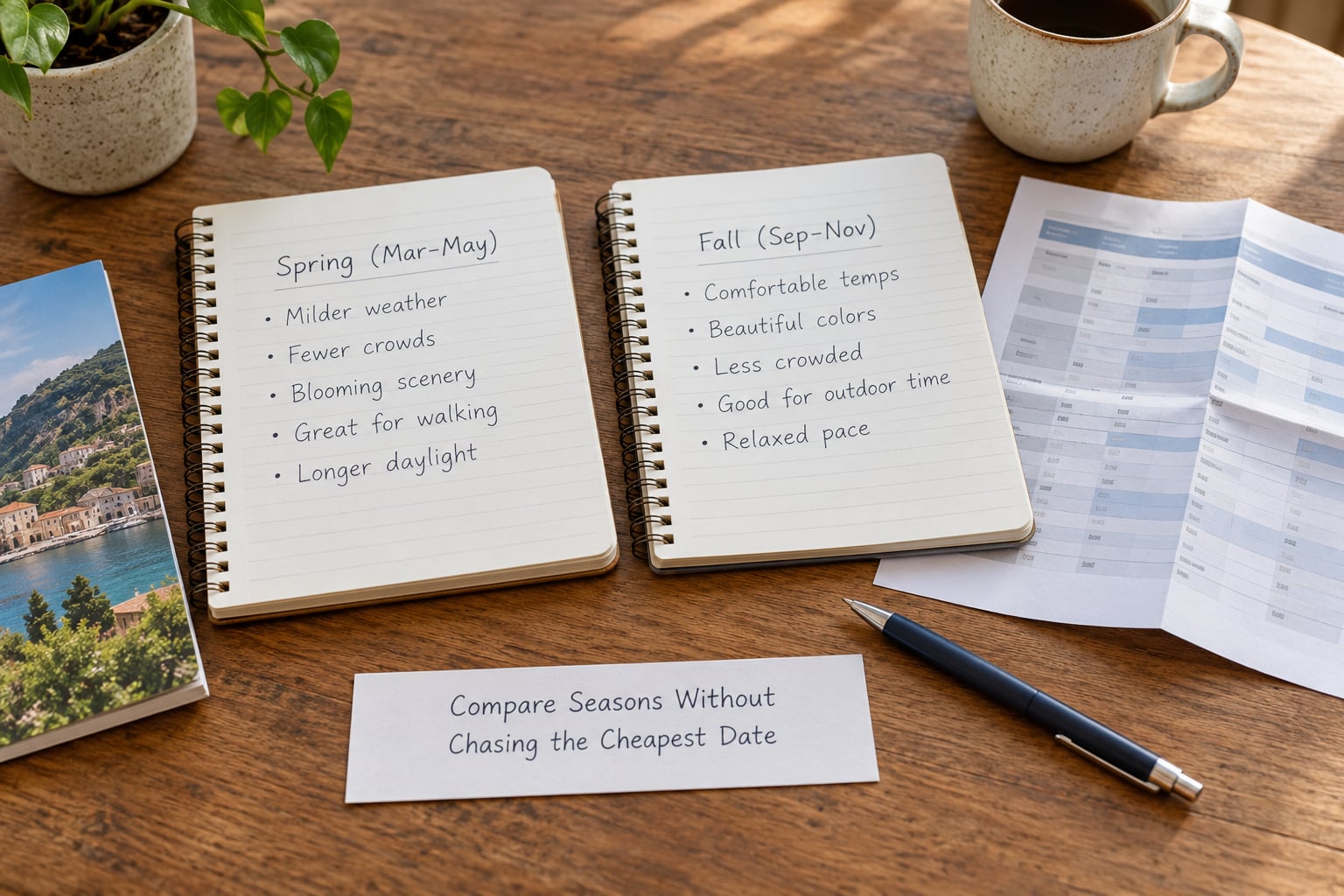
Score each candidate window on the same four columns, so you are comparing weeks rather than vibes. Here is the format I use:
| Window | Typical fare band | Crowds | Conditions to plan for |
|---|---|---|---|
| Midweek inside school holidays | Mid to high | Busy | Long daylight, everything open |
| Shoulder weeks, midweek | Low | Thin | Cooler mornings, some seasonal closures |
| Low season | Lowest | Very thin | Reduced services, weather risk |
| Weekend inside a festival period | Highest | Packed | Full services, book months out |
Midweek departures usually cost less than the equivalent weekend ones, and the saving compounds when both ends of the trip shift. Shoulder season is usually the sweet spot for people who want decent weather without the peak crowds, but check the specific climate rather than the label: shoulder season in a rainy region is a different proposition from shoulder season in a dry one.
A worked example. Say you have three weeks in spring and two candidate windows. Window A is mid-April to late April, midweek both ways, shoulder season, mild but changeable. Window B is the first week of May, midweek, still shoulder, warmer and busier. Run both on a fare calendar and the difference usually lands between fifteen and thirty percent. That is the trade you decide: a warmer week, or a cheaper one. Either is defensible; neither is wrong.
Do not move a date to save a small amount on airfare if it puts you into the week a major event is happening. Event-driven price spikes are usually larger than seasonal ones, and you will be competing for rooms as well as flights.
4. Choose the Right Base and Sequence
Flexible dates make longer stays in fewer places easier, and that is where the money usually goes. One base for five or six nights beats three addresses in three nights: you unpack once, you learn a bus route, and you stop paying for the friction of moving.
Plan day trips in a radius you could reach and return from on a bad-weather day. Anything requiring an overnight stay is really a second base, and should be treated as one.
Then resist the itch to route-optimise. Every extra stop adds a fixed cost in transfers, check-ins and lost time, and it consumes the exact buffer that made your flexible dates valuable.
5. Check Availability, Costs, and Local Conditions
Verify before you commit, using primary sources rather than summaries. Official transport sites for timetables and seasonal service dates, the property or operator site for real terms, and official tourism pages for what is running.
Check four things in this order: does the transport run on the dates you picked, what is the cancellation window, what is actually included in the fare, and what does the local weather record say for that week. Fare comparisons are only meaningful at the moment you book, so re-run your search before paying and expect it to differ.
Budget carriers deserve extra attention because headline fares hide extras. Checked bags, seat selection, and card fees can add enough to erase the saving that made the date attractive. Add the real total before you compare windows against each other.
6. Book in a Sensible Order
Scarcity decides order, not convenience. Book whatever is hardest to replace first: limited-capacity tours, seasonal trains and ferries, popular properties with genuine free cancellation, and anything tied to an event.
Next, secure transport into and out of the region. Then book your base for the first part of the trip, and leave the remainder open. That last part is the one most people skip, and it is the entire point of having flexible dates.
Decide the trigger before you start booking, so you are not making the call tired at midnight. Mine is simple: when a fare inside my chosen window falls within about ten percent of the cheapest I saw in that window, I book it. Forum advice on this question is consistent and blunt: the best day to book is usually today, and chasing a better fare is a hobby, not a strategy. A small drop is far less likely than a modest rise.
Check cancellation terms line by line. Free cancellation up to a deadline is a real tool when your dates are still moving. A fully refundable fare often costs noticeably more, so decide whether you are buying insurance or buying certainty, and only pay for the one you need.
7. Build a Light Plan and a Weather Backup
Flexible dates only help if your itinerary is loose enough to absorb them. Give each day one anchor: a museum, a hike, a market, a class. Everything else stays optional and decided the night before.
Keep a short list of wet-weather and high-impact alternatives that work indoors or come with cancellation. A spare afternoon in a city you already know is worth more than an ambitious day trip you might lose.
For a ten-day trip, I book the first five or six nights and leave the rest open. Last-minute rooms in a place you have already settled into are the easiest thing to find at short notice, and the days you decide on the spot are usually the ones you remember.
Common Mistakes
Treating the cheapest fare as the best date. The lowest price in the window is only correct if the weather, the crowds, and the services suit you. Weigh it against the other three columns before deciding.
Choosing a season from a label. Shoulder season means different things in different places. Look up the actual conditions for your dates.
Building a route with too many stops. Every transfer costs time and money and eats the buffer that flexible dates gave you. Fewer bases, longer stays.
Booking the whole trip in one go. Locking every night removes the main advantage of an open calendar. Book the entrance, the exit, the first base, and the scarce parts.
Ignoring cancellation terms. Read the deadline and the conditions, not just the word free. Some policies refund only a portion, or only before a deposit deadline.
Shifting dates without checking connected bookings. A changed flight can strand a separate ticket or a reservation that does not move with it. If you buy separate tickets, build a generous buffer between them.
Second-guessing a good fare for days. Set your trigger in advance, then stop looking. The search stops paying for itself quickly.
Frequently Asked Questions
Does flexible dates always mean cheaper travel?
How far ahead should I plan a trip with flexible dates?
How do I compare travel seasons without over-researching?
What if my dates are only partly fixed?
Should I book refundable flights and hotels when dates may change?
Can AI tools plan the whole trip for me?
Conclusion
Start tonight with one action: open a month-wide fare calendar for your route and write your earliest and latest possible dates above it. Look at the whole picture before you choose anything, pick two or three windows, and score them on fare, crowds, seasonal services, and weather. Then book the scarce parts, set your first base, and leave the rest of the trip open.