To choose a hotel room floor and view well, work out which two things matter most on this trip, then match them to a specific position on a specific floor. Higher floors usually mean less street noise and a wider outlook, but a mid-floor room at the quiet end of a corridor beats a top-floor room beside the lift shaft every time. The whole decision takes about ten minutes once you know what to look for.
The part most booking pages hide is position. A room number tells you the floor and roughly where you sit on the corridor, and that one detail explains more about your night than the room category name ever will. Two rooms sold at the same rate can be a bright corner unit with two exposures and a lift lobby window onto a service shaft.
Table of Contents›
- What You Need Before You Choose a Hotel Room Floor and View
- Step-by-Step: Picking a Floor and View in Five Steps
- 1. Set Your Priorities
- 2. Check the Floor Plan
- 3. Match the Floor to Your Needs
- 4. Choose the View That Fits Your Trip
- 5. Confirm the Hotel Room Floor and View Before You Pay
- Common Mistakes Travelers Make With Floor and View
- Frequently Asked Questions
- Is a higher hotel room always better?
- How do I choose a quiet room in a busy hotel?
- What floor is best for a view?
- Can I request a specific room number or view?
- Which floor is best for someone with mobility issues?
- Conclusion: Make the First Choice Before You Book
What You Need Before You Choose a Hotel Room Floor and View
Gather eight things before you compare rooms, and most of them take a couple of minutes to find.
- Floor location. How many floors the building has, and which ones are guest rooms rather than conference or restaurant space.
- Room orientation. Which way the window faces, and what sits across the street at the same height.
- View category. The exact wording on the rate: sea view, partial sea view, city view, courtyard view, garden view, or no promise at all.
- Noise sources. Lift shaft, stairwell, vending and ice machines, service entrance, loading bay, bar, or a main road.
- Lift position. Where the core sits on your floor and how many rooms are between it and the end of the corridor.
- Accessibility needs. Step-free access, distance from the lift, bathroom layout, and how you plan to move your luggage.
- Sunlight preference. Whether you want morning light, afternoon light, or dark curtains at midday.
- A floor plan or map. Many hotels publish one on their site or on their booking page, and reception will describe the layout over the phone if it is not published.
If you are packing for a few nights rather than a weekend, add one more: how much daylight you actually need to work in the room. Desk space and window light matter more on a working trip than the view does.
Step-by-Step: Picking a Floor and View in Five Steps
1. Set Your Priorities
Start by writing down no more than three things you care about, then cut it to two. Trying to satisfy quiet, a sea view, a balcony, a workspace, a corner unit and a low walking distance all at once leaves you with a bad compromise on every one of them.
Rank the rest in rough order: quiet, view, convenience, family access, work space, sunlight, privacy and what you are paying. Here is what the top of that list usually looks like in practice.
- Light sleeper. Quiet matters more than anything. Aim for an upper-middle floor, an end-of-corridor room with a window, and a face away from the lift core.
- Solo traveler. Prioritize a room away from the entrance and the lift lobby, with a corridor position that does not require walking past the front desk. Middle floors with more rooms on the corridor tend to work well here.
- Working from the room. Prioritize natural light and distance from the bar and lifts. A courtyard view delivers light all day; a lounge-facing room delivers noise all evening.
- Family with a stroller or mobility needs. Prioritize lift distance and step-free access. Height is worth almost nothing here.
- Trip where the view is the trip. Prioritize orientation and height, and accept a longer walk from the lift in exchange.
- Winter or overcast season. Prioritize a southern or western face and accept that overcast weeks can dull a northern-facing room for days at a time.
2. Check the Floor Plan
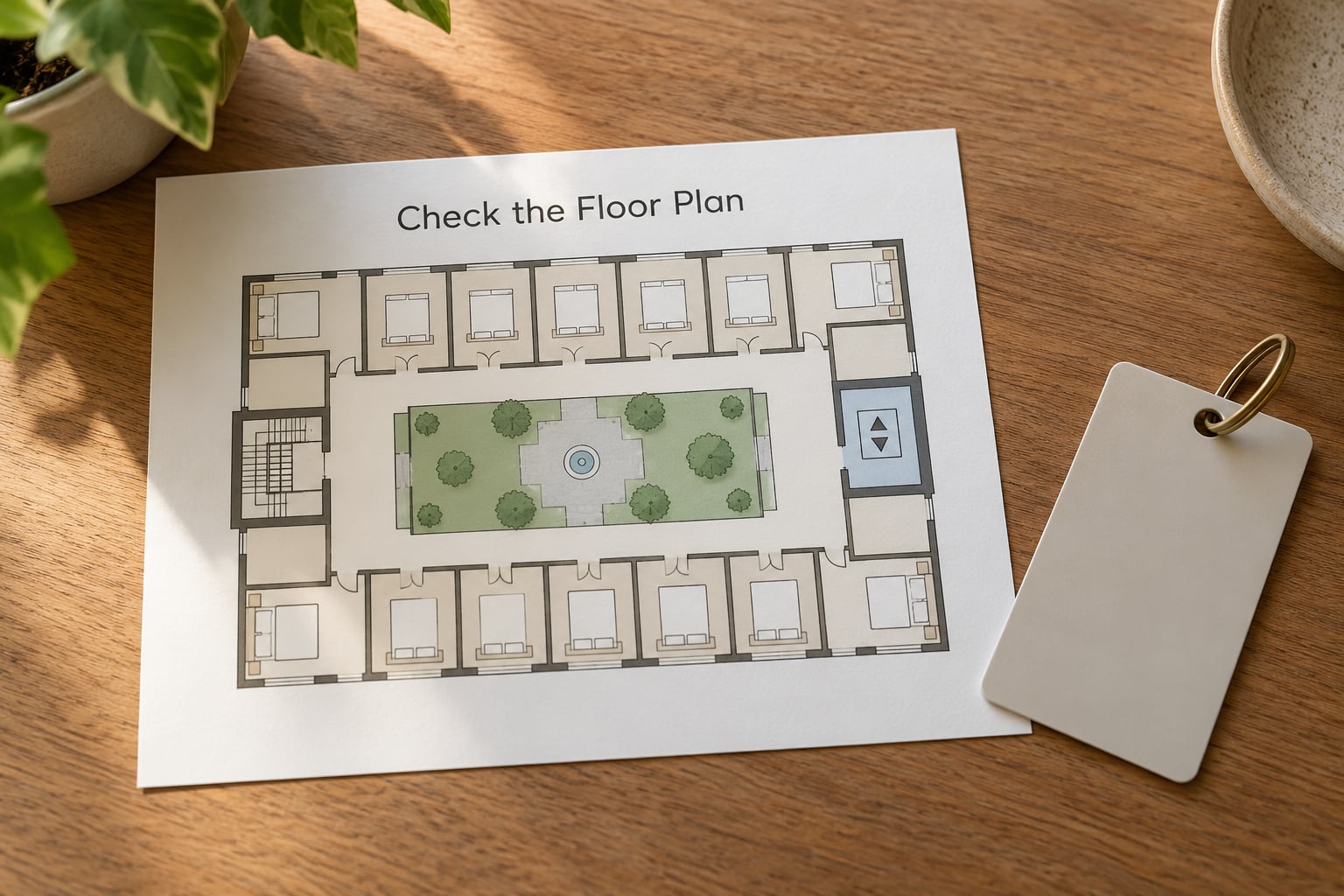
Once your priorities are set, read the floor the room sits on as if it were a map. Lift and stair core in the middle, vending and ice machines at one end, service rooms and the linen store at the other. Rooms numbered nearest the core are the ones you will hear the lift through.
Room numbers usually decode the position. In most hotels the first digit or two is the floor, and the remaining digits run outward from the lift in one direction, or around a ring corridor in newer buildings. So 420 is the fourth floor, and on a typical floor it sits about a third of the way along the corridor.
Two quirks are worth knowing. Some buildings skip the number 13 on every floor, which is why a floor can jump from 12 to 14. And room 01 is usually the first room off the lift lobby or the closest to the entrance, not a premium corner unit, even though the low number looks tempting. A room numbered with an odd figure and one with an even figure are usually on opposite sides of the corridor, not adjacent, which is how you avoid an adjoining door.
The 15-5 rule is the hotel version of basic geometry: the core of a building occupies roughly the middle 15 percent of its area, and the remaining outer 5 percent on each face is the prime real estate. Any room in that thin outer band is a corner or end unit with windows on two sides. Ask for a corner room in words rather than relying on the number alone, since numbering differs in almost every building.
3. Match the Floor to Your Needs
Higher is quieter only in the simple sense that street noise falls away. Every floor introduces its own trade, so compare them on the axes that matter rather than on height alone.
| Floor | Noise | View and light | Best for |
|---|---|---|---|
| Ground to second | Most street, traffic, loading bay and lobby noise | Limited outlook, often blocked by hedges, cars or terraces | Step-free access, heavy luggage, mobility needs |
| Third to fifth | Close to lifts, ice machines, vending and mechanical plant in many buildings | Street view with limited elevation | Convenience, budget, short city breaks |
| Sixth to tenth | Quieter, usually well above traffic and bar noise | Clear outlook over rooftops and low-rise blocks | Light sleepers, solo travelers, work trips |
| Upper-middle | Quiet, though wind and weather get more noticeable | Wide view, good daylight, usually a real outlook | Most travelers who want a view worth paying for |
| Top floor | Quietest, but exposed to wind, roof plant and lift motor noise | Best elevation, no floor above you | Views that are the point of the trip, and light sleepers who do not mind the lift ride |
Two trade-offs catch people out. A high floor means more walking to your room and total dependence on the lift, so a failure at 1am becomes your problem rather than a bystander’s. And mid floors are not automatically quiet: they are frequently where the lift shaft, boiler plant and ice machine live, and those transmit structure-borne noise through the walls regardless of double glazing.
For a solo traveler, higher is generally better for a different reason. Fewer people pass your door, and the ones who do are staff and guests going elsewhere. Just avoid the room directly opposite the lift doors, where every arrival walks past.
4. Choose the View That Fits Your Trip
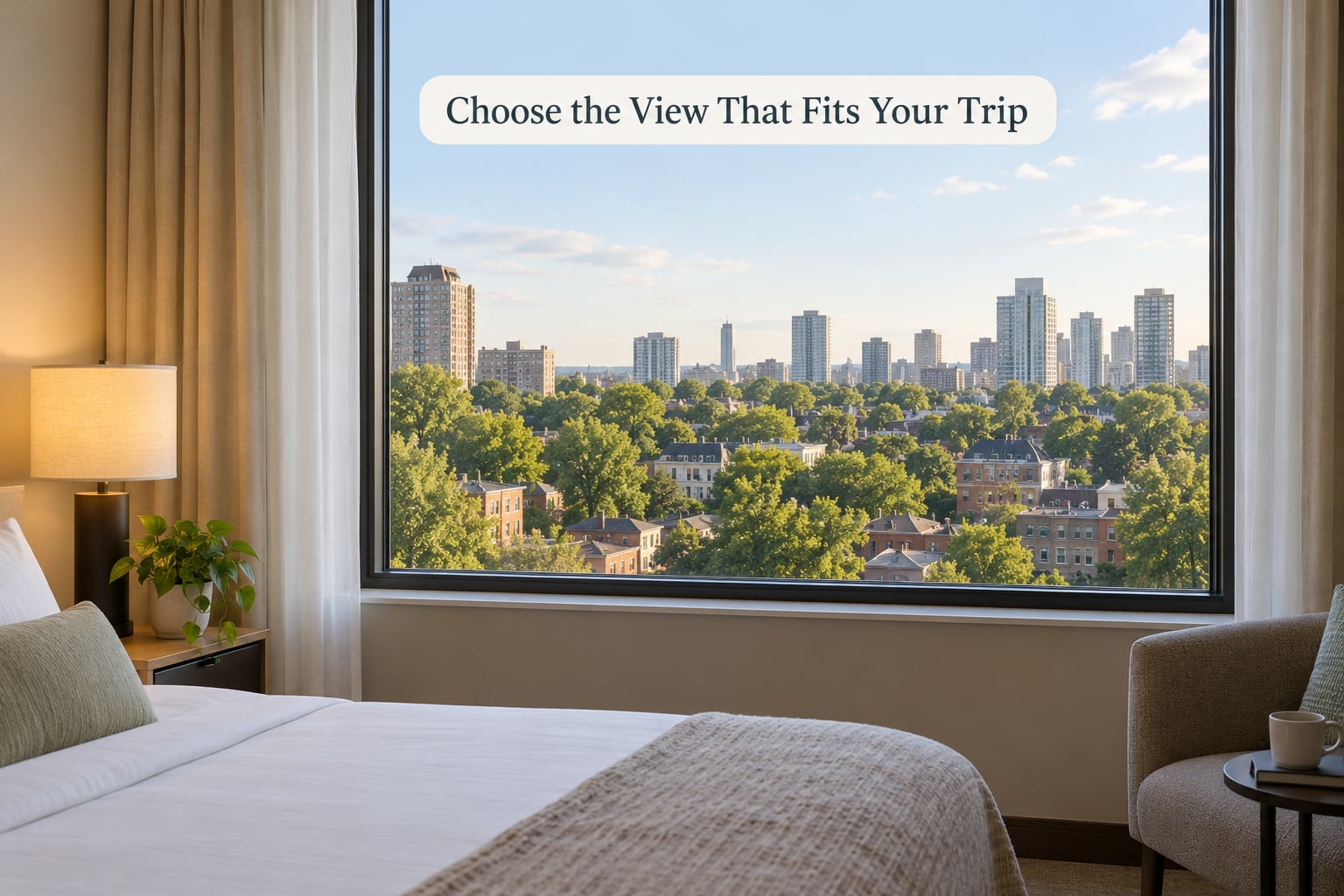
View wording is marketing copy, and the terms vary between properties. These are the labels you will actually meet, roughly from strongest to weakest.
| View label | What it usually means | Worth paying more? |
|---|---|---|
| Sea or harbor view | Direct water outlook from the room, often with a balcony | Yes, when water is the reason you picked the destination |
| Panoramic or full view | Water plus coastline or city skyline, usually from a corner room | Usually, if the description names what you can see |
| City or skyline view | Rooftops, towers and streets below; orientation decides the quality | Sometimes. Check the photo for the actual height |
| Partial view | A slice of water, mountain or skyline past a building edge or tree | Rarely. Buy it only if a glimpse matters to you |
| Courtyard or garden view | Windows onto an inner courtyard, trees or a small garden | As a quiet, light-filled alternative, often yes |
| Pool view | Outlook over the pool deck, which can mean poolside noise | Only if you will use the pool |
| Obstructed or limited view | Something blocks part of the outlook, such as scaffolding or a wing | No |
| Interior room | No exterior window, or a window onto a light well or atrium | No. Ask to be moved |
Before you commit, preview it. Search the property name with terms like review, guest photo or view, then look through recent reviews for photos shot from inside rooms rather than from the lobby. Drop the property into a map satellite view and check what sits opposite at your room’s height, because a neighboring block of flats erases a city view that looked wide open in the brochure.
Then read the orientation. A west-facing room gets the sunset and the traffic noise of the evening peak. A north-facing room in a northern-hemisphere city stays dim through winter. A courtyard-facing room is quiet and bright but never changes, which is exactly the point if you plan to work.
You can also just ask. One call to the front desk, asking what sits outside the windows of the room type you booked and whether the building blocks any of the views, takes two minutes and tells you more than the photographs will.
5. Confirm the Hotel Room Floor and View Before You Pay
Run this list before you complete the reservation, and again 24 to 48 hours out.
- Read the exact view wording on the confirmation and note whether it is guaranteed.
- Confirm the floor you will be on, and how far the room sits from the lift.
- Ask what the room faces and what is directly below it.
- Check that any accessibility needs are recorded on the reservation, not just mentioned in an email.
- Note the cancellation terms before you commit to the room type, since a view you dislike is much easier to walk away from on a flexible rate.
- Reconfirm by phone with the property, not through the booking site, and ask for your note to be passed to the front desk.
Travelers on solo travel forums repeatedly report the same pattern: put the request in at booking, call the property 24 to 48 hours before arrival to repeat it by name, and mention it again at check-in. Requests are preferences, not guarantees, and they are honored most often when the property hears them twice from the same booking.
If you want to be direct, a script helps. At booking: “I’m traveling solo and I’m a light sleeper. Is it possible to request an upper-middle floor, a room away from the lifts and the ice machines, and a view rather than a courtyard outlook? Could you note that on the reservation?”
On the reconfirmation call: “I’m arriving on the 14th under the name Ashworth. Could you check my room notes are showing, and tell me which floor I’m on and whether the sea view is guaranteed or a request?”
If the room you get does not match what you booked, check it in the first hour rather than settling in. Confirm the floor and the outlook against your confirmation email, take a photo of the view, and ask at the desk straight away. A problem raised at check-in is a room reassignment; the same problem raised the next morning is a complaint about a night you have to live with.
Common Mistakes Travelers Make With Floor and View
Assuming higher always means better. A top-floor room can sit right beside the lift motor or a roof plant room. Ask what is above and beside it before you pay the premium.
Ignoring the mid-floor problem. Lift shafts, ice machines and boiler rooms cluster in the middle of many buildings, and that noise travels through structure, not air. Double glazing on the street side does nothing for it.
Accepting a vague view description. “Nice view” and “partial sea view” are not the same promise, and one of them is a photograph taken from the best unit in the building rather than the one you booked.
Treating an upgrade as a category change. A complimentary upgrade often moves you up a floor or swaps you to a larger room in the same interior block. Ask for the category name, the floor and the outlook separately.
Skipping the accessibility check. A room six floors up with a long corridor is a poor choice for anyone using a wheelchair, a walker or a heavy suitcase. Distance from the lift matters more than the view.
Not reading the cancellation terms before upgrading. The flexible rate is often the one that lets you move a view problem on day one.
Frequently Asked Questions
Is a higher hotel room always better?
Not always. Higher floors cut street and traffic noise, but mid floors can be louder if they sit beside the lift shaft, ice machines or boiler plant, and top floors can pick up wind and roof machinery noise. Judge the room by its position on the corridor as much as by its height, and ask what sits directly above and beside it.
How do I choose a quiet room in a busy hotel?
Request an upper-middle floor, an end-of-corridor or corner room, and a face away from the lift core, vending and service areas. Ask for a room with a window and a balcony if heavy curtains will help you sleep. State the request at booking, repeat it on a call 24 to 48 hours before arrival, and mention it again at check-in.
What floor is best for a view?
Upper-middle floors usually give the widest outlook without the wind and lift dependence of the top floor, and they sit above most street-level obstructions. Check what stands at the same height opposite the building on a satellite map first, since a neighboring block can block the higher floors more than the lower ones.
Can I request a specific room number or view?
You can ask, and hotels often honor it, but it stays a preference rather than a guarantee because rooms are assigned from live inventory on the day. Direct bookings and loyalty rates are said to get better results. Ask which floor you will be on at check-in, and if the view falls short, raise it in the first hour rather than the next morning.
Which floor is best for someone with mobility issues?
Choose the floor closest to the lift with the shortest, flattest corridor from the lift lobby to the room, and confirm step-free access before booking. Middle floors are often the practical choice because lift journeys are short and the distance from the entrance stays manageable. Write the accessibility needs into the reservation itself so they are visible at check-in.
Conclusion: Make the First Choice Before You Book
Start with your first choice: name the two things that would make this trip work, a quiet room or the view, and everything else is negotiable. Before you pay, ask the hotel for the exact floor, the distance from the lift and what the window faces, then get that note onto your reservation. Ten minutes of that work settles most of what you would otherwise discover at check-in.