Protecting yourself from hotel booking scams comes down to four checks before you pay: does the property exist as described, is the channel genuine, who is the payee, and can you cancel. Do those four and you block nearly every version of this fraud, and the whole job takes about fifteen minutes on a phone. The 2026 version of this guide adds one more thing worth knowing, because the most common hotel booking scam right now arrives after you have already made a legitimate booking.
I travel solo most of the time, which makes this a live problem rather than an academic one. No second pair of eyes, more unsolicited messages, and a social pressure to sound like you know what you are doing. The checks below are the ones I actually run.
Table of Contents›
- What You Need
- Step-by-Step: How to Protect Yourself from Hotel Booking Scams
- Search for the property across multiple sources
- Contact the hotel through a channel you found yourself
- Check the cancellation and prepayment policy
- Use a protected payment method and verify the payee
- Save a complete confirmation and check the booking again
- Respond safely when a booking looks suspicious
- Respond to the messages that arrive after you book
- Common Mistakes
- Frequently Asked Questions
- Are legitimate hotel booking sites safe to use?
- Is it safer to book a hotel through the hotel or an OTA?
- Can I get a hotel booking scam refund after paying?
- Why do hotel scammers ask for gift cards or cryptocurrency?
- What should I do if I sent my card details to a fake hotel?
- How can I tell if a hotel message is legitimate?
What You Need
You do not need any special software. You do need a few things in place before you start clicking through options.
- The official booking channel. The hotel’s own website typed by you, or a large booking platform you already have an account with. Not a link someone sent you.
- A credit card, not a debit card. Card payments carry consumer protections that bank transfers, peer-to-peer apps and gift cards do not.
- A second way to reach the property. A phone number you found yourself from the hotel’s site, its map listing or a reputable directory. Never one supplied inside a message asking for money.
- A travel email address or password manager. Booking sites and hotels both hold contact details, and a separate address for travel limits the blast radius if one account leaks.
- A place to save evidence. A folder for confirmation emails, screenshots of the listing and every message. This is what a bank dispute is built on later.
Step-by-Step: How to Protect Yourself from Hotel Booking Scams
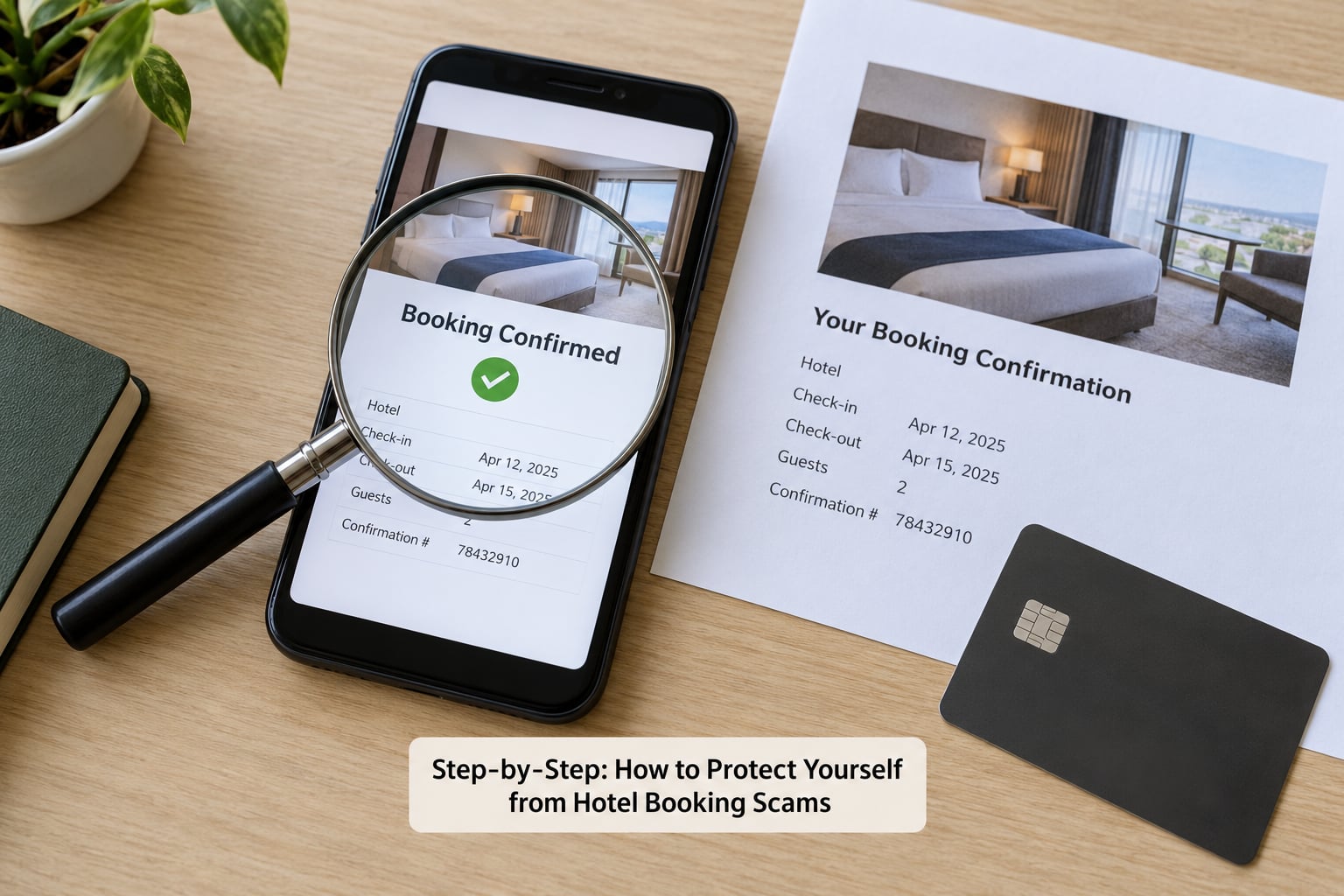
The order matters. Each step is cheap and the next one gets harder to undo, so verification comes before payment, and payment comes before anything else.
Search for the property across multiple sources
Look the hotel up on its own site, on a large booking platform and on a map listing, then compare what each one says. You are hunting for mismatches, not for the lowest rate.
Mismatches that matter: a different street address, a renamed property, photos that appear on other listings, a star rating that swings wildly between sources, or a policy on one site that contradicts another. Scammers reuse real photography and real brand logos, so identical images across sites are not proof of anything on their own.
Read the domain character by character. Look-alike sites substitute a letter, or use characters that render like Latin letters but are not. A padlock in the address bar means the connection is encrypted, not that the site is real, so it should not factor into your decision at all.
Contact the hotel through a channel you found yourself
Find the property’s phone number yourself, then call it. Ask for the reservation desk and give the name, dates and confirmation number on your booking. If the reservation exists, a real hotel reads it back to you: room type, dates, number of guests, total, and what happens if you cancel.
If the person on the phone has no record of you, stop there. That single answer is the fastest test in this entire guide, and it works even when the listing, the photos and the confirmation email all looked convincing.
The same applies to messages. A genuine platform puts your conversation inside your account, where you can open it without following anything in the message itself. A message that arrives by text, email or WhatsApp about a booking you made elsewhere deserves independent verification before you answer it.
Check the cancellation and prepayment policy
A real hotel states its cancellation terms before payment, in writing, and the terms match what its website said. Read them properly, including the deadline date and time.
Pressure tactics look different from policies. Watch for terms that appear only after you enter card details, a refund promise with no conditions attached, a demand to pay in full within hours, and a guarantee so generous that the property would be giving rooms away.
Pay attention to who bears the risk. Non-refundable rates are normal in travel, but a non-refundable rate is a reason to slow down and check, not a reason to hurry. If a seller cannot tell you what happens to your money when plans change, that is the answer.
Use a protected payment method and verify the payee
Card payments are the most protected way to pay for a room. Wire transfers, bank-to-bank sends, peer-to-peer payment apps, gift cards and cryptocurrency are effectively one-way, and no consumer dispute regime will get them back for you.
| Payment method | Fraud protection in practice |
|---|---|
| Credit card | Strongest. You can dispute the charge and, in many places, ask your issuer to reverse it while the case is investigated. |
| Debit card | Weaker and faster. The money leaves your account directly, and the time you have to raise a problem is usually shorter. |
| Bank transfer or peer-to-peer app | Almost none. Treat any request for one as a reason to end the conversation. |
| Gift card or cryptocurrency | None. These are the standard request in fake travel agency and reservation scam messages. |
Before you pay, check three things on the checkout page: the merchant name that will appear on your statement, the currency and total, and whether you arrived there from a link you trusted or a link in a message. If the merchant name is a company you have never heard of, stop and ask the property who that company is.
Save a complete confirmation and check the booking again
A real confirmation lives in three places at once: your email, your account on the booking platform, and the property’s own system. If it exists in only one, treat it as unproven.
Keep the confirmation number, property address, check-in and check-out dates, room type, number of guests, total price, cancellation terms, and the platform or hotel contact details. Add a screenshot of the payment page and the listing while the page is still live.
Then look at the booking again a few days before you travel, from the platform’s app rather than from an emailed link. Reservations do get cancelled, overbooked or quietly deleted, and this is the cheapest moment to notice.
Respond safely when a booking looks suspicious
If something feels off after payment, work down this list in order. Speed matters most in the first day.
- Stop the payment. Call your bank immediately and ask whether the charge can be stopped or reversed while it is still pending.
- Preserve everything. Screenshots of the page, the URL, the messages, the confirmation emails and your bank statement. Do not delete the thread.
- Call the property on a number you already had. Get it confirmed in writing that they have no record of you, or that they do, and ask for that in an email you can attach later.
- Contact the platform in writing. If the booking was made on one, open a case through the site and keep the case number. Phone support is useful, but a written case is the record you will need.
- Dispute the charge with your bank. Tell them the merchant does not exist or has no record of the service, and ask what evidence they need.
- Secure your accounts. If you entered card details or a password anywhere suspicious, freeze the card, change that email password from a different device, and turn on transaction alerts.
- Report it. A police report, your national consumer protection body, and in the United States the FTC and your state Attorney General are the routes that create an official record. A complaint also gives you a dated document if the case stalls.
Timelines vary by issuer and by country, so check your card agreement for the exact window. As a rule of thumb in the United States, disputes over billing errors generally need to be raised within 60 days of the statement date, and a contested charge can take one to two months to resolve. Many travelers wait far longer than that and lose the option.
Respond to the messages that arrive after you book
Once a booking email address is exposed, it reaches scam lists. That is why a message claiming your card could not be verified, or asking you to re-enter payment details to keep your room, can reach you about a booking that is genuinely real.
The rule is simple and it holds every time: never use a link in that message. Open the platform’s app or type the site address yourself, check your reservation in your account, and if there is a genuine problem, contact the property through a number you already had.
One reassurance, since it comes up constantly: giving a stranger your email address does not on its own let them reach your bank account. Scammers hope you assume otherwise, because fear makes people click. Card numbers, one-time codes and passwords are what matter.
Common Mistakes
Most people who get burned did one of a small number of things. Each has a straight correction.
Paying outside the platform. Someone in an inbox thread offers a better rate or a courtesy upgrade if you pay them directly. Fix: book through the platform’s own checkout, and treat any off-platform offer as a reason to close the thread.
Believing a rate that is too low. A per-night figure far below what comparable rooms cost is not a deal, it is the business model. Fix: price the same dates on two unrelated sources before you treat anything as a bargain.
Paying by gift card, wire or cryptocurrency because of a deadline. Urgency exists to stop you checking. Fix: no legitimate hotel or platform accepts these for a room, so the request identifies the sender for you.
Ignoring refund restrictions. Terms are rarely hidden; they are just long. Fix: read the cancellation section before paying and screenshot it, so a dispute has a written policy to point at.
Not documenting the transaction. Screenshots taken a year later are worth nothing. Fix: save the confirmation, the listing, the messages and the statements the same day.
Treating a positive review site as proof. Reviews can be bought, and some scam operations run tidy, believable profiles. Fix: look for reviews spread over months that mention specific details, not a burst of praise.
Three habits remove most of the risk. Book on the platform’s own site or the hotel’s own site, typed by you. Pay by credit card, never by transfer. Read the guest message inbox inside your account instead of the links in your email. None of this takes real time, and together they cover nearly every scam described above.
Frequently Asked Questions
Are legitimate hotel booking sites safe to use?
Large, established booking platforms are generally safe, because they hold the reservation in their own system and keep a written record of it. The risk sits with look-alike websites that copy their branding, and with messages that arrive outside your account asking you to pay again. Book through the platform’s app or site rather than a link from a message, and confirm your reservation exists inside your account after you pay.
Is it safer to book a hotel through the hotel or an OTA?
Both are reasonable, and the risk mainly depends on how you arrive rather than which one you use. Booking direct can give you clearer cancellation terms and easier contact with the property. A large online travel agency gives you a single record of payment and support if something goes wrong. Type the address yourself, check the cancellation policy, and pay by credit card either way.
Can I get a hotel booking scam refund after paying?
Often yes, but not automatically and not quickly. The outcome depends on the payment method. Credit card charges can be disputed and are the realistic route to recovery. Wire transfers, peer-to-peer payments, gift cards and cryptocurrency generally cannot be reversed, which is why those requests are a scam signal in themselves. Contact your bank immediately rather than waiting for the platform, because dispute windows are limited.
Why do hotel scammers ask for gift cards or cryptocurrency?
Because the payment cannot be traced or reversed. A gift card has no account holder to verify who received it, and a crypto transfer is essentially cash once it is confirmed. No legitimate hotel, agent or booking platform takes payment that way for a room. A request for either, especially paired with a deadline or a threat to release your reservation, identifies the sender as a fraudster without any further checking.
What should I do if I sent my card details to a fake hotel?
Call your bank first and ask them to block or replace the card, then change the password on the email account you used and turn on transaction alerts. Then preserve screenshots of the site, the messages and the statements, and open a dispute with your issuer describing the merchant as fraudulent. If you entered the same password elsewhere, change it there too. A code you sent by message should be treated as compromised and reported.
How can I tell if a hotel message is legitimate?
Never use the link in it. Open the booking platform’s app yourself or type the hotel’s address, and check whether the reservation exists in your account. Then call the property on a number you found yourself. Real messages are duplicated inside your account and the property can confirm your name, dates and room type. A request for card details, a deadline, or a payment method nobody else accepts is not how a genuine hotel operates.
Start with one habit: before you pay, find the property’s phone number yourself and ask whether your reservation exists. That single call stops nearly every hotel booking scam before a cent moves, and if something has already gone wrong, call your bank before you call the platform.