
You need about six hours on the ticket before leaving the airport is realistic, because roughly three to four hours disappear into landing, immigration, transit and the return security queue. The way to plan a layover long enough to see the city is to work backwards from a fixed return time, not forwards from when the plane lands.
The usable-time formula: ticketed layover minus 3 to 4 hours. A six-hour connection leaves two to three hours in the city. An eight-hour connection leaves four to five. Under four hours, staying airside is the honest call.
| Ticketed layover | Hours actually usable in the city | Leave the airport? | What that buys you |
|---|---|---|---|
| Under 4 hours | None | No | A lounge, a shower, one long meal and a proper rest at the gate. |
| 4 to 6 hours | 1 to 2 hours | Only if the airport sits on one transport line and you have no checked bag | One landmark or one good meal close to the station, nothing more. |
| 6 to 8 hours | 2 to 4 hours | Yes, with a tight plan | One neighbourhood, one anchor sight, one sit-down meal. |
| 8 to 12 hours | 4 to 8 hours | Yes | A proper half day: one museum or market, a long lunch, a walk home. |
| 12 to 16 hours | 9 to 12 hours | Yes | A full day, or a day-use room for a shower and a nap in the middle of it. |
| 16 hours and up, or overnight | Most of the window | Definitely | Two neighbourhoods and an evening out, or a hotel night and a slow morning after. |
The hour bands come from airline minimum connection times and the return buffer experienced long-haul travellers actually use, not from one tidy rule. Airport size, season and time of day change all of it. Updated for October 2026.
This is a planning job, not a research project. Twenty minutes at a kitchen table before you book saves an afternoon of standing in the wrong queue.
Table of Contents›
- What You Need Before You Leave the Terminal
- Step-by-Step: How to Plan a Layover Long Enough to See the City
- 1. Confirm the True Window Between Flights and Plan a Layover Long Enough to See the City
- 2. Choose One or Two Anchors Instead of a Full Itinerary
- 3. Check Where You Can Leave and Reclaim Luggage
- 4. Build a Simple Route Around the Airport
- 5. Match the Plan to Opening Hours and Energy Levels
- 6. Add a Buffer for Delays and Unexpected Problems
- Common Mistakes That Cost People Their Connection
- Frequently Asked Questions
- Can I leave the airport during an overnight layover?
- What should I do with checked luggage during a city layover?
- How early should I return to the airport before an international flight?
- Is a city layover worth it if I have less than six hours?
- Can I use an airport transit pass during a layover?
- What is the best way to spend eight hours in a city between flights?
- Conclusion
What You Need Before You Leave the Terminal
Seven things to have open in front of you, and a notepad. If any one of them is unresolved, the rest of the plan is guesswork.
- Both flight times and both terminals. Note whether you land and depart from the same terminal, and whether you cross security in between.
- Your baggage situation. Whether a bag is checked through, where it is checked to, and whether the onward flight is domestic or international.
- Passport and transit eligibility. Passport validity, blank pages, visa or visa-free transit rules for your nationality, and any onward-ticket requirement.
- Transport details. Which lines and trains serve the airport, what time the last one leaves, and whether the ticket is bought at the airport or in an app.
- Opening hours. Whether the places you want to see are open that day, and whether they need a timed reservation.
- Weather. It changes whether the plan is a walk or a ride, and it changes how much buffer you need back.
- One or two must-sees. Not a list. Two anchors at most, because you will not have time for a third.
Two of these catch people out badly. The first is baggage, since a tag that reads a different city than your final destination changes your whole route. The second is transit eligibility, because leaving the airport means clearing immigration in that country, and the rules are about your nationality rather than your destination.
Step-by-Step: How to Plan a Layover Long Enough to See the City
1. Confirm the True Window Between Flights and Plan a Layover Long Enough to See the City
The ticketed connection time is not your free time. Take three to four hours off it, and take more at the airport you know to be slow. Arrival on the ground, walking to immigration, the queue itself, collecting bags if you have to, the train or taxi into town, and then the same run in reverse with a security queue on top.
A daytime six-hour connection at a large hub gives you roughly two hours in the city. Overnight works out differently: if you land at 22:40 and fly at 14:15, you have a night plus a morning, which is more usable time than the hours suggest, because you will be asleep for a chunk of the window anyway.
Then set a hard return time and write it down. Aim to be back at the airport about three hours before an international departure and a little less before a domestic one, then subtract your travel time. A twelve-hour layover that starts with a plan to leave the terminal at 15:00 for a 20:00 flight becomes a three-hour city visit once you work the numbers backwards.
2. Choose One or Two Anchors Instead of a Full Itinerary
The fastest way to ruin a long layover is to treat it as a compressed holiday. Every extra stop adds a transfer, and transfers are where the time goes missing.
Pick one sight that justifies the trip and one thing you would enjoy even if the sight falls through. A landmark plus a neighbourhood meal is the reliable pairing. Two sights in the same walking district is better than two famous sights on opposite sides of the city.
Check the shape of the day too. A morning market and an evening viewpoint are easy. A museum that closes at five plus a hilltop panorama twenty minutes away is not.
One warning from people who have done it: two or three hours in a city reliably leaves you wanting to come back for a proper trip. That is fine as a plan. It is a bad moment to decide to book a flight on the way back to the airport.
3. Check Where You Can Leave and Reclaim Luggage
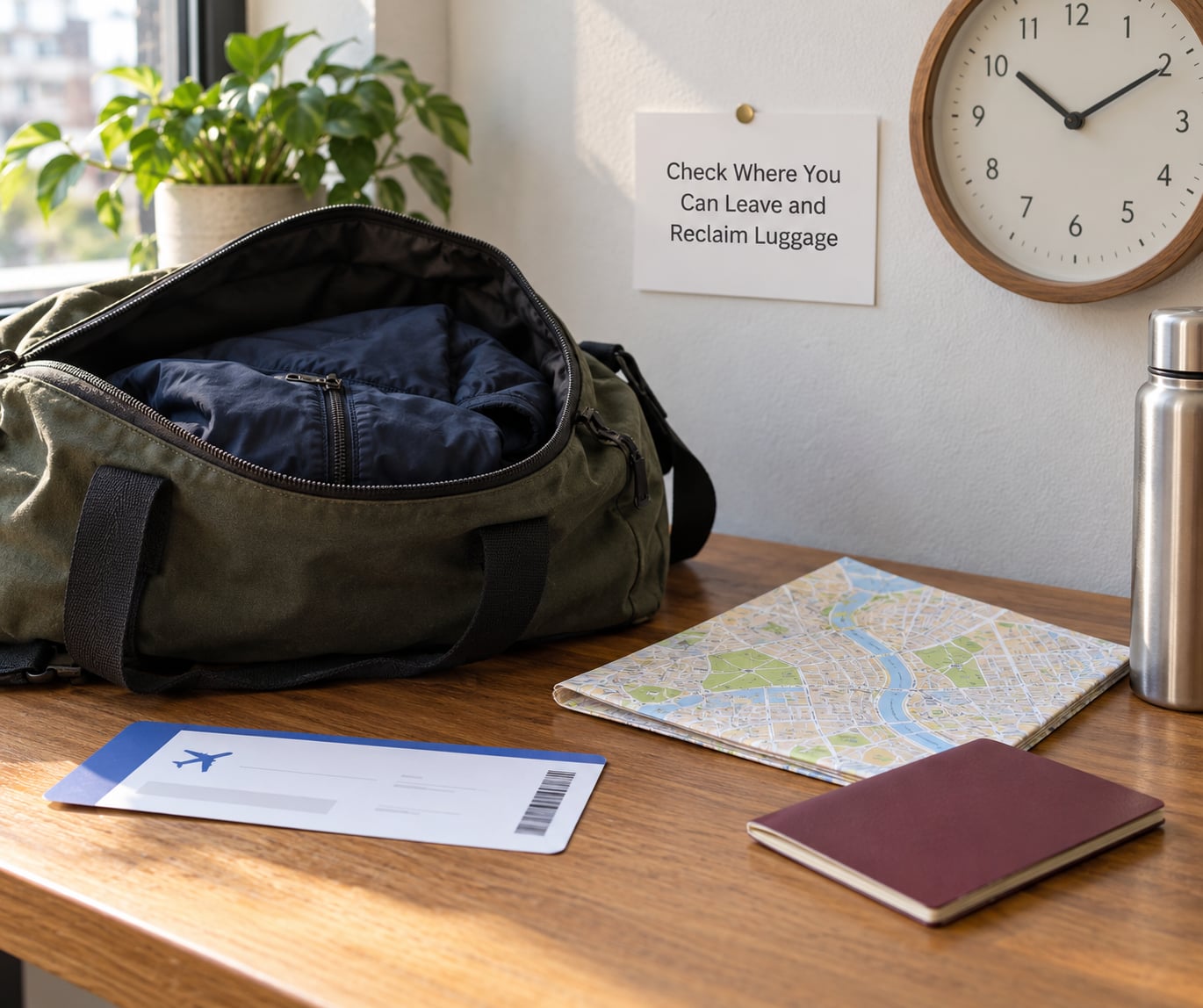
Your baggage decides how free your day is. A carry-on-only traveller walks out in twenty minutes. A traveller with a checked bag needs a plan before they leave the terminal.
| Strategy | Best when | Watch out for |
|---|---|---|
| Checked through | A domestic connection inside one terminal or one airport | Confirm the tag destination before you fly, because it decides your route |
| Claim and carry | International to domestic, or a city stop with a real bag | Adds the baggage hall queue and a re-check drop before security |
| Airport locker | Carry-on only, short stop | Not every airport has them, and sizes vary |
| Left-luggage desk or hotel storage | Long stops and overnight windows | Opening hours can be shorter than your flight times, so ask about late collection |
| Day-use room | An eight to sixteen hour stop where you want a bed | Check that check-out falls before your departure time |
On an international arrival into a domestic departure, you almost always clear immigration and customs and re-check your bag, even on a single ticket with one booking reference. That is a rule, not a possibility, and it is the single most common way people lose a connection they thought they had time for. If you are connecting that way, add the re-check to your usable-time calculation and build in a wider buffer.
Whatever you choose, keep these with you in a day bag: passport, phone and charger, medication, one change of top, a card, and a small amount of cash. Never put the things you cannot replace into a locker.
4. Build a Simple Route Around the Airport
Compare transport on five things: door-to-door time, number of transfers, reliability, operating hours and how it behaves when something goes wrong. A two-transfer metro that takes forty minutes is a worse bet than a direct bus that takes fifty-five.
Budget about an hour each way for airport-to-city travel as a working figure, then check the real number for your airport. Check it separately for the return trip, because traffic patterns at rush hour can be twice what they are at midday and the airport approach is often the last bottleneck.
Pre-load a saved route in your maps app before you land, and screenshot it, because you may be doing this on roaming data with a queue at the exit. Know which stop you need, and buy or activate the ticket before you board rather than fighting a machine at the far end.
One route pattern beats all others: go in on the fastest line, come back on the most reliable one. They do not have to be the same.
5. Match the Plan to Opening Hours and Energy Levels
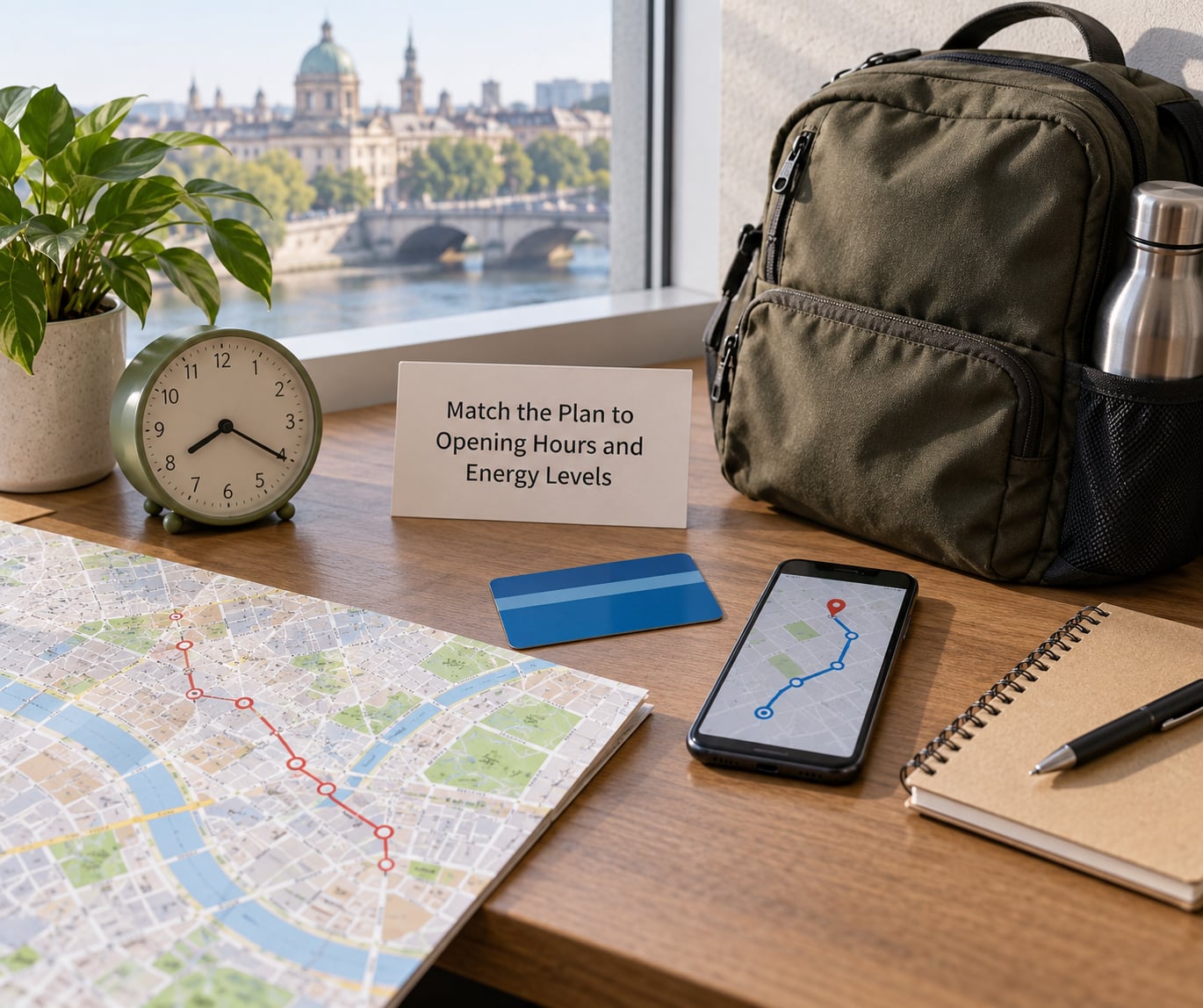
Anchors have to be open when you will actually be standing in front of them. Check the opening day as well as the hours, because a museum closed on Mondays is a wasted anchor in a Monday stop. Check whether entry needs a timed reservation, and whether the last entry is earlier than the closing time.
Then match the plan to the shape of the stop. A six-to-eight hour early morning window is better spent on one open-air sight and a long breakfast than on two museums. An evening or overnight arrival gives you lit streets, dinner and a walk, then sleep. A red-eye connection gives you the opposite: a quiet morning, coffee, and the first stop of the day before the crowds.
Adjust for the traveller, not just the clock. Anyone with limited mobility, an older parent, a small child, or a bad back should stay on one line, avoid cobbles, and plan a taxi back rather than a tight transfer. Fatigue is the underrated factor: after a long-haul flight your judgement about remaining time is worse than you think it is.
6. Add a Buffer for Delays and Unexpected Problems
Buffers are the whole trick. Keep the return buffer you set in step one intact even if the outbound journey goes faster than planned, and treat the schedule in your app as a plan rather than a promise.
Turn on flight alerts before you take off, and check your onward flight the moment you land rather than assuming. If a delay shrinks your window, cut the second anchor first and keep the meal, because eating near your destination beats rushing to it.
Have one indoor fallback within ten minutes of your return stop: a café, a bookshop, a market hall, a museum with a café. And decide now, while you are calm, when you will abandon the plan. For most airports that is when the return trip plus buffer starts to exceed your usable window.
Common Mistakes That Cost People Their Connection
Almost every missed connection on a city layover traces back to one of these. Each has a simple fix.
- Treating the ticketed time as free time. Fix: subtract three to four hours before you plan anything, and confirm the real airport-to-city travel time for that specific airport.
- Booking three stops instead of one. Fix: two anchors maximum, both in the same district, and one of them a meal that does not need a reservation.
- Forgetting the re-check on an international-to-domestic connection. Fix: check whether you land in one country and fly onward in another. If so, you clear customs, re-check, and go through security again.
- Relying on one infrequent bus. Fix: know the last departure time in both directions before you leave the terminal, and have a rail or taxi fallback you can actually afford.
- Leaving your bag behind and losing claim on it. Fix: keep passport, medication, charger and a change of clothes in a day bag, and confirm the tag destination before you fly.
- Assuming the venue is open. Fix: check the opening day and the last entry time, not just the closing time on a map listing.
- Leaving no return buffer. Fix: be back at least three hours before an international departure, further for a busy terminal or a first-time airport.
One more worth naming: going into the city without checking whether you are allowed to. Transit eligibility depends on your passport, and some nationalities need a visa even for a few hours landside.
Frequently Asked Questions
Can I leave the airport during an overnight layover?
Usually yes, and it is the easiest layover to spend well. You arrive as the city winds down and leave after breakfast, so you get an evening and a morning with no queue pressure. Bring everything you need for one night in your day bag, book any hotel or luggage storage in advance, and set a firm leave-the-city time rather than going by how good the morning feels.
What should I do with checked luggage during a city layover?
Check the tag on your bag before you fly, because it decides everything. If it is checked through to your final destination, you leave it alone unless you are connecting international to domestic, where you re-check as a rule. If you need it in the city, use a left-luggage desk or hotel storage and ask about late collection hours. Keep your passport, medication and a change of clothes with you.
How early should I return to the airport before an international flight?
Aim to be at the airport around three hours before an international departure, and add more if the terminal is large or unfamiliar. Work backwards from that: subtract your airport-to-city travel time to get your true leave-the-city time. Being back at two hours sounds generous, but one missed train or a long taxi queue eats it. On a domestic connection, two hours is usually enough at a calm airport.
Is a city layover worth it if I have less than six hours?
Under four hours, no. You will spend the whole stop in transit and queues and arrive back tired with nothing to show. Between four and six hours it works only if the airport sits on one transport line, you have no checked bag, and you are aiming for something within a few minutes of the station, such as one landmark or one long meal. Below six hours, treat the city as a possibility, not a plan.
Can I use an airport transit pass during a layover?
Yes, if it is valid for your journey and window. Airport-branded tickets are usually priced to cover a return trip between the terminal and the city, which is exactly the pattern of a city layover, and some are valid for a defined number of hours after validation. Check whether your pass covers the return leg and whether it works on the specific line you need, and keep the ticket or activated card with you.
What is the best way to spend eight hours in a city between flights?
Eight hours leaves you about four to five usable hours, which is enough for one good neighbourhood. Do this: pick one anchor sight near the city centre, one sit-down meal nearby, and one optional stroll between them. Go in on the fastest line and back on the most reliable one, be at the airport three hours before departure, and let your phone alert you if the onward flight moves.
Conclusion
To plan a layover long enough to see the city, start with the arithmetic rather than the sightseeing. Subtract three to four hours from your ticketed connection, check whether you are clearing customs and re-checking bags, and write down a hard time to be back at the airport.
Then pick one anchor and one meal in the same district, build the route backwards from your return time, and keep your passport and essentials in a day bag. Under four hours, stay airside and rest properly. Eight hours or more, leave the building.