Last updated: October 2026
Most long-haul seat advice stops at window versus aisle, which is only the first question. How to choose a seat on a plane for a long flight really comes down to three separate decisions: seat type, cabin position, and then the exact row — and each one changes what the other two are worth. Get the first one wrong and a perfect row will still be uncomfortable after hour six.
Below is the process I use. It takes about ten minutes, most of it inside the airline’s own seat map, and it works whether you are flying four hours or sixteen.
Table of Contents›
- What You Need Before Choosing a Long Flight Seat
- Step-by-Step: How to Choose a Seat on a Plane for a Long Flight
- 1. Start with the length and purpose of your flight
- 2. Choose between a window seat and an aisle seat
- 3. Check the aircraft and seat map before paying
- 4. Weigh extra legroom against convenience
- 5. Consider sleep, work and health needs
- 6. Select the right row and seat position
- 7. Confirm the selection before departure
- Common Mistakes
- Frequently Asked Questions
- Is a window or aisle seat better for a long flight?
- What is the best airplane seat for sleeping on a long flight?
- Should I choose an exit-row seat for extra legroom?
- Are the first rows of the economy cabin always the best?
- How can I find out whether a seat has extra legroom?
- What should I do if my preferred seat is no longer available?
- Choose your seat before you check in
What You Need Before Choosing a Long Flight Seat
Open these five things before you start clicking through seats. If you do, the choice takes minutes instead of twenty minutes of second-guessing.
- Your booking reference. Seat maps, change fees and paid-seat rules are all tied to the specific reservation, not just the route.
- The scheduled flight duration and time of day. A daytime leg and an overnight leg want opposite seats.
- The aircraft type. Narrow-body or wide-body, and the specific variant, decides how many rows there are and where the galleys and lavatories sit.
- Your fare rules. Some carriers include seat selection for every fare; others charge for it, and some premium fares get it free. Check before you assume.
- Your priorities, written down. Sleep, work, mobility, quick exit, low cost. Pick one main priority, because the answer changes completely when two of them collide.
If you travel with reduced mobility, are pregnant, or have a back, hip or knee condition, note it here too. Airports and airlines handle those requests differently, and some seat types are ruled out entirely.
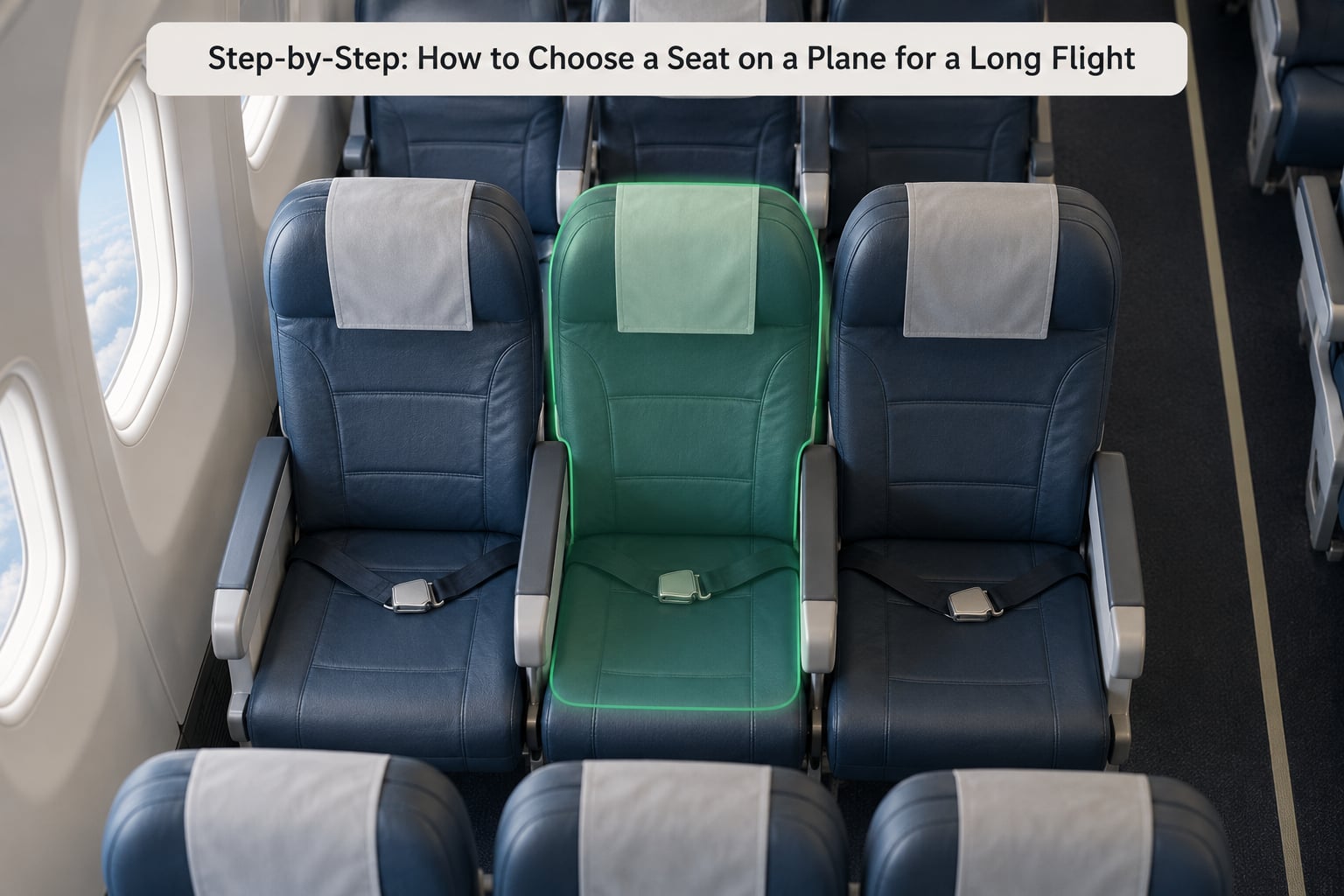
Step-by-Step: How to Choose a Seat on a Plane for a Long Flight
1. Start with the length and purpose of your flight
The honest answer to which seat is best depends almost entirely on how long you are in the air and what you plan to do. A three-hour hop to the other side of the country does not need the strategy a twelve-hour leg does.
Under four hours, pick whatever is easy to get into and out of and stop thinking about it. Over six hours, the seat starts working for you or against you. Past ten hours, you will be living in it, and an empty seat beside you matters more than almost anything you chose on purpose.
Decide what the flight is actually for:
- Sleep: window seat, side of the cabin away from the sun’s direction during daylight hours.
- Work: aisle seat, or a window seat in a two-across layout. You need to get up without climbing over anyone.
- Stretching and moving: aisle seat, ideally far from the lavatories.
- A tight connection: front of the cabin, every time.
- A baby or toddler: aisle seat near a lavatory, deliberately. It shortens the walk to the bathroom, which is the whole job.
2. Choose between a window seat and an aisle seat
A window seat gives you a wall to lean against, a view, control of the window shade, and fewer people to wake you. On an overnight flight that wall is worth a lot. It also means nobody can get past you, which is why solo travellers who value sleep keep choosing it.
An aisle seat gives you freedom to stand, stretch and walk without negotiating with strangers. It also means foot traffic, a draft from the cabin vents, and at least one neighbour who will decide they need the lavatory at the wrong moment.
The middle seat exists, and if that is all you have, use it. Sit slightly forward and recline only at the agreed angle, keep the tray table up, and avoid the row in front if you can. Nobody in a three-seat row has more space, so accept that and take what you can: an aisle-side armrest you can lift is often the only extra width available.
Rough rule: under six hours and daytime, aisle. Overnight, window. Twelve hours or more with a stiff knee, aisle, no debate.
3. Check the aircraft and seat map before paying
This is where most guides get vague, so here is the concrete part. On the airline’s site, look at the aircraft name in the flight details. A 737 is a narrow-body with roughly 30 to 34 inches of seat pitch in economy, three seats across, and rows that feel tight after hour three. A wide-body long-haul jet usually has more pitch and a wider cabin, though the exit row and bulkhead rows are the exceptions.
Then find the seat map for that specific aircraft, not the airline’s generic map. Airline websites show generic layouts; flight-specific seat maps from the booking flow are more accurate. Look for four things:
- Seat pitch and width for your cabin, if the map lists it.
- Which column sits next to a galley. Crew, trolleys, and coffee. This is the loudest and least relaxing place on the plane.
- Which rows sit beside a lavatory. Doors, queues, hand-washing noise and light spilling in all night.
- Bulkhead and exit rows. More space, different trade-offs, explained next.
Maps still lie sometimes. Airlines reconfigure cabins between aircraft deliveries, and swap aircraft on the day. Treat the map as a strong guide, not a promise.
4. Weigh extra legroom against convenience
Standard economy row. Predictable, and the seat in front reclines if the crew allows it.
First row behind the cabin door or bulkhead. Extra floor space and no seat to lean on, plus no under-seat storage, so your bag goes in the overhead bin and comes down every time you want it. First rows also take the brunt of the cabin’s swinging motion.
Bulkhead row. The wall in front gives real legroom without a small seat. You lose under-seat storage and often get a fixed armrest. For someone whose knees are the problem, this is the practical choice, and people managing joint pain use it deliberately for that reason.
Exit row. The most legroom you can buy in economy. The trade-offs are real: the row usually cannot recline at all, the area is cold because of airflow at the door, you carry everything in the overhead bin, and you are expected to help with an evacuation. Airlines set age and assistance rules for it, and passengers who do not meet them are moved at the gate. Read the rules before selecting one.
Row directly behind the exit row. The community favourite for a reason. Since nobody can recline into you, you get a usable recline angle. Check the aircraft first, because on some regional jets that row does not recline at all and it is not always marked.
Premium economy. Worth it when the flight is six hours or longer and you will be awake for most of it. On shorter overnight legs the added room matters less than you think.
5. Consider sleep, work and health needs
Sleep responds to the seat far more than people expect. Choose a window seat for a fixed wall, keep the shade down, pick the side that avoids direct sun on daytime flights, and note that cabin sidewall vents make window positions cooler than the middle of the cabin. Bring an eye mask and earplugs regardless; the seat only removes some of the reasons you would wake up.
Working needs surface area and access. A window seat over the wing in a two-across layout gives you a side wall to brace a laptop against. A three-across layout gives you almost none, and the tray table plus an aisle passenger opening a laptop bag is its own hazard.
For circulation, stand and walk the aisle every couple of hours, move your ankles and calves while seated, and keep water in reach rather than saving it for after landing. Long-haul passengers should also know the usual general advice about movement, hydration and the risk of blood clots on extended flights.
If you are pregnant, have had surgery, take a blood thinner, or have a history of clotting problems, ask your own clinician before flying and follow their guidance rather than a general article. Same goes for anything involving ear pressure, where a clinician can tell you whether you need anything specific for your situation.
6. Select the right row and seat position
Once the aircraft is confirmed, pick a zone:
- Front cabin. Boards first, eats first, deplanes first. More space in the overhead bins. Busiest and noisiest, and the forward rows pitch more in turbulence. Best for short connections and light sleepers who like being woken to walk off.
- Over the wing. The smoothest ride in the cabin because you are closest to the centre of gravity. Slightly noisier. The classic choice for anyone who worries about turbulence or gets motion sick, since the horizon stays steady in the window.
- Rear cabin. Quieter, and more likely to have an empty seat beside you, which is the single best thing that can happen on a long flight. It also means a longer walk, more time in the queue, and usually galley noise nearby.
One-line rules: sleepers take a window over the wing on the shaded side. People who stretch or need quick lavatory access take an aisle, a few rows away from the toilet. Anyone hoping for an empty neighbour takes the rear cabin and hopes. Connecting passengers take the front and walk off fast.
7. Confirm the selection before departure
Once the booking is confirmed, check your seat assignment on the confirmation email and again when online check-in opens, usually 24 hours before departure. Mobile check-in is the easiest way to do this, and the seat map shown at check-in is usually more accurate than the one you saw when you booked.
Check again roughly 48 hours out. Airlines swap aircraft for maintenance, weather and crew scheduling, and a swap can quietly turn your exit row into an ordinary middle seat on a different plane. If that happens, call or message the airline and re-pick on the new map rather than assuming your old choice transferred.
On boarding day, glance at the boarding pass. If the seat moved and the new one is bad, ask at the gate. Gate agents can often reassign a seat on a full flight, and asking costs nothing.
Common Mistakes
- Choosing only by cost. The cheapest seat on the map is often the last row on the galley side. Fix: check what is next to your seat before saving, not after.
- Ignoring the aircraft. The same seat number means very different things on a regional jet and a wide-body. Fix: confirm the aircraft type, then pull up that specific seat map.
- Treating the seat map as a promise. Cabin layouts change and aircraft get swapped. Fix: re-check 48 hours before departure.
- Taking an exit row without reading the rules. Age, assistance duties and infants can disqualify you, and you find out at the gate. Fix: read the carrier’s exit-row policy before selecting.
- Sitting directly in front of a lavatory or galley. Light, queue noise and door activity all night. Fix: aim two to three rows clear on the other side of the cabin if the layout allows.
- Ignoring the recline rules of the row in front. Seats in front of non-reclining rows get bumped constantly. Fix: check whether the row in front is an exit row or a marked non-reclining row.
- Forgetting to recheck the itinerary. Operational changes move flights, and a moved departure can mean a different aircraft. Fix: check the itinerary a final time the day before.
Frequently Asked Questions
Is a window or aisle seat better for a long flight?
It depends on the flight. A window seat wins for sleep, because you have a wall to lean on, fewer people passing by and control of the shade. An aisle seat wins for movement, working on a laptop, and getting up to stretch without climbing over anyone. Most people say window for a red-eye and aisle for anything daytime or longer than six hours.
What is the best airplane seat for sleeping on a long flight?
A window seat away from the sun, ideally over the wing for a smoother ride, in a row that is not beside a lavatory or galley. On some aircraft the sidewall vents make window positions cooler than the middle of the cabin. Bring an eye mask and earplugs anyway, because the seat only removes some of the reasons you would wake up.
Should I choose an exit-row seat for extra legroom?
Only if you are comfortable with the trade-offs. Exit rows give the most economy legroom available, but they usually cannot recline, they are cold, everything goes in the overhead bin, and you are expected to help in an evacuation. Airlines also set age and assistance rules, and passengers who do not meet them get moved at the gate. Read the carrier’s policy first.
Are the first rows of the economy cabin always the best?
No. The first rows give extra legroom and quick deplaning, but you lose under-seat storage, so everything goes overhead, and the forward section of the cabin pitches more in turbulence. They are busy and noisy. They win for short connections and lose for anyone who wants quiet or a wall to lean on.
How can I find out whether a seat has extra legroom?
Use the seat map shown during booking and check-in for your specific flight, which is more accurate than the airline’s generic map. Bulkhead rows are marked, and exit rows are usually labelled. Third-party seat databases such as SeatGuru and seatmaps.com show pitch and layout by aircraft, which helps when the airline map does not list it.
What should I do if my preferred seat is no longer available?
Re-pick from the current map rather than waiting, because an aircraft swap can change every row on the plane. Contact the airline directly if your fare allows changes, and ask at the gate on the day if the new seat is poor. Gate agents can reassign seats even on a full flight, and it costs nothing to ask.
Choose your seat before you check in
Write down your one main priority for the flight, then open the seat map for that specific aircraft and find the zone that matches it. Compare the real layout against your choice rather than the airline’s generic diagram, and pick the window or aisle seat that fits how you will actually use the hours on board.
Then check the map again 48 hours before departure. That single habit is what separates a seat you chose from a seat that was assigned to you.