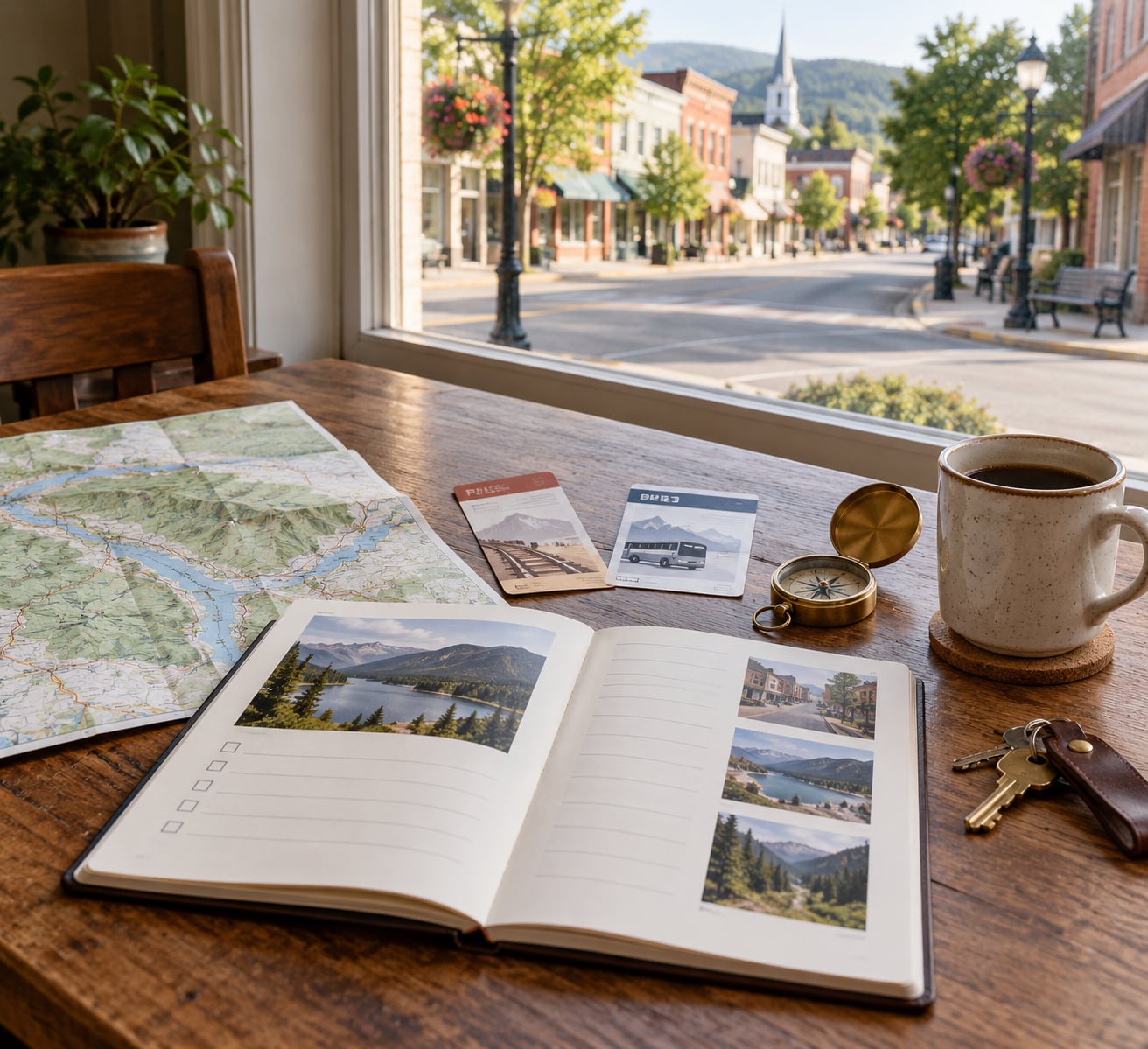
There are six realistic ways to get from an airport to a small town without a car: a scheduled airport shuttle, a pre-booked private transfer or local taxi, public transit, a ride-hailing app, a multi-leg chain through a bigger hub, and a lodge or tour-company pickup. Which one works depends almost entirely on the last mile, so verify what reaches your actual door before you book a flight.
I have planned enough car-free arrivals to know where trips go wrong. It is rarely the airport leg. It is the 30-mile gap between the nearest town and the village where you’re actually staying, discovered at 11pm with three hours of daylight gone.
This guide walks through the process in order: what to gather, how to compare the six modes, how to book each leg without stranding yourself, and what to do on the final mile. It also covers the awkward cases — no shuttle, no bus, no drivers on the app — which is where most small-town travel plans fall apart.
Table of Contents›
- What You Need
- How to Get from an Airport to a Small Town Without a Car: Step-by-Step
- 1. Confirm the Airport, Town and Final Destination
- 2. Compare Airport-to-City and City-to-Town Transport
- 3. Check the Schedule and Price for Your Exact Travel Date
- 4. Book Each Leg and Protect the Connection
- 5. Finish the Final Mile: How to Get From an Airport to a Small Town Without a Car
- 6. Save the Route Details and Test the Backup Plan
- Common Mistakes
- Frequently Asked Questions
- Can you travel from a major airport to a small town without a car?
- What is the easiest way to reach a small town that has no train station?
- Should I book airport transfers before or after my flight ticket?
- How much time should I leave between an airport flight and a train or bus?
- Is it safe to arrive late in a small town without a car?
- What should I do if my flight is delayed and I have a separate onward ticket?
- Conclusion
What You Need
Before you look at any transport options, get these written down. Five minutes of prep removes most of the risk later.
- The airport name and terminal. Small regional airports often have one terminal and one arrivals exit. Larger hubs have train stations on different levels and shuttle stops in specific parking structures.
- Your landing time, local. Note the date, the hour, and whether it lands in daylight. Everything downstream depends on it.
- The exact town and accommodation address. A booking platform may show “Hollis, NH” when your lodging is 22 miles outside Hollis. That difference decides whether a bus works at all.
- Luggage count and size. A shared shuttle van has real limits with ski bags, bicycles and hard cases. One large suitcase changes the equation completely.
- Mobility or accessibility needs. Wheelchair-accessible vehicles and child seats usually have to be requested in advance at rural operators, not requested on arrival.
- Your tolerance for cost. On the final leg a taxi is often the only option, and in remote areas it is the expensive one. Knowing your ceiling stops a bad surprise at the airport desk.
- Direct contact details for the operator. Save the taxi dispatch number and the transit authority website address in your phone before departure. Airports block signal in some rural terminal buildings.
How to Get from an Airport to a Small Town Without a Car: Step-by-Step
1. Confirm the Airport, Town and Final Destination
Most failed plans start with the wrong destination pinned in a booking box. Search the accommodation name, not the town name, and look at how far the pin actually sits from the nearest town centre.
Check whether the town has a station at all. Plenty of places advertised as small-town destinations are reached by a bus that stops at a park-and-ride twelve miles back, at a junction with a petrol station and nothing else.
Then check the airport side. Search the airport authority’s own site, not a travel blog, and look for ground transport or parking pages. Regional airports publish their operators, and the answer is often on that page in plain text. A quick call to the airport information desk costs nothing and can save an evening.
Forum travellers ask this same question constantly on r/solotravel and r/WildernessBackpacking, and the answer is nearly always the same: the last mile is unsolved, so solve it before you fly.
2. Compare Airport-to-City and City-to-Town Transport
Run the comparison on total door-to-door time, not on the airport leg alone. A shuttle that drops you in a regional city in forty minutes can still leave you facing a three-hour bus and an unsolved final mile.
| Mode | Relative cost per person | Booking lead time | Luggage and mobility | Best for |
|---|---|---|---|---|
| Scheduled airport shuttle | Lowest | Same day, check timetable | Shared space, tight for large bags | Daytime arrivals on fixed routes |
| Public transit (bus or train) | Low, needs transfers | Day pass or ticket, same day | Good for bags under a seat or in a rack | Towns with a real station or terminal |
| Ride-hailing app | Medium to high, surges at night | On demand, or reserve days ahead | Varies by vehicle class | Daylight arrivals in semi-rural towns |
| Pre-booked private transfer | Highest, quoted per trip | 24 to 72 hours ahead | Private, luggage and child seats on request | Long rural legs and late arrivals |
| Local taxi dispatch | High on rural roads, metered or quoted | Call ahead, ideally days ahead | Ask for vehicle size and seat availability | Towns with no app coverage |
| Lodge, hotel or tour pickup | Often free or low | Ask your host days ahead | Matches your booking, usually small | Guesthouses and campsites with drivers |
| Multi-leg chain via a hub | Low to medium, slowest | Book each leg, mind connections | Baggage rules apply on every leg | Remote towns with no direct service |
Two details get skipped in every comparison. The first is the schedule’s end time: a shuttle that runs hourly until 6pm is useless for a 9pm landing. The second is baggage handling, which decides whether a shared van is realistic for you at all.
Ride-hailing deserves a warning. Travellers in r/snowboarding describe coverage near Jackson Hole as very off and on, with drivers declining or going offline after dark. In r/Charlottesville the consensus is blunt: apps are unreliable early and late, and calling a local taxi company ahead of time is the fallback that works.
3. Check the Schedule and Price for Your Exact Travel Date
Timetables change with the season, and small operators change theirs more often than national rail. A route listed in a search result last spring may run three times a week in October and not at all in early spring.
Go to the operator’s own site and enter your date. Seasonal service, holiday timetables and reduced summer frequency are usually printed there and rarely reflected in third-party listings. If the operator only publishes a PDF timetable, download it and read the footnotes, because that is where the reduced-service dates live.
Compare total fares across the whole route rather than the airport portion alone. Some systems price by zone, so a cheap airport ticket can be followed by an expensive final hop. Where reservations exist, note the cutoff: some rural bus operators require booking before the previous evening.
Save a screenshot of the timetable page with the date visible. That is your evidence if a driver at the airport tells you a service was cancelled.
4. Book Each Leg and Protect the Connection

Book from the last leg backwards. Start with the leg that has the fewest options, usually the final local hop, and work towards the flight. Booking in that order means the pieces that cannot be fixed later are secured first.
If you hold a separate ticket for each leg, you own the risk at every change. A delayed flight on a protected through-ticket is the airline’s problem. A delayed flight on separate tickets is yours, and on a rural route with four departures a day that can mean an overnight wait.
Leave a buffer between a flight and a scheduled connection. Two hours is the floor for anything domestic into a regional airport, and three is wiser if the onward bus is a long-distance coach with few daily departures. Add more if you are checking a bag and landing at peak departure time.
Watch the baggage rules on each leg separately. A regional operator may cap bags at one per person or set a size limit the national carrier does not have. Getting refused at a rural bus depot with no onward service is a genuinely bad afternoon.
5. Finish the Final Mile: How to Get From an Airport to a Small Town Without a Car

This is where the last-mile connection decides everything. Work through the options in order, from cheapest to most reliable.
- Walk it. Fine if your accommodation sits within a short, well-lit walk of the stop and you are not exhausted after a long trip.
- Local bus. Usually free or cheap in town centres, but often ends early in the evening and rarely runs at all on Sundays in small places.
- Scheduled shuttle to a lodge or hostel. Common in ski towns and national park areas, and often included in the price of the stay. Ask your host which one and at what hours.
- Hotel or guesthouse pickup. The most underrated option. Many rural inns have a driver who will collect you for a modest fee or free, simply because there is nothing else. Ask at booking, not on arrival.
- Local taxi. The fallback that always exists somewhere. Call the dispatch number you saved earlier and confirm the quoted flat fare before you get in.
- Bicycle or e-bike hire. Reasonable in flat towns with a bike-share or hire shop, less sensible with a large suitcase on a road with no shoulder.
Late arrivals need more care than daytime ones. Pre-arrange something, stay near a lit pickup point rather than the airport car park, and confirm the number to call works at that hour before you land.
6. Save the Route Details and Test the Backup Plan
Put every confirmation in one place: flight details, each booking reference, the operator phone numbers, the accommodation address in the local language, and the address written out in characters. Screenshot the timetables. Download the maps for the region so you are not relying on a signal that may not exist.
Then name the backup in advance, before you travel. If the flight lands late, the alternative is the taxi dispatch. If the shuttle does not run on your arrival day, the alternative is a bus to the nearest town and a local taxi the rest of the way. If your connection fails, the alternative is a night at the airport hotel, if there is one.
Plan the return too. Forum members flag this constantly: getting back to a remote airport is harder than getting out, because services run toward the flights in the morning and away from them in the afternoon. Build the same buffer on the way back, and confirm your pickup is booked for the day before the flight, not the day of.
Common Mistakes
Booking into the nearest town and assuming the rest works itself out. Fix: check the accommodation address on a map before booking anything. If the last stretch has no bus, plan a taxi for that segment now.
Trusting a search result over the operator’s timetable. Fix: confirm every service on the operator’s own site for your exact date. Seasonal reductions and holiday timetables are published there and nowhere else useful.
Leaving too little buffer after a flight. Fix: two hours minimum for a domestic connection to a scheduled bus or train, three when the onward leg has few departures or you are checking bags.
Assuming a late bus exists. Fix: find out the last departure and its day of week before you book. In many small towns, Saturday evening is the end of the week for transit.
Ignoring luggage limits. Fix: check the baggage rule on every leg separately, and count wheels. A shared van has no room for three hard cases plus a backpack.
Not checking the return trip. Fix: book the outbound pickup before you travel and confirm the return pickup the day before departure. Outbound services are usually better timed than inbound ones.
Having no answer when nothing exists. If there is no shuttle, no scheduled bus and no driver willing to take the run, the fallback ladder is: ask your accommodation for a pickup, then call the local taxi dispatch for a quoted flat fare, then fly into a bigger hub and take a coach and a second pre-booked leg. Experienced r/WildernessBackpacking regulars recommend that last option over renting a car for a trip where the car just sits in a lot.
Renting a car for heavy luggage, several towns, or a tight schedule. Sometimes a car is the right call even if you would rather not. If you are moving bags between three towns in four days, a pre-booked private transfer chain will cost more time than it saves in stress.
Frequently Asked Questions
Can you travel from a major airport to a small town without a car?
Yes, but plan the final mile before you book. Most small towns are reached by a scheduled airport shuttle, a pre-booked private transfer, a local taxi, or a combination of a train or coach to a regional hub followed by a second leg. Ride-hailing apps work in daylight in semi-rural areas and become unreliable after dark. The hardest part is rarely the airport itself; it is the gap between the nearest town and your door.
What is the easiest way to reach a small town that has no train station?
A pre-booked private transfer or a local taxi dispatch, arranged before you travel. Without a station, there is no timetable to plan around, so the mode that works is the one you reserve. Ask your accommodation whether they run a pickup, since rural inns and lodges often have a driver and may include it. Otherwise request a quoted flat fare and confirm the vehicle size and luggage capacity when you book.
Should I book airport transfers before or after my flight ticket?
Book the flight first, then book transfers immediately for the same day, because flight times set the transfer times. Sequence it so the pieces with the fewest options are secured first: the final local hop, then the middle leg, then the airport pickup. That way you are never holding a transfer built around a departure the airline later moves. Where operators require advance reservations, rural bus and shuttle services often need booking the previous evening.
How much time should I leave between an airport flight and a train or bus?
Two hours minimum for a domestic flight into a regional airport, and three hours is safer when the onward service has few daily departures or you are checking a bag. If each leg is on a separate ticket, a missed connection is your problem rather than the operator’s, and a rural route may not run again until morning. Add buffer for the holiday periods, when airlines run fuller and regional timetables get disrupted more often.
Is it safe to arrive late in a small town without a car?
It is manageable if you arrange it in advance rather than improvising on arrival. Pre-book a transfer, or ask your accommodation for a pickup, and stay near a lit pickup point instead of waiting in the airport car park. Confirm that the taxi dispatch number you saved answers at that hour. Travellers in rural communities consistently report that calling a taxi company ahead of time beats waiting on an app after dark.
What should I do if my flight is delayed and I have a separate onward ticket?
Call the onward operator before you leave the gate, not after you land. Separate tickets mean the connection is yours to protect, and some rural services will hold a seat if you call but will not wait otherwise. Have your booking reference and the direct number saved offline, since signal is poor in many terminal buildings. If the service is gone, fall back to your named plan: the taxi dispatch to town, or a night near the airport.
Conclusion
Start by pinning down the exact address you are staying at, then check what actually reaches it on your arrival day. Compare the six modes on door-to-door time rather than fares or individual legs, book the segments with the fewest options first, and give every connection a generous buffer.
If there is genuinely no shuttle, no bus and no driver on the app, a pre-booked transfer or a local taxi dispatch is your answer. Know that before you land, not after. This guide was checked for accuracy in 2026, and timetables change, so confirm each one against the operator’s site before you book.