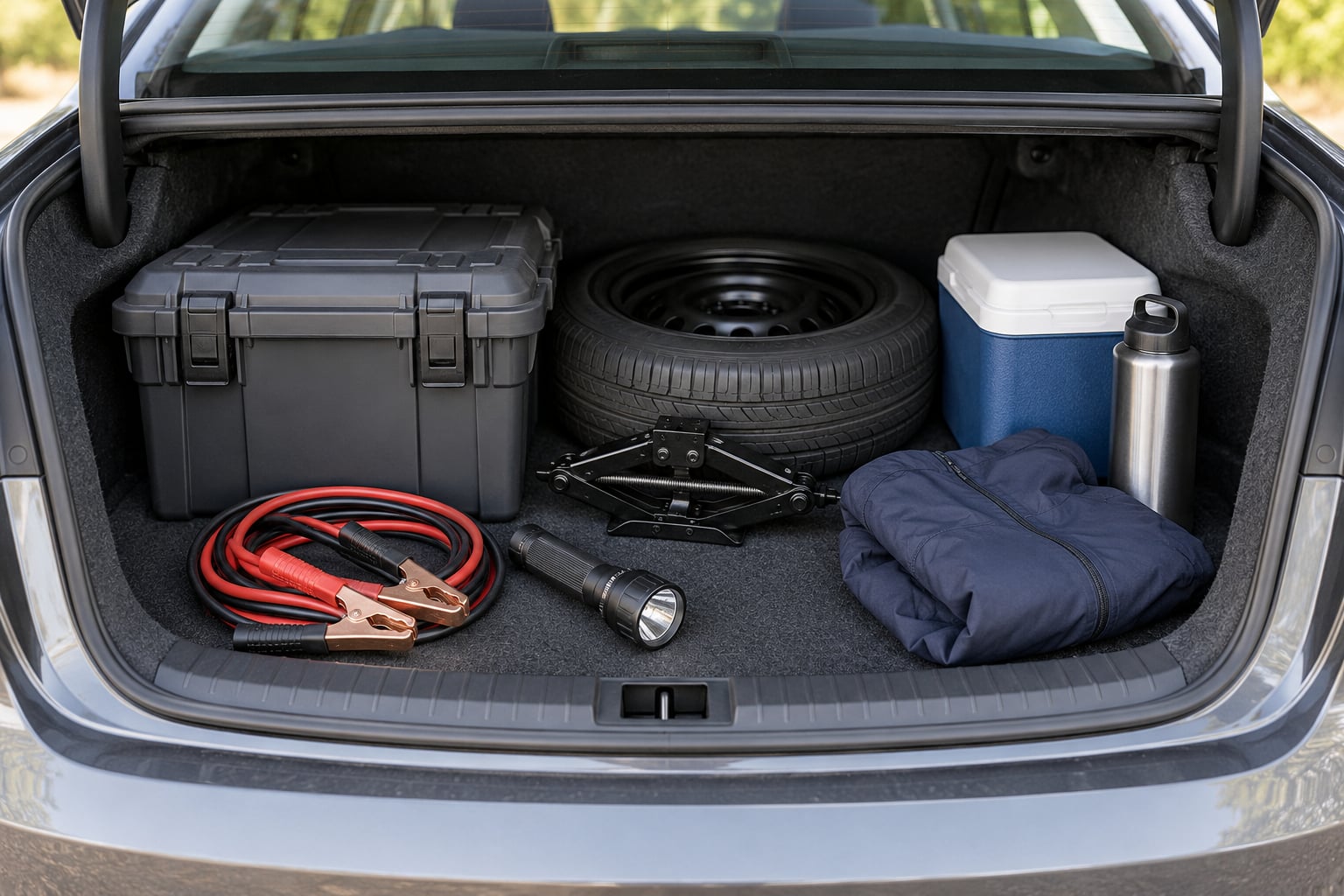
What to keep in your trunk on a long road trip comes down to a short list: a first-aid kit, warning devices, jump gear, tire tools, a light, water and food, offline navigation, weather layers, and one waterproof tote that holds all of it in place. That covers the four things that actually strand drivers, which are a dead battery, a low tire, darkness, and a phone with no charge.
I drive solo through mountain routes often enough that I keep a permanent kit in the cargo area rather than packing one per trip. The list below is that kit, organized by what it does instead of by how often people think about it. It is updated for October 2026, and nothing on it needs more than a small part of the cargo floor.
One thing worth saying up front: the most common failure is not a missing tool. It is a tool that stopped working, a flat tire inflator with a dead battery, a flashlight with dead cells, a power bank at zero percent, or a bag of ice turned into a leak. Plan for those and the list holds together.
Table of Contents›
- What to Keep in Your Trunk on a Long Road Trip at a Glance
- 1. A First-Aid Kit With the Basics That Work
- 2. A Vehicle-Rated Fire Extinguisher
- 3. Emergency Lighting and Power Tools
- 4. A Roadside Emergency Kit for the Failures You Can Fix
- 5. Water and Food That Will Not Spoil
- 6. A Cooler or Insulated Travel Bag
- 7. Extra Clothing and Weather Gear
- 8. Paper Maps and Offline Navigation Downloads
- 9. Trash Bags and Cleaning Supplies
- 10. A Compact Car-Kit Organizer
- What to keep in your trunk first when you are starting from empty
- How to pack a trunk so nothing slides
- How heavy is too heavy
- The 60-second monthly check
- Frequently Asked Questions
- What should I keep in my trunk for a long road trip?
- Should I keep a cooler in my trunk?
- How do I keep things from sliding around in the trunk?
- How heavy should my trunk be before a road trip?
- Where should I store important documents while traveling?
- How often should I check trunk emergency gear?
- Start With the Core, Then Fill In
What to Keep in Your Trunk on a Long Road Trip at a Glance
The table below is the quick reference. The third column matters more than most people expect, because several of these items should never sit in the trunk at all.
| Item | What it does | Where it belongs |
|---|---|---|
| First-aid kit | Handles cuts, burns, minor injuries | Cabin, within reach |
| Fire extinguisher | Controls an electrical or fuel fire | Trunk, securely mounted |
| Headlamp or flashlight | Lights a roadside repair after dark | Cabin, charged |
| Reflective vest and warning devices | Makes you visible to other drivers | Trunk grab-and-go bag |
| Jump cables or portable jump starter | Revives a dead battery | Trunk grab-and-go bag |
| Spare tire, jack, lug wrench | Replaces a flat outright | Trunk, under the floor |
| 12V inflator and pressure gauge | Reinflates a slow leak | Trunk grab-and-go bag |
| Water and shelf-stable food | Hydration and energy on long stretches | Trunk, low and forward |
| Offline maps and paper map | Keeps the route working without signal | Cabin |
| Weather layers and a blanket | Handles cold, rain and breakdowns | Trunk, dry bag |
1. A First-Aid Kit With the Basics That Work
A prepackaged kit beats a pile of loose bandages, because you will not find a loose bandage at 11pm on a shoulder of highway. Look for sterile gauze pads, adhesive bandages in a few sizes, an elastic wrap, medical tape, gloves, tweezers, and a small pair of scissors with blunt tips.
Add a few things kits usually leave out: a cold pack for a sprain, an antiseptic wipe per cut, hydrocortisone for an itch, and any prescription medication you use regularly, in its original labeled container. Blunt-tip scissors and nitrile gloves do more for you than a fancy trauma kit ever will on a highway.
Pack it in a hard-sided zip case or a small tackle box so it does not get crushed under a tote. Check it twice a year and replace anything expired, damp, or opened. Note the restock dates on a strip of tape inside the lid so you do not have to open it to remember.
2. A Vehicle-Rated Fire Extinguisher
A passenger-car extinguisher is not the same thing as a house extinguisher, and the difference matters. Look for a UL-listed automotive unit rated for electrical fires, with a plastic pull pin and a metal squeeze lever, and keep it within reach of the driver if your cargo area allows it.
Most small units run for only 10 to 20 seconds, so it is there to knock down a small flame and get everyone out, not to fight a fully developed engine fire. Pull, aim at the base, squeeze, and sweep. Above all, get away from the vehicle and call emergency services rather than standing beside it.
Two things go wrong with these more often than anything else. The pin gets pinched off or taped over in a way you cannot release quickly, and the gauge drops as the powder settles. Secure the unit where it cannot roll or slide, and check the needle a month or two before departure. A five-second check is cheaper than a roadside call.
3. Emergency Lighting and Power Tools
A headlamp beats a flashlight because both hands stay free, which matters when you are crouched behind a wheel with a lug wrench. Bring spare batteries or, better, a lamp you charge from the car and check monthly. Most roadside work happens in the dark because that is when the tire finally goes flat.
Reflective gear is what other drivers see, and they see it before they see you. A vest in the grab-and-go bag plus a collapsible warning triangle or a pair of flares covers both the on-highway and the shoulder-of-road case. Keep them out of the deep trunk under everything else.
For power, carry both a portable jump starter and a set of jumper cables if you have the space. Cables need a second car to be useful; a jump starter works alone. Match the clamp rating to your battery and connect positive to positive, negative to negative, engine off on both vehicles first. If the engine cranks and stalls, stop trying and call for help rather than cycling it.
Also worth having: a 12V tire inflator, a pencil tire pressure gauge, and a small tire plug kit. The gauge matters more than people expect, because a TPMS light can fail while the tire is genuinely losing air, and you will get no warning beyond the light.
4. A Roadside Emergency Kit for the Failures You Can Fix
The factory kit under your trunk floor, the jack, and the lug wrench are the foundation. Confirm the spare inflates before you need it, that the jack turns freely, and that the lug wrench fits your lug nuts. A spare you never tested is a decoration.
A tire plug kit repairs small punctures in the tread area, which covers the slow leak and the nail in the highway scenario. It does not fix a sidewall blowout or a tire that has come apart, so keep the spare as the real answer.
Round out a small roll with work gloves, a multi-tool, duct tape, a few zip ties, a tow strap, and a small bottle of fluid. Gloves matter more than they sound: roadside surfaces are sharp, hot, and filthy. A roadside assistance card or a membership number written on paper goes in the same bag, because an app you cannot load on a dead phone is not a plan.
5. Water and Food That Will Not Spoil
Water comes first and it is not close. On desert and mountain routes, aim for roughly one gallon per person per day, plus a spare gallon in the grab-and-go bag, and refill whenever a station is convenient rather than at half empty. Storing water in the trunk in summer is a bad idea, so run the air conditioning hard if you have no cooler.
For food, match the load to the trip. A few hours of driving does not need more than granola bars, nuts, dried fruit, and crackers. Overnight and longer adds things you can eat without cooking: canned beans, nut butter, tortillas, dried soup mixes, and hard cheese that survives a warm car. Vacuum-sealed pouches travel well and do not leak.
Skip anything that needs refrigeration, and treat anything perishable as a two-hour item in a car hotter than 90 degrees, one hour if it is above that. USDA guidance puts poultry at 165 degrees, ground meat at 160, and whole cuts and fish at 145. Stack sealed containers inside a cooler bag if you are carrying perishable food, and eat it early rather than late.
6. A Cooler or Insulated Travel Bag
A cooler is worth the space if you are doing real meals, camping, or driving with kids who need snacks every ninety minutes. It is dead weight on a two-hour hop, so decide by the trip rather than by habit. A soft insulated bag packs smaller and holds cold longer than a thin plastic tub of the same volume.
Pre-chill everything, including the empty cooler, and pack in order of use. Ice on the bottom and top keeps the temperature even, and a full cooler holds its temperature better than a half-empty one. Freeze some water bottles to use as your ice: no melt water, and you drink them as they thaw.
Keep the cooler out of direct sun, in the cargo area but shaded by nothing, or in the passenger footwell if you have room. A car interior heats up fast in summer, and a cooler with a partly melted ice block turns into a warm container of questionable water. Drain it and dry it out at the end of the trip or it will smell for weeks.
7. Extra Clothing and Weather Gear
Long driving means temperature swings you did not plan for, especially in the mountains or crossing the Plains at night. Pack layers that compress: a merino or synthetic base layer, a fleece or mid-weight layer, and a windproof shell. Cotton holds water and stays cold, so pick synthetics if you are buying once.
A packable rain shell takes up almost nothing and covers the case that ruins a trip, which is the fifty-mile stretch where the forecast was clear. Add a warm hat, sunglasses, and sunscreen, since UVA rays pass through most windshields. A blanket or emergency bivvy completes the set for breakdowns and for sleeping in the car.
Put all of it in a dry bag or a sealed tote. Wet wool in a closed bag in a hot car smells badly within a day, and that smell is hard to remove from a trunk liner.
8. Paper Maps and Offline Navigation Downloads
Signal drops in exactly the places you most need directions: canyon walls, forested switchbacks, long rural stretches, and the middle of a state where cell coverage ends for forty miles. Download offline maps before you leave, not when you lose signal. On Google Maps, open the app, tap your profile icon, choose Offline maps, and select the regions covering your route. On Apple Maps, download a region under Settings, then confirm it finished downloading before you unplug.
Carry a paper map or road atlas as the backup to the backup. Mark the route in pen the night before, including planned fuel stops, detours around mountain passes, and any stretch you know has no service. Write the planned fuel stops on paper too, since that is the one piece of information you need most.
Two habits help more than any app. Download the region at full detail while you are still on your home Wi-Fi, and keep the phone mounted and charged rather than loose in a cup holder. Charge it from the car with a charging cable in the grab-and-go bag, and use a power bank for the stretches where you have power but no good mount of your own.
9. Trash Bags and Cleaning Supplies
One heavy-duty trash bag in the trunk solves more problems than it sounds like. Food wrappers, receipts, napkins, and the fast-food bag from a bad stop all go in it instead of loose in the corners where they slide under the seats.
Keep a second smaller bag for laundry, so dirty clothes never share a compartment with clean ones on a week-long run. A pack of wipes, a roll of paper towels, and a microfiber cloth handle the coffee spill, the crumbs in the seat crease, and the muddy paw prints. A small bottle of cleaner or a stain stick for upholstery is worth its space when a drink tips in a parking lot.
This matters more for overnight stops than for driving. A car you leave parked with visible clutter invites attention, and a car you come back to with a bad smell costs you the rest of the trip. Take the trash out every evening, even if it is a service station bin, and leave nothing visible when you walk away from the car.
10. A Compact Car-Kit Organizer
All of the above in one waterproof tote or soft-sided organizer is the single biggest upgrade. Forum regulars on car and road-trip boards say the same thing repeatedly: the gear was always there, it just was not findable. A latching tote that you can lift out in one motion turns a trunk full of loose items into a working kit.
What to keep in your trunk first when you are starting from empty
Build in this order: first-aid kit, spare with jack and lug wrench, lighting plus reflective gear, jump gear, water and snacks, offline maps, then the organizer. The comfort items can wait for the sixth trip; the battery and tire gear cannot wait for the first one.
How to pack a trunk so nothing slides
Heavy items go low and as far forward as the cargo area allows, which keeps the center of gravity where the car was designed to have it and protects the rear seat and trunk lid in a hard stop. Mat or line the floor, then lay the tote flat and strap it down with ratchet straps or bungee cords, or wedge it against the seatbacks so it cannot travel.
Two more tricks: use packing cubes or soft bags for anything breakable, and fill the gaps inside the tote so small items do not migrate to the bottom. Never pack above the rear seat line. Load blocks your view out the back window, and that is a legal and a safety problem, not a style one.
How heavy is too heavy
There is no single number for every vehicle, but your owner’s manual gives a payload figure that includes passengers and luggage, and it is worth reading before a cross-country load. As a practical guide, a full day-trip kit usually stays in the range of 30 to 40 pounds, a multi-day kit around 60 to 80, and a cross-country setup with water, food and cooler higher still. Weight low and forward keeps handling predictable.
The 60-second monthly check
Once a month, walk to the car and check five things: the flashlight or headlamp turns on, the inflator holds a charge, the power bank is above half, the extinguisher gauge is in the green, and the spare still holds air. That single minute catches the failure that strands the most people, which is gear that quietly stopped working.
Scale the kit to the trip too. A two-hour drive needs the safety core and little else. Overnight and multi-day trips add the tote, the food, the cooler, and the weather layers. Cross-country runs mean duplicates: two tire inflators, two light sources, two ways to charge a phone.
Frequently Asked Questions
What should I keep in my trunk for a long road trip?
Keep the safety core first: a first-aid kit, spare tire with jack and lug wrench, headlamp, reflective vest, warning triangle, jump cables or a portable jump starter, 12V inflator, and a pencil pressure gauge. Then add water, shelf-stable food, offline navigation downloads, a paper map, weather layers, and a waterproof organizer. Leave documents, valuables, and any electronics in the cabin rather than the cargo area.
Should I keep a cooler in my trunk?
A cooler is useful when you are doing regular meals, camping, or driving with kids who need frequent snacks, and it is dead weight on a short trip. Use sealed containers, keep it shaded and out of direct sun, pre-chill it, and freeze water bottles as your ice so there is no melt water. Never leave perishable food sitting in a hot vehicle; above 90 degrees, the two-hour rule applies.
How do I keep things from sliding around in the trunk?
Line the cargo floor with a rubber mat, load heavy items low and as far forward as the space allows, and strap the main tote down with ratchet straps or bungee cords so it cannot travel. Wedge totes against the seatbacks, use packing cubes or soft bags for anything fragile, and fill gaps inside the tote so small items do not settle. Never stack cargo above the rear seat line.
How heavy should my trunk be before a road trip?
There is no single limit for every vehicle, but the payload figure in your owner manual covers passengers and luggage combined and is worth reading first. As a rough guide, a day-trip kit runs about 30 to 40 pounds and a multi-day kit 60 to 80. Keeping the load lighter and concentrated low and forward improves handling and fuel economy and keeps the spare accessible.
Where should I store important documents while traveling?
Keep your license, registration, insurance details, and travel documents in the cabin or a secure personal bag rather than loose in the trunk, where they are visible through the glass and easier to steal. Carry only the originals you need, store digital copies offline on your phone, and keep a photocopy or photo of key paperwork with a trusted contact at home.
How often should I check trunk emergency gear?
Spend one minute a month on five checks: the flashlight turns on, the tire inflator holds a charge, the power bank is above half, the extinguisher gauge is in the green, and the spare tire still holds air. Then do a full restock twice a year, replacing expired first-aid items and dead batteries. This catches dead gear before a long trip, not after.
Start With the Core, Then Fill In
If you are building a kit this week, do the first four items on this list and stop there. A first-aid kit, a tested spare with jack and lug wrench, a working light plus reflective gear, and jump gear will cover most of what goes wrong between you and help.
Then add the tote, water, and offline maps before you leave. Run the 60-second check the week of departure, and you have a solid answer to what to keep in your trunk on a long road trip without turning your cargo area into a garage sale.