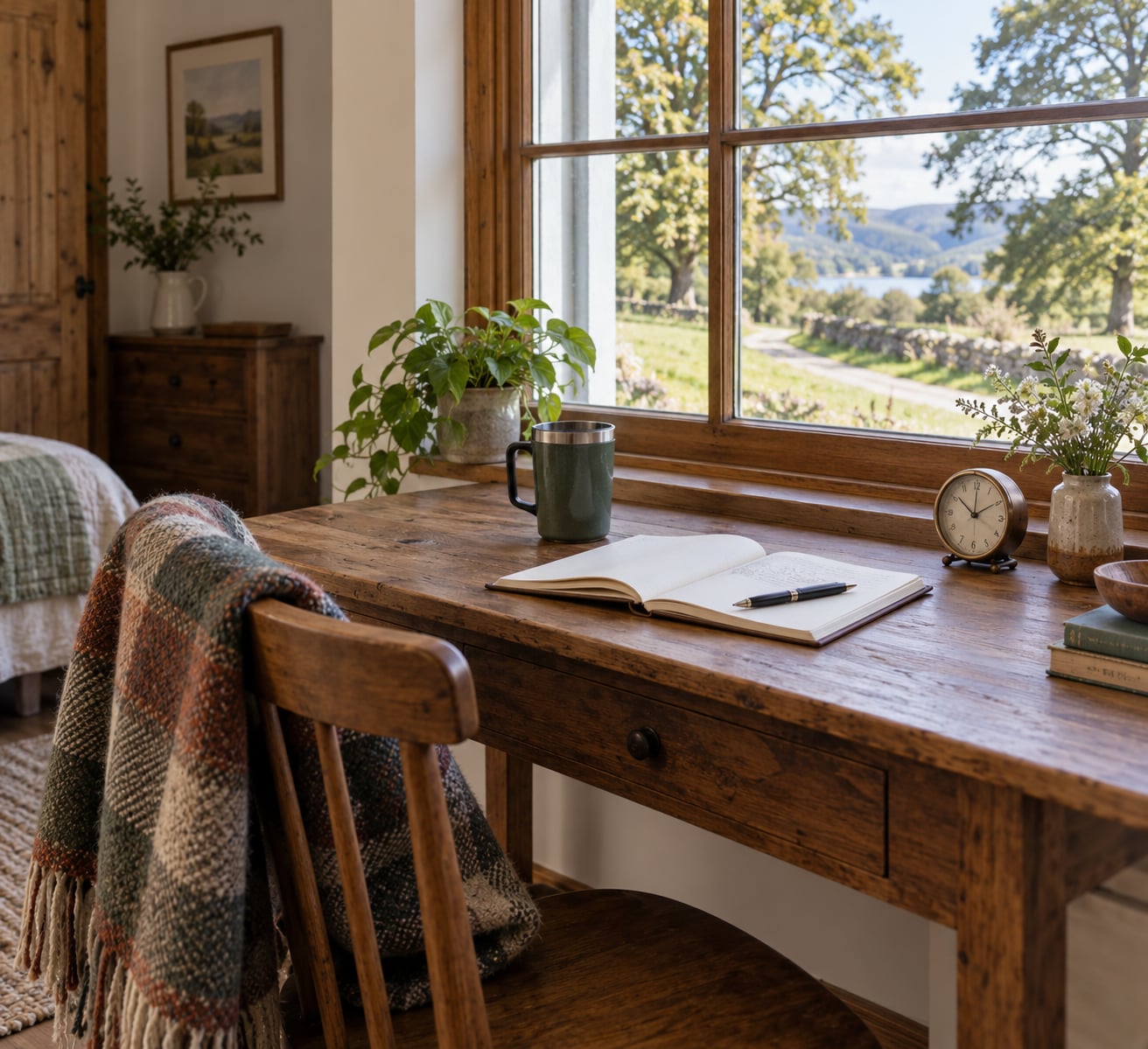
A solo writing retreat weekend is two to three days, usually Friday evening to Sunday evening, when you go somewhere away from your routine and make writing the only thing you do with your waking hours. Every logistical decision gets made before you leave, so the time itself is nothing but writing, walking, eating, and sleep. Planning one takes about two weeks of small choices and then almost no effort on the ground, and it costs far less than the residencies and workshops that dominate most writing-retreat articles.
Most writers don’t need a week in the mountains. They need two uninterrupted days and a plan good enough that they don’t renegotiate it every morning. Here is the whole thing, start to finish.
Table of Contents›
- What You Need
- How to Plan a Solo Writing Retreat Weekend Step by Step
- 1. Define the project before you choose the place
- 2. Choose a place that supports focused work
- 3. Book a quiet base for two nights
- 4. Build a schedule with writing and recovery
- 5. Pack your tools and make a backup plan
- 6. Protect your attention and set boundaries
- 7. Close the retreat with a clear next step
- Common Mistakes
- Frequently Asked Questions
- How long should a solo writing retreat be?
- What is the best kind of destination for a writing retreat?
- Do I need a budget to plan a solo writing retreat weekend?
- Is it safe to stay alone in a small hotel or guesthouse?
- Should I write on a laptop or use a notebook?
- What should I do if I lose motivation during the retreat?
- Book It Before the Idea Fades
What You Need

You need nine things, and eight of them you can arrange in a fortnight. The only hard requirement is a place to sit with a surface and a chair that does not ruin your back by Sunday afternoon.
- A destination. Somewhere between forty-five minutes and three hours away, quiet enough that nobody asks you what you are doing.
- Two nights booked. Friday arrival, Sunday departure. Two nights is the sweet spot: one night leaves you writing on Sunday in a panic, three nights starts to feel like a normal life.
- Accommodation with a real workspace. A desk or a table with an ergonomic chair, decent light, and a kettle. Ask before you pay.
- A defined project with a finish line. A number or a deliverable, not “some writing”.
- A writing kit. Laptop plus charger and backup, or notebook and pens. Both is better than one.
- A food plan. Decided in advance so you never spend writing time wondering what to eat.
- A budget range. Set a ceiling before booking, not after. A weekend guesthouse on a weeknight costs a fraction of the same room on a Friday.
- A backup plan. A second night’s worth of food, a spare charger, and an offline copy of everything.
- One recovery activity. A walk route, a swimming pool, a bookshop. Something that is not writing and not screens.
If your home is loud, shared, or full of other people’s needs, the destination is doing double duty: it is not a holiday, it is a change of room. Writers on writing forums describe this as the whole point for anyone living with family or roommates.
How to Plan a Solo Writing Retreat Weekend Step by Step
Plan a solo writing retreat weekend in seven moves: define the project, pick a place that supports focused work, book two quiet nights, build a schedule with recovery built in, pack a kit with a backup, protect your attention, and close with one next step. Each step below is about two days of lead time, and they run in order.
1. Define the project before you choose the place
Turn the vague wish into a single weekend deliverable, written down in one sentence before you look at any accommodation. That sentence is what you will read on Friday night when the room is quiet and the temptation to browse room-service menus is strong.
Good targets have a number in them. Draft 1,500 words of chapter nine. Revise one chapter end to end. Build a scene list of twelve scenes and order them. Run a research sprint and fill twenty sourced notes. If your project is stalled, the target can be diagnostic instead of productive: write three pages about why the book feels stuck, which is a writing task disguised as a way out of avoidance.
Set a floor as well as a target. The floor is the number you hit on a bad day, and treating it as a completed session is what keeps a weekend from ending in disappointment. Most writers who feel they failed actually wrote their floor number four times out of five days.
2. Choose a place that supports focused work
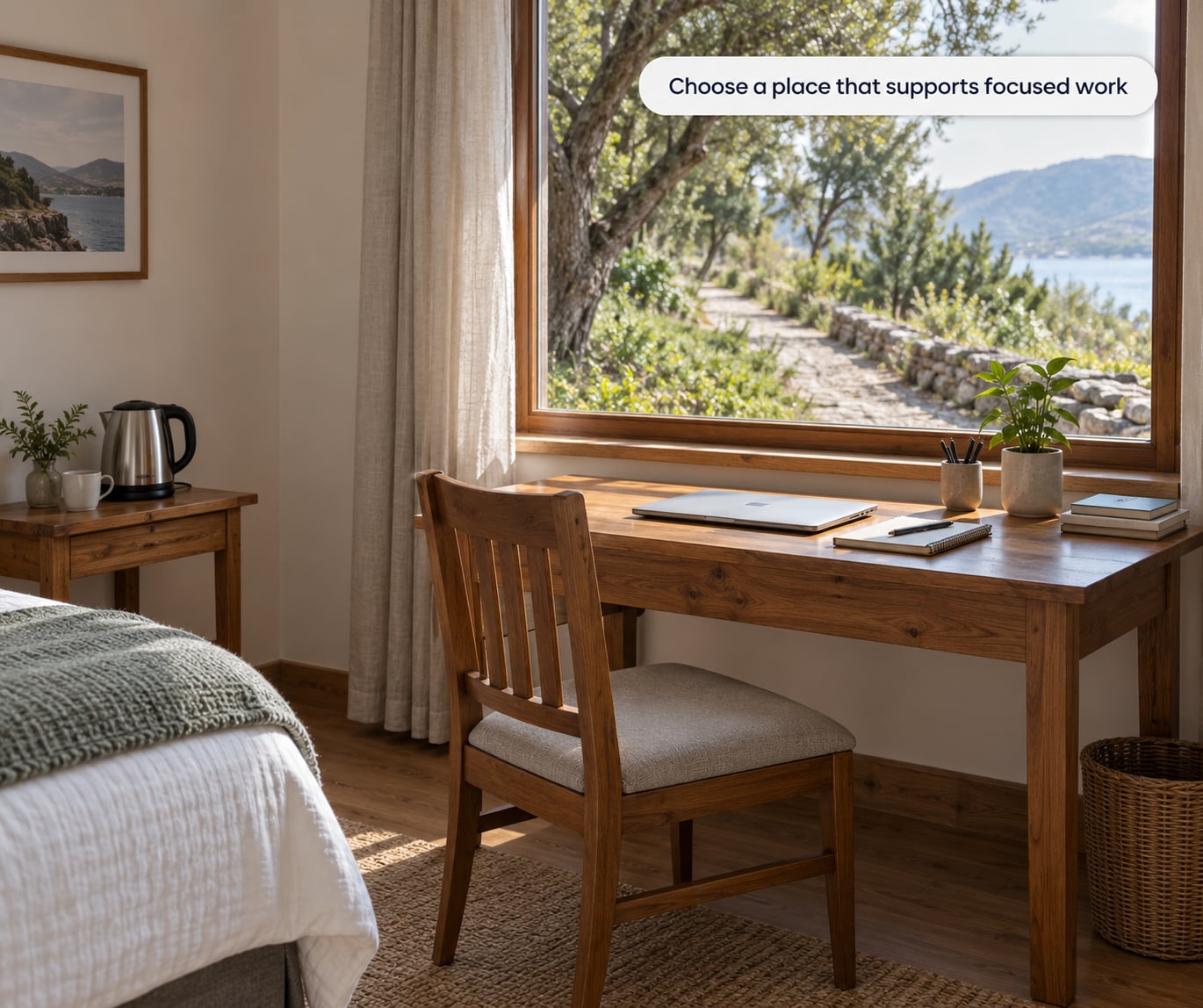
Choose for noise, privacy, connectivity, a chair, light, food access, and walkability, in that order. Beauty comes last. The most repeated failure in writer forums is picking somewhere so gorgeous you explore it all weekend and write nothing, and it happens to good writers with good intentions every single time.
Ask the host four questions before you book: is there a desk or table and a chair that is not an armchair, how is the wifi in the room, is there a kettle or coffee maker, and is there someone on site or on call at night. A remote cottage with no host and no signal is wonderful for one night and exhausting for two, especially alone.
On distance, the honest answer is that a retreat does not need a flight. Somewhere within a few hours’ drive keeps the trip cheap and the recovery real, because you can still take a walk at dusk without arranging a car. Save the long journey for the week you have already finished a draft.
Two setting types reliably suit different writers: a small town with a cafe within walking distance and no evening scene, for people who need coffee and a little human contact; and a cottage or cabin on the edge of something, for people who find that trees and water are what loosen the prose.
3. Book a quiet base for two nights
Book the stay before you finalise anything else, because a good room is the constraint that shapes the schedule. Look for a small hotel, guesthouse, inn, or serviced stay where the room faces something other than a car park, check-in is flexible, and the kitchen situation is honest about what it offers.
Where you can, take a weeknight rate on a Friday. That single trick is the difference between a DIY retreat you repeat every season and one you think about once. If you house-sit, borrow a campervan, or use a spare room behind a friend’s house, apply the same checklist, and add one thing: confirm there is a lock on the door and a working phone signal before you commit.
Book with a cancellation window if you can. Projects slip, children get ill, and a retreat you cannot move is a retreat you will cancel from the hotel lobby at 4pm with your own money gone.
4. Build a schedule with writing and recovery
Build a loose framework with two to three writing blocks a day, meals, a walk, and one genuinely empty hour. Do not fill every slot; unscheduled time is where the sentence you were stuck on usually arrives.
Use timed blocks rather than open mornings. Four rounds of twenty-five minutes with five-minute breaks, then a longer break, is the Pomodoro Technique and it works well because the finish line is visible. Pair it with a fixed first block of the day, because starting is the hard part and a clock removes the negotiation.
| Day | Morning | Afternoon | Evening |
|---|---|---|---|
| Friday | Travel, settle in, unpack the desk | Walk, then a 60-minute first session | Read, review the day’s pages, sleep early |
| Saturday | Two or three 90-minute blocks with breaks | Long walk, lunch, a nap if you need one | Two more blocks, then stop on a good note |
| Sunday | Two blocks, no new material | Review, count words, tidy the outline | Check out, one last short session at home if the mood holds |
The most reported rhythm from writers who do this regularly is simple: read something first thing, walk out for a pastry, write until mid-afternoon, walk for dinner, write again until mid-evening, then read and sleep. Walking between blocks is not filler. It is where a lot of stuck problems quietly resolve.
5. Pack your tools and make a backup plan
Pack in five groups and check each one before you lock the door. Device and power: laptop, charger, long cable, a power bank, and headphones. Drafts and notes: the manuscript file, the outline, the scene list, and the research notes, all downloaded and also on a drive or in print. Desk and comfort: earplugs, a layer for a cold room, a support for the chair back if it is not supportive.
Food and drink: enough for breakfasts and one easy dinner you can cook, plus a plan for every lunch. Refillable water bottle, travel mug, and coffee if you are a coffee person. Comfort: one thing that is purely yours, a candle if it is legal where you are going, a good pen even if you type.
Decide laptop or notebook before you go and stick to it. A hybrid arrangement works only if one device is clearly primary, because deciding mid-session is how sessions die. A notebook forces slower sentences, which some writers find solves problems their drafts have had for months; a laptop lets you search, which is faster when you are revising a long manuscript.
The backup plan is the boring part that saves the trip. Save every file to two places before you leave. Download offline maps. Carry a second charger. If the wifi fails, your writing does not have to. And if the room turns out to be unusable, know the nearest cafe with a table you could buy a coffee at, because a bad room discovered on Friday afternoon is recoverable only if you planned for it.
6. Protect your attention and set boundaries
Turn off notifications before you leave home, not when you sit down to write. Tell one named person the dates, the address, and the phone number of the host, and agree on a check-in time each evening. That single message does more for your writing than any app on your phone.
Tell your household the rules in advance rather than asking each morning. Going alone regularly triggers guilt, and guilt is the fastest way to turn a retreat into a weekend spent checking in from a cafe. A clear plan, told once, relieves it for everyone.
Set one rule for interruptions: nothing that can wait until the block ends, and nothing that requires a decision. If something genuinely cannot wait, you step away, and you add the time back by shortening the evening block. Keeping the container intact matters more than protecting any single session.
If you travel alone to an isolated stay, take the ordinary precautions without letting them take over: arrive in daylight, check the locks and where the spare key is, park the car somewhere you can see it from the window if you have one, keep your phone charged, and ask the host directly whether anyone is on the property at night. Feeling safe is mostly the result of having asked.
7. Close the retreat with a clear next step
Spend Sunday afternoon reviewing rather than writing. Count the words, note the scenes that worked and the ones that need a second pass, and write down two or three lines about the setting itself, because a good desk in a good town becomes your default retreat location for the next one.
Then do not edit what you drafted. Fresh pages are for finishing, not fixing, and a revision pass on Friday night in a tired head usually makes the work worse. Reading it cold in a week is worth more than any edit you could make on Sunday.
| Project stage | Realistic output in 48 to 72 hours | How to measure it |
|---|---|---|
| New project, nothing drafted | 500 to 1,500 words | Opening pages, or a written premise |
| Mid-draft, momentum exists | 1,500 to 4,000 words | One scene or one chapter, finished |
| Stalled draft | 800 to 2,000 words | Diagnostic pages about what is not working |
| Revision | 5 to 10 chapters revisited | Chapters restructured, not words added |
Finish with one action you take within forty-eight hours of getting home, ideally something with a deadline in it: send the chapter to a reader, schedule the next retreat, or add the new scenes to the outline. The writing habit survives a retreat only if the first session after it is booked before the weekend is over.
Common Mistakes
- Choosing somewhere too beautiful. Pick a place you would be content to spend one day in, not five. Beauty is for the walk between sessions, not the view from the desk.
- Setting goals that need a quiet month. Cut the target until it feels slightly too easy. A weekend hit at 80 percent leaves you wanting another one; a weekend blown by 300 percent leaves you hiding your laptop.
- Packing only devices. Bring paper, pens, and one physical reference or craft book. If the power fails or the room has no table, paper is still a way to write.
- Treating rest as wasted time. Schedule the walk, the nap, and the early night into the plan. Most of the sentences arrive on those, not in the sixth hour at a desk.
- Booking a room with no workspace. Ask about the desk and the chair before you pay, and check the photos for a chair with arms and no cushion. You will be in it for six hours a day.
- Going somewhere with no one around and no signal. Isolation helps some writers and unsettles others in a way they did not expect. For a first solo retreat, choose somewhere with a host nearby and a town within walking distance.
- Leaving with no continuation plan. Book the next session before you travel home. Otherwise the writing stops the day the structure disappears, which is the post-retreat crash writers describe more than any other failure.
- Announcing the trip badly. Tell people once, clearly, with dates and a plan for contact. Repeated negotiations about whether you are allowed to go will use up the energy you saved for the page.
One more worth naming: writing through the whole weekend without a single session that is not about the project. Recovery is part of the method, not a lapse from it.
Frequently Asked Questions
How long should a solo writing retreat be?
Two to three days is the useful range for a first one. Friday evening to Sunday evening gives you roughly six full writing hours a day without anyone noticing you have gone. A single day rarely breaks a stall because there is no recovery built in, and a week is a different project with a different budget. If you have never done this, start at two nights and add time once you know your own rhythm.
What is the best kind of destination for a writing retreat?
Somewhere quiet, walkable, and with a real table and chair for the room. A small town guesthouse or a cottage within a few hours of home works better for most people than an isolated cabin with no signal, because you can still walk to a cafe, buy food, and see another person if the solitude turns heavy. Pick for noise level and workspace first, scenery last.
Do I need a budget to plan a solo writing retreat weekend?
You need money, but not much, and the tier is your choice. A weeknight rate at a small hotel or inn, a guesthouse room, a house-sit, a spare room behind a friend’s house, or a borrowed campervan all support a full writing weekend. The expensive mistake is booking a Friday and Saturday at peak season; the cheap version is a weekday evening and a Sunday checkout.
Is it safe to stay alone in a small hotel or guesthouse?
For almost any reader, yes, and the precautions are ordinary. Share your address, dates, and host contact with one named person, agree on a nightly check-in, arrive in daylight, confirm someone is on site or on call, keep your phone charged, and check where the locks and spare key are. Hosts are used to solo guests and will usually tell you plainly whether anyone is around at night.
Should I write on a laptop or use a notebook?
Pick one before you go and stop deciding mid-session. A laptop suits revision and long manuscripts because you can search and reorganise quickly. A notebook suits new work, because handwriting slows sentences down and tends to surface different material. If you take both, choose a clear primary device and keep the paper for the thinking-out-loud sessions rather than the drafting.
What should I do if I lose motivation during the retreat?
Drop to your floor number rather than abandoning the session, and change the setting instead of trying harder. Walk for twenty minutes, read a few pages of a craft book, or move to a different table. Motivation is not the resource you are short of; a start time and a small target are. Most stalled weekends are won by writers who wrote badly on Saturday and returned to the work on Sunday morning.
Book It Before the Idea Fades
Pick the weekend now, name the project in one sentence, and book the room tonight while the motivation is still doing the work for you. Everything else on this list gets easier once the date exists.