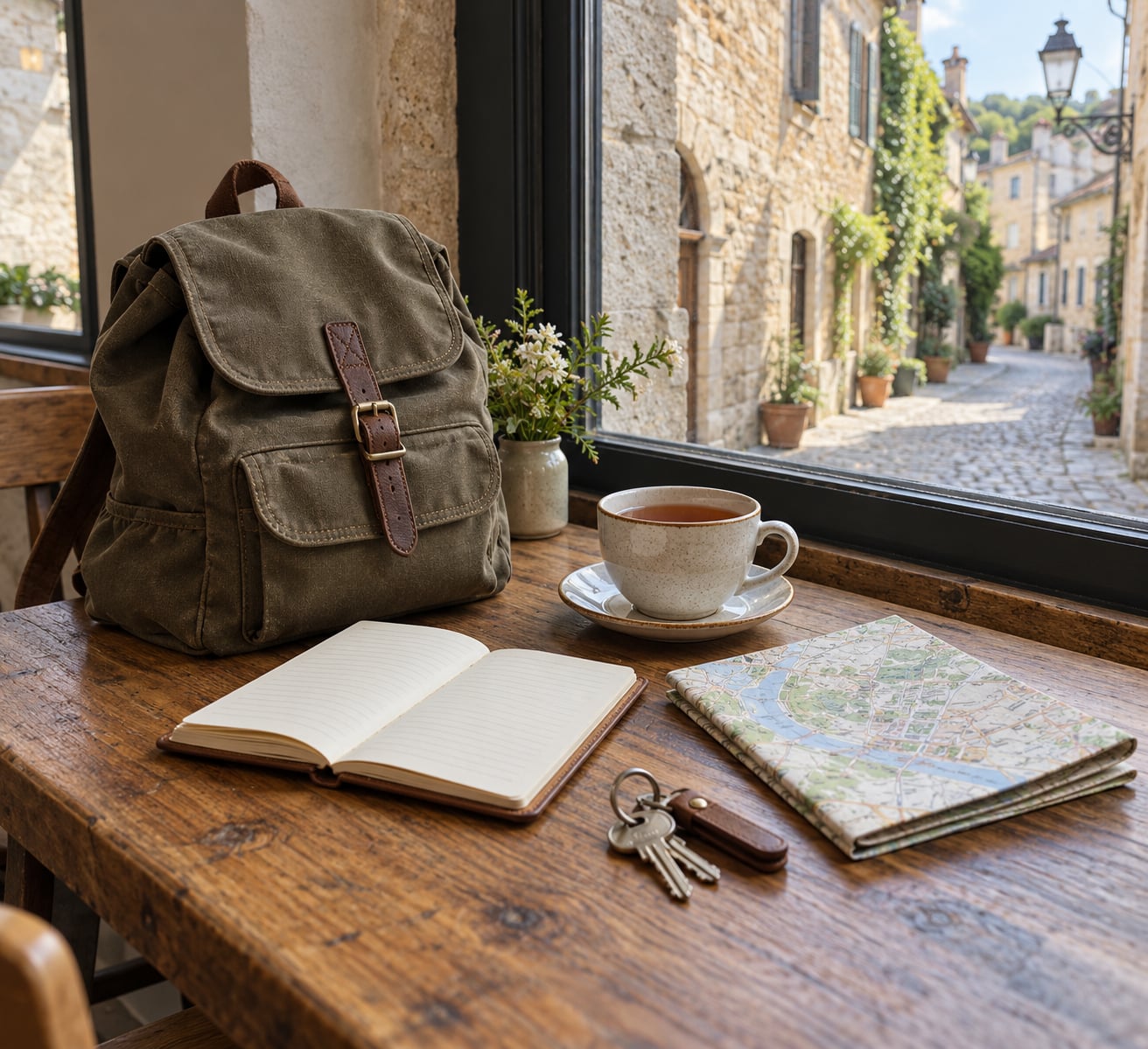
Feeling lonely on your first solo trip is normal, and it is not a sign that you made the wrong choice. Almost everyone who travels alone for the first time hits a low point in the evenings of day two through day four, once the excitement of arriving has worn off. The loneliness comes from having nobody to narrate the day to, not from being in a bad place. That is a solvable, plannable problem, and this guide shows you how to travel solo for the first time without feeling lonely: a manageable destination, one anchor per day, one or two easy ways to meet people, and a small set of evening rituals you can repeat.
You do not need to be outgoing, confident, or a particular age. You need a plan that leaves room for the quiet hours, and the willingness to let a trip be quiet sometimes. A first solo trip often takes four to seven days, and the structure below assumes a city stay with easy transport rather than a multi-week expedition.
Before the detail, here is the whole thing in six moves. Take this as your checklist and come back to it when you are stuck on night three.
- Book only the first two nights, then decide the rest once you have landed.
- Pick a destination where you can get yourself into a car or train without help, and where you can walk back to your bed.
- Give every day one anchor. Not a packed schedule, one thing that matters, and then room around it.
- Stay somewhere social for the first couple of nights, even if you book a private room for the rest of the trip.
- Put one recurring human thing on the calendar: a walking tour, a class, a museum evening, a hostel dinner.
- Share your route with one person at home and check in with them at a set time each evening.
Table of Contents›
- What You Need
- Step-by-Step: Building a Solo Trip That Feels Enjoyable
- Step 1: Choose a destination that suits your comfort level
- Step 2: Make a flexible itinerary with built-in anchors
- Step 3: Create one or two easy ways to connect
- Step 4: Prepare for quiet moments instead of trying to eliminate them
- Step 5: Check in with yourself before and after the experience
- Common Mistakes and Simple Fixes
- Frequently Asked Questions
- Is it normal to feel lonely on my first solo trip?
- How do I eat alone at a restaurant without feeling awkward?
- What if I do not meet anyone while traveling solo?
- How can I stay safe while traveling alone for the first time?
- Should I choose a hostel or a private hotel for my first solo trip?
- How do I recover when a solo travel day goes badly?
- How to travel solo for the first time without feeling lonely
What You Need
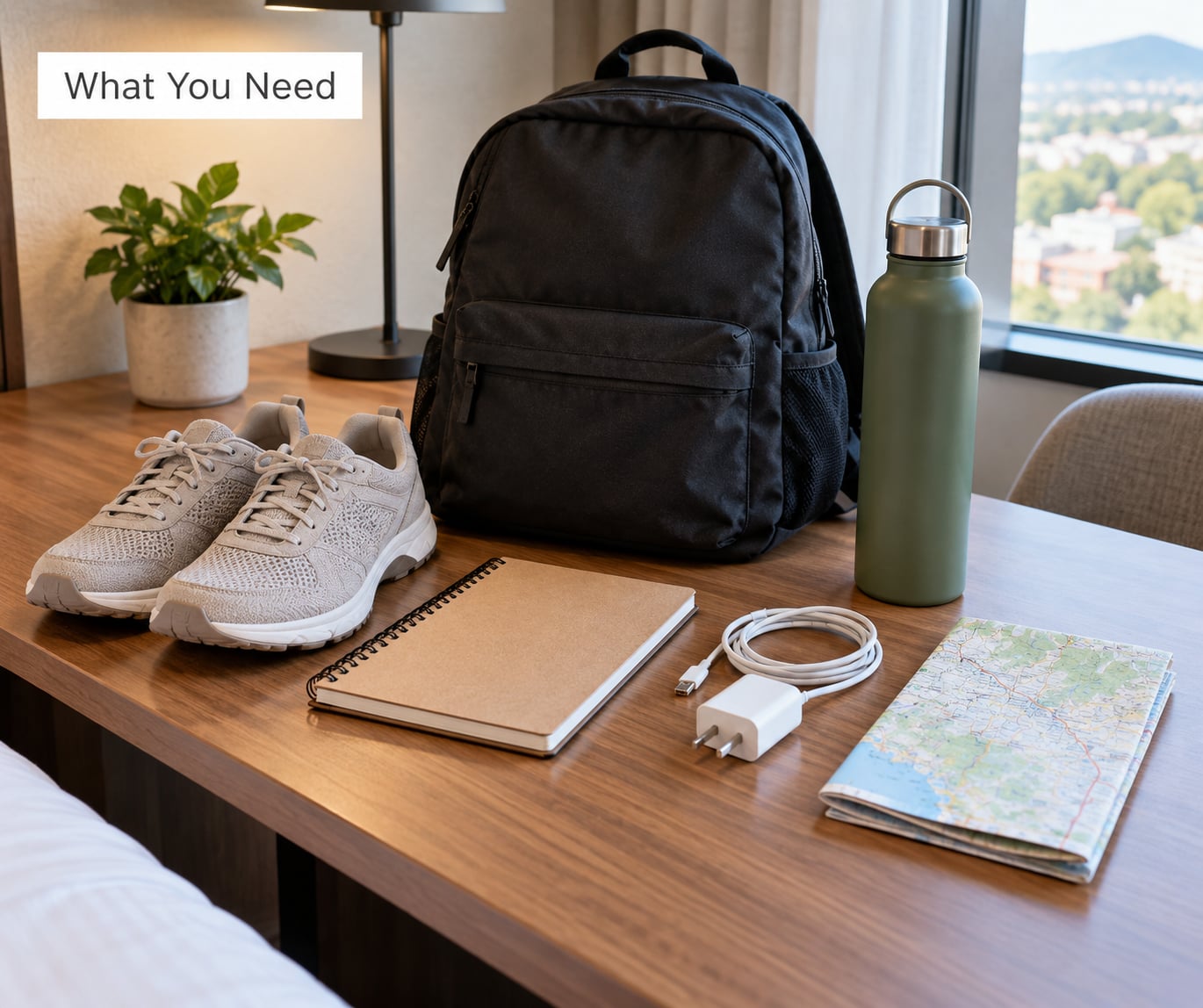
Most first-timers arrive with the wrong kind of preparation: enough to control every hour, and not enough to handle a bad one. The kit below is deliberately short, because the goal is a trip that stays pleasant when a train is cancelled and you are hungry and slightly lost.
A realistic first 72 hours. Not the whole trip. The arrival is where anxiety peaks, so decide it in advance: the transfer from the airport, the address of your accommodation written down in the local script, one meal nearby, and one thing booked for the first full day. If you only plan three days and those three days go well, the rest of the trip usually follows.
One anchor per day. An anchor is a single thing with a time attached: a museum, a market, a class, a long walk with a destination at the end. The rest of the day stays open. Free-floating afternoons are what turn a good trip into a lonely one, because there is nothing to be tired from and nobody to have spent the day with.
Backup activities, decided now. Rain is going to happen. Pick two indoor things and keep the details in your phone, so a wet afternoon is not also a decision. Most cities have a big museum, a covered market, a language class or a bookshop that works on any day of the week.
A communication plan. One person at home gets your flight details, your address, and your rough route. Agree on a check-in time each evening, even if the message is a single word. This does two useful things: it gives someone at home something concrete instead of a vague worry, and it gives you a small daily task that keeps you oriented.
Copies of your documents. Passport photo, a photo of your cards, and your travel insurance details stored somewhere you can reach without internet, such as a note in your phone or a printed sheet in your bag. Keep the physical originals with you unless you have a very good reason not to.
Working data and an offline map. Sort out a local SIM or eSIM before you land, not in the airport queue at midnight, and download the map of the area around your accommodation before you arrive. Being unable to load a map turns a small wrong turn into a real problem.
Comfort items, kept small. One worn-in pair of shoes for long days, a book for the bus, headphones, and something familiar from home. Nothing here is expensive, and each one buys you a bit of patience in a long evening.
Step-by-Step: Building a Solo Trip That Feels Enjoyable
Step 1: Choose a destination that suits your comfort level
Choose based on five practical things: how easy the language barrier is, how good the transport is, how safe it feels to walk at night, how much structure there is, and whether you can reach a restaurant or a shop without speaking to anyone. Pick a place you can navigate alone, not the place with the best-looking photos.
A first trip usually works well when the language is widely spoken or English is common, the main sights sit close together, and public transport is easy to read. Cities beat regions. A country with an overnight train culture and a strong hostel network can be ideal, but it is a harder first trip than a compact city where you can walk from one end to the other in an afternoon.
Ask yourself how much structure you actually want. Some people need a museum a day, some people want a beach and a book. Both are valid; the mistake is booking a fast, culture-packed itinerary for someone whose real problem is that they are tired after socializing, or booking a resort week for someone who will go stir crazy by day three.
Ask three locals the same question about a neighborhood or a beach and see if the answers line up. That is a cheap way to filter out the one spot everyone warns you about, and it gets you talking to people early without it being a whole social event.
Step 2: Make a flexible itinerary with built-in anchors
One anchor per day gives you just enough to get out of bed for, and just enough freedom that a bad morning does not ruin the day. A good anchor has a start time, a place, and an ending point. Without an ending point you often drift back to your accommodation by noon and spend the rest of the day waiting for evening.
Book only the first two nights. This is the single most useful rule on this list, because it converts a vague month of dread into two nights you have actually solved. Once you are there, booking the next night or two from a desk with coffee in front of you is easy, and a much better decision than a room you picked from a couch three months ago.
Keep one half-day a day unplanned. This is where the good stuff actually happens: the market you wandered into, the café that turned out to be the best meal of the trip, the bus you took on a whim and regretted for two hours and then loved.
Be realistic about distance. Aiming for six to eight hours of travel or walking per day sounds reasonable on paper and feels punishing in practice. Leave gaps in the schedule and you will still get to everything you came for.
Tell your check-in person the anchors, not just the address. A list of places is easier for them to picture than a city name, and it makes your evening message more than a location pin.
Step 3: Create one or two easy ways to connect
The trick to meeting people alone is to stand next to something rather than stand in the open. People are much easier to talk to when you are both looking at a map, a menu, or a cooking demonstration. Approaching a stranger who is already mid-meal is the one approach solo travelers on forums consistently say to skip, because those people have plans and do not want a new one.
A social hostel is the easiest option if you want conversation without arranging it. A common room with a long table, a kitchen people actually cook in, and a nightly thing the hostel organizes gives you repeated low-stakes contact with the same people, which is much easier than starting a conversation with a stranger every night. You are also close to staff and other travelers if something goes wrong with the room or the paperwork.
A free walking tour is the best single option for a nervous first-timer. You show up, you fall in step beside someone, and the guide carries the conversation for the first hour. Talking to the guide or to a person who is also clearly new is a natural way in. No plan is required from you.
A class beats a bar for most people. Cooking classes, language exchanges, drawing sessions, and walking groups all have a built-in activity, so you are not the one carrying the conversation. You leave with something you made or learned, which is a much better thing to talk about at dinner than a night out that could go anywhere.
Apps are worth having, with honest expectations. Most of them replace a small part of a trip, not the social fabric of one.
| App or community | What it is for | Best first-trip use |
|---|---|---|
| Hostelworld | Finding hostels and reading reviews | Filter for hostels with recent reviews mentioning organized dinners or group rooms |
| Free walking tours and city tours | Scheduled group walks led by locals | Book one for your first full day |
| Meetup | Local groups meeting around one interest | Look for walking, food, language or hobby groups in your city |
| Local Facebook or Reddit communities | Questions and advice from residents | Ask for neighborhood or restaurant recommendations |
| Language exchange apps | Trading conversation practice with a local | Useful in smaller cities where tourists are rare |
| Location sharing apps | Letting one person see where you are | Share with your check-in person, not publicly |
Learn five words of the local language, even badly pronounced ones. A greeting, please, thank you, excuse me, and how much are enough to unlock a surprising amount of help, and using them turns a transaction into a small human moment. Being visibly trying gets you patience from people, which is most of what you need on a hard day.
Step 4: Prepare for quiet moments instead of trying to eliminate them
Evenings are consistently the hard part, and a lot of first-timers report feeling lonelier on a long solo trip than on their first few days, when everything was new. The difference is that the novelty was doing the work for you. Once you plan your own evenings, you stop waiting for something to happen to you.
Plan a rough shape for the evening rather than a full plan. Dinner at seven, then a fixed thing at eight or nine that you can look forward to, even if it is a film or a stretch of reading in a common room. Nights get easier when there is a next thing on the clock.
Write down your night three routine now, while you are calm. It should be short enough that you will still do it when you feel low: eat somewhere with other people in it, take the long route back, be back in your room by nine, phone home for two minutes, and read until you stop thinking about the day.
Have a small kit for boring stretches of transit and dead evenings: a downloaded playlist, a book, a card game with a stranger you already met, or a walk to a neighborhood you have not seen. The goal is not to fill every minute. It is to have one thing to do when the alternative is sitting alone with the feeling that nobody is coming.
When a day breaks down, treat it as a logistics problem rather than a mood. Missed train, wrong station, closed attraction, locked phone in a bag. Each of these has a next step: check the official transport app, ask a station worker or a shop rather than a tout, and rebook. A problem with a solution takes up much less space in your head than an unstructured feeling.
Eating alone is the moment nearly everyone dreads, so plan for it deliberately. Sit at the counter rather than a single table where you are visible, or ask the staff where people eat, or take the first outdoor table. Read something rather than performing relaxation. Nobody is watching you, and the discomfort lasts about eight minutes.
Also plan for the micro-moments nobody warns you about: taking a photo of yourself, saying goodbye to someone you met for one coffee, and the arithmetic of a taxi fare for a single person. Have a small answer ready for each. A propped phone with a ten-second timer, a text message the night before, and a habit of booking the ride before you regret it.
Step 5: Check in with yourself before and after the experience
Nearly every first-timer describes the same shape once you ask them, and knowing it in advance changes how you read the bad days. It goes something like this.
| Day | What it usually feels like | What helps |
|---|---|---|
| Day 1 | Tense, overstimulated, mildly excited; too busy to notice being alone | Keep plans small, confirm the next two nights, walk off the adrenaline |
| Day 2 | New enough to be fun, unstructured enough to start floating | Add a social anchor, a class or a group dinner |
| Day 3 and 4 | The dip: evenings hit hardest, other couples look hard, motivation drops | Use your night routine, call home, be with people at dinner |
| Day 5 and 6 | A rhythm appears; you know your routes, some light familiarity | Do the harder thing you have been putting off |
| Day 7 onward | Own company starts to feel normal, sometimes boring, rarely lonely | Let the trip settle into your own rhythm |
Notice that the low point is in the middle, not the end. The instinct is to cut the trip at day four, which means you keep the hardest version of the experience and none of the payoff. If you know day three is the dip, you can plan around it instead of reacting to it.
Keep a five-minute nightly check-in, and only three questions. Did something surprise me today? What am I doing tomorrow? What did I manage on my own? That last one is the one that builds the confidence, because it turns a trip from something that happened to you into something you handled.
Before you go, name one thing you would be embarrassed to admit you were worried about, and one thing you are quietly excited about. Splitting those two lists is usually a relief, because most first-timers carry an enormous pile of small anxieties that dissolve the moment they hit a real city.
Common Mistakes and Simple Fixes
Mistake one: planning every hour. Over-planning is the most common coping strategy and it makes the first days worse. Knowing everything in advance means the first unscheduled hour feels like something going wrong. Fix: one anchor a day, everything else decided that morning.
Mistake two: retreating to be safe. Some first-timers book a private room in a quiet neighborhood and avoid everyone, which removes the loneliness in a way that also removes the trip. Fix: stay somewhere social for the first two or three nights, and switch to a private room for the last part of the trip if you want a decompression stretch.
Mistake three: comparing your trip with other people’s. A person posting a café on day nine is not a first-timer. Their ease comes from a routine that took them a week to build. Fix: measure the day against yesterday’s day, not against somebody’s highlight.
Mistake four: every evening alone. Some people treat any evening without plans as a wasted evening and go to bed at nine, which removes the exact hours when you are most likely to feel isolated. Fix: one recurring social thing a week, even something small, so you are never relying on chance to fill the hardest slot.
Mistake five: treating unfamiliarity as danger. A neighborhood you have never seen looks worse than it is, and this is why people skip destinations they would have loved. Fix: walk your immediate area for an hour in daylight after you drop your bags, learn the route between your accommodation and the nearest café and station, and ask three locals one question. Ask the same question of three people; the answers you get are far calmer than the internet’s version of that neighborhood.
Mistake six: handling other people’s worry as your own problem. The fear that a solo trip is dangerous is often somebody else’s fear, repeated so often it feels like evidence. Set a specific time to talk it through before you go, then stop discussing it. If your family is not calming down, the practical answer is a plan they can see: an address, a check-in time, and insurance details. Concern is easier to carry when it has a shape.
Mistake seven: skipping the trip because the first three days felt hard. Everyone’s first solo trip has a bad evening. Extending one night so you get through the dip is often the difference between a story you tell for years and a trip you describe as “I did not really click with it.”
Mistake eight: leaving on the last night with nothing booked. A flight or train at the end of a week of good evenings can be a strange, flat way to close. Book something small for the final day, even a café you have been meaning to return to, so the trip has an ending you chose.
Frequently Asked Questions
Is it normal to feel lonely on my first solo trip?
Yes, and it is predictable. Most first-time solo travelers describe a low point in the evenings of day two through day four, once the excitement of arriving has worn off but the trip is not long enough to have built a routine. The feeling comes from having nobody to share the day with, not from being somewhere wrong. Plan one social thing a day and a simple evening routine and the dip usually passes.
How do I eat alone at a restaurant without feeling awkward?
Pick the counter or a shared table instead of a single table facing the room, and order before you have time to sit with the discomfort. Read something, look at the menu, or work out where you are going next. The awkwardness is asymmetric: it feels enormous to you and is invisible to everyone else in the restaurant, and it usually fades within about ten minutes of the food arriving.
What if I do not meet anyone while traveling solo?
You can still have a good trip, and that is genuinely common on a first visit. Book one structured thing with a group on the day you most want company, usually a class, a group dinner, or a walking tour, and you will meet people without needing a personality for it. If the trip is otherwise working, a day without conversation is a rest day, not a failure.
How can I stay safe while traveling alone for the first time?
Stay somewhere central, walk your area for an hour in daylight after you arrive, and use official taxis or public transport rather than unofficial ones. Tell one person your address and route, agree on an evening check-in, and keep a photo of your documents and insurance details offline. If a vendor or a stranger makes you uncomfortable, leave, and notice that your reaction is information, not a rule you have to argue with.
Should I choose a hostel or a private hotel for my first solo trip?
For the first two or three nights, choose somewhere social. A hostel common room, a kitchen people cook in, and staff a few steps away make the early days easier. After that, switch to a private room if you like, since the calm end of a trip feels like a reward. A private room the whole way is fine too, but book a group activity or two so you are not alone every evening.
How do I recover when a solo travel day goes badly?
Treat it as a logistics problem first: missed train, closed site, wrong station, lost phone. Ask a shop worker or a station employee rather than a tout, rebook, and get food somewhere with people in it. Then do one deliberately pleasant thing, an ice cream or a drink, before deciding the day was a loss. Bad days are usually followed by good ones, and most first-timers remember the recovery more than the problem.
How to travel solo for the first time without feeling lonely
Pick a city you can navigate on your own, book the first two nights, and choose one anchor for each day. Add one thing a day that puts you near other people, and one evening ritual you would actually enjoy repeating.
That is enough to travel solo for the first time without feeling lonely for the whole trip. Confidence on these trips is not built by having a great night out in an unknown city; it is built by a series of small, repeatable choices that you made and handled, most of which nobody else will ever know about.