Ordering at a specialty coffee shop without feeling awkward comes down to a drink, a size and a milk, and every part of that is optional. A small drip is a complete order. A 12 oz latte with oat milk, extra hot, is a complete order. No barista expects you to know the vocabulary, and none of them is grading you on it.
The awkward feeling is real, and it usually comes from one of three things: a menu written in Italian, a counter where everyone else seems to know what they want, and the fear of being asked a question you cannot answer. All three are easier than they look, and the whole interaction takes about forty seconds.
Table of Contents›
- What You Need
- Step-by-Step: How to Order at a Specialty Coffee Shop
- How to Order at a Specialty Coffee Shop Without Feeling Awkward
- Start With the Drink You Already Know
- Choose a Size Without Guessing
- Ask About Milk and Customization Simply
- Use the Menu Codes and Brewing Terms
- Answer Questions and Ask for Recommendations
- Pay, Move Aside, and Check the Order
- Common Mistakes
- Frequently Asked Questions
- What do I say when entering a specialty coffee shop for the first time?
- What if I do not understand the coffee menu?
- How do I change a coffee order without sounding rude?
- Should I order ahead at a specialty coffee shop?
- What if the barista recommends a drink I have never tried?
- How do I politely mention a milk allergy or cross-contact concern?
- Conclusion
What You Need
You do not need anything. That is the honest answer, and it is worth saying plainly because the imagined difficulty is mostly imagined. No equipment, no preparation, no vocabulary test.
What helps is knowing four things before you walk in:
- One drink you already enjoy. You have more options than you think, and starting from something familiar makes the first order painless.
- The rough size language. Specialty cafes usually use short ounces, but plenty still use tall and grande.
- Which milks the shop carries. Dairy is always there. Oat, almond and soy are common, and each cafe has its own strengths.
- That every customization is negotiable. Syrup, temperature, foam, ice, extra shot, decaf, half caf, no sweetener. You can ask for almost anything.
If you know those four, you can order anywhere in the world without feeling like a tourist.
Step-by-Step: How to Order at a Specialty Coffee Shop
How to Order at a Specialty Coffee Shop Without Feeling Awkward
The simplest useful order has four parts, said in this order: the drink, the size, the milk, then anything you want changed.
“Could I get a medium latte with whole milk, extra hot?” That sentence covers it. Most baristas hear ten variations of it before nine in the morning. If you only know the drink, say the drink: “Just a cappuccino, please.” They will fill in the rest.
A clear, uncomplicated order is not a lesser order. It is the one most people give, and the people who order complicated drinks are usually just saying four ordinary things in a longer order. Anyone answering you kindly is not tracking your performance.
Start With the Drink You Already Know
Specialty menus look long because the same handful of drinks appear under many names. In practice there are three families, and you almost certainly already drink one of them.
- Black coffee drinkers: drip or batch brew (the default filter coffee), pour over if you want a single origin brewed to order, cold brew if you like it cold and steeped rather than iced, or an espresso if you want it intense and short.
- Milky coffee drinkers: latte for the most milk and the least foam, cappuccino for equal parts, flat white for a smaller, stronger, silkier cup, cortado for a shot cut with a little milk.
- Sweet coffee drinkers: mocha, a latte with chocolate, or any drink with vanilla or caramel syrup. Ask for it lightly sweet rather than apologising for it.
- Tea drinkers: chai, matcha lattes, or plain hot tea. Ordering tea at a coffee bar is completely normal and nobody will comment on it.
Jargon shifts from shop to shop and from country to country, so treat every name as a hint rather than a specification. A barista who hears an unfamiliar name will describe it for you.
Choose a Size Without Guessing
Most specialty cafes pour an 8 oz, a 12 oz and a 16 oz, and the only one that matters is the one you want. Sizes are also usually tied to espresso, so a larger milk drink usually gets an extra shot rather than just more foam.
Two phrases remove the guesswork. Say “I’ll have a small, please” or ask “What size is the medium here?” Baristas are used to the second question, and the answer is often an ounce count.
To check that your order landed, repeat the short version: “So, a 12 oz latte with oat milk. Got it.” It costs you three seconds and it catches a mistake before the drink is made.
Ask About Milk and Customization Simply
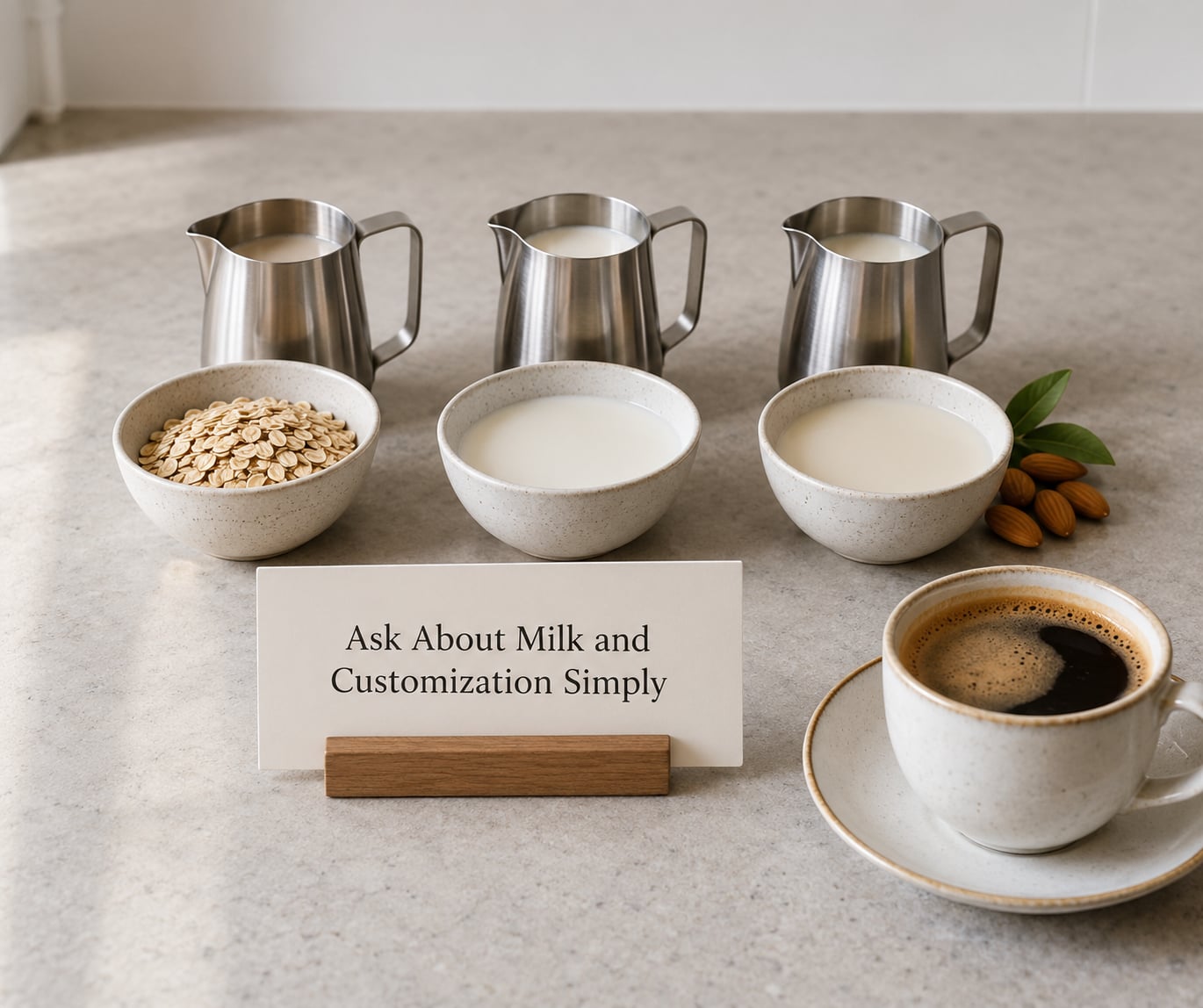
Milk is the easiest customization to ask for: “with whole milk,” “with oat milk,” “with no milk, black please.” Whole and skim are always there. Oat is the most common plant milk and froths well. Almond and soy turn up regularly too, and a cafe that has run out will say so rather than guess.
Other changes worth knowing, all one short phrase each: extra shot, decaf, half caf, less ice, no ice, less foam, extra foam, no sweetener, half syrup, vanilla or caramel syrup, and iced with milk on the side if you want to control it yourself.
Keep preferences and allergies separate. “Less sweet” is a taste and needs no explanation. An allergy is different: say the word allergy, name the milk, and ask about cross-contact on the equipment. Baristas take that seriously and change how they make the drink, so it is worth being explicit rather than hoping.
Use the Menu Codes and Brewing Terms
Here is what the menu words actually mean. Strength is my rough shorthand, not a measurement.
| Drink | Espresso | Milk | Foam | Strength | What it tastes like |
|---|---|---|---|---|---|
| Espresso | One shot | None | None | Very strong | Small, dense, syrupy |
| Doppio | Two shots | None | None | Strong | Espresso, doubled |
| Americano | One or two shots | None | None | Medium | Espresso cut with hot water |
| Long black | Two shots | None | None | Strong | Espresso cut with more hot water |
| Cortado | One shot, cut | A little | A thin layer | Medium | Espresso softened by milk |
| Gibraltar | One shot, cut | A little | Very thin | Medium | Same idea, sweeter and softer |
| Macchiato | One shot, marked | A splash | Dollop on top | Strong | Espresso with a spot of foam |
| Flat white | Two shots | A lot | Microfoam | Medium strong | Coffee-forward and creamy |
| Cappuccino | One or two shots | Equal parts | Thick cap | Medium | Balanced, foamy, classic |
| Latte | One or two shots | Most of the cup | Little | Mild | Long, milky, easy to drink |
| Mocha | One or two shots | Most of the cup | Little | Mild | Chocolate and coffee |
| Cold brew | None, steeped | Usually none | None | Medium strong | Smooth, low acid, served cold |
| Batch brew | None, filter | Usually none | None | Medium | The house drip coffee |
| Pour over | None, filter | Usually none | None | Medium | One origin, brewed to order, clearer |
The macchiato is the one word that genuinely causes mistakes. Traditionally it means espresso marked with a dollop of foam, which is nearly straight espresso. Big chain cafes turned it into a sweet caramel drink. If you want the sweet version, ask for a latte with caramel and skip the word entirely.
Words that look unpronounceable are easier than they look. Say kor-TAH-doh for cortado, mah-kee-AH-toh for macchiato, gi-BRAL-tuhr for Gibraltar, and flat white the English way it is usually said. If a word comes out wrong, baristas have heard it roughly four hundred times and will just repeat it back correctly.
Chain vocabulary does not always translate. These are the swaps that matter:
| If you are used to saying | What it usually meant | What to say at a specialty cafe |
|---|---|---|
| Venti or Grande | Large or medium | A 16 oz or a 12 oz |
| Skinny | Less milk | A latte with less milk |
| Extra hot | Hotter than usual | Extra hot still works, or just say how you like it |
| Half caf | Decaf with a shot of regular | Half caf, or decaf with an extra shot |
| Caramel macchiato | Sweet coffee drink | A latte with caramel syrup |
| Coffee with a shot | Espresso added to drip | An americano |
| Regular | Nothing special, full-fat dairy | Whole milk, or say nothing at all |
| Light roast | A milder bean | Ask which roast is on the batch brew today |
Two brew terms come up at the counter. Batch brew is the pot of filter coffee they pour from all morning, and it comes out fast. Pour over is a single origin brewed one cup at a time, so it takes a few extra minutes and tastes brighter and more distinct. Ask which single origin is on batch brew and the barista will usually tell you the country and the roast.
Answer Questions and Ask for Recommendations
Baristas ask questions because they are building a drink, not testing you. The ones that come up are hot or iced, how much milk, how many shots, syrup or no syrup, and what roast you prefer.
Any of these answers work: “Iced, please.” “Whole milk.” “Extra shot.” “No syrup.” If a question genuinely needs a preference you do not have, ask one back: “What do you recommend?” or “I usually like my coffee sweet, what would you pick?”
The easiest way out of a blank moment is to give a constraint rather than a guess. Say what you do like and what you do not, then let the barista build it: “I like coffee with milk, not too sweet, and I’d rather not have foam.” A barista is handed that every morning and knows what to do with it.
Travelling and unable to speak the language? Ask for the most popular milk drink, or point at the menu and say “this, hot.” Phone translation handles the menu itself. A smile and “thank you” covers the rest, and in coffee shops nearly everywhere, a nod at the grinder means yes to whatever was just made.
Pay, Move Aside, and Check the Order
Wait until the person in front of you has ordered and stepped aside before you speak. Say your order once, listen back to the price, and have your card or phone ready before you reach the till. That rhythm is all that most people find difficult.
When your drink is called, check that the name or order on the cup matches what you asked for before you leave. If it is wrong, catch the barista calmly and early: “Sorry, I asked for oat, this is dairy. Could I have it remade?” A remake is a small cost to the shop. You will never be asked to justify it.
If the wait is longer than the ticket suggests, ask “Is my drink still coming?” rather than standing silently. And if you are rushing, order at the till or through the shop’s app, say that you are in a hurry, and skip the queue at the bar entirely.
Common Mistakes
Overexplaining. Adding “I have never had one of these before, sorry” makes a normal order heavier. If you want context, ask for it instead: “What is a cortado, actually?”
Apologising for basic questions. Nobody apologises for asking what a size means. Asking instead of apologising is what baristas expect from a good customer.
Ordering six changes at once. Extra shot, half syrup, oat milk, less ice, no foam, decaf. That is hard to hear over an espresso machine and easy to mishear. One or two changes is plenty, and you can add more at the counter if the drink needs it.
Using chain jargon. Venti, skinny and breve do not transfer cleanly, and guessing produces the drink you did not want. Use the ounce sizes and the milk name instead.
Hiding an allergy. Asking for oat milk without mentioning an allergy is not a preference request, and it gets treated as one. Say the word allergy and mention the equipment.
Skipping the hot or iced question. That is the one detail nobody guesses, so an order that leaves it out often arrives as a hot drink you cannot drink on the walk.
None of this matters nearly as much as it feels like it does. Counter conversation about coffee is close to the friendliest small talk in retail, and being slightly unsure is not visible from the other side of the counter.
Frequently Asked Questions
What do I say when entering a specialty coffee shop for the first time?
Wait until the person ahead of you has ordered, then say the drink, the size, the milk and hot or iced. u0022Could I get a 12 oz latte with oat milk, extra hot?u0022 is a complete order. If you only know the drink, say just that and let the barista fill in the rest. Skip any apology about being new; nobody at the counter is keeping track.
What if I do not understand the coffee menu?
Most specialty menus contain the same three families: filter coffee, espresso with milk, and tea. If you drink coffee black, order drip, batch brew, pour over or cold brew. If you drink milky coffee, order a latte, cappuccino, flat white or cortado. Anything on the board you cannot place, ask the barista, and you will get a straight answer in one sentence.
How do I change a coffee order without sounding rude?
Correcting an order is part of normal service, not a complaint. Say what you asked for and what arrived, keep it short, and stay friendly: u0022Sorry, I asked for oat milk. Could you remake it with oat?u0022 Catching it before you leave the counter takes seconds. Baristas remake drinks every shift and would rather fix it than hand you something wrong.
Should I order ahead at a specialty coffee shop?
Ordering ahead helps in exactly two situations: you are in a hurry, or the counter feels intimidating. Use the shop’s app or order at the register, give the same drink, size and milk details, then wait on the side for your name to be called. If you are not rushed, ordering at the counter lets you ask questions, which is usually the whole point of going.
What if the barista recommends a drink I have never tried?
Take it. A recommendation is the fastest way to find a drink you love, and baristas genuinely enjoy giving one. Say what you normally drink so they can steer you: u0022I usually drink a milky coffee, not too sweet.u0022 If the suggestion does not suit you, say so plainly and ask for the usual instead. Nothing is locked in, and you can always try the recommendation next time.
How do I politely mention a milk allergy or cross-contact concern?
Use the word allergy, name the specific milk, and ask about the equipment: u0022I have a dairy allergy. Is the steam wand cleaned with milk? Could you make this on the shared wand?u0022 Baristas take allergy requests seriously and change their process when you ask. Ask at the start of the order rather than after the drink is made, because equipment cleaning takes time.
Conclusion
The easiest first move is to order something you already drink, add a size, add a milk, and stop there. If the menu makes you pause, say “What do you recommend?” and let the person behind the counter do the work they do all day.
Learning how to order at a specialty coffee shop without feeling awkward is not about performing coffee knowledge. It is about knowing that a short sentence is a full order, and that asking a question at the counter is the normal way to use one.