How long is too long to sit in a cafe with one coffee? For most people the comfortable answer is 60 to 90 minutes on a single drink, and somewhere around two to three hours is where staff start counting tables instead of minutes. There is no written rule anywhere. What decides it is how much of the room you are using, whether you order again, and whether the place is busy.
I have been the person at the table with the empty cup and the laptop open far too many times, and I have also been the person on shift wiping down the same table three times in a shift. Both sides feel unfair until you stand in the other one. This guide is an attempt to hand you the judgement staff actually use, plus the scripts for the two moments people dread: wondering whether to order again, and being asked to move.
Table of Contents›
- How Long Is Too Long to Sit in a Cafe With One Coffee?
- Is There a Perfect Time Limit?
- What Changes the Appropriate Length of Your Visit?
- What you ordered
- Where you sat
- What you are doing there
- What the room is doing
- What the cafe is telling you
- How Do You Know When It Is Time to Leave?
- Can You Linger Longer Without Overstaying?
- How Do Different Cafe Cultures Affect the Answer?
- Takeaway-focused coffee counters
- Neighbourhood independents
- Bakery cafes
- Hotel and airport lounges
- Libraries and workspace cafes
- Specialty coffee bars
- Frequently Asked Questions
- Can I sit in a cafe for two hours with one coffee?
- Is it okay to work from a cafe with only one drink?
- How do I know if I am taking a table too long?
- Should I order another coffee to keep my table?
- What if I need to use the cafe bathroom but do not buy anything?
- Conclusion
How Long Is Too Long to Sit in a Cafe With One Coffee?
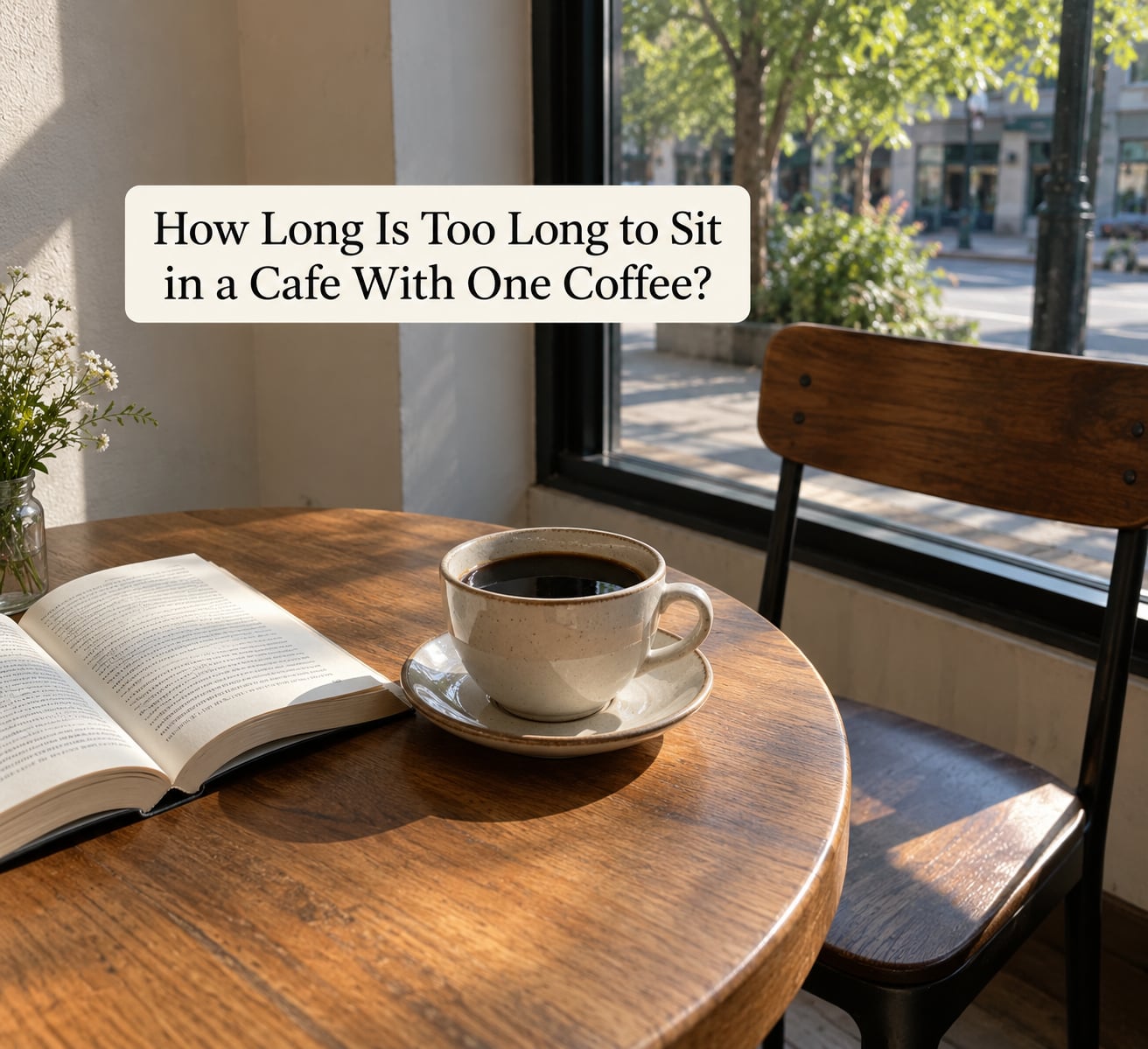
Two to three hours on one coffee is the practical ceiling in a busy shop, and the 60 to 90 minute mark is where most people start thinking about leaving. Past that, a second order or a move is fair, because the table you are holding is one the cafe cannot turn.
That number is a starting point, not a law. A quiet Tuesday morning with five people in a twenty-seat room is a different situation from a Saturday queue out the door. The drink matters too: a 6 oz espresso is gone in ten minutes, while a slow filter or a matcha is meant to last an hour. And the reason you are there changes what the room expects from you. Someone reading a paperback for forty minutes and someone running a full afternoon of calls from the same chair are making very different claims on that seat.
Here is the honest summary: the clock matters less than the ratio of time spent to what you buy, and one person alone on a four-top during a lunch rush is the real problem in most rooms, not the duration itself.
Is There a Perfect Time Limit?
No, and anyone who gives you a single number is describing their own cafe rather than yours. What you can get is a set of working defaults that fit most situations, plus a clear sense of which situations break the default.
The reason one number fails is that cafes sell seat time through drinks and food, and the price of that seat time changes with demand. An empty room has idle capacity, so a long stay costs the shop nothing real. A full room has a queue, and every minute you sit is a minute someone outside is standing. Same customer, same coffee, opposite verdicts.
| Situation | Comfortable stay | What staff read it as |
|---|---|---|
| Takeaway coffee standing at the counter | 5 to 15 minutes | Nothing to read. The chair is not yours. |
| Quick meet-up or a catch-up with a friend | 45 to 90 minutes | Normal. The drink is doing its job. |
| Reading, a crossword, gentle admin | 60 to 120 minutes | Calm and profitable if you stay off the big tables. |
| Laptop work session | 90 to 150 minutes per order | Expected, provided you re-order and the room has room. |
| Two people sharing a four-top during a lunch rush | 30 to 45 minutes | The most complained-about sight in most cafes. |
| Study session in a quiet cafe | 2 hours, then reorder | Fine when signage invites studying. |
| Empty cafe, no queue, off-peak | Three hours is usually fine | Rarely questioned. Nobody is waiting. |
| Full room, visible queue | Under 45 minutes | You are now the reason someone is standing. |
One more variable sits underneath all of these: how often you come back. Regulars across forum threads keep landing on roughly one order every ninety minutes as the unwritten rate, and it is a useful number because it works regardless of how long the individual drink takes. Order on arrival, then again when you are most of the way through your current one, and you will rarely overstay by much.
What Changes the Appropriate Length of Your Visit?
What you ordered
A single espresso buys you minutes; a flat white or a filter bought to be splayed across a book buys you an hour. Cold drinks and anything with ice melt into a problem nobody wants to sit next to, so they also shorten the natural stay. Ordering food changes everything, because a plate justifies a table in a way a cup never does. Pastries count for less than a full meal but more than nothing, which is why a bakery counter and a kitchen are different kinds of room.
Where you sat
Table maths is the single biggest complaint baristas raise. One person on a four-top during a lunch rush reads badly from across the room, even if you are being quiet and have been there an hour. Take the two-top by the wall. If you are with one other person, do not spread across a six-top. Communal tables are the exception that proves the rule: they are built for laptops, and nobody minds you there.
What you are doing there
Reading and writing are the quietest activities in any cafe. Laptops are fine in most independents now, less fine where signage says otherwise. Calls are the fastest way to shorten your welcome: speakerphone, or any call where you have to raise your voice, is the behaviour that gets remembered by staff and disliked by the room. Headphones and a low voice solve almost all of it.
What the room is doing
The 8:00 to 9:30 window and the 12:30 to 14:00 window are the busiest in most independent cafes. The trough between them, roughly 9:30 to 12:30, is the best working window there is. In the late afternoon the room tends to fill with people waiting for transport or for other people, which makes it socially forgiving of another waiter. Watch the queue, not the clock.
What the cafe is telling you
Signage at the door and the counter beats every article you read online. Cafes that want laptops gone say so, and cafes that advertise themselves as workspaces expect the opposite. Free refills also change the maths: if your filter coffee is topped up for nothing, the pressure to re-order drops, so order once and settle in.
How Do You Know When It Is Time to Leave?
Nobody enjoys being asked to move, which is why almost everyone reads the indirect signals instead. These are the ones regulars actually watch, and none of them require anyone to say anything out loud.
- Your drink is finished and there is nothing on the table. An empty cup with no book, no laptop and no second drink is the clearest signal you can send. It says you are done but not leaving.
- The machine is being cleaned down. Staff reset the bar and wipe surfaces on a rhythm. If that cycle has happened twice since you sat down, the shift is moving on and you are in the way of it.
- Chairs start going up on other tables. Stacking chairs is the loudest polite signal in any cafe. It means the room is being closed, and you should be gathering your things before the questions start.
- Someone hovers near your table without speaking. The approach-and-retreat pattern means the staff member wants to ask if you are ready to order or ready for a second round. It is not a confrontation. Answer the question.
- A queue has formed, or two people are waiting near the entrance. Nobody will say anything, but you have become the reason the room is not turning over.
- You are uncomfortable and it is coming from you. Guilt, restless energy, the need to check whether anyone is watching you. When the visit starts costing you attention rather than giving it back, the visit has already ended even if your cup is half full.
- The clock says two to three hours on one order. This is the last sign on the list, not the first. Everything above it outranks it.
Can You Linger Longer Without Overstaying?
Yes, and the trick is to make your extended stay visible as a purchase rather than as an occupation. Almost every tactic below is just a way of keeping the ratio honest.
- Ask about refills before the cup is empty. A quick “is this a bottomless cup?” takes two seconds and removes the awkward pause of an empty mug you have not finished.
- Order something that takes time. A second drink on the slower side, a toast, a bowl of soup, or a cake with a fork and a plate signals that you intend to be there for a while, and gives staff nothing to complain about.
- Re-order on your way to the counter. Filling your water from the tap or binning your cup on the way past the till is the easiest way to re-order without making it a moment.
- Take the small table, always. You can stay longer in a two-top than a six-top for the same cost, and nobody does the maths for you.
- Move outside before the room turns. A cafe block in a city is often three cafes deep. Finish your cup, walk two minutes, sit somewhere new, and the pressure resets completely. It also solves the solo traveller version of this problem, where the table is really just somewhere to be warm between transport legs.
- Leave ten minutes before the next rush lands. Finishing your coffee at 12:15 rather than 12:45 is the difference between a smooth exit and an apology.
There is one more case worth naming, because it is the one people feel worst about. If a staff member does come over, the answer is almost never adversarial. They are usually asking whether you are ordering again, whether everything is fine, or letting you know the cafe is closing in twenty minutes. A short script covers it: “Thanks for checking in. I will order one more, or I will head off shortly.” Say it plainly, smile, and either buy or go. Sitting there in silence while someone waits for an answer is what makes the moment feel bad, not the question itself.
If you genuinely need five hours, the honest answer is that a cafe is the wrong room for it and you already know that. A coworking day pass, a library desk, or a bookshop cafe with a policy that expects long stays will serve you better, and the cafe economy works better for it too. You can still come in for the first hour, get settled, and move when the working block is done.
How Do Different Cafe Cultures Affect the Answer?
Venue type matters more than country, and country matters more than most guides admit. Here is how the same one-coffee visit lands in different settings.
Takeaway-focused coffee counters
These are retail, not rooms. A cup is a transaction at the counter, the seating is two or three stools, and staying at the bar with a laptop blocks a queue. Order, drink, go. The idea of an hour here is already wrong.
Neighbourhood independents
This is where the ninety-minute re-order rhythm actually lives. Small rooms, tight margins, and owners who know their regulars by name. A regular who orders the same thing every morning can stay three hours at 7am with nobody blinking, because the shop is counting on them coming back tomorrow. That exception is real, and it is also the reason a first-timer sitting three hours feels different from the person who does it every day.
Bakery cafes
Food is the centre of the room, so a plate buys a great deal of time. These tend to be tolerant of long stays because table turns come from breakfast traffic. Order a pastry and a coffee in the morning and you have bought a couple of hours legitimately.
Hotel and airport lounges
The rules here are printed and paid for. Guests expect long, quiet stays because the whole point of the space is that you are not being bothered. If you are not a guest, the same three-hour tolerance often disappears, so check before you settle.
Libraries and workspace cafes
Two different rooms with one shared feature: nobody expects you to buy anything, because the funding is elsewhere. In a library you may be asked to leave after a couple of hours even though you have spent nothing. In a workspace cafe, laptops are the point and time limits are posted on the wall.
Specialty coffee bars
These have the shortest tolerance of all. A single-origin pour-over is a fifteen-minute experience with a built-in ending, the room is small, and the bar is often two seats wide. Sit, drink, move on.
Across borders the framing shifts too, in ways that are useful to know before you travel. In South Korea, a widely reported convention is roughly one drink per person, so ordering again at the ninety-minute mark is not optional politeness, it is the expectation. Much of southern Europe works the other way around: nobody expects you to order immediately, and tables are held longer over a slower drink. UK and US independents sit somewhere in the middle with the two-to-three-hour rule of thumb. None of these are written laws, and all of them get decided by the person running the room.
Frequently Asked Questions
Can I sit in a cafe for two hours with one coffee?
Two hours on one drink is inside the normal range in most independent cafes, especially if the room is quiet and you took a small table. Think of it as the upper half of the comfortable window rather than the edge of it. If a queue forms or chairs start going up, that overrides the number every time. If you want to stay past two hours, a second order removes the awkwardness entirely.
Is it okay to work from a cafe with only one drink?
Yes, in most places, as long as you re-order roughly every ninety minutes and keep calls off speakerphone. Laptops are normal in independents and in most chains, though signage at the door wins if it says otherwise. Headphones, a low voice, and a table size that matches your party are what actually matter to staff. Duration matters far less than noise and table maths.
How do I know if I am taking a table too long?
Watch for indirect signals rather than a clock. An empty cup with nothing on the table, the machine being cleaned down twice since you arrived, chairs stacking on nearby tables, a queue forming, or a member of staff hovering near you. Any one of those means order again or start packing up. The most reliable check is honest: if you have stopped enjoying the visit, leave.
Should I order another coffee to keep my table?
Order another drink if you want to keep the table, and there is no shame in it. A second drink is the simplest way to reset the ratio between time spent and money spent, and a slow drink plus a pastry stretches a table out legitimately. Staff would almost always rather serve you a second cup than watch an empty table and a finished customer. Ask about refills while your cup is still low.
What if I need to use the cafe bathroom but do not buy anything?
Buy a drink. There is no reason to make it more complicated than that, and it settles the whole question of how long you should stay. If you have already ordered, use the bathroom whenever you need to without announcing it. The awkward version is only the one where you use facilities, take a long seat, and leave without ordering. For anything longer than a genuine visit, use a public restroom before you arrive.
Conclusion
Use 60 to 90 minutes on one drink as your starting point, and treat two to three hours as the ceiling rather than a target. After that, the room decides: order again, or leave.
Before you settle, glance at the door and the queue. If either looks busy, take the smallest table available and plan your second order around when the rush breaks. Check in with yourself once an hour, and make your exit while leaving is still quiet. Nobody minds a guest who leaves well; the version of this people remember is the person who stayed until the chairs were going up.