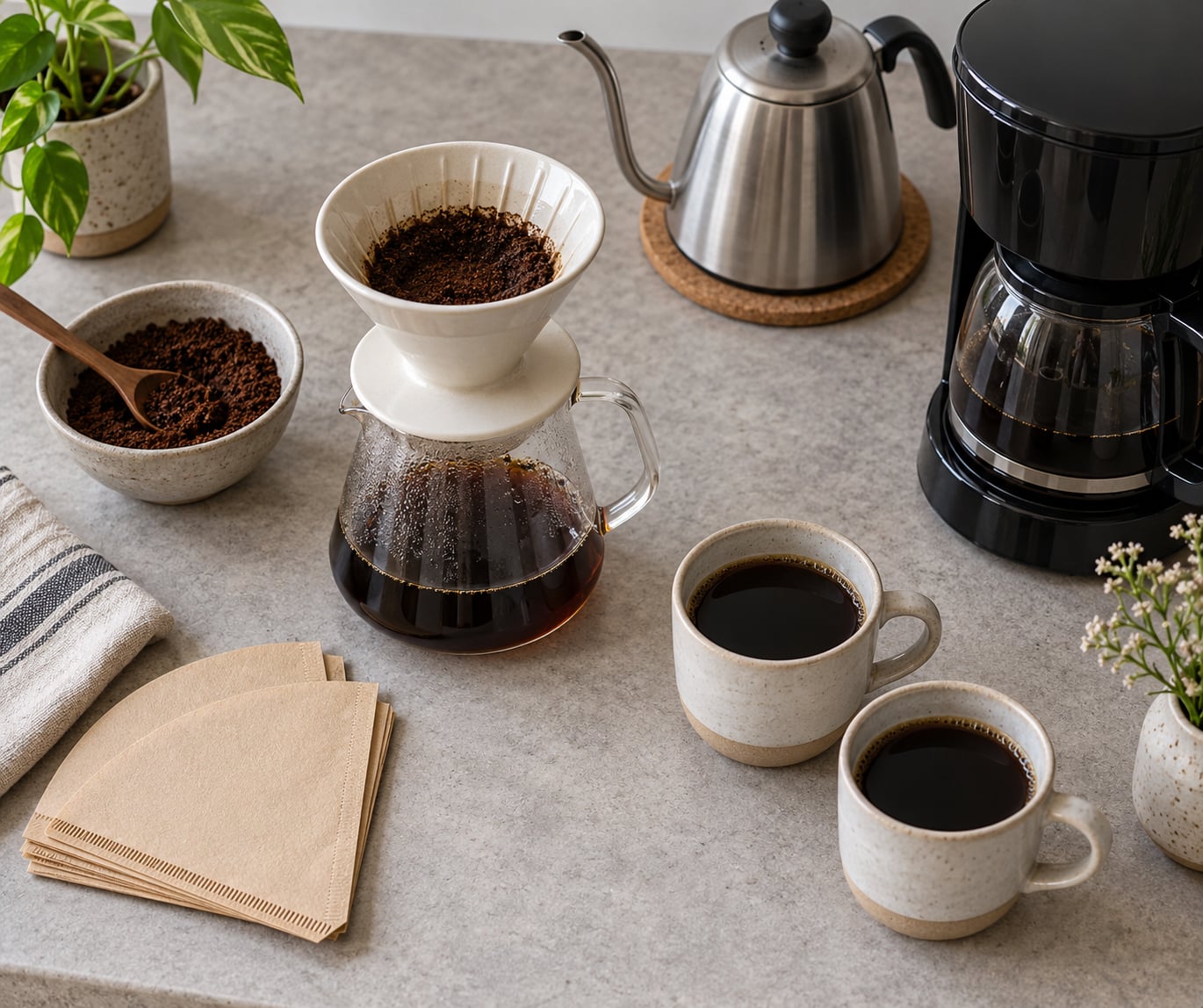
Pour-over coffee is brewed by hand, with hot water poured slowly over ground coffee in a filter cone, while drip coffee is brewed by a machine that heats water and releases it through grounds into a carafe. Both are filter brews using hot water and gravity, and the real difference is who controls the water and how much attention the brew takes.
That is the honest answer, and it surprises people who assume pour-over is a superior technique. I have brewed both for years and the honest verdict is that they are different, not better and worse. Read on for the mechanics, the flavor differences, and which one actually fits your morning.
Table of Contents›
- What Is the Difference Between Pour Over and Drip Coffee at a Glance
- How Does Pour Over Coffee Work?
- How Does Drip Coffee Work?
- What Is the Difference Between Pour Over and Drip Coffee?
- What actually changes, physically
- The terminology trap: what “drip” means in different places
- Control versus consistency
- A short history worth knowing
- How Do Flavor and Coffee Clarity Compare?
- Which Method Is Faster and Easier?
- Which Method Is More Consistent?
- What Equipment and Coffee Do You Need?
- Pour Over vs Drip Coffee for Different Drinkers
- Which Should You Choose?
- Frequently Asked Questions
- Is pour-over coffee considered drip coffee?
- What is the main difference between pour-over and automatic drip coffee?
- Does pour-over coffee taste stronger than drip coffee?
- Is a drip coffee maker cheaper than a pour-over setup?
- Which brewing method is easiest for beginners?
- Conclusion
What Is the Difference Between Pour Over and Drip Coffee at a Glance
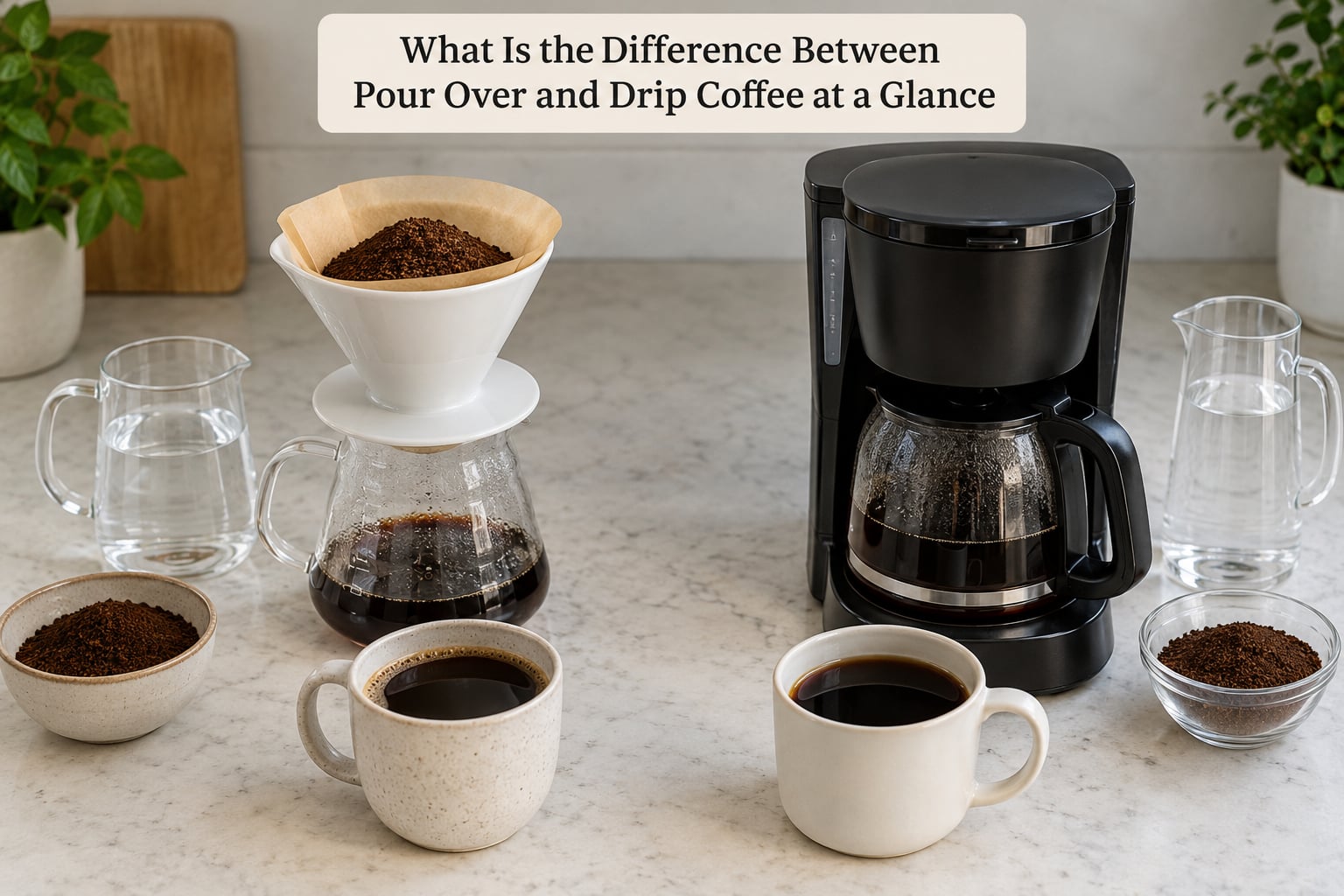
The table below covers the practical differences readers ask about most: brewing method, time, batch size, consistency, equipment, cleanup, and relative outlay. Costs are described as relative ranges rather than fixed figures, since prices move constantly.
| Factor | Pour-over coffee | Drip coffee |
|---|---|---|
| Brewing method | Water poured by hand in stages over grounds in a filter cone or flat-bottom dripper | Machine heats reservoir water and releases it through a filter basket on a timed cycle |
| Who controls the water | You do: temperature, pour rate, agitation, and when to stop | The machine does: fixed temperature, fixed flow, fixed program |
| Active brew time | About 3 to 4 minutes of your attention per batch | About 1 minute of setup, then 5 to 10 minutes unattended |
| Typical yield | One to three cups | Four to twelve cups, depending on capacity |
| Consistency across brews | Depends on how steadily you pour and how fresh the grind is | Very high: every cycle runs the same way |
| Equipment needed | Dripper, paper filter, gooseneck kettle, scale, burr grinder | Coffee maker with filter basket, carafe, paper filters; a burr grinder still helps |
| Relative outlay | Lower entry cost, but the scale and grinder add up fast | Higher entry cost, then cheap filters and infrequent descaling |
| Cleanup | Rinse a cone, tip out a filter, rinse kettle and scale | Empty and rinse the carafe, replace the basket filter, descale the machine periodically |
| Learning curve | Two to four weeks of experimenting to get repeatable results | Almost none: fill, press, pour |
| Counter space | Dripper, server, kettle, scale, grinder | One machine footprint, plus grinder and mug space |
| Best suited to | One or two cups, fresh single-origin beans, and a slow morning | Several drinkers, weekday mornings, and consistency |
How Does Pour Over Coffee Work?
Pour-over is gravity brewing with your hand on the throttle. A paper filter sits in a cone, the cone sits over a cup or server, and you pour hot water through the bed of grounds. Water moves down through the coffee, dissolves flavor compounds, and carries them through the filter into the cup.
Four variables do most of the work:
- Dose and ratio. A solid starting point is a 1:16 coffee-to-water ratio by weight, so 15 grams of coffee to 240 grams of water. Volume measures are far less reliable.
- Grind size. Medium, roughly the texture of sea salt. Too fine and water stalls; too coarse and the cup turns thin and sour within seconds of finishing.
- Water temperature. Somewhere between 195 and 205 degrees Fahrenheit. Boiling water scalds the grounds and pulls bitterness; lukewarm water under-extracts.
- Pour pattern and timing. Wet the grounds first and wait 30 to 45 seconds while trapped carbon dioxide escapes as the bloom. Then pour in slow, steady circles, keeping the bed level, until the water level drops near the grounds.
Total contact time, from first pour to final drawdown, should land around three to four minutes. The drawdown is the drip at the end: if the water falls fast and gurgles, the grind is too coarse; if it crawls, too fine.
Dripper shape matters more than most people expect. A cone such as the Hario V60 has steep walls and one large hole, which encourages flow and precision. A flat-bottom dripper such as the Kalita Wave keeps the bed flat for even saturation. A Chemex uses a thick, bonded filter that slows the draw and cleans up the cup, trading a little body for clarity.
How Does Drip Coffee Work?
An automatic drip coffee maker does the same chemistry on a fixed schedule. Cold water sits in a reservoir, a heating element brings it to a set temperature, and a shower head distributes it over grounds held in a filter basket. Water percolates through the bed, drips into a glass or plastic carafe, and a warming plate holds it at temperature until you pull the plug.
Your whole job is filling the reservoir, filling the basket, and pressing a button. That is the appeal: the machine repeats an identical cycle every morning, which is why drip wins in offices and guest rooms.
Because the cycle is fixed, quality depends entirely on what you put in. An under-filled basket lets water splash through channels and over-extract on the way, which is where the bitterness people blame on drip usually comes from. A machine that has never been cleaned does the same thing, slower.
What Is the Difference Between Pour Over and Drip Coffee?
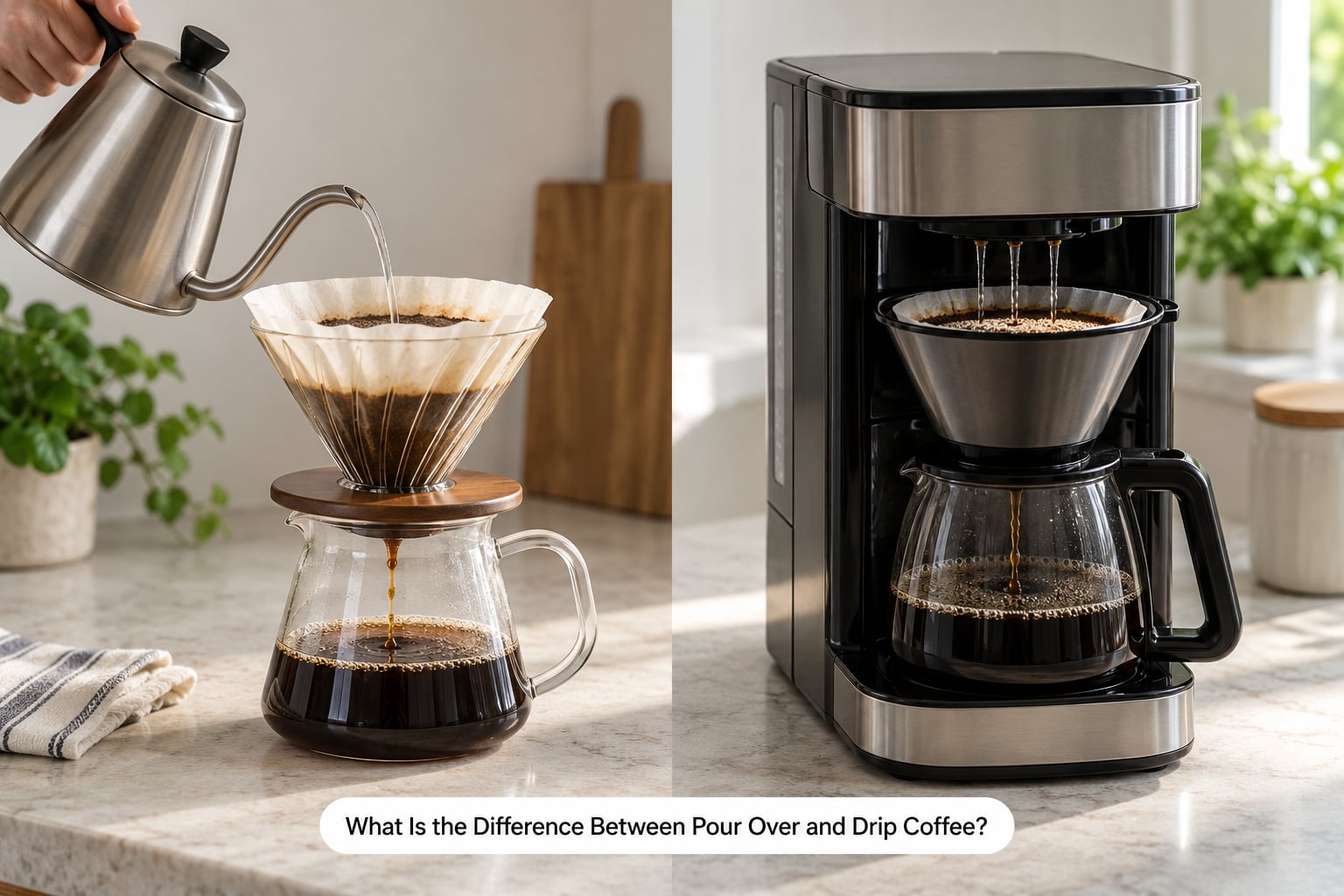
Here is the difference that actually matters, broken into the axes people search for. Pour-over gives you control; drip gives you repeatability.
What actually changes, physically
Both methods pass roughly the same amount of hot water through roughly the same amount of ground coffee in roughly the same amount of time. A machine produces agitation, pressure, and turbulence in the shower head and falling stream. A hand pour produces agitation in the impact of your pour and the swirl you give the bed. Different patterns of agitation extract differently, and a skilled pour can imitate a shower head closely.
The variable that changes most is temperature stability and flow timing. In pour-over you can stretch a brew to four minutes or compress it to two. In drip the machine picks both. More time and more agitation pull more of the heavier compounds, which is where body comes from, and past a point it becomes bitterness.
The terminology trap: what “drip” means in different places
In the United States, “drip” became shorthand for any filter brew, including a hand-poured one. In much of Europe, drip specifically means the machine, and hand-poured coffee is called pour-over or filter coffee. This inversion is the root of most confusion about your question, and it explains why a café menu can list both without a second thought.
A second wrinkle: the phrase “pour-over drip coffee maker” describes a cone dripper. So when a brand advertises a pour-over and ships a machine with a water tank, you are reading marketing, not a brewing method. A hybrid such as an OXO-style device regulates pour rate from a reservoir and sits between the two categories.
Control versus consistency
Pour-over wins the axis of control outright. You can taste two doses side by side, change one variable, and brew again. Drip wins repeatability: cup three tastes like cup one because the machine made the same decisions. Neither is universally better, and the honest answer depends on how you drink coffee.
A short history worth knowing
Melitta Bentz patented a paper coffee filter around 1908, which is the ancestor of the paper filter in nearly every cone and basket today. Gottlob Widmann patented an electric drip device in 1954, and the countertop machine followed. The pour-over cone, in the form it is brewed today, is roughly a century old and still hasn’t been replaced.
How Do Flavor and Coffee Clarity Compare?
With a fresh, even grind, a 1:16 ratio, and water in the right range, pour-over tends toward clarity and brightness. Light-roast single-origin beans show their fruit and floral notes more distinctly, because the paper filter holds back most of the coffee oils that cloud a cup. Drip tends toward body and roundness, and the same pour-over brewed with a metal filter will move toward that fuller cup too.
That said, the honest answer to whether pour-over tastes dramatically better is: usually a bit, not a different drink. A well-run machine with fresh beans lands closer to pour-over than most people expect. A badly run pour-over, with too coarse a grind or a short drawdown, tastes worse than a decent machine.
Where the difference is genuinely noticeable is single-origin coffee drunk black, light to medium roasts, and cups served without milk. Where it mostly disappears is in decaf, in diner-style coffee, in drinks with milk or a splash of cream, and in anything brewed from supermarket pre-ground bags that have been sitting open for a month.
Taste problems are usually a grind or extraction problem, not a method problem. Sour, thin, watery coffee means under-extraction: grind finer, brew longer, or use a hotter water range. Bitter, harsh, drying coffee means over-extraction: grind coarser, pour more slowly, or use cooler water.
Which Method Is Faster and Easier?
Drip is faster in wall-clock time and slower in attention terms only once you count the machine’s own 5 to 10 minute cycle. Pour-over takes 3 to 4 minutes of actual participation, and the last minute is just waiting for drawdown while standing at the counter.
Cleanup is the quieter argument for drip. A pour-over setup means a cone, a server, a kettle, a scale, and a grinder to wash or wipe, plus one more paper filter in the bin each morning. A drip machine means a basket filter to replace every few weeks, a carafe to rinse, and a descale every few months depending on your water.
One perk nobody expects: on many machines the carafe is insulated enough to stay drinkable for a while on the warming plate, so a slow pour-over is not always the better choice for a cup you will forget about at 7:40.
Which Method Is More Consistent?
Drip coffee is more consistent, and it is a genuine advantage rather than a marketing line. A fixed heater, a fixed shower pattern, and a fixed cycle mean the hundredth pot tastes like the first, which matters in an office, a rental, or a house hosting six people.
Pour-over consistency depends on four things holding steady: grind size, water temperature, pour rate, and total brew time. A burr grinder and a scale handle the first two. The other two are motor skills, and they take a few weeks to settle. Set up once and a good recipe is repeatable, but two people in the same kitchen will not produce identical cups.
What Equipment and Coffee Do You Need?
For pour-over, the honest list is short: a dripper, paper filters, a gooseneck kettle for control of temperature and flow, a small scale, and a burr grinder. A Fellow Stagg-style kettle is the common benchmark for reach. A dripper such as the Hario V60, Kalita Wave, or Chemex covers the flavor range; none of them is a wrong choice, they just favor different flow patterns.
For drip, you need a machine, a carafe, basket-style paper filters, and a burr grinder if you care about freshness. A Technivorm Moccamaster sits at the expensive end and is often the answer to the complaint that most machines run hot or spray water; Cuisinart and Mr. Coffee cover the budget and mid-range ground. Given how often people ask, the grinder matters more than the machine: pre-ground coffee stales within days, and it is the single biggest cause of bad drip coffee.
Grind reference that works for both: coarse is about the size of kosher salt, medium is sea salt, and fine is table salt. Most automatic machines are calibrated for medium grind, so a bag labeled for drip and pour-over is usually a medium grind and fine for either.
For the coffee itself, medium and medium-dark roasts are forgiving and work well in a machine. Light roasts are worth brewing by hand, since they show more detail and are harder to nail in a fixed cycle. Bag labels that say “best brewed as pour over or drip” are telling you the roast is versatile, not that the two methods are interchangeable equipment.
Pour Over vs Drip Coffee for Different Drinkers
One cup, slow morning. Pour-over. You are making a single serving anyway, so the 3 to 4 minutes cost you nothing and the control is a bonus.
Two or more drinkers, weekday mornings. Drip. One button, one carafe, everybody gets the same cup.
Office or guest room. Drip. Consistency and volume, and nobody wants to learn a pour technique at 7:30.
Hosting a group on a weekend. Either works, but a carafe machine can brew a large batch while you do other things. If guests are curious about coffee, a hand-pour is a better conversation piece than a machine.
Drinking coffee with milk. Drip has the edge. A fuller-bodied cup dilutes less, so the coffee still tastes like coffee after milk. This is a common reason people switch back after trying pour-over.
Fresh single-origin, black, and curious. Pour-over. Clarity is the whole point there, and you need a recipe you can iterate on.
Tight counter space. Drip, unless you already own a kettle. A pour-over setup really wants four items within reach; a machine is one footprint.
Ordering in a café while travelling. Ask for a pour-over when you want a single-origin brewed to order, which usually takes a few minutes and costs more than the batch brew. Anything marked filter or batch is the drip equivalent.
Which Should You Choose?
Choose pour-over if: you enjoy the ritual, you want to taste subtle differences between beans, you only need one or two cups, and you are willing to spend a few weeks learning a recipe. Choose drip if: you want a fast, hands-off routine, you brew for more than one person, or you want the same result every single morning.
If you are starting from zero, buy the grinder and either a simple drip machine or one dripper plus a kettle. Trying a pour-over first is the more common path because a dripper and a scale cost less than most machines, and you can always add a machine later.
One honest note before you spend anything: expensive beans will not rescue a badly tuned machine, and a pour-over does not make you healthier. The biggest quality lever in both methods is a fresh, even grind and a correct ratio by weight. Get those right and the method matters far less than the packaging says.
Frequently Asked Questions
Is pour-over coffee considered drip coffee?
It depends where you are. In the United States, drip is often used loosely for any filter brew, which would include pour-over. In much of Europe, drip means the automatic machine, and hand-poured coffee is called pour-over or filter coffee. The brewing chemistry is the same either way: hot water through grounds and a filter, by gravity.
What is the main difference between pour-over and automatic drip coffee?
Control. In pour-over you set the water temperature, the pour rate, how much you agitate the bed, and when you stop. In an automatic machine the heater, shower, and cycle are fixed, so you cannot adjust them. What you gain in exchange is repeatability: every pot from the machine tastes the same.
Does pour-over coffee taste stronger than drip coffee?
Not inherently. Strength comes from the coffee-to-water ratio, not the method, and both work well around 1:16 by weight. Pour-over coffee is usually brewed at a higher concentration per ounce because the batch is smaller, so if you drink it black it can taste more intense. Add the same amount of water or milk to both and the difference narrows.
Is a drip coffee maker cheaper than a pour-over setup?
Not much. A basic machine with a carafe runs in the same range as a dripper, filter, and gooseneck kettle, and the extra items a pour-over benefits from are a scale and a burr grinder, which most people eventually buy anyway. Cheaper setups exist on both sides. The honest comparison is cost per cup over time, and the machine wins only if you drink several cups a day.
Which brewing method is easiest for beginners?
Automatic drip, with no close second. Fill the reservoir, fill the basket, press a button. Pour-over is learnable in an afternoon, but it takes a few weeks of steady attention before results become repeatable, and beginners usually over-pour or grind too fine. Start with the machine, or start with a 1:16 ratio, a medium grind, a 30 to 45 second bloom, and a 3 to 4 minute total brew.
Conclusion
What is the difference between pour over and drip coffee? The mechanism is the same, the ratio is the same, and the flavor gap is real but modest. Pour-over hands you the water and asks for three to four minutes of attention. Drip takes that away and gives you a carafe, a timer, and the same cup every morning.
Start with what you already do. If you own a machine, buy a burr grinder, weigh your coffee, and fill the basket properly before you spend anything new. If you want to try the other side, a cone, a pack of filters, and a gooseneck kettle will teach you the whole craft. Whichever you pick, the coffee is mostly decided by fresh grounds, hot water, and time.