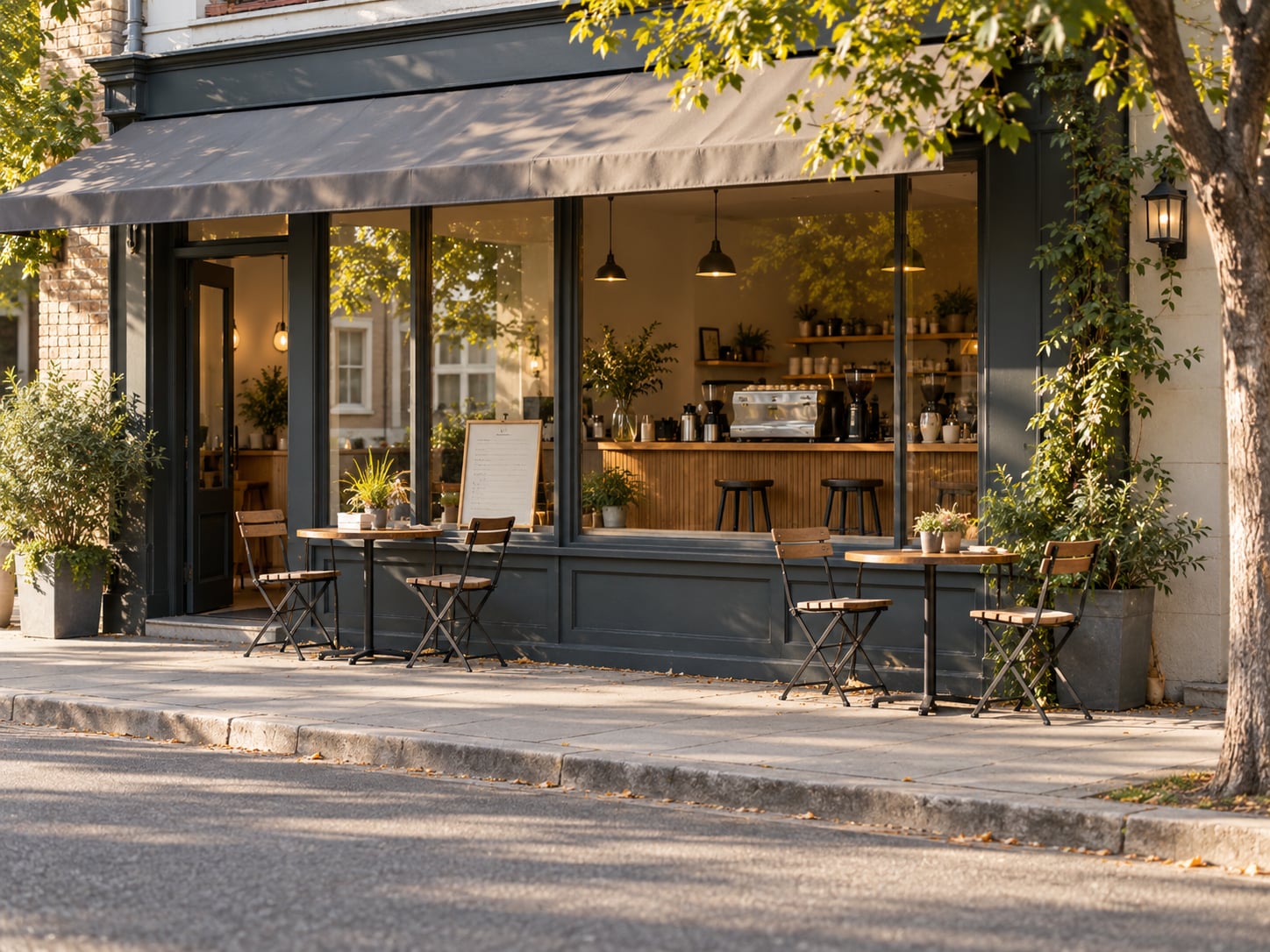
If you want to know how to spot a third wave coffee shop from the street, read the menu board first, then watch the bar for about thirty seconds. A short menu naming origins, varietals and brew methods is the strongest single tell. Burr grinders lined up behind an espresso machine, and staff pouring filter coffee by hand instead of hitting buttons, confirm what the menu promised.
I’ve spent enough slow mornings in unfamiliar neighborhoods to know that most disappointing cups announce themselves from the kerb. A wall of flavored syrups. A laminated menu forty items deep. Someone cutting in front of the person who is still ordering. None of that proves a shop is bad, and none of it proves a shop is good either. It just narrows the field fast.
What follows is a repeatable way to narrow it further: six observations that take about two minutes, in a fixed order, working from the pavement inward. No jargon required, and nothing you can’t do while holding a bag.
Table of Contents›
- What You Need
- Step-by-Step: How to Spot a Third Wave Coffee Shop From the Street
- Look for a clear coffee-focused identity
- Check how the coffee is being made
- Read the menu before judging the atmosphere
- Notice the service and seating rhythm
- Assess the room, soundtrack, and neighborhood fit
- Use a two-minute scorecard before going in
- Common Mistakes
- Frequently Asked Questions
- What is the difference between third wave and specialty coffee?
- Does a stylish cafe automatically count as third wave?
- Can you really judge a coffee shop from the pavement?
- What should I ask the barista to test whether they know their coffee?
- What signs suggest a shop is more performance-oriented than neighborhood-oriented?
- Why do map apps keep sending me to mediocre coffee?
- Conclusion
What You Need
You need two minutes, a rough idea of what a coffee menu contains, and the patience to watch instead of order. That’s the whole kit.
More usefully, these are the five things worth your attention before you walk in:
- The menu board. What is named, how many things are listed, and whether the prices are visible from the pavement.
- The brewing setup. How many machines, how many grinders, and whether anyone is brewing by hand.
- The queue and the seating. Whether people are standing in a line that moves, or a line that has become a waiting room.
- Staff presentation. Aprons, unhurried movement, eye contact, and whether one person is doing everything at once.
- The setting and its block. Materials, light, music, the smell at the door, and whether the shop seems to belong to this street.
None of these is proof on its own. You’re assembling a pattern, and the pattern is much more reliable than any single clue.
Step-by-Step: How to Spot a Third Wave Coffee Shop From the Street
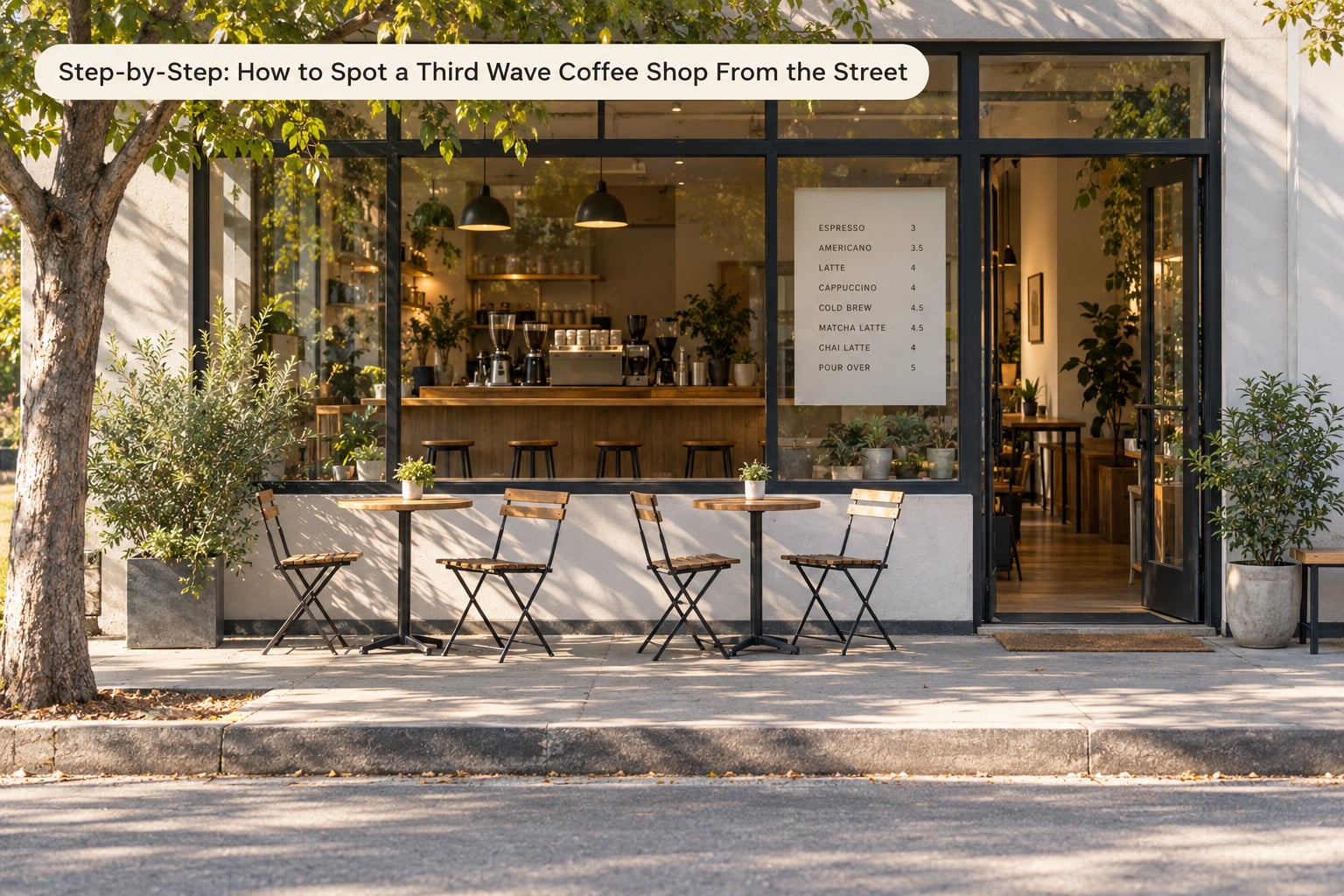
Work from the outside in, and stop at each step long enough to form an opinion before you move to the next. Most cafés only give you about ten seconds of attention as a passerby, so speed up if you must — but don’t skip the menu.
Look for a clear coffee-focused identity
A specialist coffee bar announces itself through its menu, not its paint. You’re looking for a short list where coffee itself is the substance: origins, maybe varietals and process, a filter option or two, and a couple of espresso drinks that a barista would actually recommend.
The contrast with a general café is stark. One sells coffee with pastries attached. The other sells pastries that happen to sit next to an espresso machine. For readers who want the vocabulary: single origin means the beans in that cup all came from one farm, one lot, or one country — usually one region, washing station and harvest — rather than being blended to taste the same in every cup. A third wave shop builds its menu around that idea.
Brief context helps, because the waves explain most of what you see:
| Wave | What it treats coffee as | What the menu looks like |
|---|---|---|
| First wave | A commodity | Short, cheap, often instant or mass-market |
| Second wave | A branded experience | Long, syrup-driven, espresso-forward, consistent everywhere |
| Third wave | A craft product with a place and a season | Short, origin-named, several brew methods |
What this step does not prove: a beautifully restrained menu can still be hiding an automatic machine behind the counter. That’s why the next step exists.
Check how the coffee is being made
Through the window, count what you see. A third wave bar usually shows more than one grinder, an espresso machine plus at least one manual brew setup, and a bench organised around making a drink rather than clearing a queue.
The detail worth watching is the hand work. If someone is dosing by hand, tamping, pouring a slow spiral of water into a cone, or weighing a filter bed, you’re looking at a bar built around the cup. The same is true of a visible water filtration setup — third wave shops are unusually consistent about treating water as an ingredient, because ninety-nine percent of a black coffee is water.
Two specifics to know. A grinder with visible steel burrs, rather than a plastic blade or a capsule drawer, suggests the shop grinds to order. And a shot that takes roughly 25 to 30 seconds to pull is the classic benchmark for a properly extracted espresso — the so-called 10-second rule loosely points at the same habit: watch the cup and the clock, not just the machine.
What this step does not prove: expensive gear is not the same as good coffee. Plenty of third wave shops run modest equipment extremely well, and plenty of polished rooms hide a super-automatic.
Read the menu before judging the atmosphere
This is the step people skip, and it’s the one that changes the most outcomes. Stand far enough back to read the whole board, then work down it.
Look for a filter or pour-over option alongside espresso, which tells you the shop brews by more than one method. Look for several coffees named by origin, which usually means a rotating menu rather than a house blend poured all day. Look for a roast date, or at least a season attached to a coffee — a shop that tells you when beans were roasted is telling you freshness is part of its argument. Look for tasting notes written in plain language, like stone fruit or brown sugar, which means someone on staff has tasted the lot and bothered to describe it.
Now check the small things. Is the menu readable from a distance, or is it a chalkboard with hand-lettering so clever nobody can decode it? Are prices visible, or hidden behind an ordering ritual? Can you change the milk, and does the shop care? Does it sell beans to take home, which usually means it cares about what happens after you leave?
Roast level is the fastest read on the board:
| Roast | Flavor | Relation to third wave |
|---|---|---|
| Light | Acidity, fruit, florals, origin character | Strongly associated |
| Medium-light | Balance with clearer sweetness and origin | Common and defensible |
| Medium | Caramel, nuts, round body | Neutral territory |
| Dark | Smoke, bitterness, roast character | Rare in specialty; common in second wave |
What this step does not prove: a beautiful board is the easiest thing in coffee to fake, and plenty of excellent shops keep an ugly laminated one because nobody has time for chalk.
Notice the service and seating rhythm
Watch one full interaction before you judge the room. Third wave bars tend to take an order slowly, ask a question, and make the drink in front of you rather than behind a wall of speed. The pace feels intentional rather than merely fast.
Seating tells you who the shop is built for. A couple of stools at the counter, small tables that seat two, and a bench along the wall suggest people are meant to stay twenty minutes and read. Rows of single chairs facing the door, a Wi-Fi password taped to the glass and a laptop shelf suggest the opposite — that’s a workspace, and a workspace serves a different cup of coffee than a lingerer does.
The queue is a quality signal most guides get wrong. A short line in a neighborhood shop usually means word of mouth, not rejection. A long line in a tourist district usually means a location, not a cup. Judge the queue by whether staff look unhurried during it, not by how many people are in it.
What this step does not prove: a quiet room isn’t a good room. Sometimes it’s just a Tuesday at two in the afternoon.
Assess the room, soundtrack, and neighborhood fit
Design is the weakest signal on this list, which is worth saying plainly because it’s the first thing people notice. Minimalist interiors are now cheap to produce, and a bare concrete floor tells you almost nothing about what’s in the cup.
Look instead for materials that were chosen: wood that has been oiled rather than laminated, light that a person bothered to aim, chairs you could sit in for an hour. Then the less visible stuff. Music pitched low enough to talk over. Air that smells of coffee and not of reheated milk or vanilla. A door and a bathroom you could reach. A layout that handles a crowd without blocking the counter.
Then look out at the block. The strongest third wave cafés are usually natives of their neighborhood — tucked onto a side street, priced for locals, open early enough to serve people on their way to work. A shop in a shopping arcade or an airport concourse can be excellent, but its odds are worse, and its prices will tell you that before you order anything.
Use a two-minute scorecard before going in
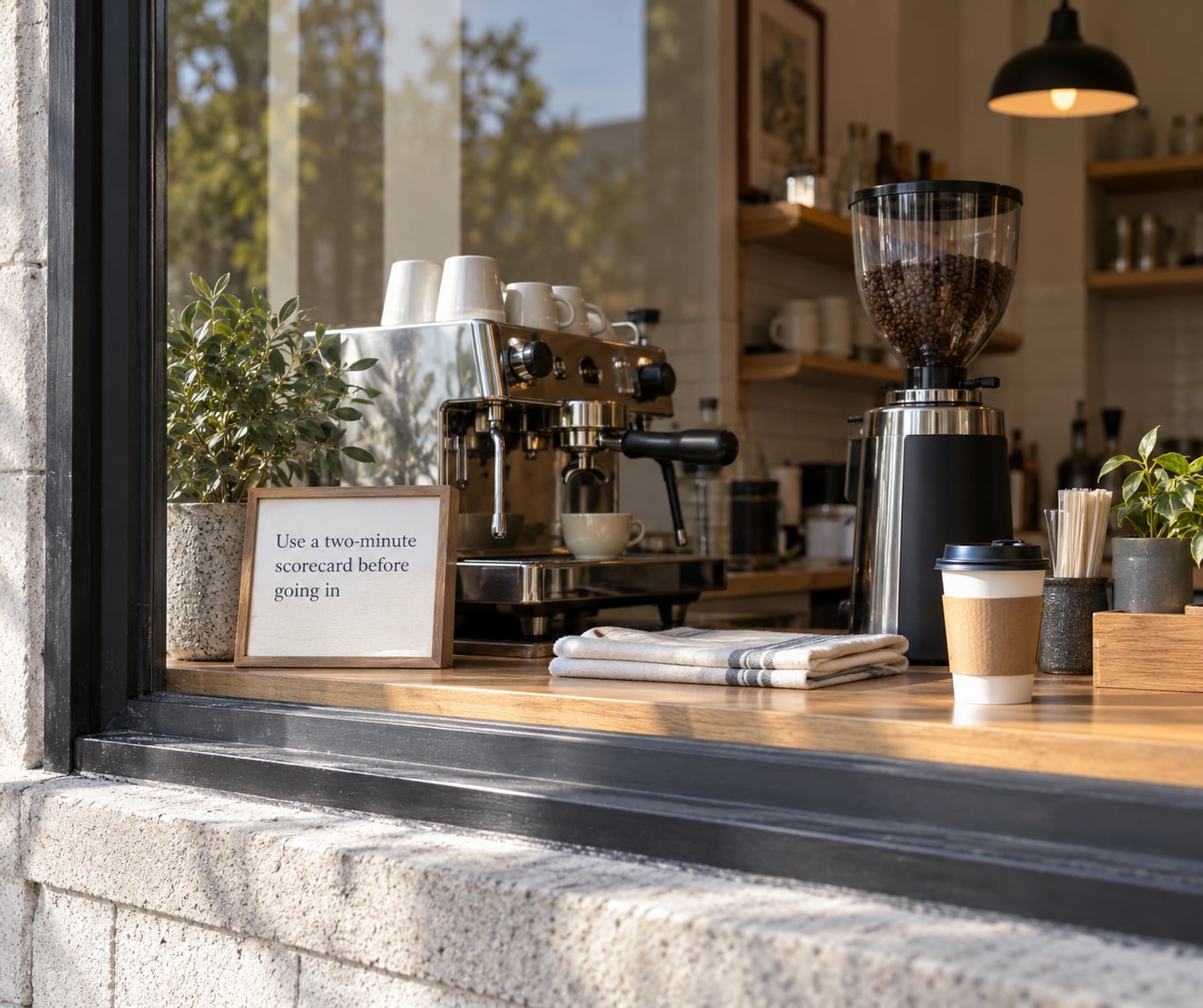
Score six things out of two each, quickly, without overthinking. Twelve points is a green light, six to eleven is worth ordering one drink and finding out, five or under is a walk-by.
| Category | 2 points | 1 point | 0 points |
|---|---|---|---|
| Coffee identity | Origins, varietals, brew methods named | Espresso drinks only, no origin detail | Syrup menu, forty-plus items |
| Preparation | Hand brewing visible, burr grinders, filtration | One machine, one grinder | Super-automatic or pre-ground |
| Menu clarity | Readable at distance, roast dates, tasting notes | Readable only up close | Decorative and undecodable |
| Service | Unhurried, explains, doesn’t cut the line | Polite, fast, scripted | Obvious queue-jumping |
| Atmosphere | Considered materials, good light, low music | Clean but plain | Noisy, sticky, no bathroom |
| Neighborhood fit | Built for locals on this street | Generic but plausible | Tourist strip or transit hub |
One unusual feature can’t define a shop. A roaster on the back wall is worth real points, but it tells you nothing about the espresso bar in front of you — plenty of roasteries run a weak café around the roasting.
Common Mistakes
Mistaking minimalism for quality. Concrete, timber and a bare counter cost about the same as the alternative now. Design was once a genuine signal; it isn’t one.
Assuming cost guarantees a good cup. A high price tells you about rent and marketing, not extraction. Some of the best cups I’ve had came from shops charging less than their neighbours.
Reading the queue as quality. Lines in travel districts are mostly location and impulse. Judge the people working, not the people waiting.
Judging by photographs alone. Interior shots flatter almost anyone. A photo tells you nothing about the grind, the water, or the last four minutes of the roast.
Expecting identical gear everywhere. There’s no standard issue espresso machine for third wave shops. Some run beautiful old machines. Some run very plain ones with excellent results. Watch the craft, not the badge.
Treating the word “specialty” as proof. The label is now marketing, worn smooth by cafés that own three grinders and serve a syrup latte at four dollars. Use the scorecard, not the vocabulary.
Frequently Asked Questions
What is the difference between third wave and specialty coffee?
Third wave is a movement with a set of behaviours: single origin sourcing, light or medium-light roasts, manual brewing methods, and coffee treated as a craft product with a documented origin. Specialty is a grading term, roughly 80 points and up on the Specialty Coffee Association scale, describing the quality of green beans before roasting. A shop can sell specialty grade beans and behave very much like a second wave cafe.
Does a stylish cafe automatically count as third wave?
No. Interior design became cheap to imitate, so aesthetics now tell you very little. Judge the menu instead: short and origin-named, several brew methods offered, roast dates or tasting notes published. A beautifully designed room serving a long syrup menu is decoration, and that combination is common enough to be unremarkable.
Can you really judge a coffee shop from the pavement?
You can narrow the field well, which is what the checklist here is for, but you cannot finish the job. The street tells you about identity, preparation and fit with the neighborhood. It cannot tell you whether the espresso is pulled well or whether this morning’s batch is stale. The forum consensus is consistent on this: order one drink, then come back and see if it holds.
What should I ask the barista to test whether they know their coffee?
Ask what is on filter today and why they chose it, or which single origin they would recommend for someone who does not usually drink light roasts. A good barista answers with an origin, a process and a reason, in under a minute, without checking a screen. A vague answer about it being lovely, or silence, tells you as much as any window ever would.
What signs suggest a shop is more performance-oriented than neighborhood-oriented?
Striped seating, an obvious work area, a Wi-Fi password taped to the glass and a counter built for standing rather than sitting all point the same way. These are not red flags for quality, only for the kind of visit you will have. Many excellent specialty cafes double as workspaces; just do not expect slow conversation and a long table by the window.
Why do map apps keep sending me to mediocre coffee?
Ranking is proximity and review count, not cup quality, so the loudest shops near a landmark win. This comes up constantly in travel threads on r/espresso and r/Coffee, where the workaround is the same one used here: walk the side streets, read boards before you commit, and lean toward cafes that sell beans or roast on site. Review counts reward marketing, not extraction.
Conclusion
Start at the kerb with the menu board, before the window and before the queue. Read the coffee list first, then watch the bar for thirty seconds and see whether the room matches what the board claimed. If the two agree, walk in and ask what’s on filter today.
Then do the part no checklist can do for you: order one drink, and go back the following week. The street tells you a shop is worth a try. Only repetition tells you it’s worth the walk.