How to dress for afternoon tea at a hotel is simpler than most guides make it sound: aim for smart casual, check the venue’s own dress code before you travel, and choose one comfortable outfit you can sit in for ninety minutes. You will never be the most dressed-up person in the room. You will be the person who looks like she belongs there.
Tea lasts about an hour and a half and you will be sitting down for most of it in a room full of people who also booked ahead. Getting the casual-versus-formal line right matters far more than the formality level itself.
Here is the short version before the detail:
- Smart casual is the working baseline at most hotels. Semi-formal is the exception, not the default.
- Check the venue’s dining page, then your booking confirmation, then the hotel’s recent social feed, and only then call reception.
- Women: a midi dress, or a blouse with tailored trousers or a midi skirt. Shoes with a closed toe or a low block heel.
- Men: a crisp button-down shirt and chinos, loafers or derbies. Jacket optional except at the strictest venues.
- Trainers, shorts, sportswear, beachwear and ripped denim cause nearly all the problems at the door.
- Book ahead, arrive ten minutes early, and hand your coat to the cloakroom rather than wearing it into the room.
Table of Contents›
- What You Need
- Step-by-Step
- Step 1: How to Dress for Afternoon Tea at a Hotel – Start With the Dress Code
- Step 2: Choose a Comfortable, Polished Base Outfit
- Step 3: Select Shoes and Accessories That Work
- Step 4: Adjust for Weather, Travel, and Personal Comfort
- Step 5: Arrive Looking Effortlessly Put-Together
- Common Mistakes
- Frequently Asked Questions
- Is afternoon tea at a hotel formal or smart casual?
- What do men wear to high tea at a hotel?
- Can I wear jeans or trousers to afternoon tea?
- Do I need to wear a hat or fascinator to afternoon tea?
- What do I wear if the hotel has not published a dress code?
- What should I wear to afternoon tea alone as a solo traveller?
- Conclusion
What You Need
Most of this is already in your wardrobe, which is the point. Before you choose anything, gather these:
- One base piece. A midi or knee-length dress, or a blouse with tailored trousers or a midi skirt. Wrinkle-resistant fabric travels better than linen or silk crepe.
- A layer. A cardigan, light blazer or shawl. Hotel lounges are often freezing, and being cold makes people fidget through an afternoon.
- Closed, comfortable shoes. Loafers, derbies, block heels or clean flats. You will walk from the lobby, up a step or two, and back.
- A small structured bag. Big enough for a phone, a card and a book, small enough to sit on your chair.
- One accessory. Pearls, a watch, simple drop earrings. One thing, not five.
- Your booking details. The confirmation email names the venue, the time and often the dress code.
On colour, pastels, florals and jewel tones all photograph well in a bright tea room. Deep navy and charcoal read as more formal without trying hard. Black works, and plenty of regulars wear it.
One note on freshness: hotel dress codes shift with the season and with corporate bookings, so treat anything you read as a starting point rather than a rule. Last checked October 2026.
Step-by-Step
Work through these in order. Each one takes a couple of minutes and saves you guessing at the door.
Step 1: How to Dress for Afternoon Tea at a Hotel – Start With the Dress Code
Yes, afternoon tea has a dress code. Usually it is implied rather than printed, which is why people get it wrong.
- Read the venue’s dining page. Search the hotel’s site for the tea service name. Grand hotels publish a dress code line; smaller ones often do not.
- Open your confirmation email. This is the most reliable free source, because it reflects what the reservations team actually told you.
- Scroll the hotel’s recent social feed. Looking at what people actually wore at that tea service last month beats any etiquette blog, including this one.
- Call reception if it matters. A two-minute call before you fly is cheaper than a spare jacket you never wear.
What you are looking for is the venue type. A lobby tea in a business hotel is a different ask from a country house hotel or a palace lounge. A Tripadvisor thread in the London forum literally asks whether smart casual is enough at a tea room, which tells you how most people read it: smart casual passes, tie optional.
Step 2: Choose a Comfortable, Polished Base Outfit
Smart casual, done properly, means one clearly intentional item plus one quiet one. Not matching, not a uniform. Just deliberate.
For women, a midi or knee-length dress in a solid colour, a wrap style or an A-line cut does most of the work. Trousers are fine too, and a Mumsnet poster’s standard advice holds up: wear trousers you own, add one new blouse or jacket, done. A wide-leg or straight-leg cut reads sharper than a skinny one under a seated tea service.
For men, a button-down shirt is the anchor. Chinos, dress trousers or clean dark jeans without distressing work at smart casual venues. A knit polo or a fine-gauge sweater over a shirt reads relaxed without reading casual. Skip the tie unless the venue asks for one. A jacket is optional in most rooms and expected at a small number.
The test is simple: if someone described your outfit to a friend, would they guess you were going somewhere nice? That is the whole bar.
Step 3: Select Shoes and Accessories That Work
Shoes are where people get hurt, literally and socially. A stiletto on carpet is a bad time, and most tea rooms have carpet. Block heels under four centimetres, loafers, derbies, ballet flats or clean low-top sneakers with no branding work.
Trainers are the single most commonly rejected item. If that is all you have, they are why you change the outfit rather than the venue.
Jewellery should not compete with you. One pair of earrings, a pearl necklace or a watch is plenty. Skip a heavy statement necklace with a busy print. Bring a small structured bag rather than a tote that has to live on the floor, and leave the bulky tote in the room if you can.
Step 4: Adjust for Weather, Travel, and Personal Comfort
Outdoor tea changes the maths. A garden terrace in June wants a light layer you can tie over your shoulders, a hat you can actually hold, and flat shoes on grass. Nothing darker than navy, cream or a soft print in direct midday sun.
In winter, the issue is almost never the outfit. It is the walk from the car. Coat, scarf, gloves over your phone, then strip to your base layers once inside. Indoor tea rooms run cold.
For travel, pack the outfit second and wear the biggest piece in transit. Nothing new on the first day. Keep a steamer or a steamy bathroom for anything creased in a case.
For different bodies, the rules hold with one swap: the good silhouette is the one that lets you sit back and put your feet under the table. Stretchy jersey instead of a stiff waistband. A wrap or A-line over anything fitted. A shawl instead of a shrug if you get cold easily. Flat or block shoes if standing or walking is hard on you. Nobody at a hotel tea service is checking your waist.
Step 5: Arrive Looking Effortlessly Put-Together
Ten minutes before your slot, do a short check in a lobby mirror or your phone camera:
- Steam or smooth anything creased from the case.
- Check shoes for scuffs and socks for a stray heel showing.
- Empty pockets, lower your phone brightness, silence it.
- Hair tidy is enough. A clipped-back style reads put-together.
- Hand your coat over at the cloakroom. Wearing a wet outdoor coat into the room is the one outfit mistake that changes how you are treated.
Arrive five to ten minutes early. Tea services with a set slot are hard to join late, and walking in with a minute to spare reads far more relaxed than making an entrance.
Common Mistakes
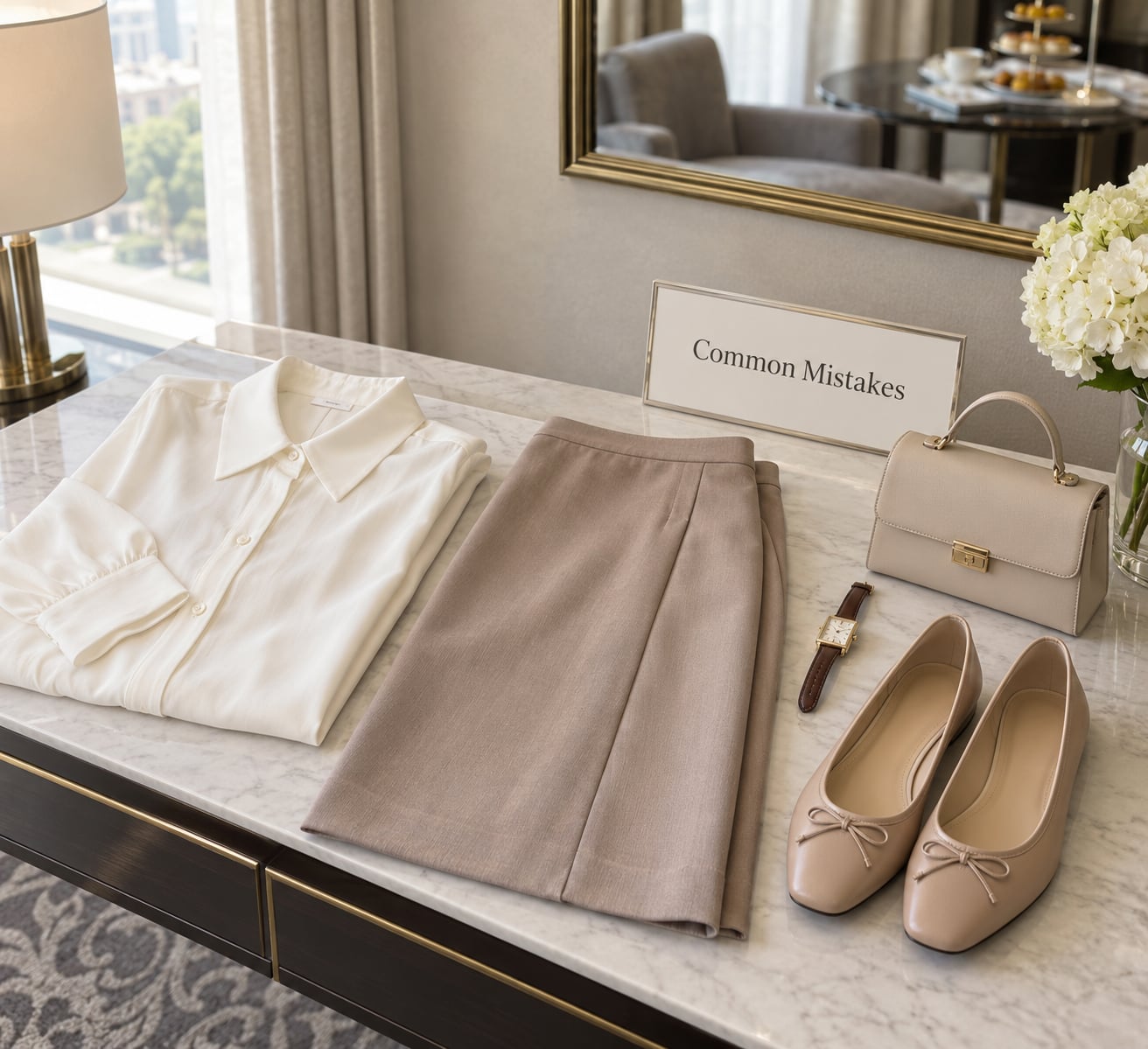
Dressing up for a relaxed venue. Full black tie to a business-hotel lobby tea makes you the stiffest person in the room. If the venue page says smart casual, believe it.
Dressing down for a strict one. The reverse happens at grand city hotels and palace properties. If the page says formal or semi-formal, add the layer and the closed shoes. One Reddit answer on the etiquette question put the range neatly: business casual at one end, hats and frilly dresses at the other. Most teas sit near the middle.
Ignoring the dress code entirely. Hotels with a published policy do ask guests to change, and it is almost always the casual end that causes it: trainers, shorts, sportswear, beachwear, ripped jeans. A missing tie gets a raised eyebrow. A pair of trainers gets you sent back downstairs.
Choosing impractical shoes. You will be sitting, then walking, then standing for a photo you did not plan on. Block heels, loafers and flats solve it.
Wearing fabrics that crease badly. Linen and silk crepe look wonderful for ninety minutes and tragic after a car journey. Crepe, ponte, cotton poplin and jersey hold up.
Overdressing a solo occasion. Nobody else is looking as hard as you think. A friend describing the experience online put it as: business casual to fancy hats, and comfort wins when you are alone.
No plan B. If you realise at the door that you have misjudged it, you have about ten seconds. A men’s spare shirt in the bag fixes a shirt situation. For everything else, hand the coat to the cloakroom, keep your shoulders back, and walk in. Hosts read nerves, not fabric.
Frequently Asked Questions
Is afternoon tea at a hotel formal or smart casual?
Almost always smart casual. Formal or semi-formal appears only at grand city hotels, palace properties and private events, and those venues say so on their dining page. A Tripadvisor thread in the London forum asks outright whether smart casual is adequate at a tea room, which tells you how most people read it. When unsure, dress at the smart casual end: neat, closed shoes, nothing sporty.
What do men wear to high tea at a hotel?
A crisp button-down shirt with chinos, dress trousers or clean dark jeans, plus loafers or derbies. Add a light blazer or knitwear for colder months or grander rooms. Wear a tie only where the venue asks for one, which is uncommon. The items to avoid are trainers, t-shirts as your outer layer, shorts, sportswear and anything distressed. Women wear trousers and flats regularly, and men wear trousers and loafers with the same ease.
Can I wear jeans or trousers to afternoon tea?
Yes, with caveats. Clean, dark, well-fitting jeans without rips or distressing read as smart casual, and dark trousers are safe at any venue. Watch what you pair them with: a tucked shirt or neat knit top and closed shoes move them firmly into acceptable territory. Denim with torn knees, frayed hems or a faded wash does not, and trainers finish the outfit in a way most tea rooms will not accept.
Do I need to wear a hat or fascinator to afternoon tea?
No. A hat is optional and never required for entry. Fascinators and headpieces show up at weddings and royal-themed events, and some guests wear a beret in winter or a sun hat on a garden terrace. Take your cues from the room rather than the internet: if most tables have hats, the day is that kind of occasion. If not, your hair is fine. Nobody will be marked down for a bare head.
What do I wear if the hotel has not published a dress code?
Assume smart casual and build one outfit that sits comfortably in that range: a midi dress or a blouse with tailored trousers, a layer, and closed flat or low-heeled shoes. Then do the free checks, which are better than guessing. Read the booking confirmation, scroll the hotel’s recent social feed to see what guests actually wore at that service, and if the tea matters to you, ring reception before you travel. Ask them what the room looks like, not whether you are allowed in.
What should I wear to afternoon tea alone as a solo traveller?
Dress for comfort first, because there is nobody adjusting the plan around you. That means flat or block shoes, a breathable layer you can take off, and a bag light enough to sit beside you rather than on the floor. Choose a table near a wall or a window rather than dead centre, keep your phone face-down between courses, and bring a book. Most tea rooms are used to solo guests, and the staff are the easiest company in the room.
Conclusion
Start with the venue, not the wardrobe. Find the tea service page, read the confirmation email, glance at recent guest photos, and you will know within five minutes whether you are dressing for a lobby lounge or a palace salon. Then build one comfortable, smart-casual outfit around that answer, put your coat in the cloakroom, and walk in. That is the whole job.