
Picking a neighborhood to stay in when you visit a new city comes down to three things: where you will spend most of your hours, how long it takes to get there from your bed, and what the street sounds like at midnight. Get those right and the rest of the trip falls into place. Get them wrong and you will spend a long weekend on trains.
The whole process takes about an hour of research, most of it done on a map rather than on booking sites. This guide works in any city, whether you are there for two nights or two months, and it holds up whether you are solo, travelling as a couple, or dragging two tired kids across town for dinner.
Table of Contents›
- What You Need Before You Compare Anything
- Step-by-Step: How to Choose the Right Base
- 1. Define what your days will look like
- 2. Build a shortlist of candidate neighborhoods
- 3. Compare the daily experience, not just the tourist appeal
- 4. Test transport and door-to-door convenience
- 5. Check the fit for safety, comfort, and budget
- 6. Test the leading choice before booking
- Common Mistakes That Ruin the Base
- Frequently Asked Questions
- Can I stay in different neighborhoods during one long trip?
- How many neighborhoods should I compare before booking a hotel?
- Is a boutique hotel in a less central area worth the extra cost?
- What if a neighborhood looks ideal online but feels different in person?
- How should families choose a neighborhood when everyone has different needs?
- The Short Version to Start With
What You Need Before You Compare Anything
Most people choose badly because they compare neighborhoods on the wrong evidence. A pretty list from a travel blog, a star rating, a map pin. You need a small amount of preparation first, and none of it takes long.
- A one-line trip brief. Write down your non-negotiables: two places you must see, one thing you would like to do, and one thing you refuse to do at 8am.
- A trip length. Two nights and ten nights reward different neighborhoods. This single number removes half your options.
- A note file or phone note per candidate area. Keep them side by side, or you will remember the last one you read and not the best one.
- A transit map and a walking map for the city. The official metro or train map, plus a walking layer you can toggle on. A five-minute difference on a road map can be a forty-minute difference on foot.
- Accommodation detail, not just the neighborhood. Floor level, which side of the building faces the street, whether there is a lift, and how far the entrance is from the nearest door. A great area and a bad room on that area’s main drag are different trips.
- Recent reviews, read for patterns. Look for the words people repeat rather than the sentences that sound impressive.
- A hard limit. A total nightly figure, or a maximum door-to-door commute to your main anchor. Choose one and write it down now, because it will stop you negotiating with yourself later.
If you only do three of these, do the trip length, the transit map and the hard limit. Those three between them eliminate most bad options.
Step-by-Step: How to Choose the Right Base
1. Define what your days will look like

Before you look at a single listing, sketch an actual day. Most first-time visitors pick a base by listing sights, then wonder why the neighborhood felt inconvenient. Instead, describe the shape of your day: two museum mornings, an afternoon back at the room because it rained, an evening somewhere with a decent kitchen.
Then note the practical constraints that travel advice usually skips. Do you have a work call at 9am on two of the days? Can you manage stairs, or does a hill ruin the plan? Are you eating dinner out every night, or cooking one in? How late will you realistically be out?
Once the day exists on paper, you can test an area against it. A neighborhood that looks ideal on a map often fails on a rainy afternoon when the room itself has to be pleasant for six hours. Realistic days make the comparison accurate, and they take ten minutes to write.
2. Build a shortlist of candidate neighborhoods
Use the landmarks, then widen. Start from the one or two districts that contain the places you cannot miss, and then follow the transit lines outward from there. Add anywhere with a direct airport or main station link, and anywhere with a cluster of accommodation in your budget range.
Stop at three to five candidates. Two means you are not really choosing, and eight means you will spend a weekend browsing. Three to five is enough to see a pattern and thin enough to compare properly.
Write one sentence per candidate describing what it is for. The old core for sights, the market district for food, the business node for fast arrivals, the residential pocket for sleep. Those labels make the next steps much faster, and they stop you from drifting back to whichever area you happen to have read most about.
3. Compare the daily experience, not just the tourist appeal
A landmark district wins on sightseeing and loses on almost everything else: louder rooms, higher prices, more traffic, and a street that empties once the tour buses leave. A residential area gives you a decent bakery, a park, and a bus stop, and puts you on a tram to see anything.
Compare each candidate on the same six things, so nothing gets a free pass:
- Meals. Can you get a good dinner within a short walk, and is there anywhere cheap and open early? Check breakfast specifically, since a neighborhood with no morning coffee is a poor base.
- Green space and shops. Somewhere to sit for twenty minutes matters more than people expect on a long trip.
- Services. Pharmacy, supermarket, laundry, a working ATM nearby.
- Noise. Search reviews for the specific words: late, bar, club, street, thin walls, party. A district that is lively at 11pm is not the same as one that is loud at 4am.
- Local life. Look at what is open mid-afternoon on a weekday. If the area only functions for visitors, you will be dining among the same restaurants as everyone else.
- Time of day. Walk the main street mentally at 8am, at 1pm and at 11pm. A street that is pleasant at two of those three is a compromise worth taking.
I also weigh the food scene more heavily than hotel quality when narrowing things down. A neighborhood with a lively late-evening food culture usually has good bones: residents, deliveries, shops that stay open. Sleeping over it is a separate question, which is why I check noise separately.
4. Test transport and door-to-door convenience
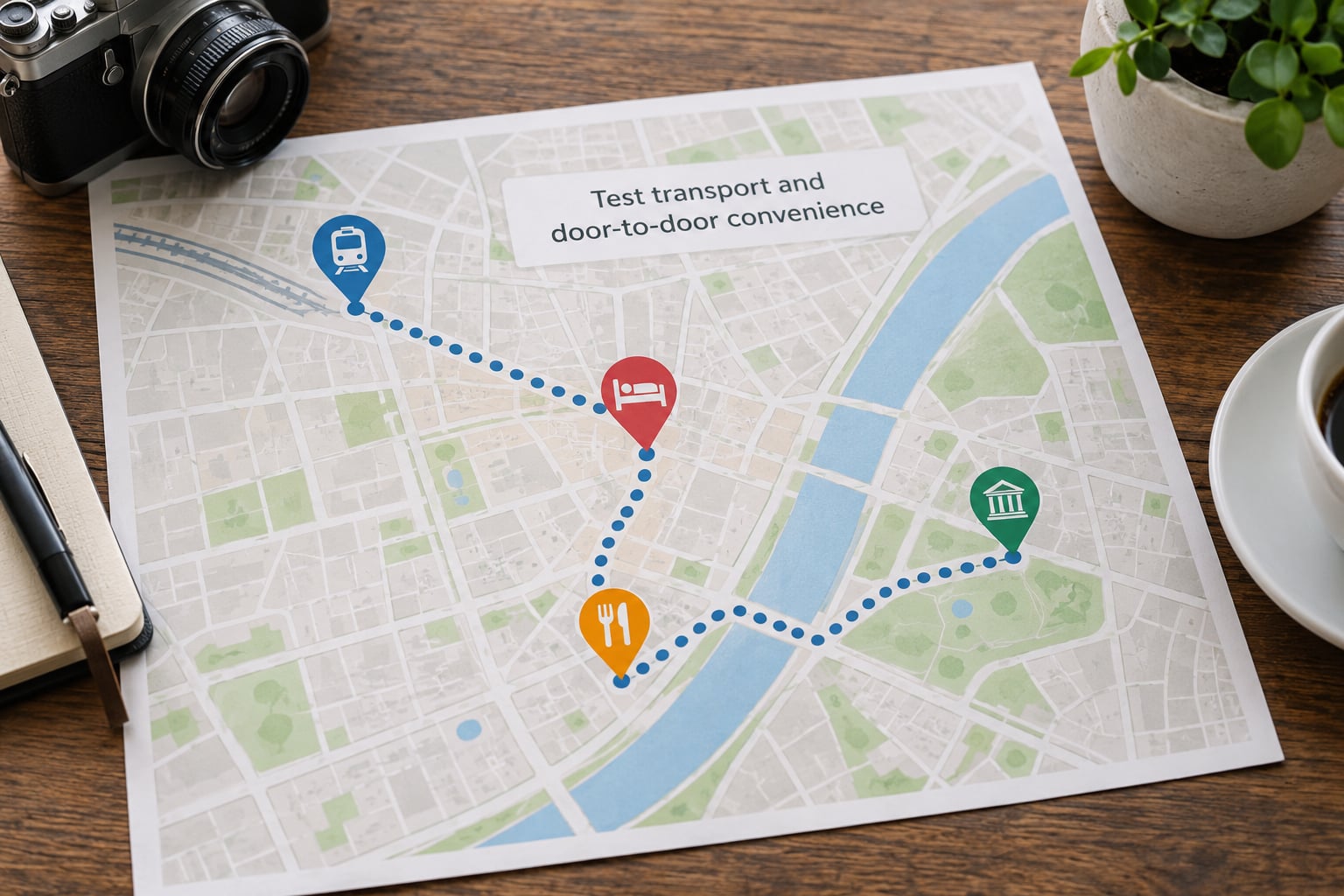
Run the trip in reverse: from your planned evening activity back to the door of the accommodation, and from the arrival point to the door, at the hour you will actually be travelling. Nine o’clock on a Tuesday is not midnight on a Saturday, and many systems run very different schedules at those times.
Then test the real walk, not the road distance. Ten minutes of flat pavement and ten minutes of uphill cobbles are not the same errand, and neither are they the same for a suitcase. Rivers, ring roads, rail yards and large parks are the sneaky ones: two points can look adjacent on the map and be a long detour on foot. Check the walking layer, then look for photos of the actual street approach.
Late-night transit deserves its own check. Find out whether the line near the accommodation still runs at midnight and at 1am, and what happens if it has stopped. If you will be out late regularly, that single fact can outweigh everything else on this list.
For a work-and-leisure hybrid, add one more leg: from the accommodation to the meeting venue at the time you would actually leave. Business districts that empty out at six are excellent for sleeping and poor for eating, and that mismatch is worth finding out before you book.
5. Check the fit for safety, comfort, and budget
Safety here means ordinary, practical comfort, not a verdict. Look at the area at the hour you will be out and back. Night-time lighting on the route from the station, how many places are still open, how busy the street is, and whether the accommodation has a staffed desk through the night. Solo travellers consistently prioritise a 24-hour front desk and an option for a women-only floor, and it is a reasonable thing to filter on directly.
Comfort is physical. Check lift access if you have luggage or mobility needs, the gradient from the nearest station exit, and whether the room faces a courtyard or a main road. A building on a busy through-road can have excellent soundproofing or none at all, and reviews from guests who stayed in that exact room are the only real source.
For budget, count the whole daily cost, not the room rate. Two extra transit fares a day, a taxi home from a late dinner, and a pricier breakfast add up across a week. A slightly higher nightly rate in a well-served area is often cheaper in practice than a cheap room somewhere that is twenty minutes from everything.
One caution on centrality. A room described as central is sometimes on the wrong side of a river or a rail line, and a place that is close by car can be a genuinely bad base in a walkable city. Verify centrality from the map, not the description.
6. Test the leading choice before booking
Take your top candidate and give it a proper ten-minute check. Walk the street in Street View or an equivalent virtual view from one end to the other, both day and night. Search reviews for the specific words that matter to you: quiet, staff, lift, noise, stairs, safe, late. Read the one-star and two-star reviews, because they mention the same practical problems as the five-star ones, in plainer words.
Then check the official travel information for anything time-sensitive, such as service changes, station works, or seasonal service on the line you rely on. If the details are unclear, email or message the property and ask directly: how far is the entrance from the nearest station exit, is there a lift, and what is the street like at night. Specific questions get specific answers, and vague replies are themselves information.
Finally, pick a backup. Rank your second candidate and note the one thing that would have to change for it to become first. If your first choice sells out, or the reviews turn out to describe a different street than the one you looked at, you can switch in a minute instead of starting over.
Common Mistakes That Ruin the Base
Defaulting to the famous district. The best-known area is popular for a reason, usually daytime sightseeing. Correction: choose the famous district only if your trip is mostly daytime sightseeing. Otherwise pick one or two stops further out on the same line.
Judging a commute by clock time. A fifteen-minute trip on paper can be forty minutes with a transfer, a wait, and a hill at the end. Correction: count the whole journey door to door, twice a day, at the hours you will use it.
Overvaluing centrality. Walking distance to the main square is not the same as walking distance to your actual plans, and it often comes with the highest rates in the city. Correction: measure against your itinerary, not the postcard.
Trusting one glowing review. A single enthusiastic review tells you almost nothing about a street. Correction: read the most recent twenty, in order, and count repeated words. Repetition is the signal.
Ignoring the night. Many areas are excellent until eleven. Correction: check evening lighting, late service, and the reviews that mention noise, before you fall for the daytime photos.
Booking before checking accessibility. Lift, gradient, and luggage distance decide whether a trip is pleasant or exhausting. Correction: ask the property these three questions in writing, and treat a vague answer as a no.
A few general tips. Book the neighbourhoods with the fewest properties first; in a city where rooms are scarce, the good areas disappear early. If you are staying more than a week, consider splitting the trip between two areas rather than one, which gives you one residential week and one central week. And take a decision on a single evening rather than a single morning, because noise problems never show up in daylight.
Frequently Asked Questions
Can I stay in different neighborhoods during one long trip?
Yes, and for trips over about a week it is often the better call. Split the stay into a central or old-town week for sights and a residential or market-district week for cooking, sleeping and slower mornings. The cost of packing once or twice is smaller than you think, and you get two versions of the city. For trips under five nights, the packing and check-in overhead usually outweighs the benefit, so pick one base and stay there.
How many neighborhoods should I compare before booking a hotel?
Three to five. Two is not a comparison, and eight or ten means you will browse for a weekend without deciding. Build the list from your must-visit anchors plus anything with a direct transit link to your arrival point, then score each one on the same six criteria so nothing gets an unfair advantage. If two candidates finish level, pick on arrival convenience: the easier the first evening, the better the whole trip feels.
Is a boutique hotel in a less central area worth the extra cost?
Sometimes, and the deciding factor is what you do in the evenings. If your plan involves cooking, reading, working or long dinners where you are staying, a quieter area with good transit and a decent kitchen can be worth more than a central room you only sleep in. If you expect to eat out late and walk home, centrality usually wins. Work out the total daily cost of both options, including transport, before deciding.
What if a neighborhood looks ideal online but feels different in person?
Trust what you observe, and move early. Check in during the afternoon, walk the block immediately, and eat somewhere local that evening rather than near the sights. If it still feels wrong, you have a simple fix: book a second night somewhere else. Many booking sites allow free cancellation within a short window, so booking one night as a test costs very little and settles the question faster than more research will.
How should families choose a neighborhood when everyone has different needs?
Decide who the base is really for. With small children, weight the park, the supermarket, the bathroom situation and the walk back from dinner, and pick a residential area near a station rather than a nightlife district. With older travelers, weight flat ground, lift access and a short route from the station. With teenagers, weight evening life. Pick the area that satisfies the two people who will be there every evening, and let the rest manage one excursion out.
The Short Version to Start With
Write your realistic day first, shortlist three to five areas, then kill any candidate that fails on late transit, real walking distance or noise at night. Pick the survivor with the simplest arrival, verify the exact room and building in reviews, and book it before the good areas go.
This method stays current as routes and neighbourhoods shift around it, and it keeps working whenever you land somewhere new in 2026.