
A workation protects your vacation days by giving you a place to finish real work, then keeping the rest of the trip genuinely off the clock. The method is simple: cut the workload down to one deliverable, pick a room that supports both focus and rest, and put recovery time on the calendar before you book anything. If you are trying to work out how to plan a workation that does not burn out your vacation days, this is the order that works. Budget about four to six hours of planning spread over a week or two before departure.
I have watched people plan workations backwards, booking the trip first and then hoping the work would fit around it. That is how vacation days disappear. Nobody intends that, but the trip always wins and the deliverables get squeezed into whatever gaps are left, which are rarely enough.
Table of Contents›
- What You Need
- Step-by-Step: How to Plan a Workation That Does Not Burn Out Your Vacation Days
- 1. Match the Trip to the Work You Can Actually Finish
- 2. Choose a Stay That Supports Work and Recovery
- 3. Put Every Work Session on the Calendar
- 4. Set Availability and Vacation Boundaries
- 5. Design the Trip as an Alternating Rhythm
- 6. Protect Sleep, Meals, and Small Pleasures
- 7. Run a Two-Week Recovery Check
- Common Mistakes
- Frequently Asked Questions
- How long should a workation be to avoid burnout?
- Can I split my vacation days around a workation?
- How do I manage meetings across time zones during a workation?
- What should I do if my workload expands while I am away?
- What makes a hotel or rental suitable for a workation?
- Conclusion
What You Need
You need five things ready before you book, and none of them are gear.
- A deliverable list. One project with a finish line, not a folder of loose ends.
- A confirmed schedule. The meetings you genuinely must attend, agreed with your manager in writing before you go.
- Your work kit. Laptop, charger, headset, and any external gear that stops you improvising with a kitchen chair.
- An accommodation brief. Desk, connection, quiet, and something restorative within a short walk.
- A recovery budget. Time and money for meals out, movement, and a proper day off that costs you nothing in vacation days.
Honestly, the hard part is coordination, not packing. Two to three evenings usually covers the workload audit, and another evening with your manager settles the schedule.
Step-by-Step: How to Plan a Workation That Does Not Burn Out Your Vacation Days
1. Match the Trip to the Work You Can Actually Finish
List every deadline, meeting, and recurring obligation that falls inside your travel window. Then sort them into three piles: must-do, flexible, and deferrable.
Most people discover they are carrying two projects when the calendar only has room for one. If you had planned to launch a site and write a course in the same ten days, drop the course and carry the site. One finished thing beats two half-done things every time.
You know the step worked when you can say the exact deliverable out loud in one sentence, with a date attached. If it needs a paragraph to explain, the trip is too short.
2. Choose a Stay That Supports Work and Recovery
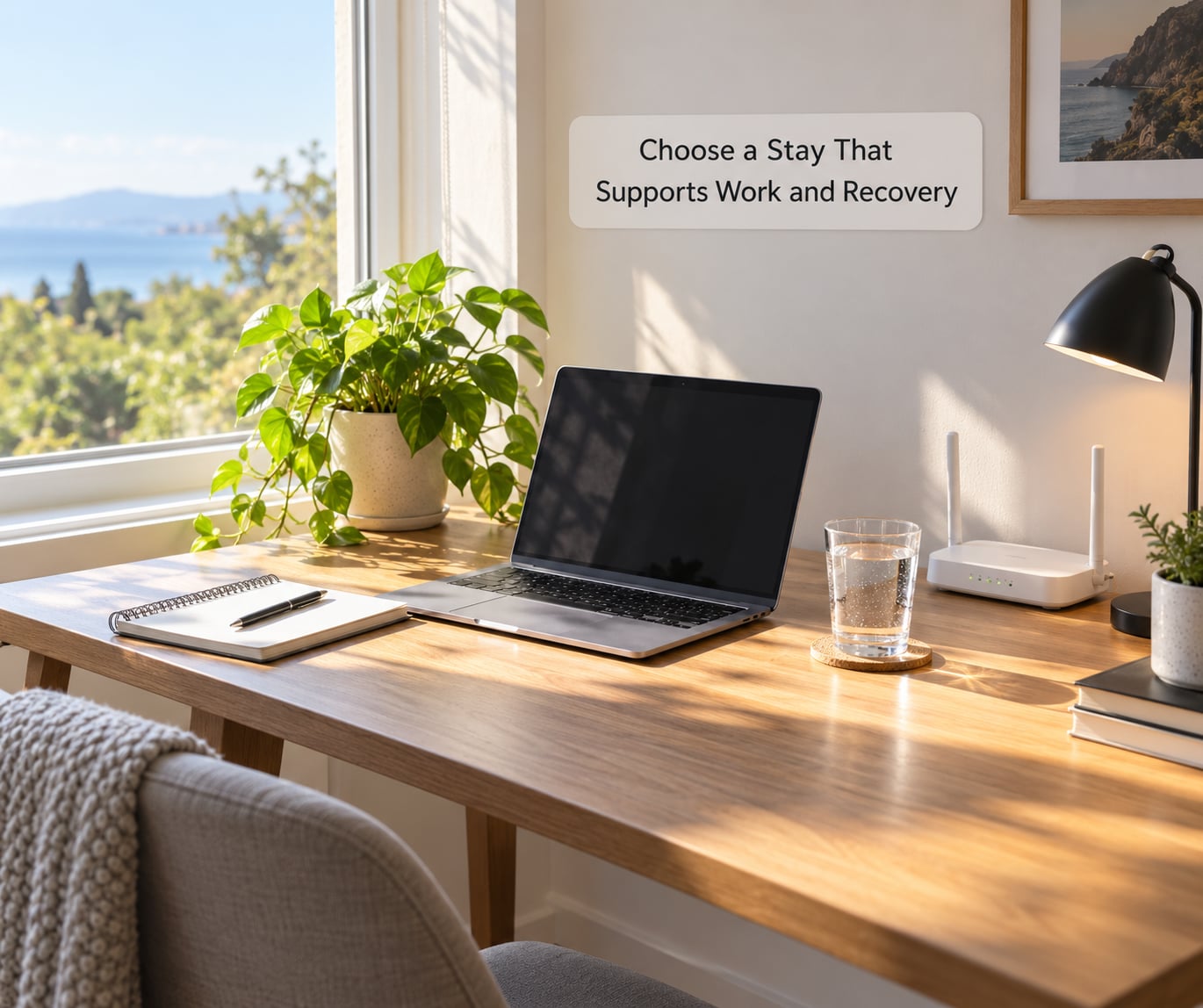
Judge a boutique or neighbourhood stay on work conditions and downtime, not on the photos. Run through a short checklist: is there a real desk rather than a dresser, is the connection reliable enough for video calls, can you hear yourself think in the room, is there daylight, is there backup power, and can you walk to something restorative in under ten minutes.
Ask the host for the connection details before you pay, and search reviews for the word wifi. Remote workers have learned this the hard way, and the pattern is consistent: the view is lovely, the connection is what you actually live with all week.
Under ten minutes of walking to a coffee counter, a pool, or a park is the difference between a stay you rest in and a room you stare at between calls. That single criterion filters out more bad rooms than anything else on the list.
3. Put Every Work Session on the Calendar
Build a realistic week with focus blocks, meetings, buffers, meals, exercise, exploring, and time you deliberately leave open. Unscheduled time is not wasted time, it is the part that stops the week from feeling like one long Monday.
A workable Tuesday looks like this: two focus blocks before lunch, one meeting in the early afternoon, a walk, dinner away from the laptop, and an evening with nothing scheduled. Notice what is missing. There is no third focus block, because there is no hour in the day where it could go without pushing dinner late.
Protect at least one recovery period a day on paper. Recovery you have not written down gets eaten by whatever is next.
4. Set Availability and Vacation Boundaries
Tell your team your working hours, your response-time expectations, how many meetings you will take, and when you are offline. Then say which period is yours. People on r/remotework and similar remote-work forums repeat the same lesson: the workations that went badly were the ones where nobody knew the rules.
Keep it short. Something like this works: “I am on the road the 12th to 21st, online 09:00 to 14:00 my time, two meetings per week, messages within a day, offline from the 18th. Deliverable is the launch, due the 20th.” That is the whole message.
Then defend evenings, one partial day, or one full day. Which one depends on your job, but you pick it before departure rather than discovering on day four that you have no rest at all.
5. Design the Trip as an Alternating Rhythm
Stack your demanding and light days instead of arranging everything at once. A simple three-day pattern: a deep work day, a lighter meeting day paired with outdoor activity, then a full recovery day with no laptop and no agenda.
Time zone differences change this pattern rather than breaking it. If you lose three hours of overlap with your team, drop the meeting day to two calls and push more of your work into deep blocks, which do not need anyone else awake.
You know the rhythm works when the trip ends with you tired in a normal way, rather than tired in the way office-tired feels.
6. Protect Sleep, Meals, and Small Pleasures
Basic recovery belongs in the itinerary, not in whatever gaps remain at the end of the day. Keep a consistent sleep window even when the timezone fights you, eat at roughly the same hours, move for thirty minutes a day, and stop working once dinner is done.
Add one small local ritual that costs you nothing in energy. A tea stop on the same corner each morning, a short walk at the same hour, or a market you only visit on Saturdays. Remote workers on travel forums describe these as the thing that makes a long stay feel like a life rather than a hotel room.
None of this is glamorous. It works because it removes the daily negotiation about whether you have earned a break.
7. Run a Two-Week Recovery Check
Two weeks after you get back, compare your energy against what it was before the trip. Write down how much recovery time got interrupted, which work blocks held up and which did not, and whether the stay worked on work terms and downtime terms separately.
Change one thing for the next trip. Shorter, lighter, different room, different rhythm. Adjusting a single variable tells you far more than changing five at once.
Common Mistakes
- Treating every day as a workday. You finish rested on paper and wrecked in practice. Fix: one recovery period on the calendar, every day, treated like a meeting.
- Booking a room that cannot do the job. A beautiful apartment with a weak connection costs you the week. Fix: ask the host, read reviews for wifi, and check for a desk before anything decorative.
- Accepting too many meetings. Someone is always available if you never say no. Fix: cap it in writing before departure and redirect requests to your async channel.
- Working through meals. It feels efficient and it eats the day. Fix: one meal a day away from the laptop, in a different room if you have to.
- Spending your vacation days on travel logistics. Flights and check-in days are not rest. Fix: take those days as work days, since they need no focus anyway.
- Returning with no buffer. The real burnout often lands the week you get back. Fix: keep two or three ordinary days at home before full schedule resumes, which is what recovering remote workers tend to need.
If you are starting out, run a short trial first. Two to four days on a familiar trip, one small deliverable, and a stay near home. Weekend-length workations get reported as too short to settle in, which is fine for a test but a poor way to judge whether the format works for you.
Frequently Asked Questions
How long should a workation be to avoid burnout?
Most people report that ten days is the shortest trip where you can still finish something and actually switch off. Below that, the settling-in and packing-up time eats the useful days. If you can only spare a weekend, treat it as a test rather than a real workation, and pick one small deliverable.
Can I split my vacation days around a workation?
Yes, and it is a common arrangement. Take your normal work days as work days, then place one or two vacation days at the front or the end. That gives you an arrival day with no expectations and a departure day you do not spend answering messages from an airport.
How do I manage meetings across time zones during a workation?
Work out the overlap with your team before booking, then cap your meetings to fit inside it. Anything that falls outside becomes written async or gets declined. If the overlap is smaller than three hours, move your work into deep blocks and tell your team that in advance.
What should I do if my workload expands while I am away?
Say something early and short: here is what I am carrying, here is what slips, which choice do you want me to make. Do not absorb the extra work silently, because the extra hours come straight out of your recovery time. Deferring is a legitimate answer when you set the deadline.
What makes a hotel or rental suitable for a workation?
A real desk, a connection that holds a video call, a quiet room, daylight, and a restorative option within a ten-minute walk. Appearance matters far less than those five things. Anyone planning a workation that does not burn out their vacation days should check the accommodation criteria first and only then compare neighbourhoods.
Conclusion
The pattern that holds up is the same every time: one deliverable, one room checked for work conditions and downtime, a calendar with recovery already on it, and boundaries told to your team in writing before you leave. Do those four things and the trip does the job without spending the vacation you were trying to protect.
Start with the first three actions before you book anything. Reduce the workload to something you can finish, write down the accommodation criteria that matter to you, and block out recovery time as if it were a client meeting. Then pick the dates.