If you are asking how hot is too hot for a hot spring soak, the practical answer is 104°F (40°C) for healthy adults. Water from 100°F to 104°F is the soaking band, anything from 105°F to about 120°F is for a quick dip rather than a soak, and water at 120°F (49°C) or above can scald skin in seconds.
Natural spring water has no thermostat. You cannot turn it down, and the temperature listed for the source is often not the temperature of the pool you are standing in. That gap is where most of the confusion comes from, so here is how to read the numbers before you get in.
Table of Contents›
- How Hot Is Too Hot for a Hot Spring Soak?
- What Temperature Counts as a Hot Spring Soak?
- Comfortable, Hot, or Dangerously Hot?
- How Long Should You Stay in a Hot Spring?
- How to Check the Actual Water Temperature
- Warning Signs That You Should Get Out
- What to do if you get burned by hot spring water
- How to Soak More Safely and Comfortably
- What If the Spring Is Too Hot for You?
- Frequently Asked Questions
- Is very hot spring water safe?
- Does soaking in a hot spring help you sleep or improve circulation?
- Can children soak in a hot spring?
- What temperature is too hot for an older adult or someone with a heart condition?
- What should you do if you feel dizzy or overheated in a hot spring?
- The Short Answer
How Hot Is Too Hot for a Hot Spring Soak?
Too hot means anything above roughly 104°F for a healthy adult soaking more than a few minutes. Above 120°F (49°C), contact with the water can damage skin in seconds rather than minutes. Below 104°F, the same soak is comfortable and low risk for most adults.
Four things decide whether a pool is comfortable or dangerous for you: the water temperature, how long you stay in it, your own health, and whether the pool is a soaking pool or a source pool nobody is meant to enter.
That last one catches people out constantly. A spring can be listed at 158°F and still have a side pool a few feet away sitting at a soakable 102°F. The source is a viewing feature. The pool is the destination.
| Fahrenheit | Celsius | Commonly described as |
|---|---|---|
| 98°F | 36.7°C | Body temperature, a warm rinse |
| 100°F | 37.8°C | Comfortable soaking, warm pool entry |
| 102°F | 38.9°C | Upper end of the comfort band |
| 104°F | 40°C | Hot tub maximum, soakable for a short session |
| 110°F | 43.3°C | Splash or brief dip only |
| 120°F | 48.9°C | Scald risk in seconds, do not soak |
| 122°F | 50°C | Geological threshold for a hot spring |
What Temperature Counts as a Hot Spring Soak?
There is no single temperature that is hot spring soaking water. Natural systems run from just over body temperature to well past 180°F, and the useful question is not how hot the spring is but how hot the pool you are entering is.
| Band | Range | What it feels like | What to do |
|---|---|---|---|
| Tepid | Below 95°F (35°C) | Warm rather than hot, almost no heat stress | Soak as long as you like, this is a cooling or rinsing pool |
| Comfortable | 95°F to 102°F (35 to 39°C) | Warm, easy to sit in for a long session | Soak 20 to 30 minutes with drinking water within reach |
| Hot but soakable | 102°F to 104°F (39 to 40°C) | Clearly hot, you feel your pulse in the water | Short session of 15 to 20 minutes, then cool down |
| Very hot | 105°F to 120°F (41 to 49°C) | Uncomfortable on entry, painful after a minute or two | Dip only, do not submerge your torso or stay in |
| Do not enter | Above 120°F (49°C) | Pain arrives almost instantly and skin damage follows | View from the bank, do not put a hand or foot in to test |
Source temperature and soak temperature are two different numbers. Water leaves a geothermal vent at whatever the rock gives it, then cools as it runs downhill or mixes with cooler groundwater. A rock-walled pool with a shallow spillway usually sits well below the source reading, and so does any pool downstream of one.
This is why posted figures feel inconsistent. Neighbouring springs in the same drainage can be 102°F and 140°F, and another a mile off can run to 180°F. Nobody is being careless. They are genuinely different water, and last year’s reading is no guarantee because flow changes with snowmelt and drought.
Comfortable, Hot, or Dangerously Hot?
The same pool can be heaven to one person and too much to another. Air temperature changes the equation more than most people expect, because hot water in freezing air reads as much hotter than the same water on a mild afternoon, even at an identical thermometer reading.
Depth matters too. Submerged, you lose air contact and cannot cool yourself by evaporation, which is why 104°F at shoulder height feels stronger than the same pool at your waist.
Put two people in the same 102°F pool and the one who soaked in cold air for an hour may feel it as a warm rinse, while the one who came straight out of a hot car finds it too much. Acclimatisation, age, body mass, circulation, and expectations all move the needle.
Risks also hide better in some settings. Deep water hides the fact that you have stopped shivering. Enclosed bathhouses hold heat and humidity, so the air does not cool you between dips. And in a remote spring with no shade and no drinking water, heat exhaustion can build before you notice anything is wrong.
| Group | Sensible ceiling | Notes |
|---|---|---|
| Healthy adults | 104°F (40°C) | The standard hot tub maximum and the usual advised limit |
| Adults over 65 | 102°F (39°C) or lower | Reduced circulation and heat tolerance, so shorter sessions |
| Children | 102°F (39°C) or lower | Constant supervision, sessions of a few minutes only |
| Pregnant people | 102°F (39°C) or lower | Check with a doctor before soaking, given overheating concerns |
| Heart or respiratory conditions | Ask a doctor first | Both heat stress and steam on the lungs are relevant |
| Anyone after alcohol | Skip the soak | Alcohol masks heat cues and adds dehydration |
| Medications affecting sweating or blood pressure | Ask a doctor first | Both dose timing and heat tolerance change the picture |
How Long Should You Stay in a Hot Spring?
Length and temperature trade directly against each other. Cooler water allows longer sessions, hotter water forces short ones, and the limit that matters is how much your core body temperature rises rather than how the water feels on your skin.
| Water temperature | Suggested session | Afterwards |
|---|---|---|
| 95°F to 100°F (35 to 38°C) | 30 minutes or more | Rest as needed, no urgent cool-down |
| 100°F to 102°F (38 to 39°C) | 20 to 30 minutes | Five to ten minutes out of the water, drink water |
| 102°F to 104°F (39 to 40°C) | 15 to 20 minutes | Cool down until you stop feeling flushed |
| 104°F (40°C) and above | About 30 minutes maximum in total | Get out even if you still feel fine |
| Above 105°F (41°C) | A dip, not a soak | Do not settle in |
Regular soakers treat 104°F as a 30-minute ceiling for an average adult, and anything higher as a short session only. That is a rule of thumb, not a permission slip. If a facility posts a 20-minute or 45-minute limit, that limit wins, and in many places the posted time is a hard stop enforced by an attendant.
Cumulative time counts too. Three short dips within the hour is more heat load than one 20-minute soak, even when each dip felt manageable.
How to Check the Actual Water Temperature
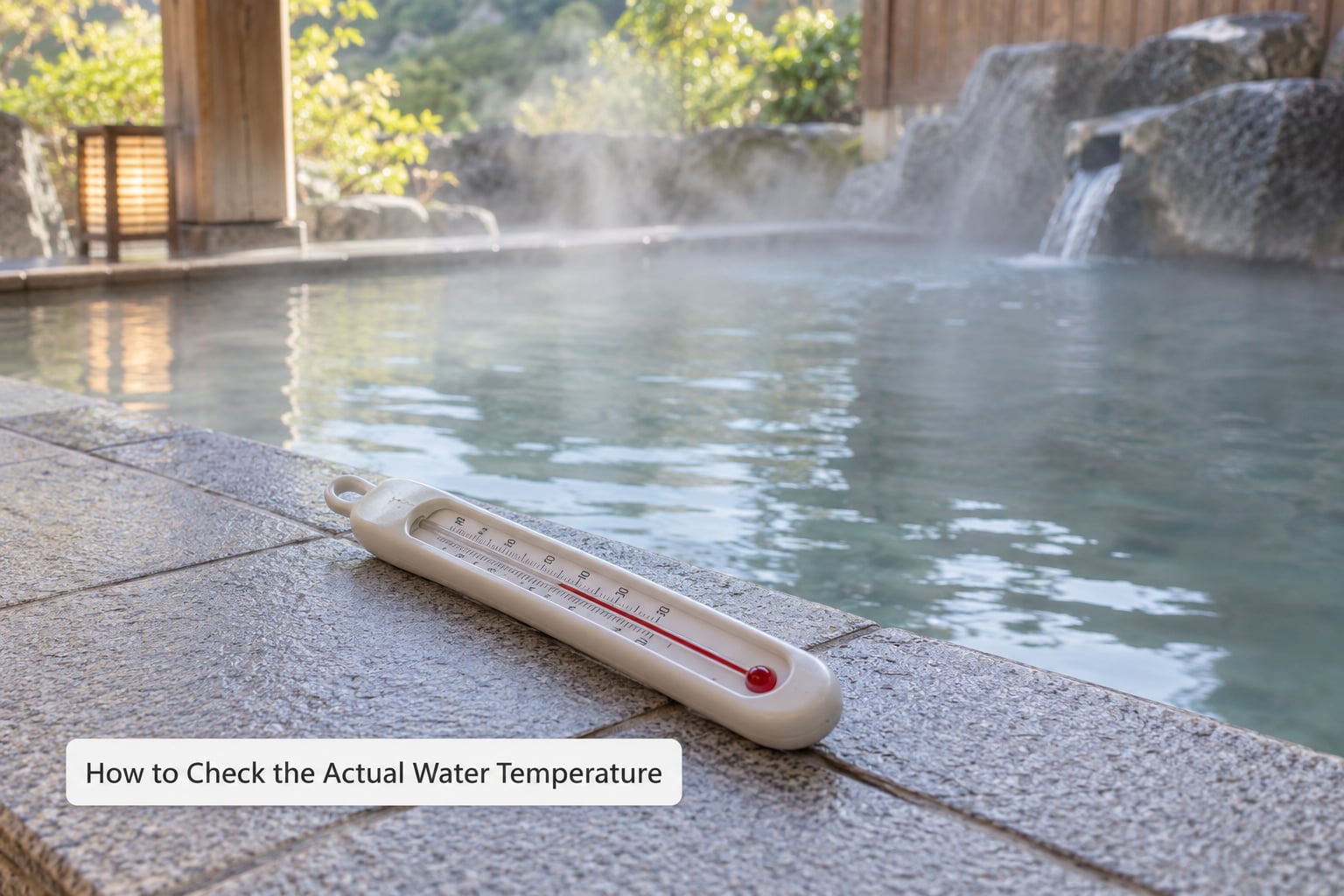
Temperatures move. A pool can run cooler in early morning, warmer at midday, and warmer still when a hot surge pushes through. Posted figures are a starting point rather than a live reading.
Here is the check I use before entering any pool. Hover a hand just above the surface first, then lower your wrist in for ten seconds without putting your body in. If the water makes you pull away before the ten seconds are up, treat it as a dip pool. Then feel the water with your toes at the edge, since a rock shelf or shallow step can run hotter than the middle of the pool.
One caveat on hands. Cold hands read hot water as milder than it is, so a comfortable hand test in winter can mislead you. Test again with a warm wrist, or with the back of the hand, if you have been out in the cold.
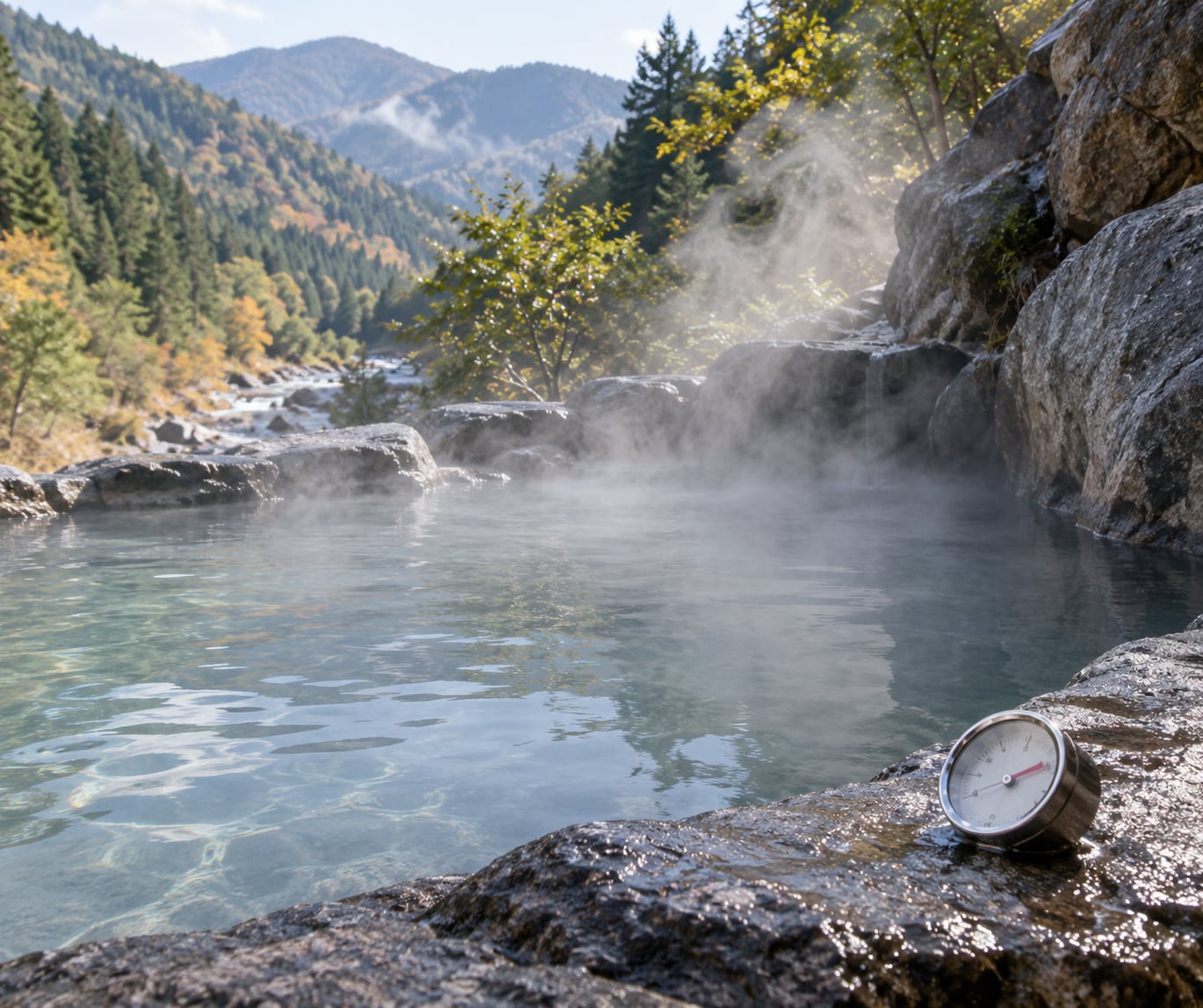
If you carry your own thermometer, rest it in the water where you plan to soak rather than in an intake channel. Put nothing back into a spring that is not yours, and never add hot water to cool a pool down. That is how scalds happen at small private facilities.
Where signage is thin or missing, ask staff, or ask someone already soaking. A person in the water will tell you how it feels faster than any gauge.
Warning Signs That You Should Get Out
Get out immediately, without pausing to decide whether you are fine, if you notice headache, dizziness, nausea, lightheadedness, unusual fatigue, muscle cramping, weakness, confusion, very flushed or bright red skin, chest discomfort, or difficulty breathing.
Nausea, confusion, collapse, and breathing difficulty are emergencies rather than discomforts. Call for help or get to a staffed area straight away.
The order matters, because heat exhaustion can turn into heat stroke and the gap between them is short. Get cool, drink water if you are fully awake, and do not return to the water the same day.
What to do if you get burned by hot spring water
Cool the burned area under cool running water for around 20 minutes, or place it in a container of clean cool water if you are away from a tap. Do not use ice, do not apply butter, oil, toothpaste, or dressings, and do not burst blisters yourself.
Take paracetamol or ibuprofen for pain if you can take it safely, keep the area clean and loosely covered, and get medical care for any burn larger than the palm of your hand, anything on the face, hands, feet, or a joint, and any burn that is deep, blistered, white, or leathery.
Hot water burns faster and deeper than most people expect. Skin can look like a mild red patch at first and turn out to be a second-degree burn an hour later, so the cooling step matters even when the burn does not look serious.
How to Soak More Safely and Comfortably
Drink water before you get in and keep drinking while you soak, especially in dry air, at altitude, or in winter. Heat escapes from you faster than you notice, and mild dehydration makes heat harder to tolerate.
Enter gradually. Get your feet and legs in, wait, then sit back rather than lowering yourself in fast. The slow entry is what tells you how the pool actually feels.
Start with a short dip, keep a real break between soaks, and use the break to cool down. Watch for the moment you stop feeling cold and start feeling loose, because that is where most people overstay.
Never soak after drinking alcohol, and be careful with a sauna or steam room stacked close to a long soak. Between a very hot sauna and 15 minutes at 104°F, the pool is the one that catches you out.
On the way out, expect a shock. Moving from a hot pool into cold air, or stepping into a cold plunge, can trigger an involuntary gasp, a spike in blood pressure, and in a cold body, a real drowning risk. Wade in slowly, keep your head above water, and walk the first minute.
If you are soaking alone at a wild spring, tell someone your plan and when you expect back, and treat any sign of heat illness as the signal to move toward help rather than toward the water.
What If the Spring Is Too Hot for You?
If the pool runs above what you want, you have options that do not involve forcing it. Pick the cooler pool at the site, soak at the waterline with only your feet and lower legs in, shorten the visit, or use a foot bath at the edge while you watch.
Many sites put a viewing area beside a source pool, and sitting near genuinely boiling water in cold air is a perfectly good afternoon without getting in.
Watch the posted rules carefully at private or indoor rooms. Enclosed tubs may run hotter than outdoor pools, may carry a lower time limit, and hold more humidity, so the same minutes carry more heat load.
Frequently Asked Questions
Is very hot spring water safe?
Very hot spring water is not safe for soaking. Above about 104°F (40°C), heat stress builds quickly with each minute submerged, and above 120°F (49°C) skin can be scalded in seconds. Natural water also cannot be thermostatically controlled, so the temperature can shift during your visit. View very hot sources from the bank rather than testing them with a hand or foot.
Does soaking in a hot spring help you sleep or improve circulation?
Many soakers report feeling relaxed and sleeping better after a moderate soak, mostly because the warm water and the ritual of unwinding settle you down. Your hands and feet may feel warmer as blood flow to the surface increases, but that is a temporary change rather than a treatment for a circulation problem. Keep sessions to 15 to 20 minutes at 104°F or lower for the calmest effect.
Can children soak in a hot spring?
Children can soak, but cooler and for far less time than adults. Aim for 102°F (39°C) or below, keep sessions to a few minutes, and stay within arm’s reach the whole time, because a child can slip under quickly and quietly. Do not let children test the water temperature with a hand or foot alone, and check with a doctor first if your child has a heart or respiratory condition.
What temperature is too hot for an older adult or someone with a heart condition?
For adults over 65 and anyone with a heart or respiratory condition, 102°F (39°C) or lower is a sensible ceiling, and shorter sessions of 10 to 15 minutes are usually enough. Reduced circulation and a slower response to heat make the standard 104°F advice a poor fit. If you take medication affecting sweating, blood pressure, or fluid balance, ask your doctor before soaking at all.
What should you do if you feel dizzy or overheated in a hot spring?
Get out of the water straight away, sit somewhere cool, and drink water if you are fully awake. Do not go back in the same day, even if you feel fine within an hour. Confusion, fainting, nausea that will not settle, and difficulty breathing are all emergencies, so reach a staffed area or call for help rather than resting alone. Feeling dizzy after a soak is not normal; it is your body telling you the heat load was too much.
The Short Answer
Check the posted temperature, treat 104°F as the ceiling for a full soak, respect the facility’s time limit, start with a short dip, and choose the pool that feels right rather than the one that looks most impressive. Get out at the first sign of overheating.
Health conditions, pregnancy, medications, age, and a previous heat illness can all change what suits you, so if any of those apply, ask your doctor instead of copying what worked for other people.