Most hikers underestimate how long a hike will take, and the number on the trail sign is almost always the most optimistic figure available. Learning how to figure out how long a hike will take takes about five minutes of arithmetic: you start with the trail’s distance, add an allowance for every 1,000 feet you climb, then add your breaks. The classic version of that shortcut, Naismith’s Rule from 1892, allows one hour per three miles of walking plus one hour per 2,000 feet of ascent.
That formula gives you a moving time — the hours your feet are actually moving. Real hikes take longer, and the gap between the two is where most of the trouble comes from. Add 25 to 50 percent for rest stops, slow ground, and the pace of whoever is slowest in the group, and you have a number you can plan a day around.
Table of Contents›
- What You Need
- Step-by-Step: How to Figure Out How Long a Hike Will Take
- How to figure out how long a hike will take using distance
- Add time for elevation gain and difficult terrain
- Adjust for weather, fitness, and breaks
- Check the result against route guidance
- Build in a safety buffer and choose a turnaround time
- Common Mistakes
- Planning tips for a more accurate estimate
- Frequently Asked Questions
- How long should I allow for a hike?
- Does elevation change the time a hike takes?
- How do I estimate hiking pace for a beginner?
- Should I add rest breaks to a hike time estimate?
- What is a safe turnaround time for a day hike?
- Conclusion
What You Need
Before you touch a formula, gather five things. Without them, any estimate is guesswork dressed up as arithmetic.
- Distance in miles or kilometres. Take the trail’s official figure from the land manager or a mapping app. Curvy trails are measured along the path, not as the crow flies, which is why a 6-mile trail on a map can read as 4.
- Total elevation gain. Cumulative ascent, the sum of every climb, not the highest point. A route that tops out at 4,000 feet but climbs 3,500 feet total takes far longer than the summit number suggests.
- Terrain type. Paved trail, singletrack, boulder fields, scree, mud, river crossings, stairs. Technical ground has no meaningful speed.
- Conditions. Snow and ice slow everyone dramatically. So do deep mud, sustained rain, heat, and altitude.
- Your own pace, honestly assessed. Pick a number based on hikes you have actually done, not on the fittest person in your group.
If you are hiking with children, the Norwegian Trekking Association (DNT) suggests doubling the adult estimate for children under 10 and adding 50 percent for ages 10 to 14. That is not pessimism; small legs and short attention spans are simply part of the route.
Step-by-Step: How to Figure Out How Long a Hike Will Take
How to figure out how long a hike will take using distance
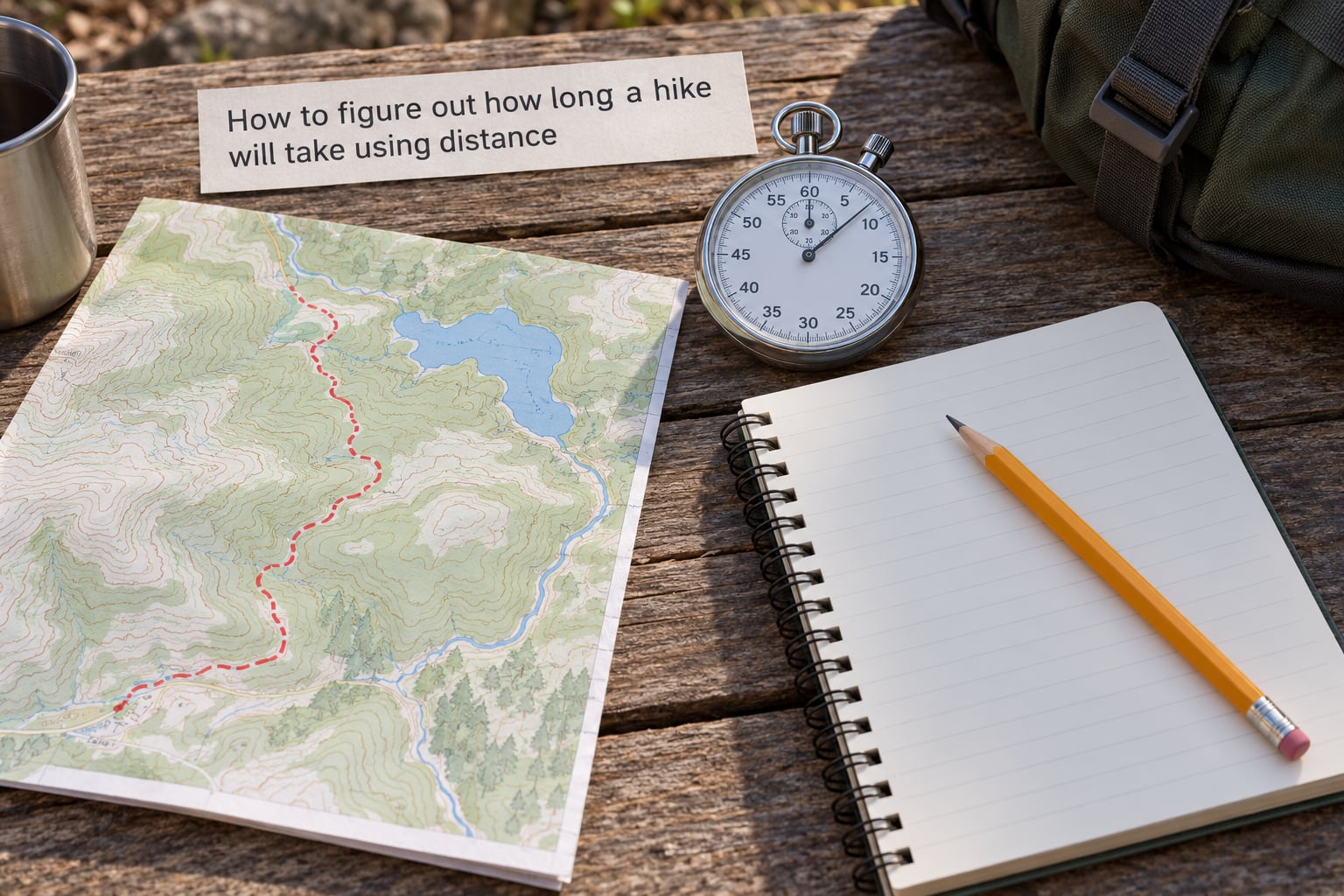
Start with distance, because it is the only number every route has. Average hikers move at roughly 2 to 3 mph on flat trail, which works out to 3.5 km/h. Speed hikers hold 4 to 5 mph and trail runners run 6 to 10 mph. Flat ground sits closer to 3 mph; anything steep pulls it down fast.
The DNT, whose members do this professionally in Norway’s mountains, plans on 3.5 km/h for an adult in reasonable shape carrying a 10 kg pack. That is a slower, more honest baseline than most trail signs use, and it is a good default if you have never timed yourself.
Is 2.8 mph a good hiking speed? For a fit adult on maintained trail, yes — that sits inside the 2 to 3 mph band that defines an average hiker. It becomes slow on a loaded climb or a long descent with a heavy pack.
Divide your distance by that pace and you have a flat-terrain baseline. If you figure out how long a hike will take using distance alone, you have ignored the hill, and every climb you meet will eat into the gap between your estimate and reality.
Add time for elevation gain and difficult terrain
Naismith’s Rule adds one hour for every 2,000 feet (about 600 metres) of ascent, published by the Scottish mountaineer William W. Naismith in 1892. The DNT’s version is finer-grained and metric: 15 minutes per 100 metres of gain, roughly 400 m of climb per hour on steep ground.
Book Time, used by outdoor schools and youth groups, works differently: 30 minutes per mile plus 30 minutes per 1,000 feet of gain. It tends to produce a higher number than Naismith’s Rule and is closer to total elapsed time than pure moving time. Knowing which of the two you are using explains most of the disagreement you will find online about which formula is right.
| Formula | Flat rate | Climb allowance | Best for |
|---|---|---|---|
| Naismith’s Rule | 1 hr per 3 miles (5 km) | 1 hr per 2,000 ft (600 m) | Mountains, backpacking routes, quick baseline |
| Book Time | 30 min per mile | 30 min per 1,000 ft (304 m) | Day hikes, conservative planning |
| DNT standard | 3.5 km/h on marked trail | 15 min per 100 m | Metric routes, partly hilly terrain |
| Tobler’s function | Speed varies with gradient | Built into the gradient term | Rolling terrain where grades vary constantly |
Descent deserves its own line. It is not free time: the DNT allows 30 minutes per 400 metres of descent, and steep downgrades punish knees enough that solo hikers should slow down rather than bank the hours.
A worked example, every number shown. Take a 9-mile trail with 2,300 feet of gain:
- Flat baseline: 9 miles at 2.5 mph = 3.6 hours
- Elevation: 2,300 ft at Naismith’s 1 hr per 2,000 ft = 1.15 hours
- Descent allowance: 1,600 ft, about 490 m, at 30 min per 400 m = 0.6 hours
- Moving time: 3.6 + 1.15 + 0.6 = 5.35 hours, call it 5 hours 20 minutes
- Breaks: 5.35 hours of hiking at 1 hr per 5 hrs = 1.1 hours
- Hard terrain and a slow group: add 20 percent = 1.3 hours
- Planned total: about 7 hours 45 minutes
A trail sign advertising five hours was not lying. It assumed a fitter walker, no breaks, and dry trail.
Adjust for weather, fitness, and breaks
Weather is the largest single swing factor. Walking speed drops by about a third for every 5.5 degrees of ascent, and heat, humidity, or headwind take a further cut. Rain has a subtler cost: wet feet, cold clothing, and slippery rock slow you and add stops you did not plan.
Load matters too. For every 1 percent of your own body weight that you carry, expect to be 6 seconds per mile slower. As a rough guide, keep a day hike under 10 percent of body weight, an overnight under 20 percent, and treat 30 percent as an absolute ceiling for multi-day trips.
Then add breaks deliberately. The DNT allows one hour of total break time per five hours of hiking for adults, and that covers water, food, shoes, photos, and the bathroom stop nobody plans for. Those unplanned stops are consistently the biggest source of the gap between a posted estimate and your actual finish time.
Altitude and fatigue work quietly. Above 8,000 feet, most hikers slow down and none of the formulas know it. The final third of a long day feels slower than the first third for everyone, so resist the urge to shave minutes off your total at mile eight.
Check the result against route guidance
Your calculation is a starting point, not a verdict. Official trail guidance, ranger reports, and recent trip reports all carry useful information, and each assumes something slightly different.
Read the published estimate’s assumptions before you trust it. A sign that assumes a fit adult with a day pack on maintained trail means something very different for a family carrying camping gear on a rocky descent. App-generated numbers work the same way: some are built on a gradient-based function like Tobler’s, which handles rolling ground better than a flat average does, while others just apply Naismith’s Rule to the route and stop there.
Recent trip reviews from other hikers are usually the most honest source available. Look for reports from the last few months and in similar weather. Trail condition reports and ranger updates tell you whether snow, washouts, or closures have invalidated the route since the sign was posted.
If two credible sources disagree by an hour, assume the larger number. Every forum thread worth reading on this topic arrives at the same conclusion: underestimation is the rule, not the exception.
Build in a safety buffer and choose a turnaround time
Now convert your estimate into a plan. Pick a hard turnaround time and choose a specific spot to reach by it — a junction, a trailhead, a road — before you start, not while you are tired and committed.
Work backwards from sunset rather than forwards from your start time. Subtract your planned duration, then subtract the buffer you are adding for terrain and weather. That buffer should be 25 to 50 percent on an unfamiliar trail, which is the simplest correction most people need to make to Naismith’s Rule.
For solo hikers this step matters more than the arithmetic. Set the buffer generously, carry more water and insulation than the forecast suggests, and tell someone your route and your hard turnaround time. A plan you abandon at mile seven is a good plan; a plan you push past dusk is not.
Common Mistakes
Using distance alone. Ten flat miles is a completely different day from three miles with 2,000 feet of climb. Fix: always add the elevation allowance before you commit to anything.
Treating moving time as total time. This is the most common error, and it is the reason a five-hour estimate becomes a seven-hour day. Fix: add one hour of breaks per five hours of hiking, then check the arithmetic includes descent.
Picking an unrealistic pace. Beginners often aim at a trail runner’s speed and pay for it in the last third of the day. Fix: calibrate from a hike you have actually finished, not from a flattering memory.
Forgetting who sets the pace. Formulas describe one person in average shape. Fix: use the slowest hiker’s pace, and if children are coming, apply the age multipliers.
Ignoring conditions. A dry-trail number applied to snow, mud, or an ice field can be off by hours. Fix: add 30 to 50 percent when the ground is anything other than dry and firm.
Planning tips for a more accurate estimate
Time three hikes you have already completed, recording actual moving time and total elapsed time separately. Divide your result by the formula’s prediction to get your personal multiplier, then use it from then on. That single habit beats any published number.
For beginners, plan with the slower end of the published range and pick a shorter route. Experience is the only real fix for a slow baseline, and short hikes build it quickly. Experienced hikers should still re-estimate after any long layoff; fitness fades faster than memory of it.
Groups should agree on a pace before the trailhead and build in a regrouping stop every hour or two, because a slow start tends to become a late finish. Anyone using a GPS watch or mapping app should treat the displayed pace as moving time only, then add their own breaks on top.
Local knowledge beats every formula in a changing condition. Recent trip reports from the same season tell you what the ground is actually doing right now.
Frequently Asked Questions
How long should I allow for a hike?
Allow the formula’s moving time plus 25 to 50 percent for breaks, terrain, and a slow group member. For example, a 9-mile trail with 2,300 feet of gain calculates to roughly 5 hours 20 minutes of moving time, which becomes about 7 hours 45 minutes once breaks and difficult ground are included.
Does elevation change the time a hike takes?
More than most people expect. Naismith’s Rule adds one hour per 2,000 feet of ascent, and the DNT adds 15 minutes per 100 metres. Two routes of identical length can differ by two or more hours purely on climbing, and descent costs real time too at about 30 minutes per 400 metres.
How do I estimate hiking pace for a beginner?
Start with 2 to 3 mph, or 3.5 km/h, on maintained flat trail, then assume you will be at the slow end of it. Ten miles at 2.5 mph is about four hours of walking before you add a single break. Avoid planning any first hike in the ten to fourteen mile range.
Should I add rest breaks to a hike time estimate?
Yes, and most trail estimates do not. The DNT allows one hour of total break time per five hours of hiking for adults, which covers water, food, footwear, photos, and the stops nobody planned. Skip this step and a realistic estimate becomes an optimistic one.
What is a safe turnaround time for a day hike?
Set it so you are back at the trailhead an hour before sunset at minimum, and earlier on unfamiliar or remote ground. Work backwards from your estimate plus a 25 to 50 percent buffer, and pick one specific point on the trail as your hard turnaround before you set out.
Conclusion
Working out how long a hike will take comes down to four numbers in order: distance gives you a flat baseline, elevation gain and descent add the climbing cost, breaks convert moving time into real elapsed time, and a buffer protects the whole plan. Start with the route’s distance and total ascent, apply Naismith’s Rule or the DNT standard, add one hour of breaks per five hours, then add 25 to 50 percent before you set a turnaround time. Calibrate that percentage against hikes you have already finished, and your estimate will beat the trail sign every time.