To plan a trip around fall foliage without crowds, treat the crowd calendar as your main planning variable rather than a detail. Travel a week on either side of the regional peak, move your days to Sunday through Thursday, and put your base in a smaller town rather than the one every bus tour is heading to. People still arrive early at packed trailheads and wonder why the parking lot is full. Choosing a different week fixes that faster than any other move.
The reason this works is that fall colour is a moving target. Peak colour travels south and downhill as temperatures drop, roughly a week of delay for every 100 miles south and several days later for every extra 1,000 feet of elevation. That spread is the reason a packed weekend and a quiet one can sit only four days apart and look completely different.
What you give up is certainty. No tracker can promise a date, and a single early frost or a week of rain can end a season locally. The approach below accepts that uncertainty and plans around it, which is why the booking advice leans hard on free cancellation and one primary destination plus a fallback.
Allow about two to four weeks of planning for a self-drive trip, longer if you need a specific lodging type. The work is mostly research, and most of it happens before you book anything.
Table of Contents›
- What You Need
- Step-by-Step
- Choose destinations with a longer foliage window
- Travel just before or after the predicted peak
- Build a base outside the busiest visitor center
- Visit headline attractions at off-peak times
- Create one flexible plan for each day: the core of planning a trip around fall foliage without crowds
- Save money and time with smart transport choices
- Pack for changing conditions and check the route
- Common Mistakes When Planning a Trip Around Fall Foliage Without Crowds
- Frequently Asked Questions
- What is the best time to visit for fall foliage?
- How far ahead should I book hotels for autumn leaf season?
- Is it better to stay in a famous fall-color town or nearby?
- What should I do if leaves change earlier or later than expected?
- Are weekdays noticeably less crowded for fall foliage?
- How can I plan a trip around fall foliage without crowds when I work remotely?
- Start With Flexibility, Not a Single Peak Date
What You Need
You need nine things sorted before the booking window opens, and most of them cost nothing but an evening of attention.
A destination shortlist of two or three regions. Not one. A shortlist gives you somewhere to go when a storm strips the leaves early, and it stops you from booking a week on instinct.
At least two reliable foliage reports. The Foliage Network tracks reports from across the United States, and SmokyMountains.com publishes a dated prediction map with a stated update cadence. Pair them with the local ranger station or state tourism tracker for whichever region you are leaning toward. Prediction maps tell you what is likely, live reports tell you what is actually on the ground.
Two or three date options per destination. The first choice and a fallback on either side of the predicted peak. You cannot decide between them yet, and that is the point.
Transport information for the region. Know how you are getting there, how long the drive is from the nearest airport or rail station, and what the last scheduled service back out looks like. Scenic rail lines and shuttles run on fixed timetables that do not flex around your schedule.
Accommodation with free cancellation. This is the single most important booking decision you will make. Look for a property you can hold through the peak week and release if the season runs early or late.
Offline maps. Mountain roads and byways have dead zones that last longer than you expect. Download the region before you leave home, not in a car park with two bars of signal.
A weather source you can check quickly. The national weather service forecast for a specific coordinate beats a general regional outlook when you are deciding whether a ridge trail is walkable in the afternoon.
Walking gear for variable ground. Layered clothing, a rain shell that closes properly over a pack, and footwear with grip for wet leaves. Trails that are fine in September can be slick by late October.
A backup plan for low visibility or rain. A short list of things worth doing nearby that still work in grey weather, from a covered bridge route to a town with an orchard trail or a good bakery.
Step-by-Step
Choose destinations with a longer foliage window
Start by picking places where colour changes at different times rather than all at once, so a forecast that runs two weeks early still leaves you something to photograph. Elevation, latitude, tree species and slope exposure are the four levers.
Higher ground turns first because nights get cold sooner. Northern forests turn before southern ones for the same reason. Sugar maples give you a hard red that arrives and leaves fast, while oaks and beech hold a slower bronze that can carry you through a late window. Exposed ridges and south-facing slopes run warm, so they hold green longer; shaded north slopes and valleys turn early.
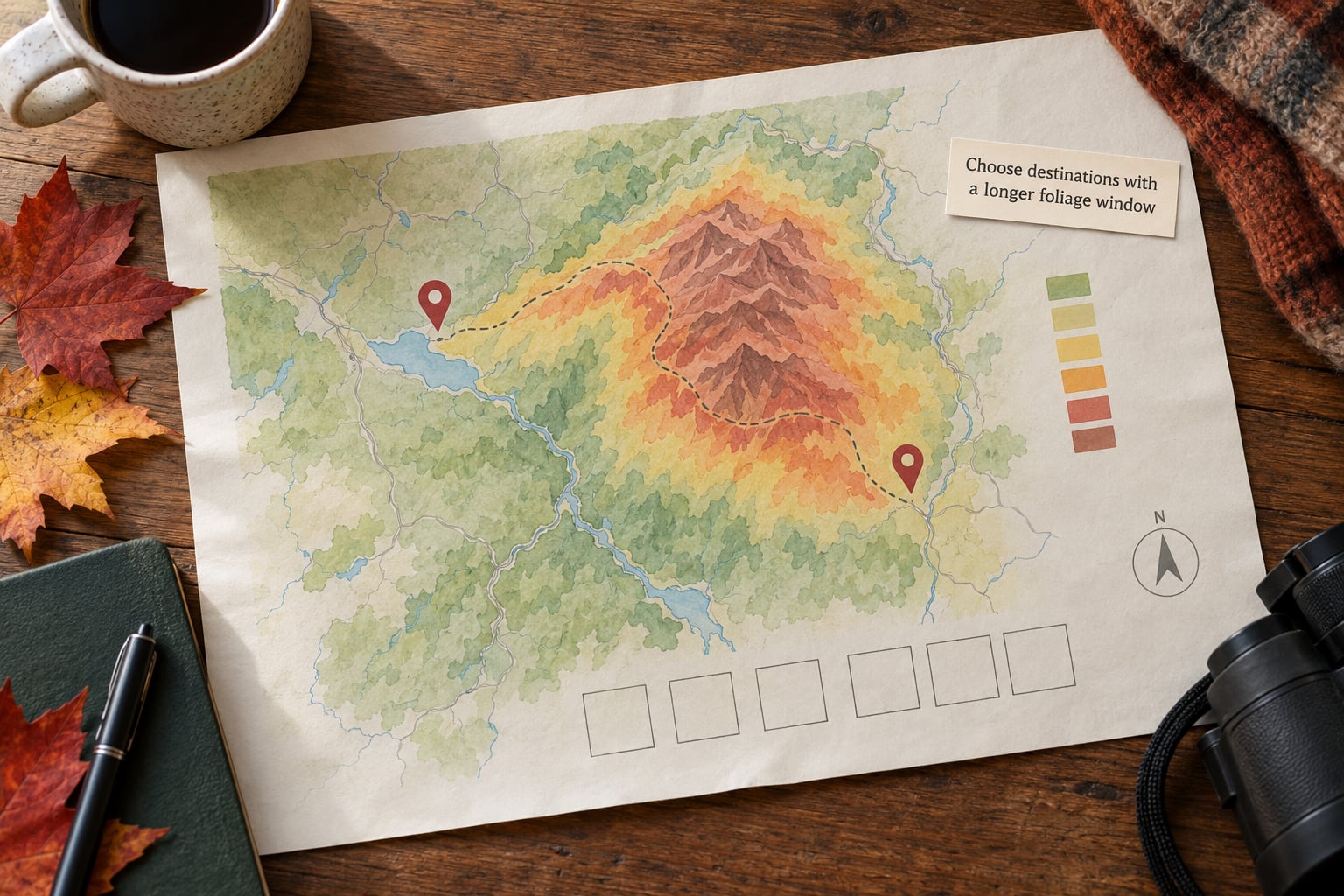
Elevation is the most useful lever because it is also a crowd lever. The higher viewpoints that colour first are usually the ones people skip, since the drive is longer and the walk is steeper. The famous low-elevation valley overlooks stay busiest longest because they are close to town and easy to reach.
Build your route around one primary destination and one weather-resilient alternative. Two different regions in the same general latitude is a better pairing than two towns twenty minutes apart, because a storm system rarely wipes out both at once.
Travel just before or after the predicted peak
Book the edges of the predicted window rather than the middle of it, because the middle is where the crowds concentrate. Seven to ten days off peak is usually early enough to keep the colour and late enough to miss the peak weekend traffic.
Get your dates from more than one source. Start with the prediction map for the broad window, then check live reports from visitors who were there in the last few days. Local hotel and inn staff are an underrated signal; front desk people are asked about conditions constantly and adjust their own advice to what they are hearing. Historical peak ranges for the region tell you how much a date can move year to year.
Time a prediction map against the actual reports. A map showing peak across a wide area on a given date is an average of many observers, and the interesting detail is almost always at the edges. Where reports disagree sharply, the region is between peaks, which is exactly the condition that gives you solitude and a partly green hillside.
Then check the calendar. Public holiday weekends compress the entire season’s demand into a handful of dates, so those weekends are the ones to avoid or to book a year ahead if you have no choice.
Build a base outside the busiest visitor center
Stay in a smaller town or a rural area within a reasonable drive of your priority trails, and you cut the crowd load without giving up access. The famous town with the main overlook in the centre is the most expensive and most crowded place to sleep in a peak week.
Compare travel times rather than distances. A town forty minutes further from the headline trail can still put you there before the good light, while a town twenty minutes away that sits behind a single-lane bridge can add an unpredictable half hour every morning. Check the drive at the hour you will actually make it, not at noon on a map.
Value the flexibility. A smaller base usually means more choices each day, because you are not locked into one loop of crowds. If the colour is late, you are closer to the higher ground. If rain sets in, you are nearer a town with a covered bridge route and somewhere warm for coffee.
Regular travellers on the r/roadtrip forum make the same point from a different angle. Pick a region, commit to fixed dates there, and accept slightly past-peak colour in exchange for the quiet. Chasing perfect peak everywhere is what produces a trip spent in queues.
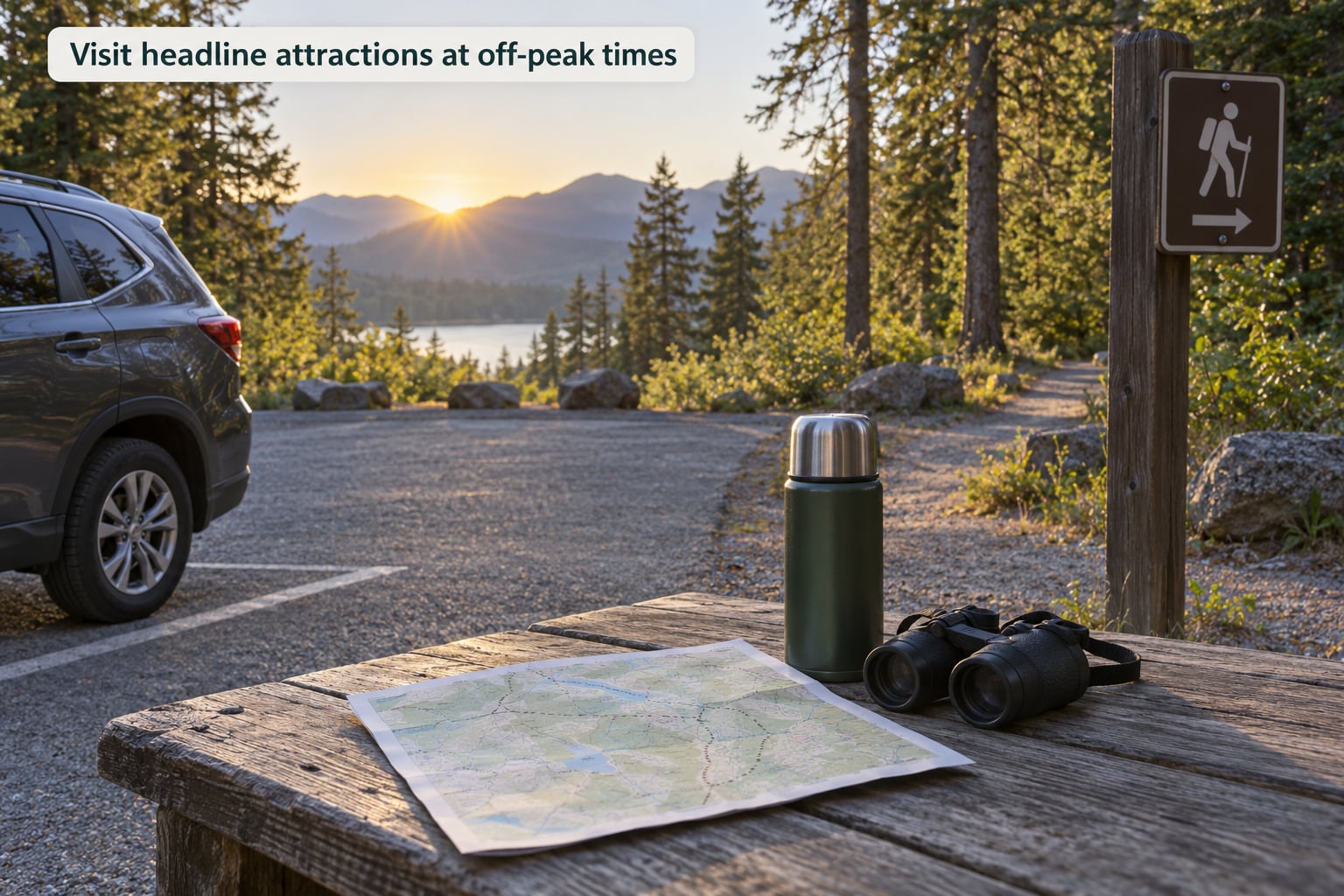
Visit headline attractions at off-peak times
Arriving before nine in the morning and staying past four in the afternoon is the difference between sharing a viewpoint and having it to yourself. Most of the congestion at famous overlooks and trailheads compresses into the middle of the day.
Check the parking situation the week before. Some popular areas use advance parking reservations or reservation systems for vehicles carrying more than a certain number of people, and others close a lot once it fills. If there is a reservation, make it, and note that some operate on a release schedule rather than a rolling basis. If there is not, find out what time the lot is usually full and work backwards from it.
Weekdays are the difference you will feel most. A trail that holds twenty people on a Sunday morning might hold three on a Tuesday, at the same colour, in the same weather. Use the visitor centre for the same reason, and ask where the local staff walk when they have a free afternoon.
Have a small rule for pull-offs. Parking at a signed pull-off is a privilege the people behind you depend on, so do not block a sightline or park over a ditch. Hikers posting on r/PNWhiking warn that even distant and moderately difficult trails fill up in October, so the effort of walking further is real. It is also the most reliable way to find a genuinely quiet morning.
Create one flexible plan for each day: the core of planning a trip around fall foliage without crowds
Give every day a primary route and a shorter alternative, and decide in the morning which one you are taking based on the conditions you can see. The alternative should be shorter and reachable without a second long drive, not a different region.
Start walks early, because early is also when the light is best and the surfaces are safest. Build generous travel buffers, because a colour trip is a slow trip and the whole day does not need to be filled. Daylight is short, which works in your favour: the usable viewing window runs from first light to about an hour before dark, and that is the window that matters.
Reserve only the transport you cannot get otherwise, such as a rail seat or a shuttle with a fixed timetable. Leave the rest of the day open, and add two or three nearby activities that survive bad weather, because a half-day of rain is normal rather than exceptional.
One note on solo trips. Without a group to coordinate, you can change plans on your own terms, which is a real advantage in this season. You can also reach first light without waiting for someone who sleeps late, and a weekday cafe or a trail start is a good time to be somewhere quiet by yourself.
Save money and time with smart transport choices
Staying outside the destination cuts the cost of a peak week noticeably, because demand drops faster than distance does. Rooms in a neighbouring town usually hold availability when the headline town is full, and the price gap widens the closer you get to the peak weekend.
Monday to Thursday travel also costs less than Friday to Sunday for the same room on the same road, and it is the difference between a lot you can park in and a lot you circle. If you can take a mid-week arrival day, the drive in and the first afternoon both get easier.
Look at the transport options that skip the traffic funnel entirely. A scenic rail line, a ferry, a park shuttle or a bike hire removes the parking problem rather than solving it, and the reservations for these are limited, so they belong in the early booking list. Where the region has none, the road trip is the option that lets you outrun crowds by moving your base twice.
Map your route to avoid backtracking before you book anything. A loop that spends four hours driving back over scenery you already photographed is the most common way a foliage trip eats its own daylight.
Pack for changing conditions and check the route
Autumn weather in a colour region changes within a single day. Mornings can be near freezing, afternoons can be mild, and a shower can arrive before you have finished the walk. Pack in layers you can add and remove without stopping, plus a rain shell and a warm mid-layer for the shaded side of a ridge.
Assume wet leaves. Water sits on forest floor for days, and roots under leaf litter are the main injury risk on an autumn trail. Footwear with grip matters more here than any other gear choice, and poles help on the steeper descents.
Carry more water than you think, and keep a headlamp in the pack even in October, because the days are short and a walk that feels easy at noon can take an hour longer than you planned in the soft light near dusk.
Check the route the same morning. Look at the forecast for the specific trail coordinate, check trail and road closures, check transit status, and check fire restrictions, which affect parking and campgrounds in some regions. Download your maps ahead of time and let the phone stay in your pocket rather than trying to load a route in a car park with no signal.
Common Mistakes When Planning a Trip Around Fall Foliage Without Crowds
Booking to an advertised peak date. The fix is to book the outside edge of the window with free cancellation, then decide in the week before you travel. People who lock a non-refundable room to a single forecast date take on all of the risk and none of the flexibility.
Staying only in the famous town. The fix is to pick a base by drive time to your priority trail, not by proximity to the name everyone knows. You can be twenty minutes from the same overlook and a world away from the parking queue.
Booking every activity weeks ahead. The fix is to reserve what has a fixed timetable and leave the rest loose. Over-scheduling a colour trip leaves you stuck in a building on the one morning the hillside was at its best.
Chasing one perfect viewpoint. The fix is to plan two viewpoints per day, one famous and one quieter, and choose between them on the morning. Half the fun of a colour trip is not knowing which ridge you will be standing on at four in the afternoon.
Ignoring elevation and weather in the plan. The fix is to treat elevation as a scheduling tool rather than scenery. If the low ground is two weeks ahead of the high ground, plan a high-elevation day early in the trip and save the valleys for later.
Building a rigid hour-by-hour itinerary. The fix is to plan around a daily route, not a daily schedule. Start early, leave buffers, and let the conditions choose the order.
Slow travel suits this season better than almost any other. Fewer stops per day means you are on a trail while the light is still low, and a town you stay two nights in is easier to learn than one you pass through. Ask the person at the bakery what turned first this year. Then wait for the second week of the window instead of the first.
Frequently Asked Questions
What is the best time to visit for fall foliage?
The best time is usually the shoulder of the regional window, roughly seven to ten days before the predicted peak rather than the peak date itself. Colour is still turning, and the traffic that normally funnels into one weekend has not arrived yet. Check a prediction map for the broad window and live reports for the last few days before you commit.
How far ahead should I book hotels for autumn leaf season?
Start looking three to six months ahead for a peak week in a popular region, and book anything free to cancel as soon as you see it. Cancellable rooms let you hold the peak dates and still move if the season runs early. In shoulder areas or shoulder weeks you can often do closer to the trip, provided you are flexible about the exact property.
Is it better to stay in a famous fall-color town or nearby?
Nearby, almost always. Rooms outside the headline town are cheaper and more available in a peak week, and you can drive in for the famous viewpoint during the quiet hours and come back. Judge the base by drive time to your priority trail at the hour you will actually travel, not by how close the name sounds on a map.
What should I do if leaves change earlier or later than expected?
Move up rather than down when colour runs early. Head to higher ground, where the peak arrives first, and keep the low valleys for later in the trip. If colour runs late, stay on the warmer slopes and southern faces, and add an activity that works in any weather. Avoid driving to chase colour, since that is where the driving time disappears.
Are weekdays noticeably less crowded for fall foliage?
Yes, and it is the single most reliable change you can make. Mid-week lodging usually costs less as well, and the same trail or overlook that holds a crowd on a Sunday can be nearly empty on a Tuesday at identical colour. If you can shift two or three days of your trip, that shift does more than arriving earlier does.
How can I plan a trip around fall foliage without crowds when I work remotely?
Book one base with free cancellation and a reliable connection rather than a chain of overnight stops, then plan your walk time around the quiet hours. Weekday mornings and late afternoons are when the views are best and the trailheads are empty. Keep calls inside, and treat the forecast as your schedule: colour and weather decide which day you walk, not your calendar.
Start With Flexibility, Not a Single Peak Date
Pick a region with a broad colour window, hold a cancellable room in a town that is not the famous one, and build each day’s route from the reports you can read that morning. Dates and weekday travel do more for a crowded trip than any amount of early rising.
Updated October 2026 for the current season.