What to bring to a natural hot spring day trip comes down to eight things you probably own already: a dark swimsuit, a quick-dry towel, water shoes, a dry change of clothes, a reusable water bottle, sun protection, a warm layer, and a few small bills. A natural spring has no changing room, no showers, no lockers and often no shade, so you cover the gaps yourself. Here is the full list, plus what to keep in the car.
I have made this drive more times than I would like to admit, and the same three things always trip people up: a white swimsuit that comes out of the sulfur water looking like it sat in a bleach spill, a wet towel with nowhere to go, and a change of clothes that is still damp when the sun drops behind the ridge. None of that ruins a day, but it changes it.
The word “natural” is doing a lot of work in that query, so let me be precise. A natural hot spring is groundwater that surfaces at naturally elevated temperatures, often somewhere around 90 to 125 degrees Fahrenheit, and it is not treated, filtered or chemically altered. The sulfur, silica and dissolved minerals are still in the water. That is why the pool smells, why the edges are stained orange, and why a light-colored suit never recovers.
Everything below assumes the undeveloped kind: a dirt pullout, a short trail, a pool with a rock lip. If your destination has a front desk and a gift shop, skip ahead, because you are packing for a different trip.
Table of Contents›
- What to Bring to a Natural Hot Spring Day Trip at a Glance
- What to wear
- What to use in the water
- What to carry
- What to check before you leave the house
- Natural vs Developed Hot Springs: What Changes About Your Packing
- 1. Swimwear or Quick-Dry Clothing
- 2. A Lightweight Towel
- 3. Sandals or Water Shoes
- 4. A Change of Clothes
- 5. A Waterproof Phone Pouch
- 6. Reusable Water Bottle
- 7. Sun Protection
- 8. Light Layer or Packable Jacket
- 9. Toiletries and Personal-Care Items
- 10. Small First-Aid Kit
- 11. Cash and a Small Payment Method
- 12. A Reusable Bag or Small Day Pack
- What Not to Bring to a Natural Hot Spring
- How to Soak Safely: The 15-20 Minute Rule
- What to Add for Winter, Desert, and Hike-In Springs
- Winter and snow soak
- Desert summer soak
- Hike-in backcountry
- Frequently Asked Questions
- Do natural hot springs have changing rooms and showers?
- Can I bring a towel into a natural hot spring?
- How long should I soak in a natural hot spring?
- Is clothing optional at natural hot springs in the US?
- Is there a lot of bacteria in natural hot spring water?
- Is a hot spring bath the same as an onsen?
- Conclusion
What to Bring to a Natural Hot Spring Day Trip at a Glance
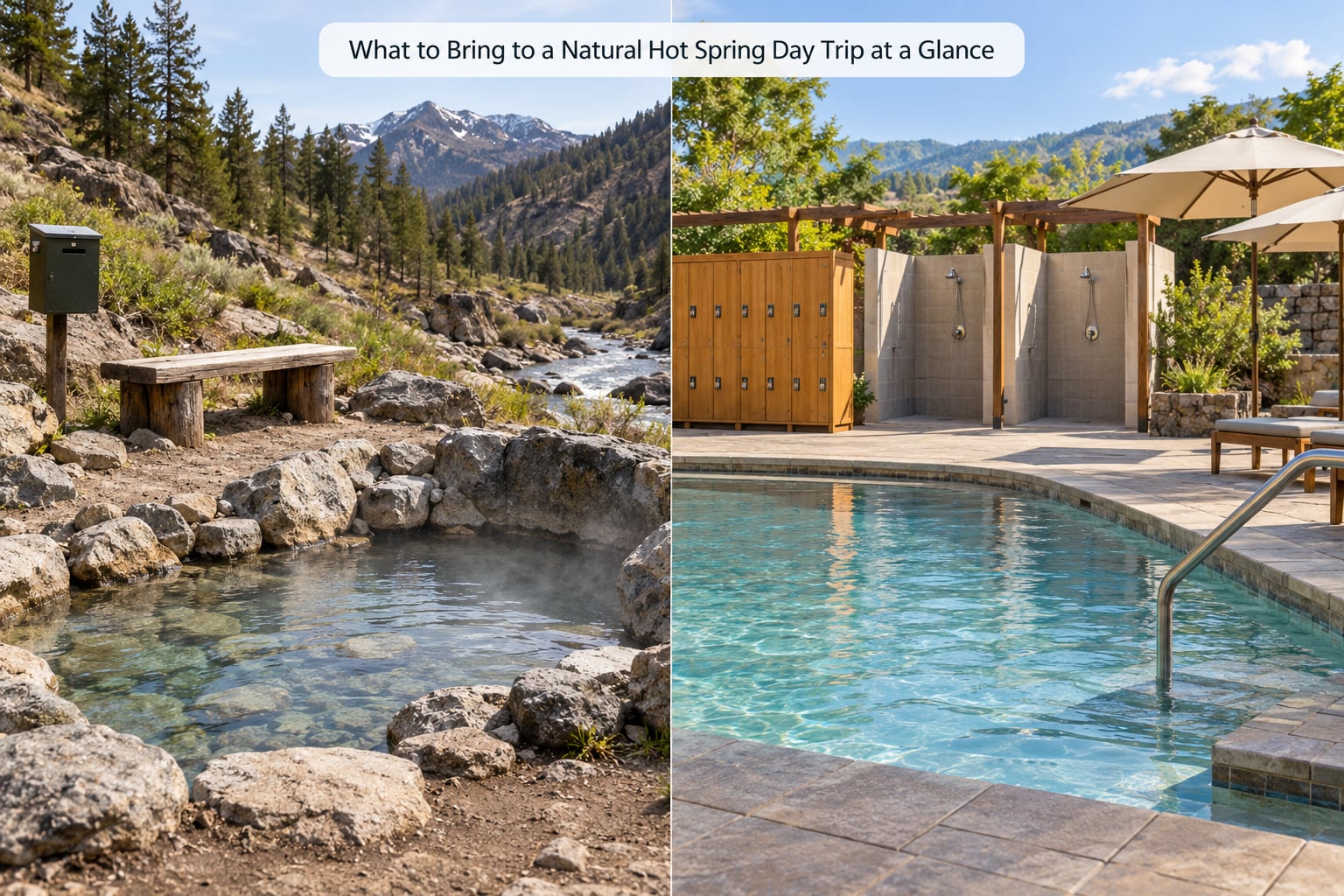
Group the gear by what it does for you, because that is how you will actually find it in the car on the way back.
What to wear
- Dark-colored swimsuit, or quick-dry shorts and a rash guard if the pool is clothing-optional or mixed use
- Sandals or water shoes with grip for wet rock
- A warm layer for the walk back, and dry underwear and socks in a sealed bag
What to use in the water
- Microfiber quick-dry towel
- Waterproof phone pouch if you want photos or music
- Leave every scrap of jewelry, sunscreen and lotion at the bank
What to carry
- Reusable water bottle, at least one liter
- Electrolyte tablets or a salty snack
- Reusable bag or small day pack to keep dry things dry
- Small bills, a first-aid kit, sunscreen and a hat
What to check before you leave the house
- The spring’s own rules, posted by the managing agency
- Whether a fee exists and whether the box takes cash or cards
- Whether there is a restroom, and where you will change
- Weather, including the temperature at the hour you plan to be in the water
| Item | Why you need it | Notes |
|---|---|---|
| Dark swimsuit | Sulfur and mineral staining is permanent on light fabric | Black or navy, older the better |
| Microfiber towel | You are air-drying, not toweling | Roll it damp in a bag, it still dries |
| Water shoes or sandals | Travertine and algae are slick when wet | Straps, not slip-on sneakers |
| Dry change of clothes | Getting out of hot water in a chill breeze is a fast temperature drop | Sealed in a dry bag or duffel |
| Water bottle, one liter or more | Heat plus a long soak drains you before you feel thirsty | Drink between rounds, not after |
| Electrolytes and a snack | Long soaks burn more energy than most people expect | Something salty and something with carbs |
| Waterproof phone pouch | Phones do not survive a drop into a mineral pool | Test the seal at home with a paper towel |
| Warm layer | Mornings, shade and post-soak chills hit fast | Fleece or packable shell |
| Small bills | Self-pay boxes and roadside vendors often take cash only | Ones and fives, not a fifty |
| Reusable bag or day pack | Holds wet gear, trash and your dry stuff in one place | A tote beats a pack on a car trip |
That table is the whole trip in ten rows. Everything past it is the reasoning.
Natural vs Developed Hot Springs: What Changes About Your Packing
This is the distinction that decides your list. A developed resort treats the water, controls entry, and built the amenities around it. A natural spring is just water that arrived on its own, and the site around it is whatever the land manager decided it could be.
| Feature | Natural spring | Developed resort |
|---|---|---|
| Changing room | Rarely. You usually change in the car or behind a tree | Usually, with private cubicles |
| Showers | Almost never before entering | Required rinsing showers |
| Lockers | None. Everything stays on you or in the car | Yes |
| Shade | Whatever the canyon gives you | Structures, umbrellas, cabanas |
| Fee | Free, or a self-pay box, often cash only | Day-use fee or membership |
| Restroom | Sometimes, and sometimes a long walk away | On site |
| Phone signal | Often none | Usually full bars |
| Towels | You bring your own, and you take it home | Rental or membership |
That table is why people arrive unprepared. Resort habits are hard to shake, and a resort list leaves out half of what you actually need.
1. Swimwear or Quick-Dry Clothing
Bring a dark swimsuit, and wear the old one. Mineral and sulfur staining attacks light and bright fabrics first, and once it sets it usually does not come out. A neon rash guard is a bad choice for the same reason a white bikini is.
At many US springs nudity is normal or expected, sometimes with an adult-only window after dark. Rules differ by state, county and land manager, and they change, so read the sign at the trailhead before you pull your suit over your clothes at the car.
A practical compromise is a swimsuit worn under street clothes or a rash guard over quick-dry shorts. You can dress in thirty seconds anywhere, and you are covered if someone is walking in who did not expect the opposite.
Quick-dry clothing earns its spot if the site is clothing-optional or family friendly. Skip a cotton t-shirt as your only layer. It stays wet for an hour and it stays cold for two.
2. A Lightweight Towel
Microfiber dries in minutes and packs down to nothing, which is exactly what you want at a pool with no building. Cotton is the wrong tool here: it holds water, it does not dry in a chill, and a soaking wet cotton towel is a heavy thing to carry back to the car.
If you dislike the damp-towel-in-a-bag routine, a change robe is the alternative. It is a poncho that swaps wet for dry in one motion, and it works well for the walk back or for sitting in the shade afterward. It is bulky, though, and it is useless for anything other than the trip itself.
Two things to know. Many springs rent or supply nothing at all, so check before you leave. And a towel that stays at the pool is a towel somebody has to haul out of a creek, so take yours with you. A towel never goes into the water, and it never goes anywhere it will be left behind.
3. Sandals or Water Shoes
The ground at a natural spring is wet travertine, algae, gravel and root. It is uneven, it is slick, and it gets slicker as you get tired. Most injuries at these sites are ankles, not backs.
A water shoe with a treaded sole gives you the most confidence on the entry. Any strap sandal with a decent grip works nearly as well and dries faster. Flip-flops are fine on a flat developed deck and questionable on a sloped rock approach.
Skip sneakers. A soaked pair has no grip on wet rock and takes an hour to dry on your feet. If the hike in is long, bring proper hiking boots for the trail and change into sandals at the water.
4. A Change of Clothes
Exiting a 100-plus degree pool into open air is one of the fastest temperature changes in a day trip. Your body is wet, the breeze hits damp skin, and the shade is already getting colder than you expected.
Pack one complete dry set: underwear, socks, shirt, pants, and whatever you need for the drive home. It lives in a sealed bag or a dry bag inside your tote, so it does not get damp from your own wet gear. This is the single most missed item on a car trip.
Where you change depends on the site. If there is no structure and no other bathers around, changing out of view behind the car is normal. With other people present, a towel held as a screen or a quick change under a layer does the job. Pack accordingly, and give yourself the extra minute.
5. A Waterproof Phone Pouch
At a natural spring your phone is going to be damp, dusty, or both. The value of a sealed pouch is that you can still take the photo of the travertine terrace, check the map when you come back into signal, and stop worrying about sand in the charging port.
Choose a roll-top or snap-seal pouch with a floating leash so you can neck-wear it or wrist-loop it. Test the seal at home with a dry paper towel before you rely on it, because most failures show up underwater and never come back.
What stays outside the pouch: anything you would be upset to lose. A natural pool has no locker and no lost and found, and a phone left on a rock gets picked up, washed away, or stolen. Keep the pouch on you the entire time, and turn the brightness down.
6. Reusable Water Bottle
Bring at least one liter for a half-day visit, more for a hike-in spring or a summer soak in a desert basin. Soaking in hot water dilates your vessels while you sweat and lose water at the same time, and the thirst signal arrives late.
Drink during the soak, in the breaks between rounds, not all at once when you climb out. Add electrolytes if you are in there more than an hour or the day is hot. A stick packet in the bottle lid pocket takes no space and no planning.
An insulated stainless bottle is worth the weight for two reasons: cold water in summer, and warm water for the drive home. Wash it out and dry it before the lid goes back on, because a stale bottle at the car is a detail you notice all afternoon.
7. Sun Protection
You are spending real time outdoors, and the walk in and the waiting between soaks are often more exposed than the soak itself. Broad-spectrum sunscreen with SPF 30 or higher, a wide-brim hat, sunglasses, and lip balm with SPF cover the basics.
Apply before you walk out and reapply every two hours, or right after you towel off, since water and sweat both take it away faster than the clock suggests. A stick formula in a pocket is easier to reapply than a bottle and does not run into your eyes with sweat.
One important exception. Mineral and sulfur water is famously hard on sunscreen oils, and a lot of regulars consider it rude to bring creams or lotions near the pool. Apply on the walk in, wash or brush off the sand, and keep the bottle in the bag at the water’s edge.
If the spring is clothing optional, that usually goes for sunscreen too. Mineral-rich hot water is not great for skin that has just been slathered in chemicals. If you need it, keep it in your car bag and reapply when you are dressed.
8. Light Layer or Packable Jacket
Mornings at a canyon spring are often near freezing even when the forecast says something warmer, and shade at a natural pool is real shade, not the cheerful kind at a resort. A packable fleece or wind-resistant shell that fits in a bag handles both.
The main job is the walk back. Soaking in hot water dilates your blood vessels, and stepping out into moving air can make you lightheaded. Having a warm layer on the bank, not back in the car, is what keeps that from turning into a fall.
Add warm socks and a beanie in the cold months at high elevation, and consider a second pair of dry socks for the drive. Wet socks in a car for an hour is how a great day turns into a grumpy one.
9. Toiletries and Personal-Care Items
Assume you will not find soap, water, a restroom or a mirror, then pack for the worst case. That means a travel size of unscented body wash, a brush or comb, hair ties, a small mirror, and any contact lens solution or case.
Hair is the surprise. Sulfur and silica strip natural oils, and long hair often dries like straw afterward. A little coconut or jojoba oil worked through the ends before you soak helps, and a leave-in conditioner after the shower buys you back some softness. Do not put either of those in the water.
For skin, a heavy-duty moisturizer that you slather on the drive home makes the biggest difference. Pack more than you think. Sunglasses, a hair tie on your wrist, and a small mirror for the car round out the kit.
10. Small First-Aid Kit
Keep it small and specific: blister bandages, a few standard strips for cuts from sharp rock, antiseptic wipes, ibuprofen or your usual pain reliever, an antihistamine for bug bites or an allergic reaction, a few elastic bandages, and any prescription you would not want to be without for six hours.
Altitude sickness is the one people forget. If you are driving up a mountain to reach the spring, add the remedy that works for you. Small cuts near mineral water get irritated fast, so clean and cover them right away.
A headlamp belongs in this kit too. A spring that looks magical at sunset is an awkward place to find a dropped sandal in the dark, especially when cell service is not there. A cheap light is good insurance against a long walk at dusk.
11. Cash and a Small Payment Method
Many natural springs are free and open access on public land. Some charge a day-use fee through a self-pay box, and a good number of those boxes are cash only, or take a card but have no signal to process it. Bring small bills: ones, fives, a twenty.
Day-use fees at developed facilities and the parking at trailheads vary so much by site that it is not worth quoting a range here. The current number is on the managing agency’s page, and it is worth reading the night before rather than at the gate.
Also carry a card for the gas station, the parking fee on Forest Service roads, or the sandwich shop on the drive home. Cash for the box, card for everything else.
12. A Reusable Bag or Small Day Pack
One bag solves the logistics. A sturdy tote or a small day pack holds your dry clothes, the towel, the bottle, the first-aid kit, the pouch, and the trash you generate, so nothing ends up scattered on a rock in the sun.
On a car trip, a tote is easier than a backpack because you open it once. On a hike-in soak, a pack with a wide waist strap is the only sane option, and it keeps your hands free on the approach.
Use a roll-top or a water-resistant tote, and add a couple of extras. A dry bag for the electronics is worth it, a clip-on carabiner locks a bag to a tree at a developed site, and a small rubbish bag handles the pack out and pack out principle without asking anyone else to carry it.
If you are going alone, also carry an offline map and tell someone your return time. Not because soaking solo is risky in itself, but because a canyon trail with no signal is a place where a plan someone else holds is worth something.
What Not to Bring to a Natural Hot Spring
Most etiquette problems at natural springs are packing problems. The list of things that annoy regulars and, in some cases, violate agency rules is short and specific.
- Soap, shampoo, and conditioner. No exceptions. Unscented body wash belongs at the car, at least 50 feet from the water.
- Lotion, oils, and sunscreen. They coat the surface and end up in the pool. Apply before, wash off after.
- Glass. No bottles, no jars, no glass jars for drinks. It breaks and it stays in the creek.
- Jewelry, watches, and rings. Sulfur tarnishes silver and chews on cheap alloys, and metal in the water heats up dangerously fast.
- Towels in the water. Use the towel on the bank, and take it home with you.
- Dogs. Most sites prohibit them, and it is not a formality: hot water and drinking spring water can both hurt a dog.
- Food and drink in the pool. Keep them at the bank. Alcohol and hot water is a bad combination.
- Camping next to the pool. The Forest Service and BLM generally require a substantial distance, often 200 yards or more.
- Your phone in the open. Pouch it, or leave it in the car.
- Photos of other bathers. Never, at a clothing-optional site, without a written permit.
Those rules are not arbitrary. Soap and oil change the chemistry of the water, glass stays in the ground forever, and everything else is just manners with a health or safety reason behind it.
How to Soak Safely: The 15-20 Minute Rule
Hot spring water can be hotter than you expect. Source temperatures at some springs run close to 200 degrees Fahrenheit, and the pool at the outlet can be scalding. Test the water with the back of your wrist for several seconds before you commit, and enter slowly, feet first.
Then watch the clock. Most regulars soak 15 to 20 minutes, get out, cool down in the shade for 10 to 15 minutes, and go back in. That rhythm is not fussiness. It is how you get several good rounds instead of overheated dizzy blur after one long one.
Get out immediately if you feel dizzy, nauseated, cramped, short of breath, or develop a headache. Those are heat-illness signals, not signs to push through. Drink water, get into shade, and cool down before deciding whether to go back in.
With kids, the rules get tighter. Keep a hand on them, set a timer you can see, and be out well before they are tired or cold. Enter and exit fast, which is easier in a suit than in a bulky outfit, and never let a child near the outlet end of the pool.
After the last round, rinse off if there is water, dry your skin, and put the moisturizer on while you are still slightly damp. Then sit for ten minutes before you drive, especially if the drive is long.
What to Add for Winter, Desert, and Hike-In Springs
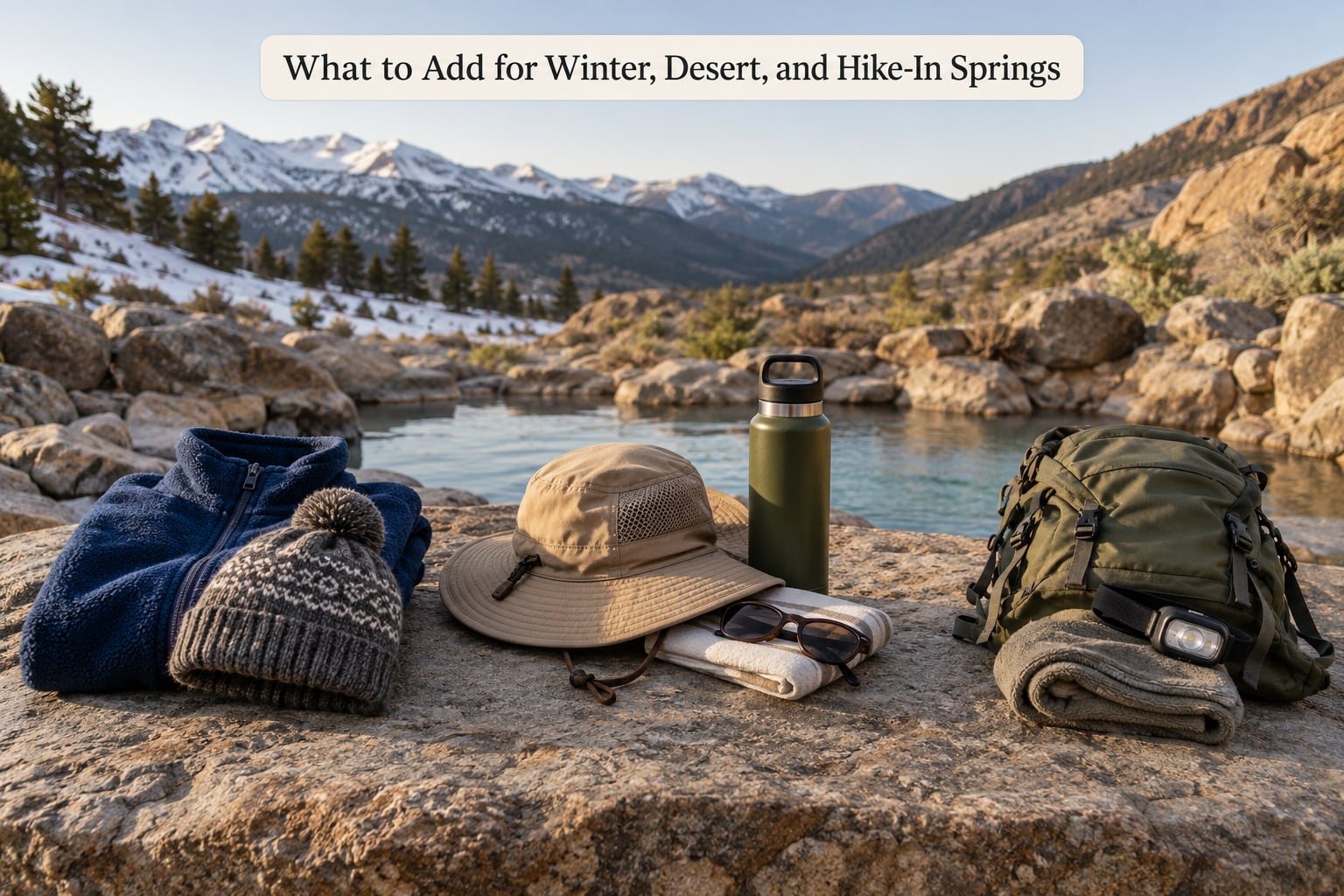
Most of the core list holds all year. These are the conditional extras, and each one solves a specific problem rather than general preparedness.
Winter and snow soak
Add a wool or merino beanie, warm gloves you can stow, a second insulating layer, a thermos of something hot for after, and hand warmers in the car. Snow changes the footing entirely, so water shoes with serious tread matter more here than at any other time. Plan the walk back on packed snow, and dry your boots in the car with a sock stuffed in them.
Desert summer soak
Add one more liter of water per person, electrolyte packets, a full coverage sun shirt, a wide-brim hat with a chin strap, two umbrellas or a shade tarp for the car, and a small hand fan. The long drive back in a hot car is the real risk of a desert soak, so start it before you feel ready to leave.
Hike-in backcountry
Add a proper backpack with a waist strap, more water than the map suggests, real trail shoes, a headlamp, an offline map, a satellite messenger or a personal locator beacon if the route is remote, and a rubbish bag. A dry bag becomes essential once you are carrying a towel and a change of clothes uphill. Camp well away from the pool, and confirm whether the site allows overnight use at all, because many do not.
Frequently Asked Questions
Do natural hot springs have changing rooms and showers?
Almost never. Undeveloped springs usually have a parking area, a trail and a pool, with no building, no lockers and no shower. Plan to change in your car or out of view of others, and bring everything you need to get clean on the drive home. Developed resort springs are the opposite: private changing rooms, rinsing showers and lockers are standard, so you can travel lighter.
Can I bring a towel into a natural hot spring?
Bring the towel to the pool, not into the water. Towels belong on the bank while you soak, and they go home with you when you leave, because anything left behind eventually ends up in the creek. A microfiber quick-dry towel is the practical pick. A change robe is the alternative if you dislike carrying a damp towel, and it doubles as your warm layer on the walk back.
How long should I soak in a natural hot spring?
Fifteen to twenty minutes per round is the range most regulars use, then ten to fifteen minutes of cooldown in the shade before going back in. Source water at some springs runs close to 200 degrees Fahrenheit, so test it with the back of your wrist and enter slowly. Get out if you feel dizzy, nauseated, cramped or short of breath, and drink water in the breaks.
Is clothing optional at natural hot springs in the US?
At many of them, yes, and sometimes only for adults after dark, but the rules belong to the land manager and they change. Some states and counties are far stricter than others, and Arizona in particular has a mix of clothing-optional and clothing-required sites with local ordinances behind them. Read the sign at the trailhead, and bring a swimsuit under your street clothes so you can cover up fast if someone walks in.
Is there a lot of bacteria in natural hot spring water?
There are thermophilic bacteria and algae in most geothermal water, and the sulfur smell people dislike is a sign of the same mineral-rich chemistry. In practice, the risk is low for healthy adults soaking briefly, and the far bigger concerns are heat-related illness, slipping on wet rock, and entering with soap or lotion on your skin. Do not swallow the water, keep cuts covered, and shower as soon as you get home if you have open skin.
Is a hot spring bath the same as an onsen?
The water is the same idea and the rules are not. A Japanese onsen is a managed public bath where you shower before entering, wash and dry completely, and never put a towel in the water. At a US natural spring you may be nudity-optional, you almost certainly have no shower, and the pool is in a landscape rather than a building. Treat an onsen rule set as good manners, then check the local sign.
Conclusion
What to bring to a natural hot spring day trip is not a longer list than a resort trip. It is a different list, and the difference is that every amenity you expect has to come from your own car.
Start with the ten rows above: dark swimsuit, quick-dry towel, water shoes, a sealed dry change of clothes, a liter of water, electrolytes, a pouch, a warm layer, small bills, and one bag to hold it all. Add the seasonal extras that match your trip, and read the rules on the sign before you pull your clothes on.
Then take everything back out with you, including the towel. Pack in, pack out is the shortest piece of hot spring etiquette there is, and the springs that stay open are the ones where people bother to follow it.