Learning how to plan a slow travel itinerary for beginners comes down to four decisions: pick one region, choose two or three bases instead of ten cities, give each base at least five nights, and book only the things that actually need a reservation. Everything else you leave open. That sounds almost too simple, but the hard part for most first-timers is not the destinations, it is resisting the urge to fill every hour. Most beginner trips do not fail because of bad places. They fail because of bad pacing.
This guide takes about fifteen minutes to read and about an hour to apply, and it works whether you have two weeks of annual leave or three months. I have planned this way for years of slow trips out of a home base of small cities, and the same skeleton holds up whether you are travelling solo, with a partner, or with kids who need a nap at one.
Table of Contents›
- What You Need Before You Book Anything
- How to Plan a Slow Travel Itinerary for Beginners Step by Step
- Start with one destination and fewer bases, not a list of cities
- Set a slow pace before choosing activities
- Choose one anchor experience per day
- Pick stays that support a slower rhythm
- Build in flexible and rainy-day options
- Review the itinerary for travel fatigue
- Common Mistakes Beginners Make With a Slow Itinerary
- Frequently Asked Questions
- How many nights should I stay in each destination?
- How do I plan a slow travel itinerary without overplanning it?
- Is slow travel realistic if I have a full-time job?
- Is slow travel cheaper than a normal holiday?
- What should I do when a slow travel day falls apart?
- Conclusion: One Region, Two Bases, Five Nights Minimum
What You Need Before You Book Anything
You need very little. A slow travel itinerary is a decision document, not a research project, so most of what you need is a set of honest answers rather than a pile of tabs.
A shortlist of one or two regions. Not a list of cities. If your list has more than a handful of towns on it, cut it in half and keep the ones you would still be happy to see in the rain.
Fixed dates and the travel time you genuinely have. Count the door-to-door days, not the days you wish you had. A 14-day trip with a long flight home is really an 11-day trip, and building a plan for 14 leaves you scrambling at the end.
A budget range you can say out loud. You do not need a spreadsheet with per-night figures. You need to know whether you are staying in a self-catered apartment, a small guesthouse or a proper hotel, because that choice changes how much time you can afford to spend on food out.
A pace, written down. Some people want two anchors a day. Some want one and a long walk home. Decide this before you look at any activity list, because the list will otherwise decide for you.
Your non-negotiables. Three things you would regret missing. For me on a two-week trip that is usually one museum, one long walk, and one meal I cannot book at home. Three is enough. Ten defeats the purpose.
Any accessibility or dietary needs. Stairs, walking distances, early starts, low-sugar or vegetarian options. Slow days tend to include more walking on unfamiliar surfaces, so this is worth checking rather than improvising.
One planning system. Paper works. A single note in a phone app works. What does not work is a system that forces you to schedule a trip hour by hour before you have been there, because that is the habit slow travel is trying to break.
How to Plan a Slow Travel Itinerary for Beginners Step by Step
The method below is a skeleton you build in one sitting, then deliberately loosen. Work through it in order. Each step takes a few minutes, and skipping ahead is what produces the exhausting eight-country trip you were trying to avoid.
Start with one destination and fewer bases, not a list of cities
Pick a single region and aim for two or three bases inside it. Bases that are within about two hours of each other by train or bus let you change your mind for the weekend without repacking your life. Here is the pacing rule I use, and the one number people in slow travel communities agree on more than any other: four nights is the floor, a week is comfortable, and a fortnight is where a place starts to feel familiar.
| Total trip length | Bases to aim for | Nights per base | What this looks like |
|---|---|---|---|
| 7 days | 1 | 7 | One place, everything from a day trip |
| 10 days | 2 | 4 nights then 5 nights | One move, with a slow arrival and a slow end |
| 14 days | 2 | 7 nights each | The sweet spot for most beginners |
| 30 days | 3 | 10 nights each | Enough time for one real routine per base |
| 90 days | 4 to 5 | 18 to 22 nights each | Settling in rather than sightseeing |
Notice what the table does not say. It does not say one attraction per day, and it does not fill the days for you. It only decides how long you are staying, and that single decision removes most of the anxiety later.
Set a slow pace before choosing activities
Decide how many fixed commitments you want in a day before you pick any, because a day with two anchors is a very different day from one with none. For most beginners, one fixed thing plus one optional thing is the right ceiling. Anything more turns a holiday into a queue.
Split everything into two lists. Anchored plans are date-locked or capacity-limited: a booked dinner, a train with a fixed departure, a guided walk that runs twice a day. Optional ideas are the market you have not been to yet, the museum you heard about from your host, the swim you keep meaning to do. Anchors go in the calendar before you go. Optional ideas stay on a single phone note and never get a time attached.
Then protect your rest. Slow travel reads as lazy on paper, and the common beginner mistake is to treat the walk back from lunch as lost time. Block a real gap in the middle of every day, usually mid-afternoon, and treat it as booked rather than empty. On the r/travel thread about how much planning is too much, the pattern was almost identical: thorough research beforehand, one live list during the trip, and no day-by-day schedule at all.
Choose one anchor experience per day
Pick a single thing a day that genuinely matters to you, and leave the rest of the day to drift. An anchor can be a museum, a long neighbourhood walk, a market you buy breakfast from, a cooking session, a swim, or an evening where someone else decides where you eat. It does not have to be the thing you would put on a postcard.
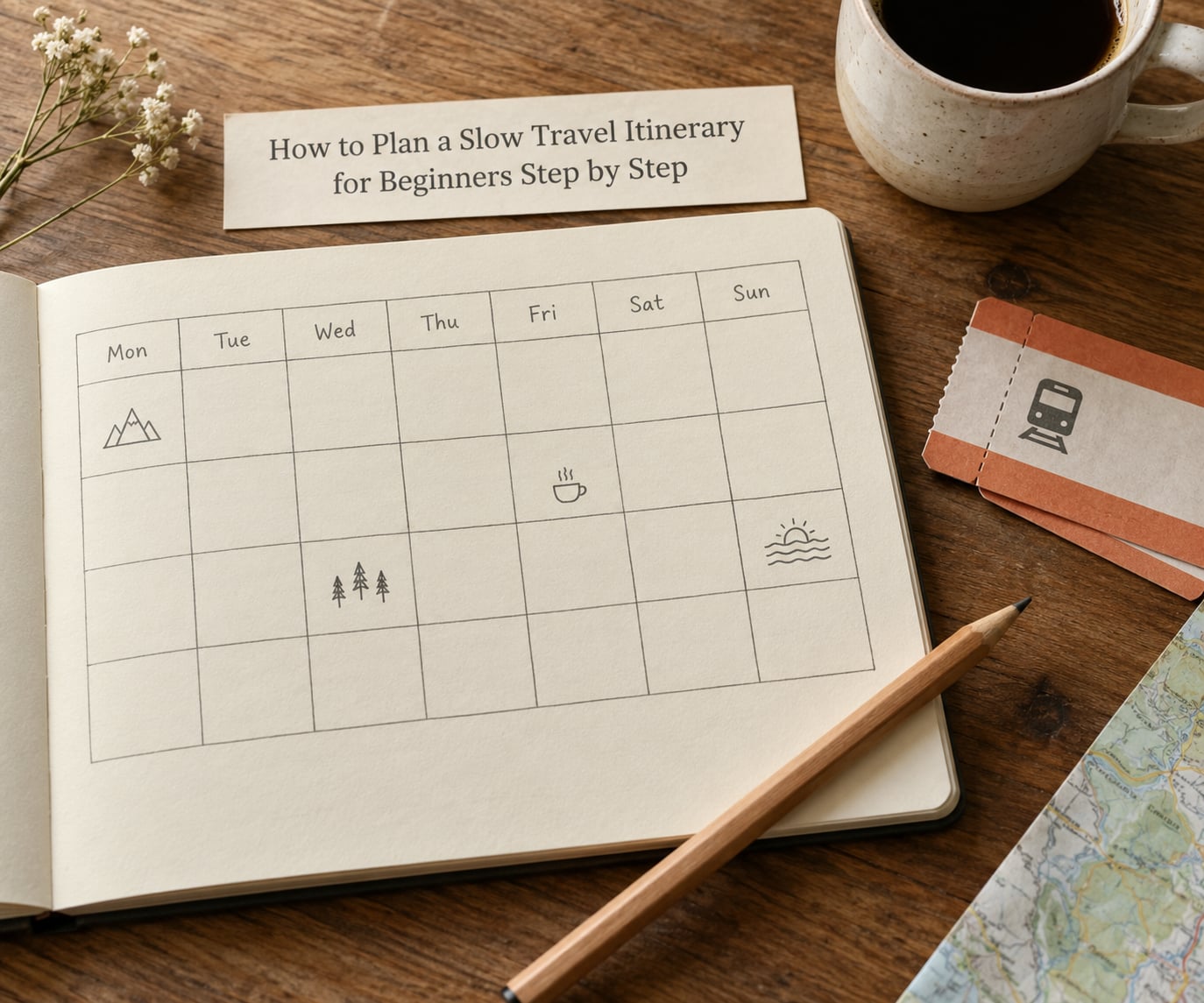
This is where the phrase slow travel itinerary template actually earns its keep. Write each anchor as a single line with a rough time window, not a start and end time. Six lines for a week is plenty. When you can see the whole week at a glance, you stop rearranging it, and the days start doing what days do, which is surprise you.
Pick stays that support a slower rhythm
Choose a place that makes a lazy day easy: a short walk to a bakery, a kitchen if you want to cook some meals, a room quiet enough to sleep in, and a neighbourhood where people actually live rather than one made entirely of restaurants. Walkability matters more than a view, because at a slow pace you will cover a lot of ground on foot.
Four nights or more unlocks much better rates than seven single nights, and it means you can book a proper apartment with a washing machine. That machine is not a luxury on a two-week trip. A self-catered base also lowers daily costs quickly, since groceries and a simple dinner replace a restaurant most nights.
Ask three questions before you book: is check-in flexible, is there a laundrette nearby, and will the same staff be there when I leave. Long stays in places that treat guests as passing through are the ones that get tiring. The home-exchange community makes the same point from the other side, that staying a week or two in one home is what shows you the actual rhythm of a place instead of its visitor face.
Build in flexible and rainy-day options
Keep a short list of things that work in bad weather: a small museum, a long lunch, a covered market, a neighbourhood with cafés, a bus to a town you have not seen. Five entries is enough. This is not a backup itinerary, it is a list you can act on in ten minutes when the rain sets in and the day ahead looks bleak.
Plan the first and last day of each base lightly. Arrival days go wrong, and a delayed train should not cost you something you cannot reschedule. The same goes for departure days. Book the anchors on the middle days first, and only then add anything to the edges.
Now build the logistics of settling in rather than the logistics of sightseeing. The first week of a longer stay is where slow trips are won or quietly lost, and almost nobody covers it. Find the supermarket, the laundrette, the bakery, the nearest pharmacy, the bus stop home, and one late-opening place for dinner. Do that on day two and the rest of the stay gets easier.
Review the itinerary for travel fatigue
Read your plan back once, looking only for signs of a trip that will exhaust you rather than excite you.
More than three location changes in a fortnight means you are travelling, not slow travelling. Two anchors plus a late dinner on the same day is a schedule, not a holiday. More than four hours of transit in one day cancels the day it touches, so plan around it rather than pretending it does not exist. Repeating the same attraction twice means you did not trust yourself to choose. Nothing after dinner on any day means evenings are packed before you have seen how the light goes out where you are staying.
Travel fatigue usually announces itself as a low-grade irritation on day three, and by then you are usually booked into something. Fixing the plan before departure costs nothing.
Common Mistakes Beginners Make With a Slow Itinerary
Booking every day in advance. A locked nine-day calendar is not a rich trip, it is a corridor. Keep one day in three completely free, and accept that you will not see everything.
Choosing bases for convenience on day one. An airport hotel on arrival night is a reasonable choice. An airport hotel for four nights is a place you never see.
Confusing slow travel with doing nothing. Slowing down is not the same as staying in and being bored. On r/slowtravel the disagreement is real, and the people who enjoy it longest describe a full local routine, not an empty diary.
Booking non-refundable things too early. Transport and stays are where the risk sits. A flight you cannot change on day three is a flight that decides your week for you. Use flexible options where they exist and travel by rail when the distance allows.
Moving too often because it feels efficient. Packing and unpacking is unpaid work. Every extra move costs you roughly half a day, and half a day is four hours of a stay you wanted.
Ignoring food. The single best hour of a slow day is often a market and a late lunch with nowhere to be afterwards. Put a meal in the day on purpose rather than treating eating as a gap between plans.
Expecting the first week to feel easy. Arriving somewhere alone with no routine is genuinely awkward, and people describe the first few days as the hardest part. Build a routine early: same bakery, same walk, same café. By day four you have regulars.
Three habits carry most of this. Put anchors in the calendar and everything else in a note. Re-plan each evening, looking at tomorrow’s energy rather than tomorrow’s list. And count nights, not days, when you build the whole thing.
Frequently Asked Questions
How many nights should I stay in each destination?
Four nights is the practical minimum, one week is comfortable, and a fortnight is where a place starts to feel like somewhere you live rather than somewhere you are visiting. Anyone staying under three nights is usually passing through rather than slow travelling. As a rule, take a third of your trip, split it into two or three bases, and never book a base you have not stayed in for at least four nights.
How do I plan a slow travel itinerary without overplanning it?
Plan every evening for the next day, not every day of the trip. Before departure, write only the anchors: booked meals, date-locked trains, guided walks that run once. Keep everything else on a single list with no times attached, and leave roughly one day in three entirely blank. If you can see the whole trip written down and it fits on one page, it is slow enough.
Is slow travel realistic if I have a full-time job?
Yes, within limits. Two weeks of annual leave usually means two bases, seven nights each, and that is plenty. A common pattern for people with jobs is one longer annual-leave trip plus a few weekend slow trips closer to home, where the pace is the same but the time budget is smaller. Weekend slow travel is really just one base, one or two anchors, and no transfers.
Is slow travel cheaper than a normal holiday?
It usually is, but not for the reason people expect. The saving comes from weekly rates on accommodation, cooking some meals in a self-catered apartment, and not paying for constant intercity transport. The trap is seasonality, since a month-long stay in a peak month can cost more per week than a week in the same place off-season. Shoulder season is where staying longer actually pays.
What should I do when a slow travel day falls apart?
Treat it as a normal outcome, not a failure. Fall back on your short bad-weather list of five options, or do nothing and eat somewhere you have not been. Long stays in a place make this easier because the same thing that feels like a wasted day at home feels like a free afternoon abroad. Just check that nothing you booked today is a fixed commitment, and move it if you can.
Conclusion: One Region, Two Bases, Five Nights Minimum
To plan a slow travel itinerary for beginners, do four things. Choose one region, set the number of nights per base before you pick a single activity, write down only the anchors that need a reservation, and leave one day in three completely empty. Everything after that is reaction to being there, which is the part people remember.
Your first action takes ten minutes. Open a note, write the number of nights you have available, and split them into two or three bases of at least four nights each. Once that line exists, the rest of the trip gets much easier to plan, because you are filling a shape rather than inventing one.
Slow travel is not the absence of planning. It is more intentional planning, with a lighter grip. If you follow the method above, learning how to plan a slow travel itinerary for beginners becomes a fifteen-minute exercise instead of a month of open tabs, and the trip you get back from is one you will still be thinking about in a year.