
Yes, you can live in a hotel and pay monthly. Most hotels will quote a monthly rate for any stay of roughly 21 to 31 nights, but you have to ask for it directly and you have to ask the right person. Knowing how to book a long stay hotel at a monthly rate comes down to three things: who you contact, what you ask them in writing, and what you check before you hand over any money.
The part almost everybody gets wrong is who they call. The front desk and the central reservations line work from a rate sheet. The monthly rate lives with the property’s Director of Sales or Reservations Manager, and in most cases that person can improve on it.
This guide walks through the whole process for anyone staying three weeks or longer, whether you are a remote worker, a solo traveller on a slow month, a family between homes, or on an assignment. No affiliate buttons here. Just the sequence, the questions, and the traps.
Table of Contents›
- What You Need Before You Contact Anyone
- The stay, pinned down precisely
- A monthly ceiling and a nightly ceiling
- A list of nonnegotiables
- Names of the right people
- Flexibility, honestly assessed
- A shortlist of five to eight properties
- Step-by-Step: How to Book a Long-Stay Hotel at a Monthly Rate
- Step 1: Define the stay and monthly budget
- Step 2: Search booking channels for a long stay hotel at a monthly rate
- Step 3: Compare the full monthly cost, not the headline nightly rate
- Step 4: Ask the hotel for a monthly rate and get every term in writing
- Step 5: Negotiate or request the best available rate
- Step 6: Verify the property before you pay
- Step 7: Confirm and document the reservation
- Which type of property suits which kind of stay
- Common Mistakes
- Frequently Asked Questions
- Can you live in a hotel and pay monthly?
- Will hotels negotiate rates for extended stays?
- Are extended stay hotels cheaper than regular hotels?
- How much does a month-long stay at a hotel cost?
- Can I rent a hotel room for 6 months?
- What is it called when you stay at a hotel for a month?
- Conclusion
What You Need Before You Contact Anyone
Most failed long-stay bookings fail in the first email because the request was vague. A property needs six things before it can quote, and if you supply them up front you usually get a real number back the same day.
The stay, pinned down precisely
Exact arrival date, exact departure date, and the number of nights in total. “About a month” produces a polite non-answer. Thirty-one nights is a different quote from twenty-eight, and the hotel knows it.
A monthly ceiling and a nightly ceiling
Decide what the total accommodation budget is for the whole stay, then divide it by your night count. Keep a second number too: the most you would pay per night equivalent once fees land. Those two figures are what make it easy to say yes or no to a quote on the spot.
A list of nonnegotiables
Write down the three or four things that would actually break the stay if you did not have them. Usually that is a kitchenette you can cook in, a desk that is not a bedside table, in-unit laundry or a machine on site, reliable Wi-Fi, parking, or a room that fits a family. Everything else is a preference.
Names of the right people
Find the Director of Sales and the Reservations Manager for each property. Small independent hotels and aparthotels usually do not have those job titles, so there you email the owner or the general manager directly. Larger groups run group sales pages and a reservations office email, both of which beat a phone call.
Flexibility, honestly assessed
Say plainly whether your dates can move by a few days and whether you might extend. That single sentence gives the person you are emailing permission to offer you a better rate, because a booking that can shift a few days is worth more than a locked one.
A shortlist of five to eight properties
Compare like with like. Mixing a boutique hotel in one neighbourhood with an extended stay brand on the outskirts produces meaningless totals. Pick a handful in the area you actually want to live in, then send every one of them an identical request.
Step-by-Step: How to Book a Long-Stay Hotel at a Monthly Rate
Step 1: Define the stay and monthly budget
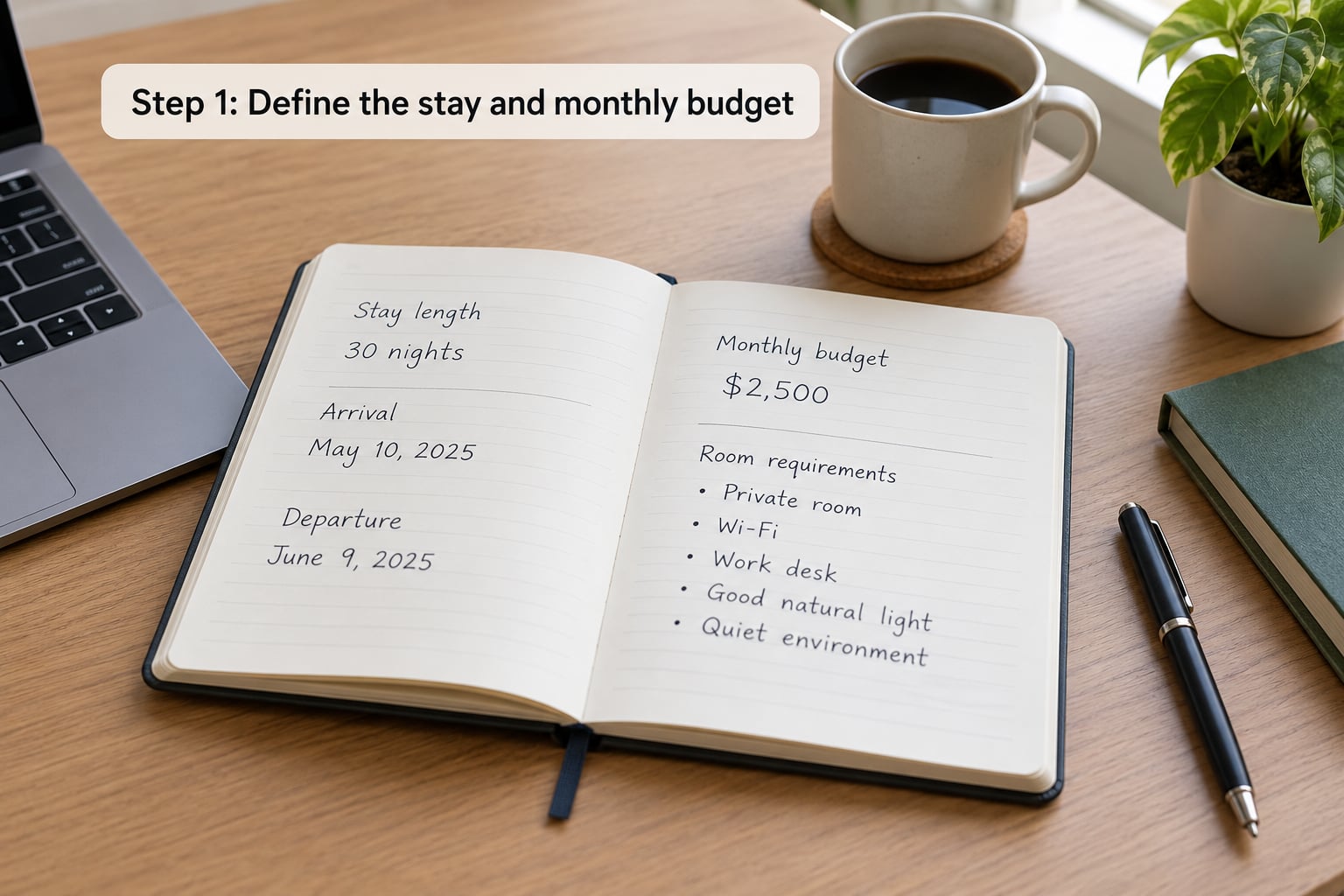
Turn the trip into a one-page brief. Dates, nights, total budget, nightly equivalent, neighbourhood, and the short list of needs you will not compromise on. Keep it in a document you can paste from, because you will send roughly the same text to eight properties.
Add a realistic extension estimate. If there is a fair chance you will stay three nights longer, say so in the brief rather than springing it on the hotel at the end. Properties plan staffing and housekeeping around length of stay, and a flagged extension is often the easiest discount on the table.
You have a usable brief when you could hand it to a stranger and they would know what to book without asking you anything.
Step 2: Search booking channels for a long stay hotel at a monthly rate
Run four searches side by side, because no single channel sees the whole market. Start with the property’s own website, since most sites hide a monthly or weekly calculator under “long stay” or “corporate rates”. Then search booking platforms with your real dates rather than a placeholder, because monthly pricing does not surface on a default search.
Extended stay brands are worth checking on their own terms. They are built for stays of weeks and months, so the rates are honest and the rooms usually have a kitchenette and a real desk. Full-service hotels and independent properties are often cheaper per night, but the monthly rate only appears once you ask.
The fourth channel is the one people forget: agencies and relocation specialists. They place long stays constantly and hold rates most travellers never see, and they are the right route for a six-month or business-assignment stay where someone else can handle the invoice terms.
You have found the right shortlist when every property on it can give you a written monthly quote for the same dates and the same room type.
Step 3: Compare the full monthly cost, not the headline nightly rate
A nightly rate multiplied by thirty is the number most people compare, and it is the number that misleads them most. Long stays attract fees that short stays never meet: cleaning charges, resort or destination fees, parking, laundry, early check-in, and internet packages billed separately.
Work through this list for every quote before you compare anything:
- Base rate for the full stay, and whether it is locked or can float with occupancy
- Taxes and any tourism or city levy charged on top
- Cleaning: one deep clean per stay, or a weekly service charge
- Resort, destination or facility fees, and whether they are charged per night or per stay
- Parking, per night or per month
- Wi-Fi, and whether it is included or sold as a package
- Utilities, and whether electricity is metered and billed to you
- Laundry, in-unit or a shared machine with a per-use charge
- Kitchenettes, and whether cooking is permitted or discouraged
- Early check-in and late check-out fees
- Security deposit, and how long the property holds it
- Any furniture or equipment charge
Then normalise everything: divide the full monthly total, fees included, by the number of nights and compare that single number across properties. A quote that looks 20 percent cheaper on paper can be more expensive once a weekly cleaning charge and metered electricity are added.
Most extended stay properties without a hard minimum stay apply only a small weekly discount and a noticeably larger monthly one. Monthly rates commonly land 15 to 30 percent under the equivalent nightly booking once fees are counted, and the gap widens in shoulder season.
Step 4: Ask the hotel for a monthly rate and get every term in writing
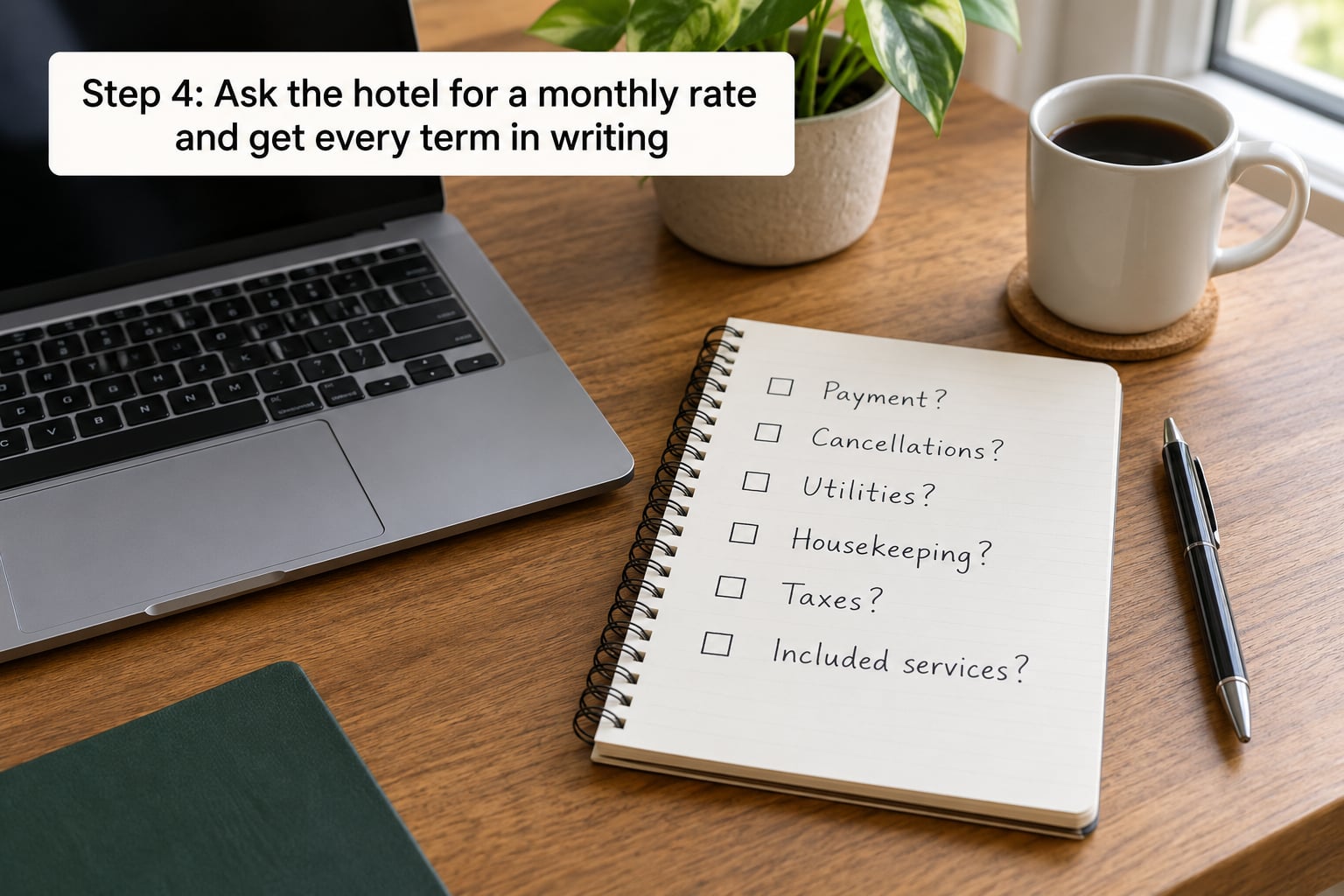
Send one short email to the Director of Sales or Reservations Manager. Ask for a written monthly quote for your exact dates, and ask for the itemised breakdown. Attach or paste your brief so nobody has to reply asking what you meant.
These are the questions to get answered before money moves:
- Is there a monthly or long-stay rate for my exact dates, and is there a minimum length of stay?
- Is the rate locked for the whole period, or can it change monthly?
- What does the monthly total include, line by line?
- What is the payment schedule, and how many nights are taken up front?
- What is the cancellation policy, and is a deposit refundable?
- What happens if I leave early, and what happens if I stay longer?
- Are utilities, Wi-Fi, parking and housekeeping included or charged separately?
- Do you require a signed agreement, and does that change the terms?
One forum pattern is worth repeating here because it costs people real money: travellers who repeatedly report calling the front desk or the central reservations line, hearing that no monthly rate exists, and moving on. The pricing sits with sales and reservations leadership at the individual property, and that is who has to answer you.
You have done this step properly when you have an itemised quote in writing, with the fee list visible rather than attached to a rate sheet.
Step 5: Negotiate or request the best available rate
Ask rather than haggle. The request that works is short and specific: “Would you improve on this if I confirmed today, or include parking and Wi-Fi at this rate?” Most properties have levers they can pull without cutting their headline price.
Five levers reliably move the number, and each has a trigger:
- Timing. Shoulder season and the weeks either side of the holidays carry the most slack. In cities with a strong summer or winter peak, aim for the edge of the season rather than its middle.
- Arrival day. Midweek arrival and departure rates lower, and they also help you dodge weekend pricing if the property bills by weekend night.
- Length. Extending from 28 to 31 nights, or committing to a full calendar month, often crosses a threshold in the hotel’s own rules.
- Flexibility. Offer to shift dates by a few days in exchange for a better rate, or accept a room type upgrade rather than a discount.
- Booking speed. If you can confirm the same day, say so. That is often worth more than any amount of email politeness.
Pay attention to the date maths. Travellers report deliberately choosing 31 nights because some jurisdictions reduce or exempt accommodation tax for stays past a certain night threshold, and the difference can be refunded. UK accommodation VAT, for example, drops to a reduced rate from the 28th night of a continuous stay. Local rules differ, so ask the property directly how their tax is calculated on your dates rather than assuming.
Do not expect a property to drop below its own published floor, and do not offer guaranteed occupancy you cannot deliver. One polite follow-up is normal; a chain of counter-offers is not.
Step 6: Verify the property before you pay
A monthly stay is long enough that a noisy street or a broken lift matters. Check reviews written by people who stayed weeks rather than nights, since a one-night review tells you about the bed and nothing about the plumbing, the laundry or the neighbours.
Confirm the practical details in writing: the exact room type and size, whether the kitchenette has a hob and a fridge or just a kettle, whether laundry is in-unit or shared, and what the housekeeping schedule is for a stay your length. If you are working, ask what the Wi-Fi is and whether anyone else in the building is bandwidth-limited.
Check the neighbourhood at the hour you will actually be out and back. Walk from the property to where you will buy groceries at night and to the nearest transit stop, and look at the map for late-night bars, building works and parking restrictions.
Then read the terms one more time, specifically the cancellation clause, the early departure clause and the deposit refund timing. Those three lines decide what a change of plan will cost you.
You are ready to pay when the total you will be charged is a single number you can point to, and you know what happens to your money if you leave early.
Step 7: Confirm and document the reservation
Ask for written confirmation, not a hold. It should contain the arrival and departure dates, the number of nights, the rate and the total, the payment schedule, what is included, the deposit amount, the cancellation terms, and a named contact with a direct phone number and email.
One traveller on a long-stay booking described the useful test as simple: keep everything in one place. The quote, the confirmation, the terms, and the contact name. When something goes wrong at 9pm on a Sunday, an unanswered inbox is what turns a fixed problem into a lost deposit.
Save the confirmation as a PDF rather than a screenshot, note the date you received it, and confirm arrival and check-in times by email a few days out. If you are travelling internationally, record the local emergency number and the property’s address in the language of the country.
Which type of property suits which kind of stay
Hotels, extended stay hotels, aparthotels and serviced apartments all sell a month. They are not interchangeable, and the difference is usually the kitchen, the desk and how much of the running cost is folded into the rate.
- Full-service hotel with a monthly rate. Restaurant, room service and daily housekeeping; you usually still need to eat out. Best for a first stay of three to six weeks in a city you do not know.
- Extended stay hotel. Built for weeks and months, with a kitchenette, in-unit laundry in many units, and weekly housekeeping. Often no minimum stay, sometimes a 30-night one. Best for solo travellers and remote workers who want to cook.
- Aparthotel or serviced apartment. A self-contained flat with hotel services, often let weekly or monthly, sometimes under a lease-style agreement past three months. Best for longer stays and for anyone who wants a separate living space.
- Furnished monthly apartment. No daily services at all; you clean it yourself and you may need a lease. Best if you are staying six months or more in one place.
The rule of thumb is simple: three to four weeks in a hotel or extended stay hotel, one month upward in a serviced apartment or furnished let, because services you do not use still get paid for in the rate.
Common Mistakes
Each of these has shown up repeatedly in traveller threads and in guest reviews of long stays. Most are avoidable with one extra sentence at the right moment.
Calling the front desk. The front desk cannot change pricing. Contact the Director of Sales, the Reservations Manager or, in a small independent property, the owner. If you get told no monthly rate exists, ask who does set them and contact that person directly.
Comparing nightly averages. Thirty nights at the nightly rate ignores cleaning, resort, parking, laundry and internet charges. Compare one total including every fee, divided by the night count.
Assuming utilities and Wi-Fi are included. Ask specifically. Electricity is frequently metered, and some properties sell Wi-Fi as a daily package that quietly costs more than the room discount saves.
Ignoring the minimum stay. A property quoting 28 nights minimum will not shorten it to your dates without restarting the clock. Check the minimum before you invest an evening in a quote.
Paying a large nonrefundable deposit before reading the terms. Ask about refund timing and early departure in the same email. A 3-month deposit still being held after you have checked out is a complaint people write about repeatedly, and it is avoidable by asking upfront.
Booking weekend and holiday dates. Long stays billed by weekend night cost more for the same number of nights. Shift arrival to a weekday where you can.
Splitting one stay into several bookings to look cheaper. This works until you need to move rooms mid-stay, lose continuity on any dispute, and find that the property treats you as three separate guests. Do it only when you genuinely intend to change property, not as a pricing trick.
Treating a short-stay platform price as the real price. Platform rates carry service fees and, for long bookings, often revert to standard nightly pricing after the first week. Use them to read the market, not to lock a stay.
One habit covers most of these: get it in writing before you pay. An itemised quote with clear payment, cancellation and deposit terms is the single thing that separates a good long-stay booking from a bad one.
Frequently Asked Questions
Can you live in a hotel and pay monthly?
Yes. Most hotels will quote a monthly rate for a stay of roughly 21 to 31 nights or longer, usually covering the room, utilities and weekly housekeeping in one invoice. Ask the property’s Director of Sales or Reservations Manager directly rather than the front desk, and specify your exact dates, number of nights and number of guests. Longer stays sometimes need a signed agreement.
Will hotels negotiate rates for extended stays?
Yes, though they frame it as finding the right rate rather than haggling. Properties have levers: a waived parking or resort fee, included Wi-Fi, a room upgrade at the same price, or a rate that improves if you confirm the same day. Traveller reports also note that deliberately booking 31 nights can cross a tax threshold in some countries, so ask how taxes are calculated on your dates.
Are extended stay hotels cheaper than regular hotels?
Usually, but not always. Extended stay hotels build their rates around long occupancy, so the nightly figure is already honest and monthly discounts are modest. Full-service hotels often look cheaper before fees, then lose that advantage once cleaning, resort and parking charges are added over thirty nights. Compare one all-in monthly total divided by nights, on the same room type, for both.
How much does a month-long stay at a hotel cost?
It depends almost entirely on the city and the season, which is why ranges mislead more than they help. What holds across markets is the discount structure: expect the weekly rate to sit only slightly below the nightly rate, and the monthly rate noticeably below both. In shoulder season the monthly discount against nightly booking often reaches 15 to 30 percent once fees are counted.
Can I rent a hotel room for 6 months?
Most hotels will, but the paperwork changes at that length. Past three months many properties ask for a signed lease-style agreement, set longer payment terms on invoice rather than upfront nights, and tie the rate to a rolling month-to-month clause. Stays beyond six months are usually arranged through an agency or a relocation specialist who can hold a rate across several properties.
What is it called when you stay at a hotel for a month?
It is generally called a long stay, an extended stay, or monthly rate booking, and the property is usually an extended stay hotel. If you want a kitchen and self-catering, the terms you are looking for are aparthotel or serviced apartment, and a furnished monthly apartment is the term for a lease-style stay with no hotel services at all.
Conclusion
Booking a long stay hotel at a monthly rate is a negotiation you win by asking the correct person the correct questions. Write the brief, find five to eight properties in the neighbourhood you actually want, and send the identical request to the Director of Sales or Reservations Manager at each one.
Compare one number per property: the full monthly total including every fee, divided by nights. Then ask for the payment schedule, cancellation clause, deposit refund timing and early departure terms in writing before you pay anything. That is the whole method, and it takes one evening.