Planning a company offsite without a corporate hotel comes down to four decisions: what outcome the offsite must produce, how much per person you can spend, which kind of non-hotel space fits your headcount, and how you will cover the logistics a hotel would normally handle. Most teams under thirty people find that a rented house, a small lodge or a day-trip venue gives them more usable space and more atmosphere for less money than a conference floor, as long as they confirm capacity, fees and rules in writing before any money changes hands.
An office offsite is a planned gathering away from the normal workplace, used for strategy, workshops, planning or team connection. A retreat leans more heavily on team building and lasts longer. That distinction matters here, because a work-focused offsite usually runs two or three days and needs desks, power and a reliable connection, not a ball pit.
This guide covers how to plan a company offsite without a corporate hotel, including the venue types that work, how to compare them, and where the approach quietly breaks down. Plan on eight to twelve weeks for a first attempt, longer if you are traveling internationally or you need a property that sleeps the whole team.
Table of Contents›
- What You Need
- How to Plan a Company Offsite Without a Corporate Hotel, Step by Step
- 1. Define the Offsite’s Purpose and Success
- 2. Set the Budget, Headcount and Decision Rules
- 3. Choose the Right Location and Travel Radius
- 4. Compare Non-Corporate-Hotel Venues
- 5. Design a Schedule That Mixes Work and Connection
- 6. Confirm Rooms, Meals, Technology and Accessibility
- 7. Book, Communicate and Measure the Offsite
- Common Mistakes
- Choosing a destination before defining the goal
- Comparing the sticker price instead of the total cost
- Booking before testing connectivity and meeting space
- Overpacking the agenda
- Leaving dietary and accessibility needs until late
- Relying on one supplier
- Sending vague travel information
- Frequently Asked Questions
- What is the best alternative to a corporate hotel for a company offsite?
- How many employees is an offsite too small for a non-hotel venue?
- Should a company offsite provide all meals with the venue?
- How far in advance should I book a company offsite venue?
- How do I check whether a boutique venue supports remote presentations?
- Conclusion
What You Need
Gather these inputs before you look at a single property. Without them, every venue looks the same and every quote gets compared on the wrong number.
- Final headcount range. A floor and a ceiling, not a guess. Everything downstream depends on it.
- Per-person budget and total budget. Decide both, and know which one you will not exceed.
- Fixed dates plus one or two alternates. Alternate dates are your leverage when a property is already booked.
- Work objectives. The decisions or outputs you want when everyone is back home.
- Travel distance and transfer time. Total door-to-door time, not miles.
- Attendee needs. Dietary requirements, step-free access, quiet space, early risers, partners or children coming along.
- Decision authority. Who signs, who pays, and who can approve an exception mid-booking.
- A planning team of two or three. One organizer, one budget holder, one logistics contact.
Smaller groups are easier to organize than large employee events. A group of twelve has fewer bedrooms to verify, fewer dietary requirements to reconcile and a much easier time filling one property than negotiating a block at a larger property. If your headcount is climbing past roughly thirty, the difficulty curve bends sharply, and you should read the limits section below before committing.
Two documents do most of the heavy lifting: a one-page brief with objectives, dates, headcount and budget, and a running tracker listing every property you have contacted, what they quoted, and what they confirmed in writing.
How to Plan a Company Offsite Without a Corporate Hotel, Step by Step
The process runs in seven stages, and the order matters more than the speed. Work from objectives to budget to venue, then add activities, food and transportation. Reversing that order is how teams end up with a beautiful venue and no idea what they were supposed to accomplish there.
1. Define the Offsite’s Purpose and Success
Write down one primary goal, two or three supporting objectives, and the specific decisions you expect to close. If you cannot name what changes when people get home, you are booking a holiday, not an offsite.
Then define how you will know it worked. For a strategy session that might be a signed-off plan with three named owners. For a leadership retreat it might be a written list of commitments. Clarity here is what prevents expensive but irrelevant spending, because every later decision has something to answer to.
A useful test: if the offsite were cancelled tomorrow, what would you regret? Write that regret down. It is usually the same thing as your primary goal.
2. Set the Budget, Headcount and Decision Rules
Fix a total and a per-person figure, confirm your likely attendance range, and name who can approve an exception. Then write spending rules for rooms, meals, transport, activities, accessibility arrangements and contingency.
Protect the essentials first: beds that are actually available, food everyone can eat, travel that does not destroy a day of productivity, and access needs. Optional enhancements only get money after those are covered. If you let enhancements in early, they quietly displace the essentials by the time the budget is committed.
Hold a contingency share of the budget unallocated until two weeks before the offsite. Notebooks go missing, flights get cancelled, and someone always needs a late checkout.
3. Choose the Right Location and Travel Radius
Judge destinations on total journey time, not attractiveness. A place two hours from a major airport usually beats a spectacular spot that requires three separate connections.
Score each candidate on airport and rail access, total transfer minutes, neighborhood walkability and evening safety, seasonal weather, activity options in case a plan gets rained out, and how reliably a team can get a signal for video calls.
A workable rule of thumb is to keep door-to-door travel under an hour each way. Longer than that, you lose arrival evening and departure morning to transit. Once you are choosing how to plan a company offsite without a corporate hotel, this calculation often decides the destination before you start comparing properties.
With a distributed team, check timezone overlap before you check scenery. A destination that is easy to reach but awkward for remote presenters will cost you more than the airfare saves.
4. Compare Non-Corporate-Hotel Venues
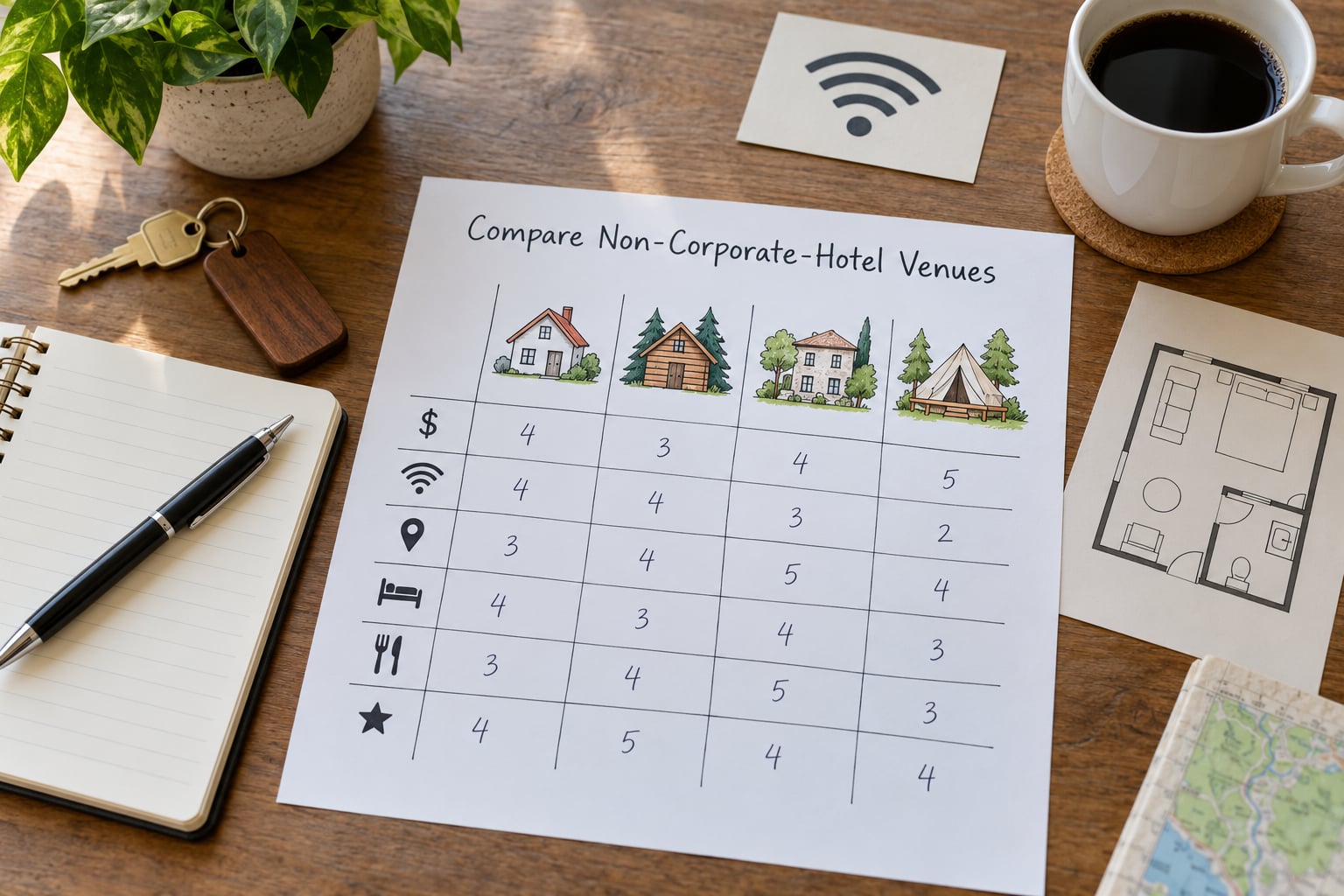
Non-corporate-hotel venues fall into a handful of recognizable types: boutique hotels and independent inns, guesthouses, farmhouse and ranch stays, camps and lodges, villas and multi-bedroom rentals, houseboats and converted or unusual spaces. Each one prices and fails differently.
Build a weighted checklist and score every property on the same eight criteria. Weight meeting space and connectivity highest if you have real work to do; weight space per person and shared outdoor areas highest if the point is connection.
- Room consistency. Can the property guarantee a set number of rooms or bedrooms, or is capacity a “sleeps up to” figure?
- Meeting space. Is there a real table area with power, or do people end up using a coffee table?
- Food. Kitchen access, and whether outside catering is permitted.
- Connectivity. Reliable internet for video calls, ideally with a backup.
- Accessibility. Step-free routes, ground-floor sleeping options, accessible bathroom availability.
- Privacy. Whether you can ask for exclusive use of the whole property.
- Cancellation terms. How much notice you can give, and what happens if someone drops out.
- Total cost. The final invoice, including cleaning, service charges and minimum-stay requirements, not the nightly headline rate.
Talk to the owner or property manager directly rather than only through a booking platform. Group organizers repeatedly find that direct conversation surfaces the real capacity, the real fees and the real house rules faster than any listing does.
Group travelers widely report one pattern worth knowing before you compare quotes: once cleaning and service fees are counted, the gap between a rental and a hotel narrows sharply at small headcounts and only widens once you need the entire property. Ask every property for the complete invoice figure, not the nightly one.
5. Design a Schedule That Mixes Work and Connection
Build an agenda with arrival and settling-in time, two or three protected focus blocks, shared meals, one or two team activities, unstructured social time and an evening wind-down. Keep day one light. Everyone arrives tired, and a packed first morning is the most reliable way to lose a group before the real work starts.
Protect focus time explicitly. Put the agenda on a shared board, name a facilitator if the group drifts, and agree in advance that meetings run to time. In a house setting there is no staff to enforce a schedule, so your group does it or it does not happen.
Plan one team activity that uses the property rather than a generic trust fall. A kitchen challenge, a guided walk on the property, or a session built around the local area gives you something a conference room could never offer.
Always keep a wet-weather and a schedule-change backup. In a house, a cancelled outdoor activity means twenty people in a living room with no plan, so decide what the substitute is before you need it.
6. Confirm Rooms, Meals, Technology and Accessibility
Turn your brief into a written venue checklist and keep a confirmation record for each item. Ask in writing and get answers in writing, because memory and goodwill are not evidence.
- Room block or bedroom allocation, and how beds are shared.
- Dietary needs collected from every attendee, including allergies and severity.
- Presentation equipment, screens, adapters and a reliable speaker setup.
- Internet speed tested on the property, plus a backup hotspot or second connection.
- Power outlets at every seat, including the long meeting table.
- Step-free routes, ground-floor sleeping, and a plan for guests with mobility needs.
- A genuinely quiet space for calls and focused work.
- Emergency procedures, nearest medical facility, and the local emergency number.
- Whether outside catering and outside activity providers are allowed.
Verify real capacity, not advertised capacity. The headline figure is usually the maximum the owner will allow; the comfortable number is limited by bathroom count and bed mix. A property that advertises twenty sleepers may offer fifteen comfortable ones, and bathroom count is usually what decides it.
The strongest advice from people who organize group work trips is simple: confirm capacity and facilities in writing before committing any money. One clear email is cheaper than a reshuffle.
7. Book, Communicate and Measure the Offsite
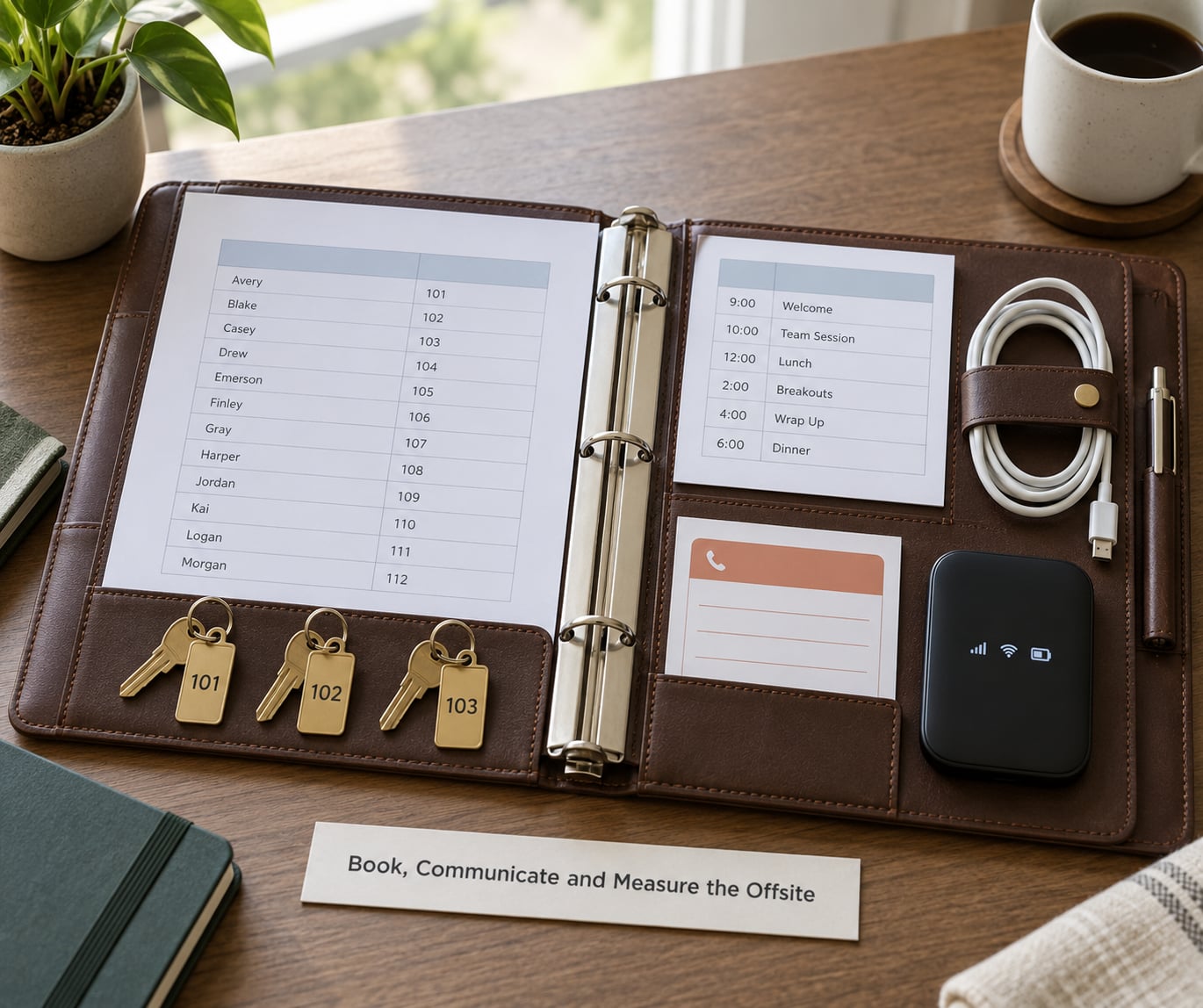
Compare the final proposals side by side using your weighted checklist, then check the cancellation and force majeure terms line by line. A whole-property booking usually carries the full cost the moment someone cancels, while a hotel room block absorbs attrition far more easily. That single difference is the strongest argument for the hotel option, and it belongs in your decision.
Collect attendee details securely, then send one clear itinerary. It should include contacts, packing guidance, expense rules, what is provided and what to bring, and the accessibility details people need. A single well-organized document beats five emails and a group chat nobody reads.
Run a short survey before the offsite to confirm rooming, dietary and access needs, and another after it. Tie the post-event questions directly to your original objectives so the feedback answers the question you set out to solve rather than asking whether everyone had fun.
Common Mistakes
These failures repeat, and each one has a straightforward fix.
Choosing a destination before defining the goal
A destination chosen by whoever is most excited becomes a trip with no outcome. Fix: write the objective first, and let the location follow from travel time and activity fit.
Comparing the sticker price instead of the total cost
Nightly rates hide cleaning fees, service charges, minimum stays and the cost of feeding people without a venue kitchen. Fix: request the complete final invoice for the same headcount and number of nights from every option.
Booking before testing connectivity and meeting space
A beautiful room with no reliable connection and one uncomfortable table will cost you a working day. Fix: ask for the measured connection speed, the number and type of outlets, and a photo of the space where you will actually sit.
Overpacking the agenda
More sessions do not mean more alignment. Fix: decide your essential focus blocks first, then fill the remainder, and leave real gaps for settling in.
Leaving dietary and accessibility needs until late
These are the requests a property cannot solve at short notice. Fix: survey attendees before booking, not after.
Relying on one supplier
One cancelled flight, one sick host or one failed connection and the offsite stalls. Fix: hold a backup date, a second contact at the property, and an offline copy of the agenda.
Sending vague travel information
Vague instructions generate a dozen anxious questions and a poor start. Fix: send one itinerary with times, addresses, contacts and what to bring.
One honest caveat about non-hotel venues: they are usually easier to arrange than a conference venue, but the logistics move onto you rather than disappearing. Cleaning, catering, capacity verification and cancellation exposure all land on the organizer. Teams who accept that trade are almost always happier with the result than teams who assume a rental works like a hotel.
Frequently Asked Questions
What is the best alternative to a corporate hotel for a company offsite?
When you plan a company offsite without a corporate hotel, the answer for most teams is a whole-property rental: a large house, villa, lodge or farmhouse you book for exclusive use. You get shared living and kitchen space, which hotels charge a premium for, with no meeting-room minimums or resort fees. A boutique hotel or independent inn suits teams who want service and less cleanup.
How many employees is an offsite too small for a non-hotel venue?
Below about ten people, a non-hotel property usually stops being economical because minimum stays and cleaning fees do not divide well. At that size a single boutique hotel room block or a day offsite is simpler and cheaper. Above roughly thirty people, multi-bedroom capacity and bathroom count become the binding constraint, and splitting across several properties in one neighborhood works better than one large house.
Should a company offsite provide all meals with the venue?
It depends on the kitchen. If the property has a real kitchen and your group enjoys cooking, groceries plus one catered meal usually give you the best mix of cost, bonding and flexibility. Confirm before you book whether outside catering and outside activity providers are allowed. Confirm dietary requirements with every attendee in advance, including allergy severity, and hold backup options for the first night.
How far in advance should I book a company offsite venue?
Plan on eight to twelve weeks for a domestic trip, and longer if anyone needs a visa or you are targeting a narrow travel window. Whole-property rentals often carry minimum-stay rules and stricter cancellation terms than a hotel, so early commitment costs you flexibility. If your dates are fixed and popular, start earlier. If they are flexible, booking later can work but shrinks your choice of properties considerably.
How do I check whether a boutique venue supports remote presentations?
Ask for the measured connection speed, the number of power outlets at the working table, and whether there is a quiet space for calls. Ask whether outside catering and outside providers are permitted, and confirm any noise restrictions with neighbors or local rules. Request a photo of the actual room you will use, not the marketing shots. Test the connection yourself if a video session is the point of the trip.
Conclusion
To plan a company offsite without a corporate hotel, start with the outcome you need, fix the per-person budget and headcount, then shortlist two or three non-hotel venues that pass the weighted checklist. Request written proposals, compare the complete experience rather than the room rate alone, and confirm capacity, connectivity and rules before paying anything.
Pick a start date now and put the objective and budget on a single page. Everything else gets easier from there.