Pack more activities than you think you will need, hide them in one bag, and hand them over one at a time across the drive instead of all at once. Boredom in a car is not about having too little to do, it is about novelty burning out and running out of options at the worst possible moment.
Here is the short version for anyone in a hurry. Put together one quiet activity, one interactive game and one backup option before you leave. Everything below is how to phase those three across six hours of driving without a single meltdown.
A few zero-supply car games to start with:
- I Spy — one person picks a color or letter, everyone else hunts for it through the window.
- Number plate bingo — grid of letters, everyone hunts for plates that match while staying quiet.
- The alphabet game — take turns naming something visible outside that starts with the next letter.
- Road sign bingo — squares for stop signs, yellow diamonds, mile markers, bridges.
- Color hunt — first to spot three red cars, two trucks, one school bus.
- Sound spotting — call out sirens, engines, wipers, gravel, wind.
- Scavenger hunt by category — find five things that are round, four that are blue, three that make noise.
- Destination guessing game — everyone guesses where the car is going, scored on how close the answer is.
Table of Contents›
- What You Need
- Step-by-Step
- Build a Simple Activity Kit
- Match Activities to the Trip
- Start With a Low-Effort First Activity
- Rotate Between Focus and Movement
- Use Games That Fit the Route
- Plan for Boredom and Resistance
- Save Screens and Snacks for When Needed
- Build a Calm Ending to the Drive
- Common Mistakes
- Frequently Asked Questions
- What games work on a long drive without screens?
- How long should the drive be before children need a break?
- How do I keep kids entertained on a long drive when nothing I suggest works?
- How do I keep two children with different ages entertained?
- Are audio stories or movies a bad idea for children on long trips?
- Conclusion
What You Need
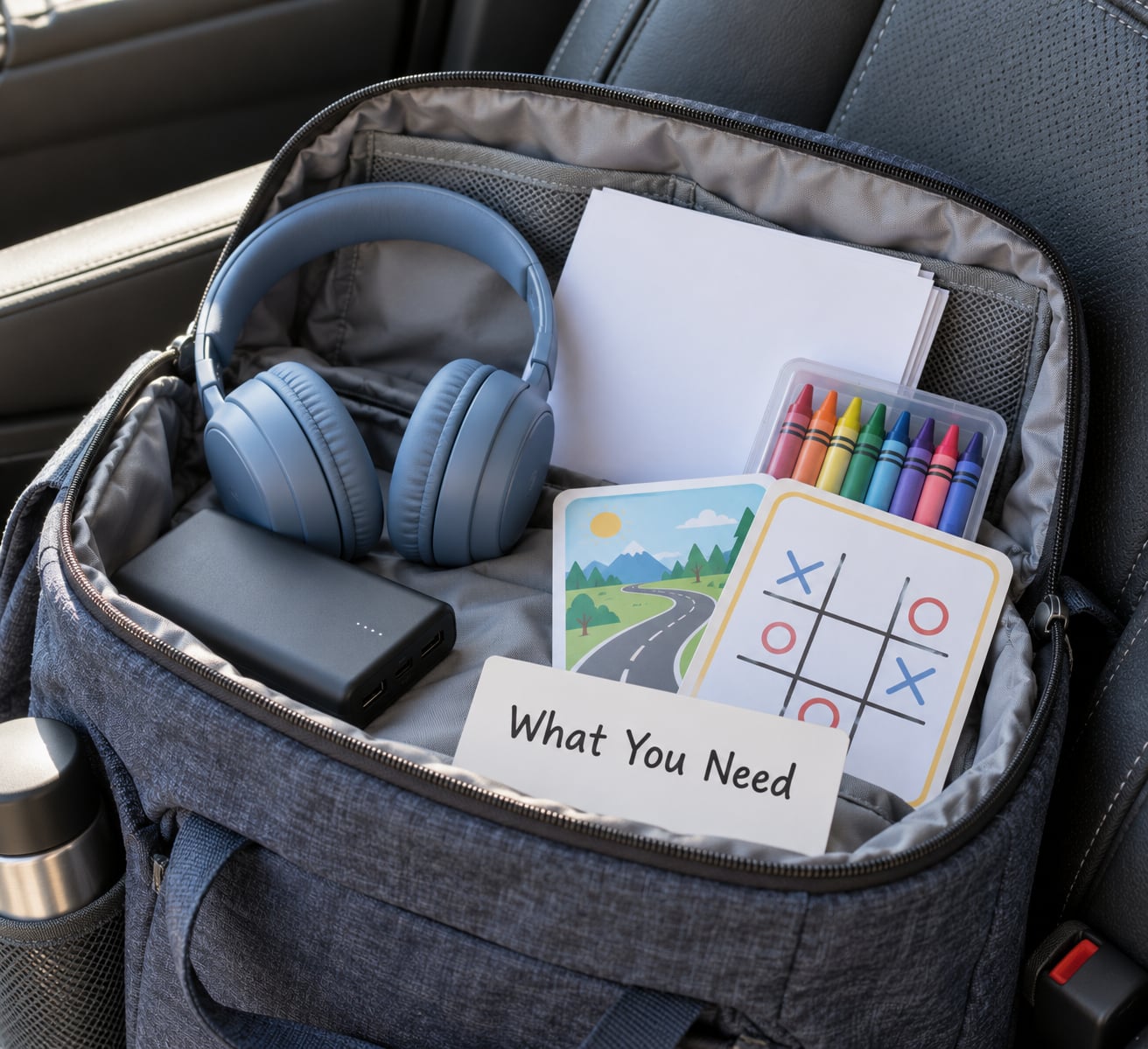
The rule I use is about two activities per hour of driving, rounded up. A six-hour trip gets twelve. That sounds like a lot until you remember they are mostly paper, crayons and reusable window games that cost nothing.
Before leaving, download anything digital. Streaming and podcasts drop out constantly in dead zones between towns, and a buffering screen is worse than no screen at all.
Charge every device and pack a power bank and a car charger. Nothing drains a parent faster than a dead tablet twenty minutes into a tantrum.
Put snacks in sealed containers that a child can open one-handed, and keep an empty bag nearby for rubbish. Sticky fingers find every surface in the car.
Estimate the real trip length before you pack, not the number on the map. Add an hour of margin, because the last hour is where rides fall apart.
One more thing parents rarely think of: your library may lend audiobooks, travel games and even portable players. Borrowing beats buying, since most travel toys get used twice.
Step-by-Step
Knowing how to keep kids entertained on a long drive comes down to sequencing, not volume. Work through these eight steps in order and the back seat runs itself for most of the trip.
Build a Simple Activity Kit
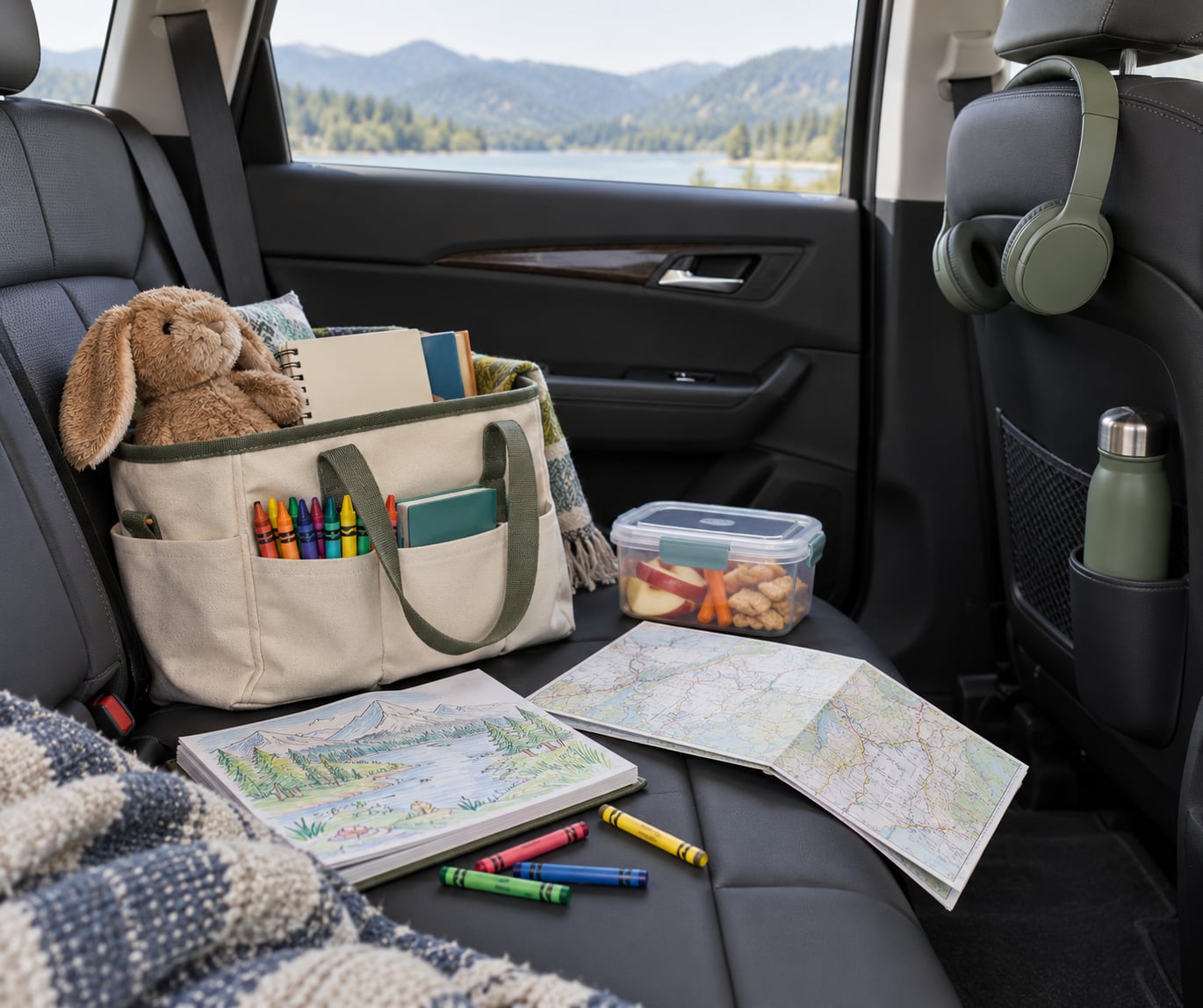
Mix quiet drawing materials, one or two books, reusable window games and an audio option. That covers the toddler who needs stillness and the ten-year-old who gets restless, in one bag.
Skip loose small pieces while the car is moving. A box of small toys emptied onto the seat floor ends up under the pedals.
A travel tray or lap desk changes more than you would expect. It gives small hands a flat surface, so a coloring book stops sliding into the seat gap every time you turn.
Match Activities to the Trip
Divide the drive into stretches and match each one to your children’s ages, energy and the traffic you expect. A six-hour motorway stretch with a four-year-old needs a completely different plan from a two-hour back road with a teenager.
Note the traffic before you leave. Three hours of stop-and-go will kill a scavenger hunt that works beautifully at speed, because nobody can look out of the window properly.
Start With a Low-Effort First Activity
Open with something easy and slightly boring, like a coloring book or an I Spy round. It establishes the rules of the system without demanding that anyone settles into a hard task.
That first activity also gives you time to focus on the road while the kids entertain each other. Nobody has to talk to the driver.
Rotate Between Focus and Movement
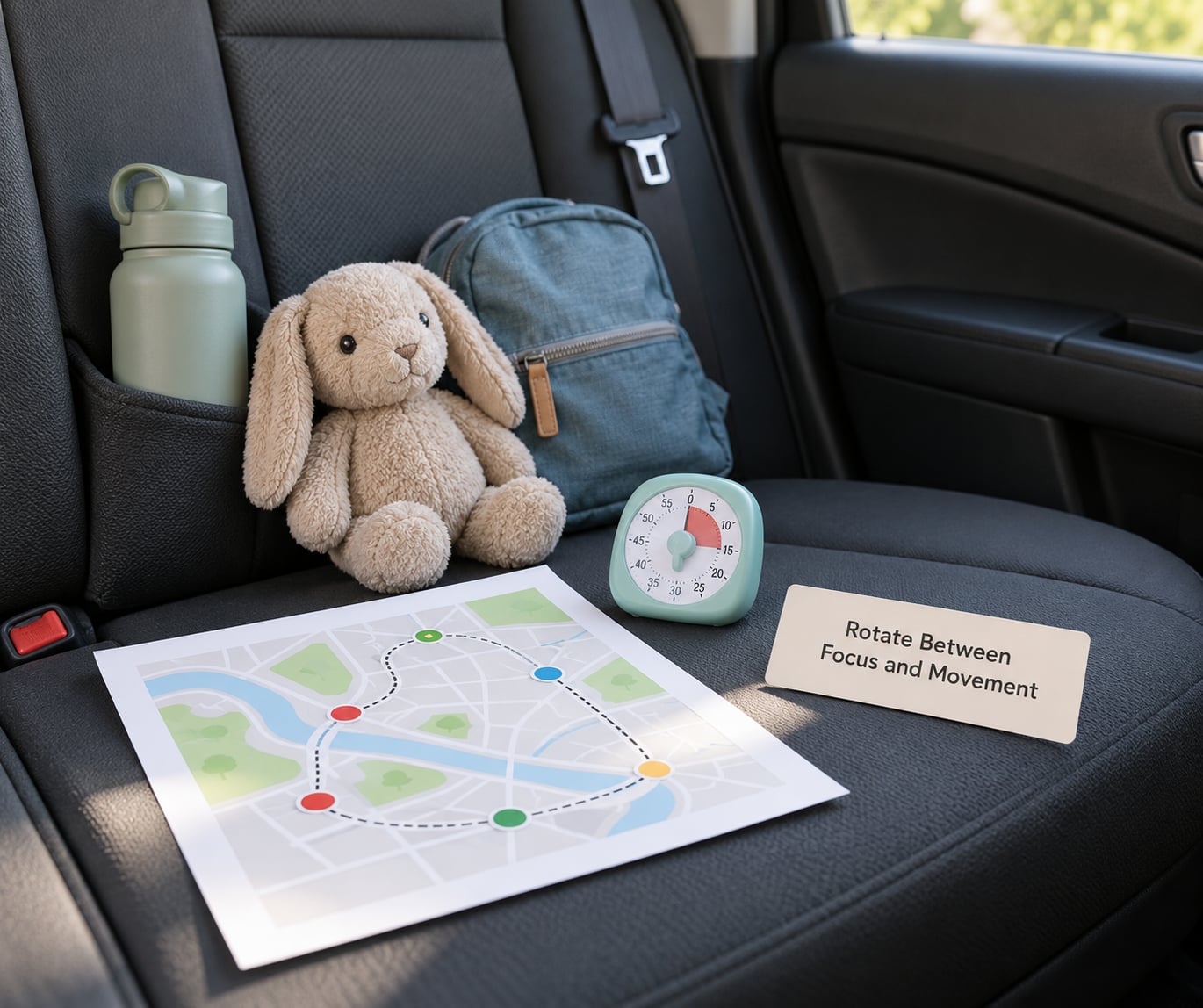
Alternate seated activities with movement. A quiet stretch of drawing or listening followed by five minutes of standing, stretching or a hallway-style game keeps the seated phases from turning into squabbling.
You can spot fading attention before you hear it. Answers get shorter, the same question arrives twice, and drawing turns into poking and tearing.
When you stop, keep it brief. Two songs, one snack, one bathroom stop, then back in. A stop that becomes twenty minutes converts a manageable restlessness into a fresh problem.
Use Games That Fit the Route
Pick games that use the scenery rather than compete with it. Road sign bingo, scenery spotting and sound spotting all work quietly and need nothing from the glove box.
For sibling conflict, let the children compete against the adults instead of against each other. Adults losing badly at a spotting game settles arguments faster than any prize.
Two caveats. Never run a game that requires the driver to look away from the road or twist around, and skip anything involving reading or close drawing if anyone gets motion sick in the car.
Plan for Boredom and Resistance
Have three backups ready in the stash bag, unused. Most trips need one or two of them, and having them there is what stops you negotiating from the driver’s seat.
The parent-pick rule helps: when a child rejects an activity, you get one go at choosing a different one, then it is their turn to commit. Offering unlimited vetoes trains them to reject everything.
For a child who has gone quiet and tearful, lower the demand instead of raising the volume. Get everyone quiet, offer water and a window seat, then reintroduce a low-effort game. Escalating a meltdown rarely works.
Save Screens and Snacks for When Needed
A screen is a perfectly good tool when you are stuck in traffic, driving at night or past everyone’s limit. Using one is not a parenting failure, it is a scheduling decision.
Just avoid it as the answer to every lull, or the drive becomes a queue of small negotiations. Give screens a job, like a specific stretch of road, and they keep their value.
The same goes for snacks. Use a snack for a planned break rather than as the thing you hand over whenever someone sighs. Snack bingo works well here, with squares for each snack in the cooler.
Build a Calm Ending to the Drive
Protect the last hour. Hold your best activity back for it, because a child with something to look forward to behaves much better in the preceding hour.
Give the final stretch a predictable rhythm: one game, one snack, one quiet activity, then a short talk about what happens when you arrive.
Talking about arrival in specifics helps. Name the first thing you will do, whether it is unpacking, a bath or letting them run around outside.
Common Mistakes
Overplanning every minute. A packed schedule with no gaps produces its own disappointment the moment a child finishes early. Leave white space between activities.
Choosing activities for the wrong age. Babies under one are usually fine with a song and a snack. Trying to entertain a teenager with a matching game ends in refusal. Age-match, then layer.
Skipping movement breaks. Restless kids in a car seat get restless everywhere else in the car. A short stop every couple of hours prevents a lot of escalation.
Forgetting downloads. Weak signal on a rural stretch will strand you. Download stories and podcasts at home on the wifi.
Using screens for every lull. It works, and then it becomes the only thing that works. Save it for the hard stretches so it stays useful.
Reacting to boredom with irritation. Boredom is not misbehavior. Annoyed answers guarantee the meltdown you were hoping to avoid.
If you are still stuck on how to keep kids entertained on a long drive, the fix is almost always more sequencing, not more supplies.
Frequently Asked Questions
What games work on a long drive without screens?
The ones that use the window and need nothing from the glove box: I Spy, number plate bingo, the alphabet game, road sign bingo, sound spotting and scenery hunts. They work because the entertainment is already out there, so there is nothing to lose or spill. Pick two that involve looking out of the window and one that involves talking, and you have a full hour covered.
How long should the drive be before children need a break?
Most children need a real stop every two to three hours, and younger ones need it more often. A stop does not have to be long. Two songs, a bathroom, a short walk around the car and something to drink is enough. On longer drives, plan stops before you hit the worst part of the day rather than waiting for the complaints to start.
How do I keep kids entertained on a long drive when nothing I suggest works?
Put one option back and lower the demand instead of adding more. A child who rejects three ideas in a row is usually tired, not contrary. Offer water, a window seat and ten minutes of quiet, then reintroduce a single easy game. If you have a stash bag, let them choose the next item themselves, which usually ends the standoff faster than another suggestion from you.
How do I keep two children with different ages entertained?
Use one activity that has two roles, like a spotting game where the older child keeps score and names harder targets while the younger one hunts. Audio works well here, since a story can hold a four-year-old while an older child reads along. Avoid handing each child their own separate kit, because they will want to swap within about two minutes.
Are audio stories or movies a bad idea for children on long trips?
No. Audio stories are often the single best tool for a long drive, because they need no screen and they end themselves. Test any new podcast or story with a younger child first so you know they will stay with it. Movies work well at night or in heavy traffic, and are worth saving for stretches where nothing else will land.
Conclusion
Long drives get easier when entertainment is a schedule rather than an emergency. Pack roughly two activities per hour, hide them in one bag, phase them against the natural stretches of the trip, and keep your best one back for the final hour.
Before you leave, choose one quiet activity, one window game and one backup, and put all three where a passenger can reach them. That is how to keep kids entertained on a long drive, without handing over the whole basket at mile one.