Learning how to plan a trip with no rental car comes down to three decisions: pick a base near frequent transit, group what you want to do by neighborhood, and check that the connections between them actually run when you need them. Everything else — bikes, ferries, taxis, walking — fills the gaps between those three.
It is a very different way to travel, and for a lot of trips it is the better one. You skip the rental counter, the insurance question, the parking fees, and the hour lost finding somewhere to leave the car. What you get instead is a trip that moves at street level, where you notice the neighborhood between the station and the hotel.
The catch is that car-free travel punishes vague planning. A destination can be genuinely easy to reach and still be impossible to tour without a car if the sights sit forty minutes off the bus line. So the work happens before you book anything.
Table of Contents›
- What You Need to Plan a Trip Without a Rental Car
- How to Plan a Trip With No Rental Car: Step-by-Step
- 1. Choose a destination or area with workable public transport
- 2. Pick one or more convenient bases
- 3. Group attractions into daily walking and transit routes
- 4. Check schedules, reservations, and last rides
- 5. Build a comfortable mix of walking, cycling, and public transit
- 6. Plan meals, rest stops, and daily essentials
- 7. Keep a simple backup plan for missed connections
- How to plan a trip with no rental car without overpacking each day
- Common Mistakes and How to Fix Them
- Frequently Asked Questions
- Can you travel without a rental car in a rural area?
- How much walking is reasonable for a car-free trip?
- Are taxis and rideshares useful if I plan to use public transit?
- How should I manage luggage when using trains and buses?
- What should I do if a public transit connection is late or canceled?
- Conclusion
What You Need to Plan a Trip Without a Rental Car
You need far less than most people assume. Nobody memorizes a bus timetable before a flight, and you should not try.
- A destination and your dates. Fixed or flexible, but you need to know how many evenings you actually have.
- A smartphone with offline maps. Download the region before you land, because map apps want a connection to be useful and street-level detail is the whole point.
- Current transit information. The operator’s own app or site for each city you visit. Schedules change, and the printed timetable in the station lobby is not always current.
- A payment method for fares. Contactless card, transit card, or whatever the local system uses. Some cities still run largely on paper tickets bought at a machine.
- Reservations where they are needed. Some attractions sell timed entry, some ferries fill up, and some island hops only run a few times a week.
- Comfortable walking shoes. This is not a detail. A car-free day can easily be ten kilometers on foot.
- A day bag. Everything you need for a full day out, carried the whole day.
That is the whole kit. The one thing worth adding, if you take laptops seriously, is a plan for where you will work — cafés with outlets and long opening hours, rather than the nearest coffee counter to your accommodation.
How to Plan a Trip With No Rental Car: Step-by-Step
Seven stages, in this order. Each one reduces how much you depend on private transport, and each one is easier when the stage before it is already settled.
1. Choose a destination or area with workable public transport
The first filter is simple: can a visitor reach two useful activities from the same base without a car? If the answer is no, either the destination is wrong or the area you would be staying in is wrong.
Look at what actually connects things. In a city, that means the metro, light rail, tram, or frequent bus network, and how late it runs. On an island or a peninsula, it means the ferry timetable, because the ferry is the road. In a rural region, it means a smaller bus network that may run twice a morning and twice a night.
The trap here is checking whether you can reach the center, and stopping there. Plenty of destinations have excellent transit to the middle and nothing at all to the interesting parts. Outlying viewpoints, beaches, and villages are usually the ones served worst.
A useful test: pick the three things you most want to see, then look up how you would get from one to the next before you commit to the place. If two of those three require the same transfer twice, that is a long day, not an impossible one — but you should know that going in.
2. Pick one or more convenient bases
This is the single decision that makes or breaks a car-free trip, and it is worth more thought than anything else on the list.
What you are looking for in a base is not “central” in the sightseeing sense. It is near a frequent stop — ideally a rail station or a stop with services every ten minutes or so — with groceries, something to eat, and evening activity within a short walk.
Three patterns work well. A single base for a city stay, which keeps you from repacking. Two bases for a longer trip, one per region, which cuts backtracking. And a one-night pass-through stay when a long train ride breaks a journey into something survivable.
Staying in the old town gives you the atmosphere and the walkability. Staying beside the main station gives you the convenience. In most cases the walkable neighborhood within ten minutes of a major station is the sweet spot, and you should check the last service of the night before you book rather than after you arrive.
3. Group attractions into daily walking and transit routes
Stop treating the map as a list of separate errands. Instead, group stops into days, and cluster each day’s stops so you are moving in one direction rather than zigzagging across town.
A day that works looks like this: three morning stops within fifteen minutes of each other, a midday meal in the same district, an afternoon ride on one line or one ferry crossing, and an evening activity near where you will eat. Every transition is a short walk or a single hop.
Two or three stops a day in one neighborhood is plenty. The instinct to fit five is what turns a car-free day into an eight-hour walking marathon with a museum queue at the end.
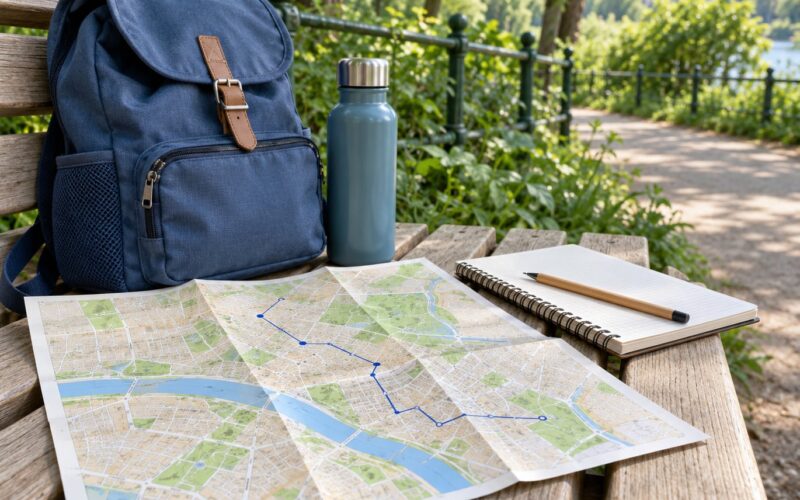
One thing I do on a map before booking anything is draw the transit line through the stops. A line with four of your stops on it is a day that flows. Four stops in four corners of the city is four separate errands wearing a day’s clothing.
4. Check schedules, reservations, and last rides
Some services run all day and you can simply turn up. Others run on a pulse — a bus every two hours, a ferry four times a day, a last departure at 18:40. Those are the ones that decide your day.
What to verify before you book:
- Advance booking. Rail and some long-distance buses sell out well ahead for popular routes, while local buses rarely need it.
- Timed entry. Attractions with capped entry sell slots and they go, particularly in summer and at weekends.
- Service interruptions. Engineering works, seasonal timetables, and holiday reductions all change frequency without changing the route.
- The last ride back. Not the first departure out, and not the last one from the station to your hotel — the one that gets you back before the place stops running.
- Changeover time. A three-minute connection between two lines is three minutes. Ten is a different plan.
Once you know the pulse of the network, you build your day around it rather than fighting it. When the ferry leaves twice a morning, the second crossing is not a backup, it is the actual plan, and the morning is scheduled backwards from it.
5. Build a comfortable mix of walking, cycling, and public transit
Match the mode to the route, the weather, your mobility, and the distance. Walking is free and it is the mode that gives you the most, but it is not the right answer for everything.
Walking works best inside a neighborhood or along a waterfront. Cycling works best on flat, well-marked paths and in cities with dedicated lanes, and public bike-share is a useful way to test whether a route is bikeable before committing. Ferries are the surprise winner on coastal and island trips — a scheduled crossing often beats a long indirect bus, and a bicycle usually comes along for a modest fee. Buses and trains carry you between districts. Taxis and rideshare fill the awkward gaps: the last kilometer, the late return, the station that does not connect to your hotel.
None of these replaces planning. A rideshare is a way to solve a specific gap at a specific moment, and treating it as a default quietly turns a car-free trip into an expensive one.
6. Plan meals, rest stops, and daily essentials
Where you eat is transport infrastructure. A midday stop in the district you are already in saves a return trip; a restaurant twenty minutes away across town costs you an hour of your day.
Put the day’s structure in place before you leave the accommodation: where you will eat, where you will drink water, where the toilets are, and where you can sit down for twenty minutes. In older cities with cobbles and limited benches, a bench is worth more than an extra stop.
Carry water, a small day bag with whatever you need to actually enjoy the day, and one layer more than the forecast suggests. Walking slows you down and makes you warmer than a traveller in a vehicle, which is counterintuitive and consistently true.
Then allow recovery time. A car-free itinerary that runs at the pace of a car is not sustainable for more than a few days. Somewhere in most days there should be an hour with nothing in it — a café, a park bench, a second coffee that turns into the rest of the afternoon.
7. Keep a simple backup plan for missed connections
Transit gets cancelled. The ferry is late. The bus is full and the next one is an hour away. This is ordinary, not a crisis, and it is much easier to handle if you set it up before you are standing on a platform in the heat.
Five things, all of which take a few minutes:
- An offline map of the area, downloaded.
- Screenshots of your tickets and bookings, since phone signal does not always cooperate.
- The address of your accommodation written out in the local language, plus a screenshot of the map pin.
- One alternative route per day — a second bus line, a longer walk, a different station — so you have something that does not depend on the same service.
- The local taxi number, saved in your phone, even if you barely intend to use it.
And every day needs a low-effort version. One stop, one meal, one walk, and a good evening is a successful day, not a wasted one. Knowing in advance what that version looks means a delay becomes an inconvenience rather than the reason you cancel the rest of the week.
How to plan a trip with no rental car without overpacking each day
There is a compact formula that works almost everywhere, and it is the reason car-free itineraries often feel better than the ones people plan with a car.
One neighborhood, two or three nearby stops, one meal, and a flexible evening.
In a compact city that produces a full day: a morning market and two landmarks inside the old town, lunch where you already are, an afternoon gallery within ten minutes of where you sat down, then an evening you decide at four o’clock based on the weather and how your legs feel.
In a slower place — a small island, a coastal town, a rural region with two bus routes — the same formula stretches. Two stops become a morning walk and an afternoon swim, one meal becomes a market run and a cook-it-yourself evening, and the flexible evening becomes the best part of the day. The formula is the same because the constraint is your attention, not distance.
Give the flexible evening real weight. It is what absorbs a missed connection, a downpour, or the point at which you simply want to sit still. If a day’s only plan is one thing that must happen at a fixed hour, you have no margin anywhere.
Common Mistakes and How to Fix Them
Most car-free trips go wrong in a handful of predictable ways. Each of these has a fix you can apply before you leave.
Booking too many distant attractions. Three sights in three different parts of the city means three round trips and a day spent on transit. Fix: cap it at one area per half-day and put anything far away on a single dedicated day.
Relying on infrequent buses. A bus every two hours is not a connection, it is a schedule. Fix: treat every service with a gap over ninety minutes as a planned transfer, not a convenience, and check the return before you commit to the day.
Ignoring changeover times. Five minutes between two services is a gamble with a timetable. Fix: add ten minutes to every interchange, and use walking time between close stops instead of a second vehicle.
Wearing the wrong shoes. This is the mistake that ends more car-free trips than any schedule. Fix: break in proper walking shoes before departure, and keep a pair for the worst day, not the best one.
Treating a transit map as a real-time travel plan. A map tells you what exists. It does not tell you what runs tonight, or what happens when the line is replaced by buses. Fix: check the operator’s live information the morning of, and know that the printed map is for orientation, not timing.
Five things worth remembering. Stay within about fifteen minutes’ walk of frequent transit and you will walk far less than you expect. Check the last service of the night before you book a room, not after. Pack lighter, because everything in the bag is something you are carrying. Expect the trip to be slower and see that as the point. And take the taxi when the alternative is missing a train — that is a planned decision, not a defeat.
Frequently Asked Questions
Can you travel without a rental car in a rural area?
Sometimes, but only with realistic expectations. Rural areas usually have one or two bus routes, often running every two hours and stopping early in the evening. Plan on one or two set destinations a day, based on the timetable rather than the map distance, and treat a day trip as an all-day commitment because the return service is not flexible. Check whether the sights you want have any service at all before you commit, and keep the last departure time written down somewhere you will see it in the morning.
How much walking is reasonable for a car-free trip?
Most travelers find ten to fifteen kilometers across a whole day is comfortable when it is broken up, and miserable when it is not. The number matters less than the shape: short walks between stops with a proper sit-down in the middle are fine, and one long unbroken stretch of five kilometers is what ends the day early. Budget a bench and a café in every half-day, and if one member of your party does not walk well, cluster more tightly and ride more rather than dropping the plan.
Are taxis and rideshares useful if I plan to use public transit?
They are the connective tissue, not the transport plan. Taxis and rideshares earn their place on the last kilometer between a station and your hotel, on late returns after services have stopped, and on trips where walking would take too long or the weather turns. Used that way they cover the weak points that make car-free trips stressful. Used as the default between every stop, they quietly become the most expensive part of the trip and defeat the point of planning around transit.
How should I manage luggage when using trains and buses?
Travel light. A wheeled bag on a station platform is a liability, and stairs are more common than lifts on older networks and small ferry terminals. If you must bring more than you can carry, book a service that includes luggage in its fare and expect to handle it yourself at least twice. Keep everything in one bag you can lift, pack the heavy items at the bottom, and keep documents, medication, valuables, and one change of clothes in your day bag rather than in checked luggage.
What should I do if a public transit connection is late or canceled?
Confirm the next departure before you start rearranging anything — a delay often means the next service arrives sooner than the timetable suggests. Let the staff or driver know if you are connecting to a booked train or ferry, since missed-connection policies vary and are usually more forgiving when you asked. If the wait becomes long, use the backup route you chose earlier, take a taxi if it saves a connection you cannot afford to lose, and stop treating the day as ruined. The backup plan exists so a bad hour stays an inconvenience.
Conclusion
Car-free travel works when the plan is built around three things: a base near frequent transit, activities grouped by neighborhood so each day stays in one zone, and connections verified for the hours you will actually be moving.
Start there, in that order. Knowing how to plan a trip with no rental car comes down to picking the neighborhood first and checking what runs past it, then clustering what you want to do and seeing how many of those stops sit on one line. Everything after that — bikes, ferries, walking, an occasional taxi — fills the gaps you have already identified rather than the ones you discover on the way.