The short answer: learning how to beat jet lag going east comes down to three levers — start shifting your clock earlier three days before you fly, live on destination time the whole way, and anchor yourself to daylight at the right hours once you land. Eastbound travel is harder because your internal circadian clock runs slightly longer than 24 hours, so every time zone east asks you to shorten your day, and you can expect to need roughly one day of adjustment for each zone crossed.
I fly east more often than I’d like, and the trips that go well follow the same pattern almost every time: an early start, real morning light, and meals and sleep on the destination’s clock rather than mine. The trips that go badly are the ones where I try to live in two time zones at once.
There is no trick that erases jet lag entirely, and anyone promising you one is selling something. What you can do is get a meaningful chunk of your first two days back.
Table of Contents›
- What You Need to Beat Jet Lag Going East
- Step-by-Step
- How to Prepare Before You Leave
- How to Use Light After Arrival Going East
- How to Protect Your Sleep at the Destination
- How to Manage Meals, Hydration and Activity
- How to Recover Without Rushing the First Days
- Common Mistakes
- Frequently Asked Questions
- How long does jet lag last when you travel east?
- Should I sleep on the plane when flying east?
- Is jet lag worse going east than west?
- Is light therapy useful for eastward jet lag?
- How many time zones count as long-haul jet lag?
- When should jet lag symptoms prompt a doctor’s visit?
What You Need to Beat Jet Lag Going East

You need very little, honestly. The plan works for most people with a phone, a watch, and a willingness to be awake at an inconvenient hour for about a week.
- A light plan — know roughly what time the sun rises where you’re going, because light is the signal your body clock actually listens to.
- A flexible bedtime for three days before departure — this is where the adjustment is actually won or lost.
- An alarm for your destination wake-up time — one fixed wake time matters more than going to bed at the right hour.
- An eye mask and comfortable shoes — for a long flight and for walking off jet lag on arrival morning.
- A water bottle you can refill — cabin air is dry and you’ll be dehydrated before you feel thirsty.
- Access to daylight where you land — a room with a window and a reason to step outside early.
How long it takes depends mostly on how many zones you cross and how far your travel day shifts. Most health bodies, including the CDC and NHS travel health guidance, use a simple rule of thumb: about one day per time zone.
| Time zones crossed eastward | Common route | Rough days to feel roughly adjusted |
|---|---|---|
| 2 to 3 | US East Coast to the Caribbean, or a UK to Eastern Europe hop | 2 to 3 days |
| 5 to 6 | US to UK or Western Europe | 5 to 6 days |
| 8 to 9 | US to Central or Eastern Europe | 6 to 8 days |
| 11 to 13 | US to East Asia, or Europe to East Asia | 10 to 13 days |
Those are averages, not deadlines. People who already keep an early or late routine, or who arrive on a route they’ve flown before, often adjust faster than the table suggests.
Step-by-Step
Five steps, mapped to the three phases of an eastbound trip: before you fly, in the air, and the first day or two after you land.
How to Prepare Before You Leave
Start three days out and move your wake time 30 to 60 minutes earlier each day. That is the whole exercise — a small daily phase advance, repeated, not one heroic early night.
- Wake earlier, in daylight. Get outside within an hour of getting up if you can. Morning light is the strongest phase-advance signal you have.
- Move meals earlier too. Breakfast an hour sooner, dinner an hour sooner, and pull your caffeine cut-off back with them.
- Dim the evenings. Lower lighting after dark, put screens to bed earlier, keep the room cool. You’re training yourself to be sleepy sooner.
- Protect the last night. Do the opposite on the night before flying: stay up later than usual. An all-nighter before an eastbound flight sounds clever and it backfires — you’d start the trip already depleted.
If a rigid 30-minute shift is impractical, shift by 15 minutes a day and start a day earlier. Small and repeated beats large and abandoned, and the CDC and NHS both frame the pre-travel shift as gradual rather than abrupt.
One flight choice helps more than anything else: book a departure that lands in the morning or early afternoon local time. Landing at 2am means your body wants to sleep at the exact moment you need to be functional, which is why the red-eye eastbound is the classic way to lose a day.
How to Use Light After Arrival Going East
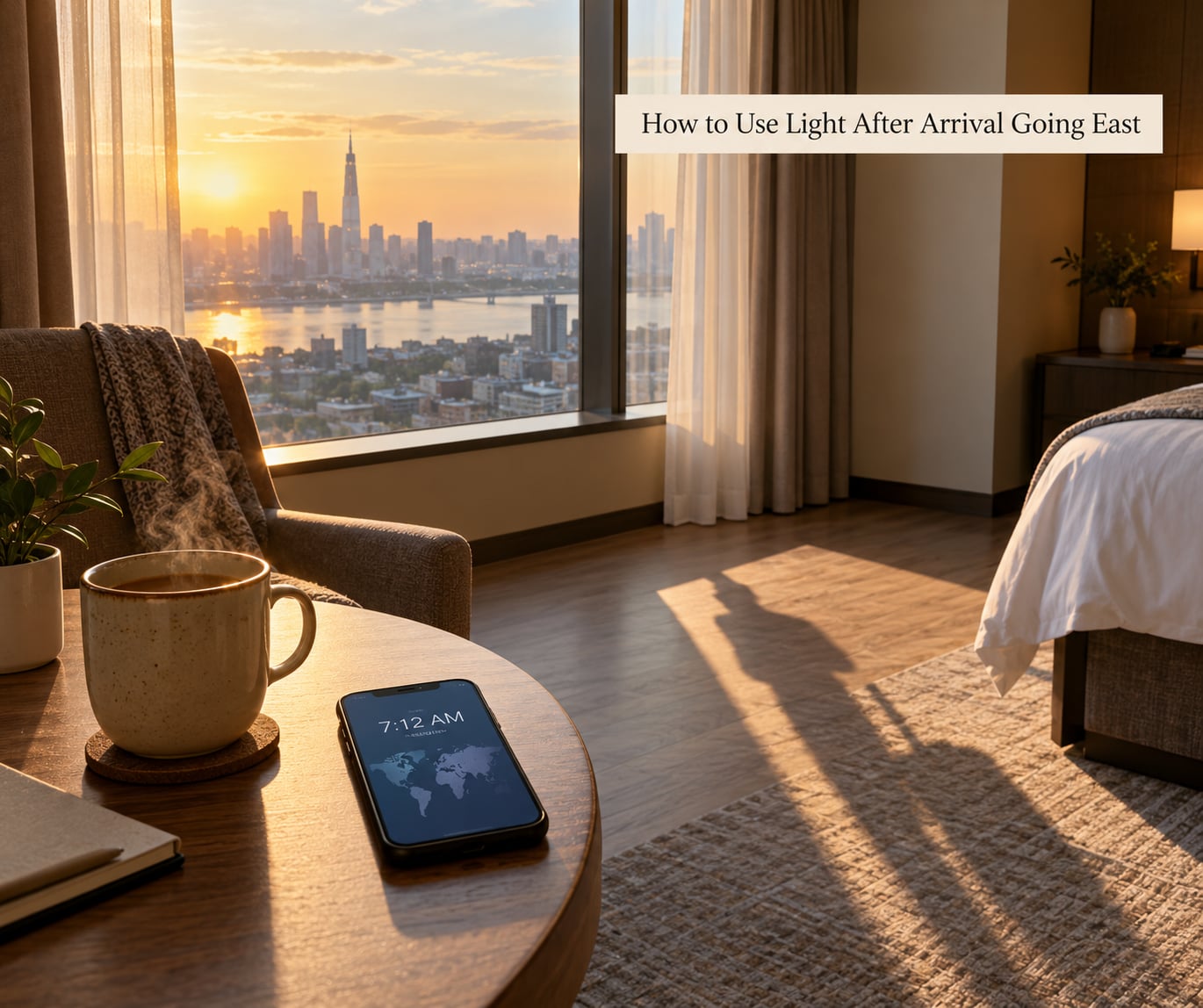
Light is the single strongest lever you have, and going east it has to point one direction: get bright light in your morning and keep your evenings dim. Morning daylight pulls your body clock earlier, which is exactly the shift you need.
Go outside within an hour of waking and stay out 20 to 30 minutes. A walk beats a window seat because real outdoor light is far brighter than anything indoors, even on an overcast morning.
If your body wakes at 3am and you cannot fall back asleep, keep the lights low and do not scroll. Bright light at 3am tells your clock it is still early, and you lose the shift you fought for all day.
In the evening, do the opposite. Dim overhead lights, skip the bright bathroom bulb, and put your phone on night mode. Nothing about your evening routine needs to be dramatic; it just needs to be consistent for a few nights while the clock catches up.
Worth knowing: these light rules are general guidance, and they are not a substitute for medical care. If sleep problems persist well past the adjustment window, or you have a condition or medication that makes light exposure a concern, talk to a doctor.
How to Protect Your Sleep at the Destination
Keep one wake time and hold it every day, even after a bad night. Your clock anchors more reliably to when you get up than to when you lie down.
- Nap before mid-afternoon local time, and cap it at 20 to 30 minutes. Set an alarm. A 20-minute nap takes the edge off without spending the sleep pressure you need tonight.
- Stay awake until local bedtime. This is the hardest part on day one and the most important. Falling asleep at your normal home hour means waking at your normal home hour, and you start over.
- Cut caffeine eight hours before bed. Caffeine’s half-life is around five to six hours, so a mid-afternoon coffee is often still working at midnight.
- Block unwanted light and noise. Blackout curtains if the street lights wake you, earplugs or a fan if the room hums.
People often reach for melatonin around this point. Used correctly it can help with the timing, but the dose and timing vary and interactions are real, so ask a pharmacist or your doctor which product suits you and when to take it rather than doubling up on strength. The same goes for over-the-counter sleep aids like diphenhydramine: some travellers use them at the destination to force sleep, and they carry their own grogginess and dependency questions.
How to Manage Meals, Hydration and Activity
Eat on destination time. Your stomach is a decent time cue, and shifting meals is one of the cheapest ways to nudge the whole system earlier.
In the air, refuse any airline meal that lands in the hours your body thinks is the middle of the night. Travellers get odd looks for turning down dinner at 2am local, but it is the single least useful meal service of the day. Drink water, skip the alcohol, and keep caffeine to your morning.
On arrival, stick to food you already know. Your digestion is going through enough without introducing a new cuisine at 1am local.
Move gently and often. A 20-minute walk after lunch and another in the late afternoon builds the sleep pressure that will pull you under tonight, and it burns off the restlessness that makes the first night miserable. Skip the intense evening workout; hard training close to bed leaves you wired.
How to Recover Without Rushing the First Days
Here is the shape of a first day that works, assuming you land mid-morning local.
- Landing to 10am: skip the airport lounge coffee if it’s late, get outside, and eat a normal breakfast on the local schedule.
- Midday: eat lunch at local noon, walk for 20 minutes, and if you must nap, keep it to 20 minutes before 2pm.
- Afternoon: keep moving. Museums, a market, a walk through a neighbourhood you would not otherwise see. This is the boring part that buys you a normal night.
- Evening: dinner at local time, dim lights from about an hour before bed, no caffeine after mid-afternoon, and stay in bed until local wake time even if sleep is patchy.
You will probably wake once or twice that first night. That is normal and it usually passes by the second night.
If you have to work on arrival day, protect the two anchors: get outdoor light early and stay awake until local bedtime. A bad meeting at 11am is survivable; skipping both is how people end up still on home time four days later.
On short trips under five days, adapting costs you more than it saves — and the flight home eastbound will hit you just as hard. On a two- or three-day trip, keep your home rhythm, schedule nothing demanding, and treat the jet lag as an inconvenience rather than something to be solved.
Travelling with small children, the plan is gentler: shift their sleep and meals by 30 minutes a day rather than forcing an adult schedule, keep daytime naps short and early, and expect the whole household to take an extra day or two. Toddlers adjust on hunger and light far better than on a strict timetable.
Most eastward travellers feel reasonably aligned within the estimate above, though plenty say it takes longer and a week is not unusual. Persistent insomnia lasting well beyond that, marked mood changes, or symptoms severe enough to disrupt your trip are worth raising with a doctor rather than treating with more supplements.
Common Mistakes
Staying on home time for the first two days. It feels safe and it is the single biggest reason people stay awake at 3am on night three. Switch to the destination’s clock from the moment you land, meals included.
Sleeping through the destination morning. Oversleeping until 10am feels like catching up and it throws away your best light. Set an alarm and get into daylight early instead.
Napping for two hours in the late afternoon. Long naps taken after mid-afternoon local time eat directly into tonight’s sleep pressure, so you wake up at 2am having had all your sleep in the afternoon.
Drinking to celebrate or to sleep. Alcohol shortens the time to fall asleep and fragments the second half of the night. It also worsens the dehydration that makes day two feel worse.
Booking a full itinerary for day one. A museum morning, a tour, dinner at 9pm and a rooftop bar at 11 is three chances to be exhausted and awake at the wrong hours. Keep day one light on purpose.
Assuming a supplement solves it. Homeopathic jet lag pills, 5-HTP and CBD come up constantly in traveller forums and none of them have good evidence behind them. Homeopathic products contain no active ingredient at all. If you want to use something, ask a pharmacist about melatonin instead.
Forgetting the return flight. Many people manage the outbound and collapse on the way home, because that leg is eastbound too. If your return pushes you across more zones, pre-shift for it the same way you did outbound.
Frequently Asked Questions
How long does jet lag last when you travel east?
Most health guidance uses about one day of recovery per time zone crossed, so a five or six hour jump west to east usually takes five to six days to shake. You will usually notice improvement sooner than that, with sleep pressure returning before energy does. Expect the first night or two to be the worst. Individual routines matter a lot, and travellers who already keep early or late hours often adjust faster.
Should I sleep on the plane when flying east?
Sleep on the plane only when it is night at your destination. On an overnight eastbound flight that usually means the middle hours, with an eye mask and earplugs so the cabin lights do not wake you. If your flight is a daytime one, stay awake and push through to local bedtime. Forcing sleep during destination daylight sets you back the day you arrive.
Is jet lag worse going east than west?
Yes, consistently. Your circadian clock free-runs at slightly more than 24 hours, so travelling west lets you go to bed later and wake later, both of which your body resists less. Going east means waking earlier than your body wants and shortening your day, which is the harder direction to shift. If you have a choice of routes, a westward one is noticeably easier.
Is light therapy useful for eastward jet lag?
Morning bright light on arrival is one of the most reliable parts of the plan, because light is the main signal anchoring your body clock. Get outside within an hour of waking and keep your evenings dim to reinforce the shift. Over-the-counter light therapy lamps are an option some travellers use, though outdoor light is much stronger. If you have an eye condition or take photosensitising medication, check with a doctor first.
How many time zones count as long-haul jet lag?
Two to three zones is usually noticeable, particularly if it moves your bedtime past your tolerance. Five to six zones, such as US to UK, is where most people describe the trip as real jet lag. Eight or more means roughly a week or more before you feel aligned. Distance flown matters far less than the number of time zones crossed.
When should jet lag symptoms prompt a doctor’s visit?
Ordinary jet lag settles within about a day per time zone. See a doctor if insomnia persists well past that, if you cannot function at work, if mood is markedly affected, or if you have return trips where jet lag is always unusually severe. Symptoms that appear on a trip without any time zone change are worth mentioning too, since travel fatigue and travel sickness can look similar at first.
If you take one thing from this, make it the three-day pre-shift. Book a flight that lands in the morning, start moving your wake time earlier three days out, and get into daylight within an hour of waking on arrival day. Everything else is detail on top of those three moves, and if you want to go deeper on slow, solo travel once you are on the other side of it, we have guides on that too.