To read hotel reviews and find the useful ones, ignore the headline score and work through roughly fifteen instead: the ten most recent, then the five most detailed, checking whether the same issues recur and whether the reviewer stayed in the room type you are booking. A property with two thousand reviews tells you almost nothing on its own.
I book nearly every trip this way, usually alone, usually in a city I have never visited. The hard part was never finding reviews. It was cutting through them fast enough to make a decision before a good rate disappeared.
What follows is the system I settled on. It takes about fifteen minutes per property, and it scales down to four minutes when I am choosing between two finalists.
Table of Contents›
- What You Need
- Step-by-Step: How to Read Hotel Reviews and Find the Useful Ones
- 1. Start with the details that affect your stay
- 2. Check the reviewer’s travel context
- 3. Separate specific observations from vague praise
- 4. Look for patterns across reviews
- 5. Check how the hotel responds
- 6. Compare platforms and review formats
- 7. Make a decision based on your own priorities
- Common Mistakes
- Frequently Asked Questions
- What is the 15/5 rule in hotels?
- How many hotel reviews should I read before booking?
- How do I tell if hotel reviews are fake?
- Which hotel review site is the most reliable?
- Should I read one-star reviews at all?
- How do I judge whether recent reviews are trustworthy?
- Conclusion
What You Need
Reading reviews badly does not come from missing information. It comes from starting without a property name, a set of priorities, and a plan for where the reviews come from.
Before you open anything:
- A specific property. Not a neighbourhood. Open the actual page for the actual building, because the chain page and the individual hotel page carry different scores and different review volumes.
- Your priorities, written down. Three of them, in your own words. Quiet, walkable to the station, a desk I can actually work at, breakfast included, a room that does not smell of damp.
- Access to at least two platforms. One platform alone is a single opinion wearing a statistics costume.
- A note on your travel context. Solo or not, business or leisure, one night or a month, which season, any mobility needs, which room type you are actually booking.
- Fifteen unhurried minutes. The whole exercise fails if you do it in the four minutes between two booking tabs.
Step-by-Step: How to Read Hotel Reviews and Find the Useful Ones
1. Start with the details that affect your stay
Write your three priorities before you read a single review, then match each one to a section of the page. Most review screens break down into rooms, cleanliness, location, service and value, and each one carries dozens of comments from people who cared about something else entirely.
This ordering matters more than it sounds. When I read top to bottom in order of arrival, I notice whatever is loudest. When I read against a checklist, I notice what I came for. Learning how to read hotel reviews and find the useful ones is mostly an exercise in reading selectively.
A few examples of how a priority maps to a section:
- I sleep badly means keyword-search the review text for noise, walls, lift, corridor, street, and air conditioning.
- I work two hours a day means I look for a desk, a chair that is not a stool, socket access, and wifi reliability, which reviewers mention far less often than the view.
- I want a walkable base means I read location comments for the specific route I care about, not the boast about being steps from everything.
- Mobility matters means I read check-in and access comments, because a third-floor walk-up with no lift is not a small problem.
Note also that room type is a filter, not a detail. The standard double and the corner suite are different products sharing a URL.
2. Check the reviewer’s travel context
Every review describes one person’s night. The skill is deciding whether that night resembles yours, and the useful signals are room type, length of stay, purpose of trip, season, group size and any stated need.
A guest who booked two nights for a stag weekend, got a twin on the third floor facing the courtyard, and hated it is not evidence that the hotel is bad. They are evidence that the courtyard wing is rough on weekend groups. Someone arriving alone for six quiet nights in October has a completely different experience, and their review is the one you should lean on.
Long stays skew complaints in a specific direction. Guests staying three weeks complain about housekeeping frequency, storage space, laundry, and whether the weekly cleaning felt enough. A one-night guest never notices. Neither account is false; they are answers to different questions.
Where a review states what it cost, that is worth extra weight. A guest who paid a discounted rate and a guest who paid the full flexible rate are grading the same room against different expectations, and the first one is usually fairer company.
3. Separate specific observations from vague praise
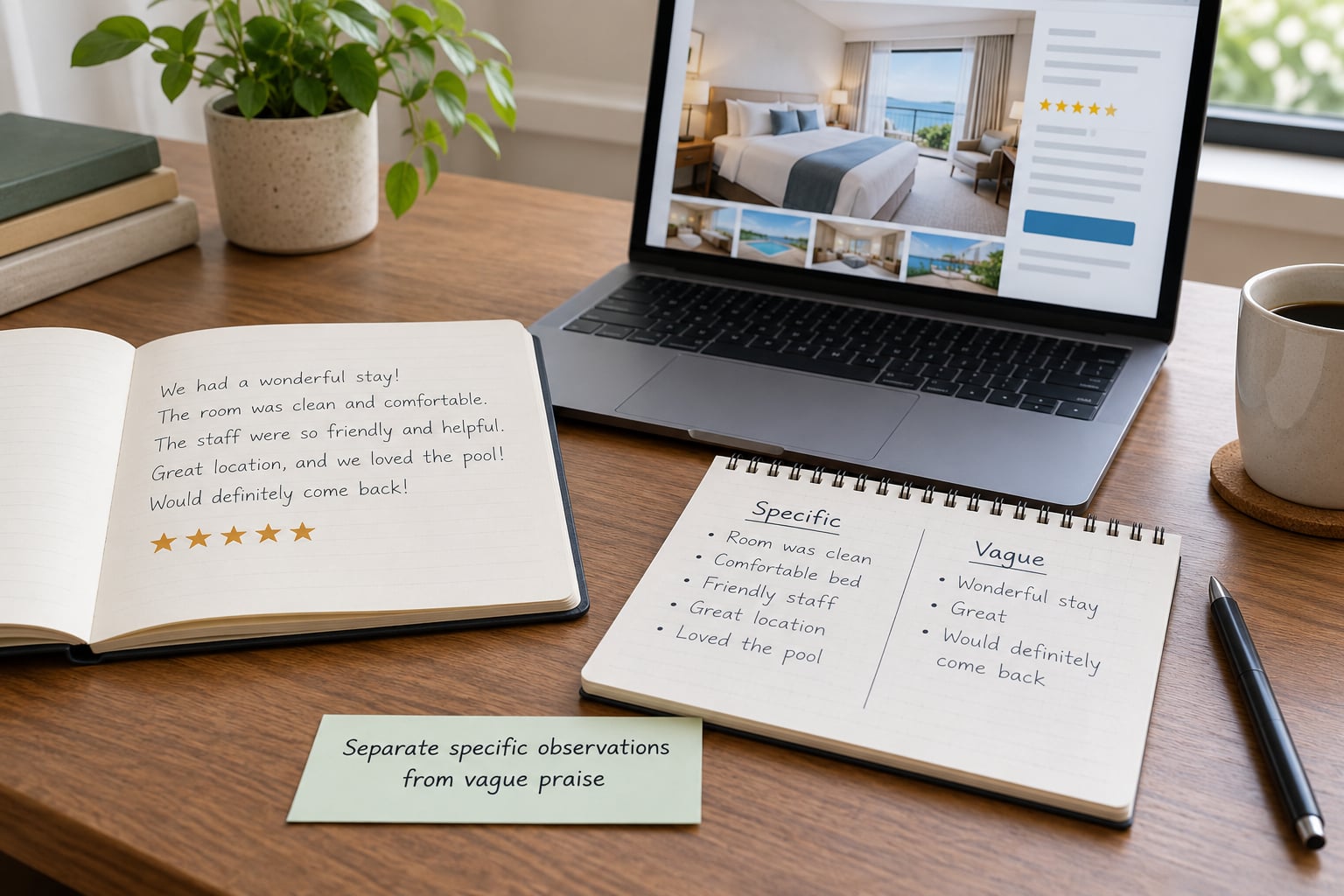
Specific beats enthusiastic, every time. “The walls are thin enough to hear the lift arriving” tells you what to pack. “Fantastic room, amazing staff, would definitely stay again” tells you nothing you could not have written about any property.
Real reviews tend to contain a detail you can verify. A walking time to a station. A stain on the shower curtain. The 6am queue for breakfast. A room that smelled of drains after rain. Those details are checkable, and that is exactly what makes them useful.
Here is the contrast that settles it for me:
| Less useful | More useful |
|---|---|
| Beautiful hotel, great service | Four minutes walk to the metro, quiet side of the street, small desk that fits a laptop |
| Rooms were dirty | Carpet had not been vacuumed under the bed and the bin was still full at 4pm on check-in day |
| Noisy at night | Thin walls onto the lift shaft, heard every arrival until midnight |
| Great value | Paid a discounted nightly rate for a twin in November, would not book again at that rate |
A balanced four-star review naming two good things and one real drawback is the single most valuable comment on any page. Five stars with no complaint usually means the guest was asleep for most of the stay. Three stars with a clear, fixable grievance is worth more than a page of praise, because you know what you are walking into.
4. Look for patterns across reviews
One complaint is an anecdote. The same complaint in five reviews written by five people who stayed in different weeks is a specification of the building.
Sorting by most recent rather than most relevant or most helpful is the single filter that changes what you see. Default ordering is usually a relevance algorithm, not a date sort, and it tends to surface long detailed reviews from years ago that describe a property that may since have been renovated, re-staffed or sold. Recency also exposes velocity: a property that had fifty reviews last month and none this month has something going on.
Complaint vocabulary clusters in predictable ways. A widely circulated US analysis looked at five thousand one and two-star hotel reviews and ranked the words that appeared most often. It is a decade old now, so treat it as a baseline rather than current data, but the pattern still holds and it is useful as a search vocabulary:
| Complaint word | Share of one and two-star reviews |
|---|---|
| room | 43.4% |
| hotel / motel | 34.6% |
| dirty | 16.7% |
| bed | 11.3% |
| staff | 7.7% |
| smell | 7.2% |
| front desk | 6.8% |
| location | 6.5% |
| rude | 6.3% |
| smoke | 5.2% |
Search for those words and you will build your own picture in about a minute. Reviewers travelling solo tend to use the front desk and safety language specifically: whether someone answered the phone at midnight, whether luggage could be stored after checkout, whether staff were welcoming to a woman eating alone in the lounge.
Some complaints justify acting on their own, without waiting for a pattern. Anything touching your safety, accessibility, or basic welfare qualifies: broken locks, mould, hot water that never arrives, a fire door propped open, bed bugs, a lift out of service on the only floor you can reach.
Those are not preferences, and one credible report about them deserves a phone call rather than a second opinion from a stranger.
5. Check how the hotel responds
The reply thread is the least read and most revealing part of a review page, because it shows the property’s behaviour under complaint, not the guest’s expectations.
A real resolution looks like this: the reply thanks the guest, agrees on the specific failure, says what changed and when. Staff member by name, shift changed, mattress replaced, noise policy enforced on a particular corridor. Even a short reply does this if it is specific.
A weak reply is a template. “Thank you for your valuable feedback. We hope to welcome you back.” That response is addressed to nobody and tells you nothing.
A defensive reply is worse than no reply. Blaming the guest for the room they were assigned, disputing a photograph, or arguing with a reviewer tells you how the front desk behaves when challenged. That is a real signal, particularly if you are travelling alone.
Silence is ambiguous. Properties with high review volume often leave replies to the worst ones and stay quiet on the praise, which reflects legal and staffing pressure more than anything about service.
One thing readers ask before they write anything honest: hotels do not routinely evict guests over a bad review. Indirect retaliation is the more realistic risk, in the form of worse service on a return visit or losing points on a loyalty scheme. Keep photos and keep copies, and write in factual, behavioural language rather than accusation. You get the same information across every platform and you remove the parts that invite a fight.
6. Compare platforms and review formats
No platform is reliable on its own, because each one rewards something different. Booking.com carries the largest volume of verified stays. Tripadvisor has the widest reach and the largest pile of unverifiable contributions. Google tends to carry the freshest and most local voice, including comments from day visitors. Yelp is strong on independent properties and short stays. Agoda skews heavily toward Asia-Pacific bookings.
Here is how I use each one:
| Platform | Best for | Known weakness |
|---|---|---|
| Booking.com | Volume of confirmed stays, room-level filtering, reading recent feedback for a booked property | Requesting reviews after checkout pushes scores up; some properties respond with incentives |
| Tripadvisor | Wide coverage for comparison, long-term reputation history, unusual properties | Large numbers of one-contribution reviews that cannot be authenticated |
| Google Business Profile | Fastest local signal, current condition, front-desk and check-in reports | Review counts are low for many hotels, so a single bad month skews everything |
| Yelp | Independent and small properties, honest detail from repeat guests | Thin coverage outside North America and Western Europe |
| Agoda | Properties in Asia-Pacific, sometimes better OTA-only pricing context | Regional bias, translation quality varies |
| Hostelworld | Hostels and dorms, atmosphere and solo-traveller practicality | Hostel standards vary enormously under one name |
Where two platforms disagree, do not declare a winner. Record the conflict and ask which one has the evidence. A 9.2 on Booking.com and a 7.6 on Google usually means one of three things: the properties have different review populations, the score is inflated by post-checkout prompting on one side, or something changed recently and the fresher data is telling the truth.
Filtering controls are worth using. Room type, language, verified stay, and date sort narrow hundreds of reviews down to a manageable and relevant set. Most readers never touch them, which is exactly why the default view keeps feeling useless.
Watch the generated review summaries too. Several platforms now auto-summarise what guests said, and the summary inherits every bias in the underlying text while presenting it in confident prose. It is a useful pointer to which themes dominate. It is not evidence.
7. Make a decision based on your own priorities
When you finish reading, write four lines. Not a review of the hotel, a review of your decision.
- Must-haves met. Which of your three priorities are confirmed by recent, specific comments?
- Acceptable compromises. Which shortfalls are things you can genuinely live with, and which would spoil the trip?
- Unresolved red flags. What did you see once and could not explain away?
- Fit with the reason you are going. Does the property’s actual strength matter to this trip, or are you paying for a feature you will not use?
That last line is where most bookings go wrong. A beautiful lobby is irrelevant on an early flight. A kettle in the room matters a great deal when the nearest cafe opens at nine.
If you travel solo, add a fifth check: recent mentions of the front desk, night staffing, luggage storage after checkout, and how anyone describes walking back to the property at night. Those comments are scattered across platforms and rarely collected anywhere.
If a deal-breaker shows up in a recent review and you are not certain, message the property directly. Ask whether the room type you want faces the courtyard or the lift. Ask whether the wifi works in the room or only the lobby. A specific question gets a specific answer, and a front desk that answers well is itself a form of review.
Common Mistakes
Treating the aggregate score as a verdict. A review score is an average across years of stays by people who wanted different things. It is a starting point, not a conclusion. Look at volume, recency and consistency instead.
Reacting to one isolated review. A single furious one-night stay can be real and still tell you nothing about your six-night booking. Weight it against everything else you read.
Ignoring the dates. Reviews from before a renovation, a change of ownership or a staff turnover describe a different business. Sort by most recent and read the last twelve months properly.
Treating every reviewer as the same guest. Comparing a business traveller’s one night to a long-stay guest’s month is not a fair test of anything. Context first, always.
Comparing mismatched room types. The review of the budget double says nothing about the suite you are booking. Filter by room type where the platform allows it, and re-read the summary line when the section changes.
Reading whatever the default sort shows. Most pages default to most relevant or most helpful, which buries recent problems under long reviews written years ago. Switch to most recent every time.
Assuming a good management reply guarantees good service. Replies show how the property behaves when challenged. They say nothing about the room you will get.
Taking generated summaries as evidence. An automatic summary compresses the reviews, and compression removes the caveats that mattered.
Believing a perfect score at face value. A property showing only five-star reviews is usually a property with a low review count or a strong prompting system, not a flawless one. Anyone can raise a one-star average, which is why a wall of five-star reviews deserves more scepticism than a distribution with real spread.
Frequently Asked Questions
What is the 15/5 rule in hotels?
The 15/5 rule is a simple sampling method for reading hotel reviews: read at least fifteen, weighted toward the ends of the star distribution rather than the middle. In practice that means the ten most recent reviews plus the five most detailed ones you can find, including any one-star comments. The middle of the rating scale mostly repeats itself, while the extremes contain the concrete details that let you judge a property against your own priorities.
How many hotel reviews should I read before booking?
Fifteen is a sensible floor, and the composition matters more than the count. Read the ten most recent, then the five most detailed you can find, and check whether issues repeat. If the same problem appears in three unrelated reviews from different months, treat it as a property characteristic rather than bad luck. Read fewer than that and you risk generalising from one guest’s night.
How do I tell if hotel reviews are fake?
Look for clusters posted close together, copy-paste phrasing, extreme rating distributions, reviewers with a single contribution and no history, polished stock-style photographs, and mentions of a free stay or discount in exchange for feedback. None of these proves anything alone. They matter most when combined with an implausibly perfect score, low review volume, or praise so generic that nothing in it could describe a different hotel.
Which hotel review site is the most reliable?
None on its own. Booking.com gives you the largest volume of verified stays, Tripadvisor has the widest reach and the most unverifiable contributions, and Google Business Profile tends to have the freshest local view including check-in reports. Cross-reference at least two for every property, and where the scores disagree, work out which source has more relevant recent evidence rather than assuming the higher number is more honest.
Should I read one-star reviews at all?
Yes, and more carefully than the five-star ones. One-star reviews contain the most specific information about problems, and problems are what distort a trip. Read them for named, checkable details rather than emotion: a specific floor, a specific problem, a specific date. A review complaining about a stag party in a courtyard wing tells you something useful about that wing without telling you anything about the whole hotel.
How do I judge whether recent reviews are trustworthy?
Sort by most recent, then apply the same test you would to any review: is it specific, does the reviewer name a room type or a date, does the reviewer have a visible history on the platform, and does the claim match what other guests describe? A property whose newest ten reviews are strikingly similar in tone and timing is worth a second look, as is one that suddenly collects a burst of reviews in a fortnight with no change of season.
Conclusion
Start here: write down three things that would actually make or break your trip, open one property, and sort the reviews by most recent. Read fifteen of them against your list rather than in the order the page offers, and check whether the same issues come back each time.
Then do the unglamorous part. Cross-check the property on a second platform, look for anything touching safety, accessibility or smell that appears more than once, and message the front desk with one specific question about the room you are booking. Fifteen minutes of that is worth more than an hour of reading whatever the default sort hands you.
Because learning how to read hotel reviews and find the useful ones is not about finding a perfect property. It is about knowing which parts of someone else’s night apply to yours, and which parts you can safely ignore.