To find a hotel in a historic building, search specialist heritage directories rather than general booking engines, then check what the building actually is before you pay. Historic Hotels of America and Historic Hotels Worldwide cover the US and international properties, the National Trust, Landmark Trust and Sawdays cover the UK, and state tourism offices list registered landmarks by town.
Three routes lead to a genuine heritage stay: a member property of a heritage organization, a building converted through adaptive reuse into a hotel, or an independently owned landmark inn or coaching house. The trap is a modern build styled to look old, and the second trap is a genuinely old building with no lift, no air conditioning and a bathroom at the end of the hall. Both are avoidable if you know what to ask.
Most of the work takes an evening of research and a short list of direct questions to the property.
Table of Contents›
- What You Need
- Step-by-Step: How to Find a Hotel in a Historic Building
- 1. Define what historic means to you
- 2. Search the right places and search terms
- 3. Verify the hotel really sits in a historic building
- 4. Check whether the stay suits present-day travel
- 5. Compare the total value and location
- 6. Read reviews and ask precise questions
- 7. Confirm the booking directly
- Common Mistakes
- Treating a themed building as a historic one
- Assuming old means comfortable
- Skipping accessibility
- Booking on atmosphere copy alone
- Booking without confirming the exact room or building
- Ignoring the practicalities a small town imposes
- Frequently Asked Questions
- How do I know if a hotel is really in a historic building?
- Do historic hotels have elevators and air conditioning?
- What are old-fashioned hotels called?
- Where should I search for a historic hotel in a specific city?
- How far in advance should I book?
- Conclusion
What You Need

Start with a destination and a radius rather than a property name. The traveler who gets the best results searches by region and what the town is known for, not by fame, and that habit alone filters out half the irrelevant listings.
Then gather five things before you open a single booking site:
- Destination and radius. A town, a region, or a rail corridor. If you have no car, add the nearest station name and a maximum walking distance.
- Dates. Peak season changes everything at heritage properties, both in price and in how hard the rooms are to get.
- A budget band. Room rate alone is misleading once taxes, parking and on-site dining are added.
- The era or style you want. Victorian, Georgian, Art Deco, a former railway hotel, a coaching inn, a mill, a castle, a colonial building. The more specific this is, the better your search terms get.
- Your tolerance for old-building trade-offs. Stairs, small rooms, sloping ceilings, no air conditioning, shared bathrooms. Decide this before you fall in love with a photo.
One distinction to settle early: a protected heritage property is a building with recognised architectural or historical status, listed on a national or state register or preserved through adaptive reuse. A vintage-themed property is a recent build with period styling. Only the first is what most people mean when they search this way.
Step-by-Step: How to Find a Hotel in a Historic Building
1. Define what historic means to you
Write down the period, the architectural style and how much restoration you want to see. Restored to modern standard with clean lines and a new bathroom is one experience. Preserved with original staircase, period furnishings and sloped ceilings is another, and it is the second one people are usually after.
Decide as well whether a stately home converted into rooms counts. Some travelers want a working hotel that happens to occupy an old building, which is a quieter, more convenient experience. Others want the opposite, a building so grand that the stay is the event.
2. Search the right places and search terms
General hotel search engines index amenities and price, not heritage status. Their historic filters match a keyword in the description, which means a chain property with a retro lobby can outrank a listed Victorian inn.
Specialist directories do the sorting for you:
- Historic Hotels of America covers member properties across the US, each vetted for significance and continued operation.
- Historic Hotels Worldwide is the international equivalent and covers castles, manors and colonial properties.
- National Trust and Landmark Trust list heritage buildings in England and Wales, many self-catering.
- Sawdays is a long-running specialist agency for privately owned houses, inns and small independent hotels.
- State and city tourism offices publish lists of registered historic properties by town, which is the fastest route when you already know the place.
- Local historical societies know which buildings were saved, which were demolished, and which hotels sit in something worth seeing.
Search by vocabulary rather than by date. Terms like historic hotel, heritage stay, adaptive reuse, coaching inn, wayside inn, railway hotel, coaching house, former mill and stately home all surface different buildings. Search engines reward exact phrasing, so type the phrase you would say out loud.
Outside the US, add the local words: a Spanish parador, a Japanese ryokan, a colonial casa in Latin America, an Indian haveli or a caravanserai turned guesthouse. Each carries an implicit heritage filter that English terms do not.
Building type also predicts what you get, and this is worth knowing before you fall for a photograph.
- Coaching inn or wayside inn. Original staircases, deep window seats, a building that was already a business. Small rooms, uneven floors, and often no lift above the second floor.
- Railway hotel. Grand public rooms, usually close to transport, sometimes since split into several separate properties. Corridor layouts designed for luggage, and secondary rooms can be windowless.
- Mill, granary or warehouse conversion. Volume, exposed beams, tall windows, and often a restaurant in the old machine room. The least original joinery, and sound carries through open-plan spaces.
- Castle, manor or stately home. The building is the attraction, with grounds and a formal dinner attached. Rarely walkable to anything else, often no lift, and dinner at a single sitting.
- Colonial-era or mission building. Courtyards, thick walls and a strong sense of place. Thick masonry in a hot climate can be punishing without cooling.
Each of those is a pattern rather than a rule. Read the list as a set of questions to ask, not a set of answers to accept.
3. Verify the hotel really sits in a historic building
Ask three questions before you believe any of it. What year was the building constructed, what was it originally used for, and when was it last restored?
A building that was a bank, a post office or a mill and is now rooms has a verifiable public record. Most countries maintain a national register of historic places, and US listings run through the National Register of Historic Places with state and local registers alongside. Search the building name plus register, and the original use, and see whether the dates on the property’s own site line up with the record.
Watch the wording. An architecturally significant restoration with a named preservation award means something. Old-fashioned, atmospheric and built in the spirit of means the marketing is doing the work.
4. Check whether the stay suits present-day travel
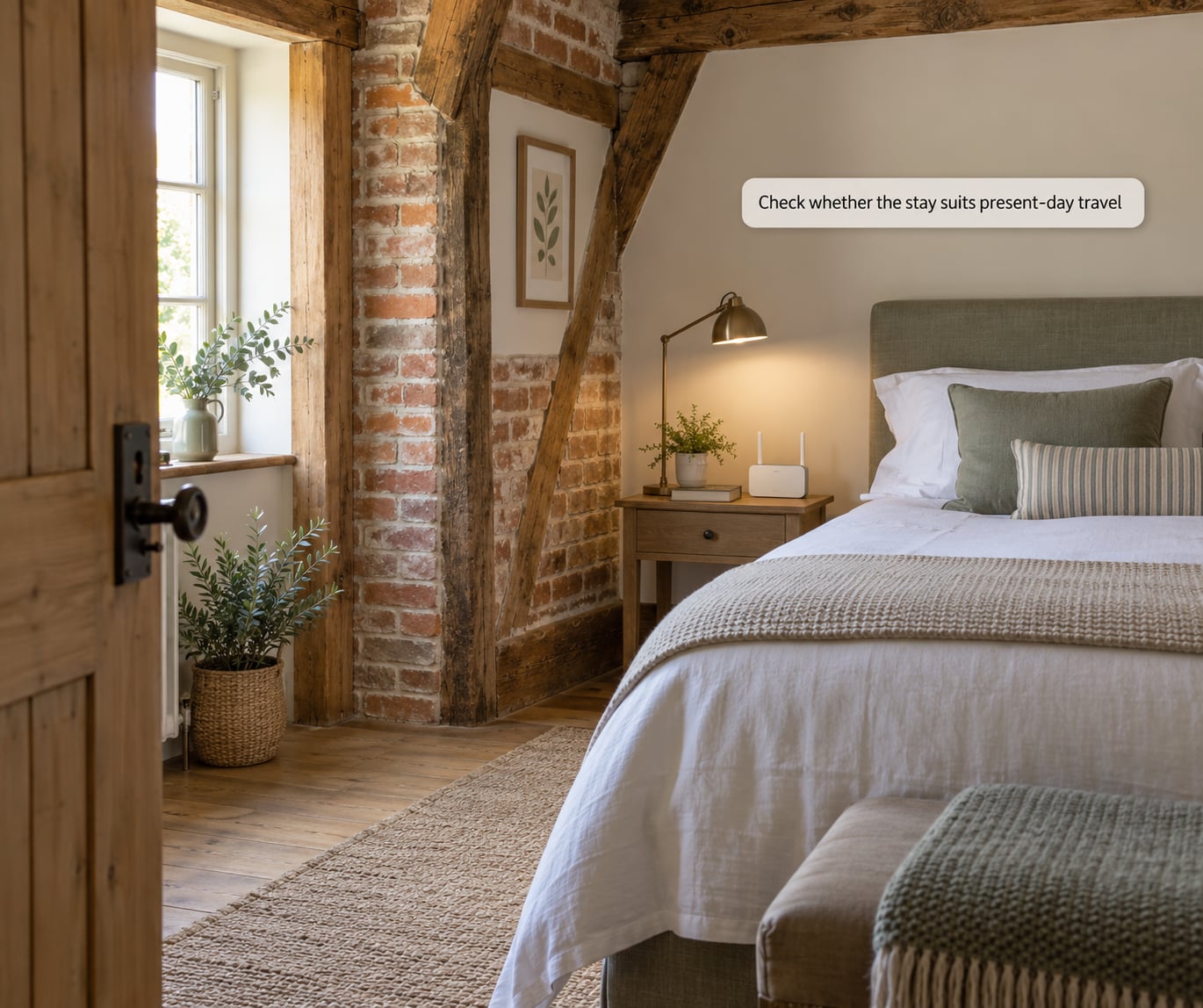
Old buildings carry predictable compromises, and travelers who are told about them in advance treat them as part of the stay. Travelers who find them out after paying treat them as a bad review.
- Stairs and lifts. A three-storey Georgian inn with no lift is common. Ask which floor your room is on before booking, and whether a lift exists at all.
- Air conditioning. Listed buildings often went in before cooling was expected. This decides whether the property works for you in summer.
- Room size and shape. Former attic rooms have sloped ceilings, corridors have deep sills, and wings added in different centuries do not line up.
- Bathroom location. Some properties are fully en suite. Some are not, and nobody finds that out gracefully.
- Insulation and noise. Single-glazed sash windows and thin internal walls mean street noise and temperature swings.
- Wi-Fi, parking and climate control. Old buildings rarely have generous bandwidth, secure parking or individually controlled heating.
If any of these are hard requirements rather than preferences, check them before you book, not after you arrive.
5. Compare the total value and location
Compare the whole trip, not the nightly figure. Add taxes and fees, parking, breakfast if it is not included, and the cost of eating somewhere else once you realise the on-site restaurant has one sitting and closes at nine.
Location is where heritage properties quietly cost you. A castle or a country house with good architecture and no bus route will need a taxi every single day. Properties in historic town centers tend to be walkable and hostile to cars in exactly the same measure, so decide which side of that you are on.
For a solo trip especially, check the practicalities nobody markets: distance from the station, whether check-in is staffed late, whether there is dinner on site, and what the street looks like at eleven at night.
Season changes the equation more here than it does at a chain. Heritage rooms are small and scarce, so peak dates sell out at rates that have little relationship to the room next door. In the UK and much of Europe, August is the worst month for value at a listed property. Late spring and early autumn usually give you the same building, better light for photography, thinner crowds in the surrounding town and a much easier conversation if something is not right.
Winter has its own logic. Some historic properties close entirely for a season, which is worth checking before you plan a December trip around one. Others run at their quietest and best rates.
6. Read reviews and ask precise questions
Skip reviews that mention romance, atmosphere or history, and read the ones that mention stairs, water pressure, the bed size and the walk to the bathroom. Those reviews are diagnostic. Look for the same complaint appearing more than once, because one outlier is noise and four is a design decision.
Reviews also answer the location question faster than a map does. Search for comments on the walk from the station, the parking situation, and how loud the street is at night. If the property is a converted building in an old town, the neighbourhood is part of the experience whether you planned it or not.
Recent reviews matter most here. A building renovated three years ago is a different product from the one described in a review from five years back.
Where a traveler is booking alone, review tone is also a fair signal. Look for whether staff mention directions, dinner and luggage without being asked, and whether the desk is staffed through the evening. Independent inns of ten to twenty rooms are usually run by people who know the town, and that shows up in how the replies read.
Then email or message the property directly with specific questions. Ask which floor the room is on, when the building was constructed and what it was before, whether there is a lift, whether there is air conditioning, whether the bathroom is en suite, how good the Wi-Fi is for video calls, how late check-in runs, and which building the room you have been offered actually sits in. Properties that answer these plainly are the ones worth booking.
Asking the property directly also gets you the room that best matches what you asked for, which is rarely the one a booking engine shows first.
7. Confirm the booking directly
Book direct when the property offers meaningfully better cancellation terms, and book through an agent when it offers something the property does not, such as a National Trust or Sawdays property you can only reach that way. Some heritage properties run on a reservation lottery instead of a booking calendar, with entries opening many months in advance, so check before you assume a room is simply unavailable.
Before any payment goes through, have five things in writing:
- The cancellation deadline and any deposit or prepayment rule.
- The room category you booked, and whether that category spans more than one building.
- What is included: breakfast, parking, transfers, the guided tour, the evening meal.
- Arrival details, including late check-in and whether someone is on the desk.
- The historic features of the specific room, such as the original staircase, the working fireplace, the view, the floor you will be on.
Read the cancellation terms closely. Independent heritage properties often ask for payment in full up front because a booking is a small number of rooms in a building that cannot be refilled at short notice.
One last thing to check before you commit: what happens when the property is between the booking you made and the renovation that is scheduled for 2026. A number of listed buildings renovate a wing or a floor at a time, and the noise is exactly what you came for the walls of. Asking when the current phase finishes costs you one message.
Common Mistakes
Treating a themed building as a historic one
Period furniture, a brass bed frame and a colour palette from 1925 tell you nothing about the building. Check the construction date and the register. If the site never mentions a year, ask.
Assuming old means comfortable
The single most common complaint about historic stays is not the atmosphere, it is the missing lift and the absent air conditioning. Both are fixable by asking before booking. Neither is fixable after you arrive with a suitcase.
Skipping accessibility
Multi-storey listed buildings frequently have no lift at all. If stairs are a genuine problem, treat the lift question as a filter on the property list rather than a question about one room.
Booking on atmosphere copy alone
Words like charming, atmospheric and timeless carry no information. So do untidy old towns where the building is new, or old buildings that were rebuilt so thoroughly that nothing original remains.
Booking without confirming the exact room or building
A property can be 80 percent historic and 20 percent new, and the twentieth part is where you end up. Ask which structure your room sits in before you pay, and expect a straight answer from a place worth staying at.
Ignoring the practicalities a small town imposes
Historic inns in small towns close early and shut entirely on Sundays. Check the last dinner sitting, the nearest open restaurant, and how you get back after the evening if you are travelling alone.
Frequently Asked Questions
How do I know if a hotel is really in a historic building?
Search the building name plus the national or state register of historic places for your country, and look for a construction date and original use. A real heritage building has a public record: a year, an architect or builder, a former function such as a bank, mill, railway station or coaching inn, and a documented restoration. A property that only talks about mood and period styling has given you no evidence at all.
Do historic hotels have elevators and air conditioning?
Often not. Listed buildings frequently predate both, and preservation rules can make installing them difficult, so a three-storey Victorian inn may have no lift and no cooling. Ask which floor your room is on and whether air conditioning exists before you book, not on arrival. Many properties solve this with ground-floor or lower-floor rooms, and some have portable cooling units in summer.
What are old-fashioned hotels called?
The vocabulary changes with the building type: coaching inn or coaching house, wayside inn, tavern or alehouse, railway hotel, former mill, granary, warehouse conversion, castle hotel, parador in Spain, ryokan in Japan, and haveli in India. Searching these words alongside your destination surfaces far more genuine buildings than searching for the word historic alone.
Where should I search for a historic hotel in a specific city?
Start with the city tourism office, which usually publishes a list of registered historic properties, then cross-check against a heritage membership directory such as Historic Hotels of America or Historic Hotels Worldwide. General booking engines are better for comparing room types and cancellation terms once you already know the building. In the UK, National Trust, Landmark Trust and Sawdays cover most heritage stays outside the major cities.
How far in advance should I book?
Independent heritage properties have a handful of rooms, so popular ones fill months ahead and famous ones book out a year or more. Some run a reservation lottery rather than a live calendar, with entries opening well in advance of the stay, so check for that before assuming availability. Shoulder season is both easier to book and better value, and it avoids the summer air conditioning question entirely.
Conclusion
Choose the kind of stay and the location first, then verify the building is genuinely historic before you look at rooms at all. To find a hotel in a historic building with any confidence, the register entry, the construction date and the original use decide whether the place is what you came for, and a short list of questions about lifts, air conditioning, bathroom location and which building your room is in decides whether it works for you.
Once those answers are straight, confirm the cancellation terms, the room category and the arrival details directly with the property, and book a stay in a historic building knowing exactly which floor you are sleeping on.