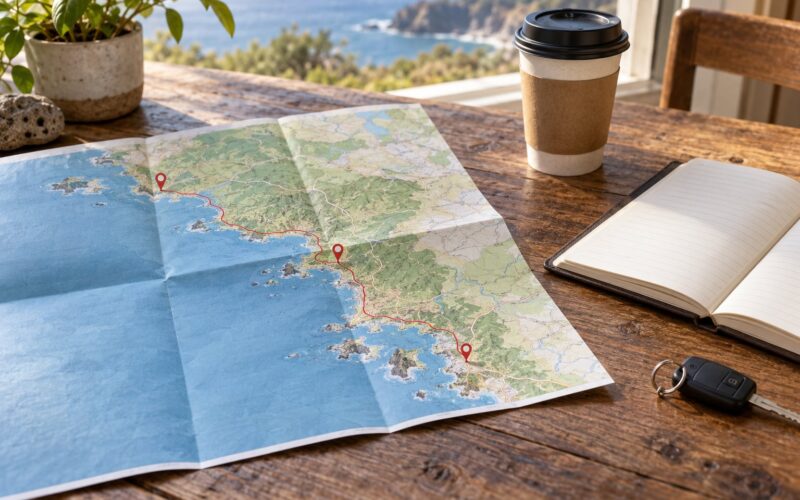
I have come home from trips to places I loved needing a free Sunday to recover from the holiday itself. The photos are good, the walking is done, and I am more tired than the day I flew out. That gap between what a trip was supposed to feel like and what it actually felt like is usually a planning problem, not a personality problem.
Resting on vacation means deliberately protecting unscheduled, low-demand time so the trip rebuilds you: one anchor per day, a base you stay in rather than pass through, and a real disconnection from work. It is not a shorter holiday or a lazier one. It is a holiday with room in it, and the room is what does the work.
The trick is that nobody schedules rest. We schedule trains, tables and timed entry slots, then treat whatever is left over as spare time to be defended against. Learning how to rest on vacation instead of sightseeing nonstop is mostly a matter of putting the empty hours in the plan yourself, before you leave, where they cannot be quietly spent.
What follows is a seven-step process. Each step tells you what to do and, more usefully, how you will know it worked.
Table of Contents›
- What You Need
- Step-by-Step: How to Rest on Vacation Instead of Sightseeing Nonstop
- Step 1: Decide What Rest Means for You
- Step 2: Choose a Base That Makes Doing Less Easy
- Step 3: Give the Trip Fewer Commitments
- Step 4: Build Days Around One Gentle Activity
- Step 5: Protect Rest From Evening FOMO
- Step 6: Adjust the Plan When Your Body Needs More Space
- Step 7: End the Trip Without Rewarding Yourself With Exhaustion
- Common Mistakes
- Frequently Asked Questions
- How do I actually rest on vacation instead of sightseeing nonstop?
- Can a vacation be both active and restful?
- How long should I stay in one place to actually unwind?
- What do I do when the people I am travelling with move faster than me?
- Is a restful vacation boring?
- Conclusion: Start With One Unhurried Day
What You Need

Before any of the steps make sense, you need three things sorted, and none of them are expensive.
Enough time in one place. Most rest needs at least four nights in a single spot. Three days of moving is a transfer, not a rest. A week is where the change usually shows up; two weeks is where a habit can reset.
A base that makes stopping easy. A quiet room, a bed you like, food within a few minutes’ walk, and something outdoors you can reach without planning. The test is simple: can you step outside the door and be somewhere good within ten minutes? If everything requires a train, a ticket or a taxi, you will default to doing more.
A few arrangements made before departure. An out-of-office with dates on it. One nominated person who handles anything urgent. A first night with nothing booked. A last day kept light. These take twenty minutes and they are the difference between a trip that starts resting and a trip that starts catching up.
Step-by-Step: How to Rest on Vacation Instead of Sightseeing Nonstop
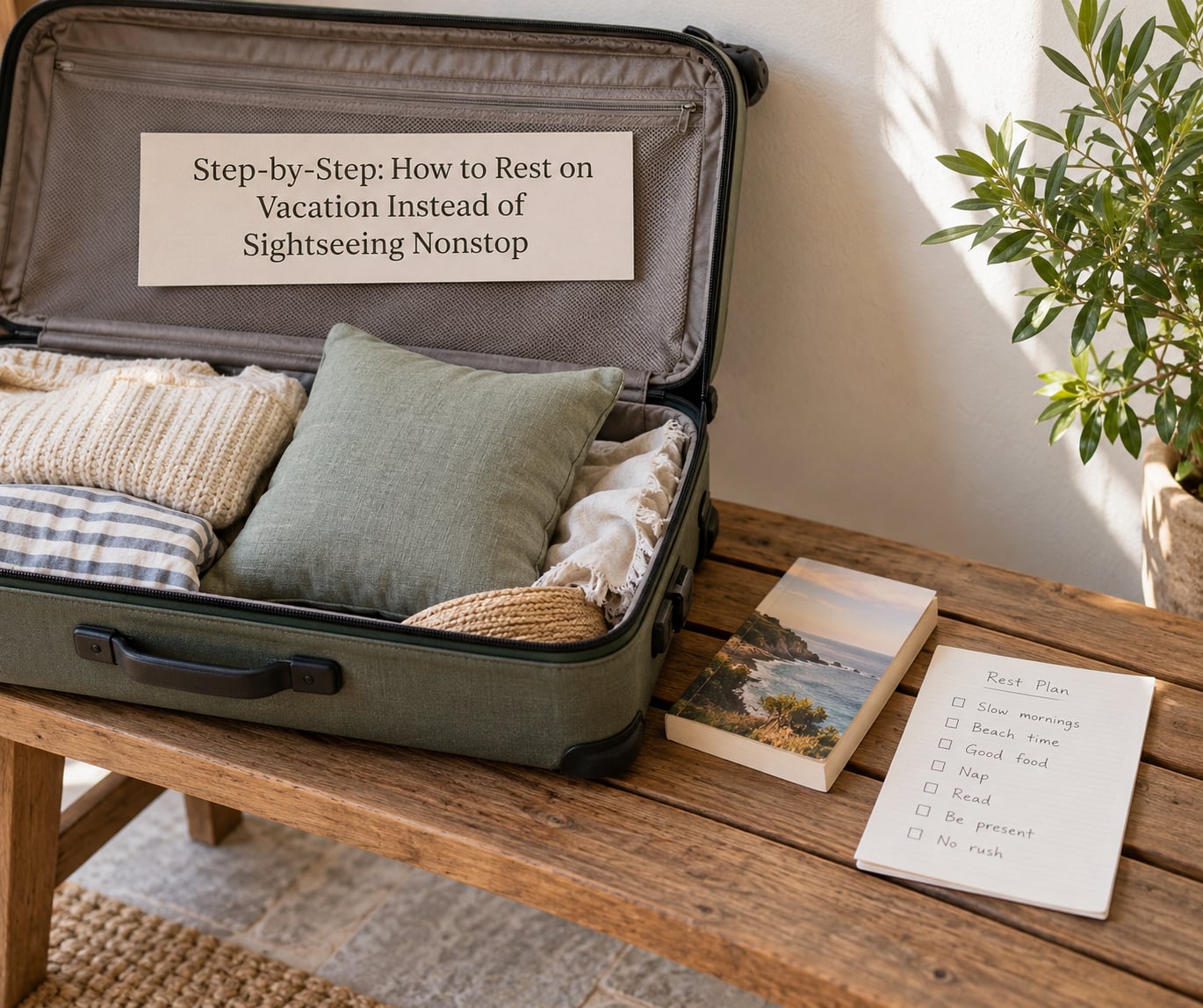
Step 1: Decide What Rest Means for You
Rest is not one thing, and treating it as one is why trips disappoint. Before planning anything, pick the kind of rest you actually need. Sometimes it is doing nothing at all. Sometimes it is simply sleeping nine hours for a week. Sometimes your body is fine and your head is still at work, and what you need is to be mentally unreachable. And sometimes you will feel restless unless there is a gentle thread to pull, like reading, cooking, sketching or walking a familiar route.
Write yours down in one sentence. How you will know it worked: by day three you are not mentally rehearsing the rest of your life, and you are not quietly disappointed that the day had no achievement in it.
Step 2: Choose a Base That Makes Doing Less Easy
Pick one walkable neighbourhood and stay in it for four nights or more. Resist multi-city itineraries even when the route looks efficient, because every transfer spends a chunk of the holiday on logistics and arrival energy. Small towns, coastal villages and residential districts tend to beat resort strips for rest, since there is less pressure to consume anything.
Shoulder season is the cheapest form of rest there is. Fewer queues, emptier rooms, lower prices, and far less of that FOMO in your chest when you see the line outside the place you had planned to visit.
How you will know it worked: you spend a whole afternoon within walking distance of where you slept, and it never once feels like you are missing something.
Step 3: Give the Trip Fewer Commitments
Limit what you book in advance to one or two anchor experiences for the entire trip, and put them in the middle rather than the start. Everything else stays open, on purpose, not as an oversight. A vacation without a rigid itinerary is not a trip without structure; it is a trip with a different structure, one built around open hours instead of filled ones.
Leave the first morning after arrival completely empty. You will be tired, possibly jet-lagged, and definitely unable to enjoy a timed entry. An empty first morning is also the single most reliable way to stop arriving on holiday already behind.
How you will know it worked: you can describe tomorrow in a single sentence, and that sentence contains the word “maybe”.
Step 4: Build Days Around One Gentle Activity
One outing. That is the daily ceiling, and it should be optional in the truest sense, the kind you can decide against at breakfast without rearranging anything. After it, give yourself a substantial block of genuine rest, then eat without rushing.
The part people skip is the rule after: nothing is required once you get back. No second museum because you are already out. No catching up on the neighbourhood you failed to see this morning. A day with one thing in it and a long unhurried stretch around it is a full day, not a wasted one.
How you will know it worked: your evenings are not spent catching up on the day you did not do.
Step 5: Protect Rest From Evening FOMO
The quiet evening is where a lot of these trips fall apart, because the afternoon’s calm creates a small panic that you have wasted it. Set a stopping time early and treat it as fixed. Dinner, then something slow and low-stimulation: reading, a bath, an early film, music with no screen. Notice what you would normally do at this hour, and skip it.
Also agree, before the trip, on check-in windows with the people who will message you. One message a day at a chosen time removes the need to check constantly and takes a surprising amount of mental work off the day.
How you will know it worked: you do not dread setting an alarm, which is the clearest sign that you have stopped running your own holiday.
Step 6: Adjust the Plan When Your Body Needs More Space
Watch for the four honest signals: poor sleep two nights running, a constant low hum of irritation, the sense that everything is too much, and a schedule you are counting down rather than looking forward to. When one of those shows up, drop to a lower tier for a day. Sleep in. Walk the same short loop again. Skip the outing entirely and read.
Have a backup version of the trip in your head from the start, so changing plans feels like part of the design rather than a failure of discipline. A day that gets cancelled is data. It tells you what your actual capacity is, which is information you rarely collect at home.
How you will know it worked: you reschedule without apologising, and the rest of the trip absorbs it easily.
Step 7: End the Trip Without Rewarding Yourself With Exhaustion
Keep the last day spacious. No last-minute checklist, no “we have to fit in the one thing”, no airport run timed to the minute. Many people spend the final day of a holiday in a transport terminal, which is a strange way to end something meant to restore you.
Protect one ordinary working day after you get home and keep your out-of-office running for it. Decide in advance which small routines travel back with you, because routines survive a trip better than sightseeing does. A short morning walk and a screen-free breakfast usually hold better than any plan you make in the airport.
How you will know it worked: the first Sunday back is uneventful, and you notice it with a bit of relief.
Common Mistakes
Booking the whole week in advance. Advance bookings feel responsible and cost you all your options. The fix is a hard cap: one or two anchors, and the rest decided that morning.
Treating rest as a reward for finishing the day. If you only get to sit down once everything is done, you will never do it. Rest goes in first, in writing, and the activity fits around it.
Scheduling rest so tightly it becomes a task. A timetable of self-care is another itinerary, and it quietly adds pressure. Unstructured hours are the point.
Letting one person set the pace for everyone. Say the quiet part out loud on day one rather than agreeing to a plan you will resent by day three. Most groups are fine with it; a few are not, and you want to know which early.
Counting days off instead of hours of low demand. A fortnight of sightseeing is a lot of days and almost no low-demand hours. Length is rarely the problem. Unstructured length is.
Arriving with no recovery day at home. You cannot skip the decompression, only move it. Put it in the calendar before you book anything.
If you genuinely love sightseeing, the fix is not to stop. It is to keep the volume and drop the density: fewer places, longer in each, one a day at most, and time to sit down in between. The sights are not the problem. Rushing past everything at once is.
Frequently Asked Questions
How do I actually rest on vacation instead of sightseeing nonstop?
You protect the empty hours instead of trying to fill them. Book one anchor per day, keep the first morning after arrival free, and stay in one walkable base rather than moving between places. Set an out-of-office before you leave and put the phone away at meals. Rest comes from unplanned time in a schedule you built on purpose, not from being motionless all day.
Can a vacation be both active and restful?
Yes, and the combination works better than either extreme alone. The test is density, not activity: one substantial thing per day, done at your pace, leaves room around it to recover. A long walk, a market you cook from, a swim before breakfast and an afternoon with no booking is a full and restorative day. A week of five tick-boxes in a row is what leaves people exhausted.
How long should I stay in one place to actually unwind?
At least four nights, and a week is better if the trip allows it. Anything under three nights is mostly travel time, and you spend the holiday recovering from the journey rather than benefiting from the place. Staying put also removes the daily decision of what comes next, which is one of the most tiring parts of sightseeing. Look for somewhere walkable, quiet at night and close to something outdoors.
What do I do when the people I am travelling with move faster than me?
Raise it early and keep it light. Saying u0022I want a slow morning today, meet me at twou0022 works better than agreeing to the pace and resenting it. Book your own one thing, tell people where you will be, and give yourself permission to skip a second plan without explaining. Companitions who are easy about this are worth keeping; the ones who are not are telling you something useful before the trip goes wrong.
Is a restful vacation boring?
Boredom on holiday is usually unstructured time meeting a productivity habit, not a property of rest itself. Give the day a gentle thread and the feeling tends to change: reading, cooking one meal from a market, swimming, sketching the same corner four times, walking until you get tired. The day needs no achievement to be worth having, but it does benefit from one thing you chose rather than one thing you had to do.
Conclusion: Start With One Unhurried Day
Rest on vacation is a decision you make before you go, not something that fills in when the plans run out. Pick one thing your trip is actually for, delete one booking you would resent, and protect one day with nothing in it. That single open day changes what the rest of the week feels like, and it is far easier to book than another excursion.