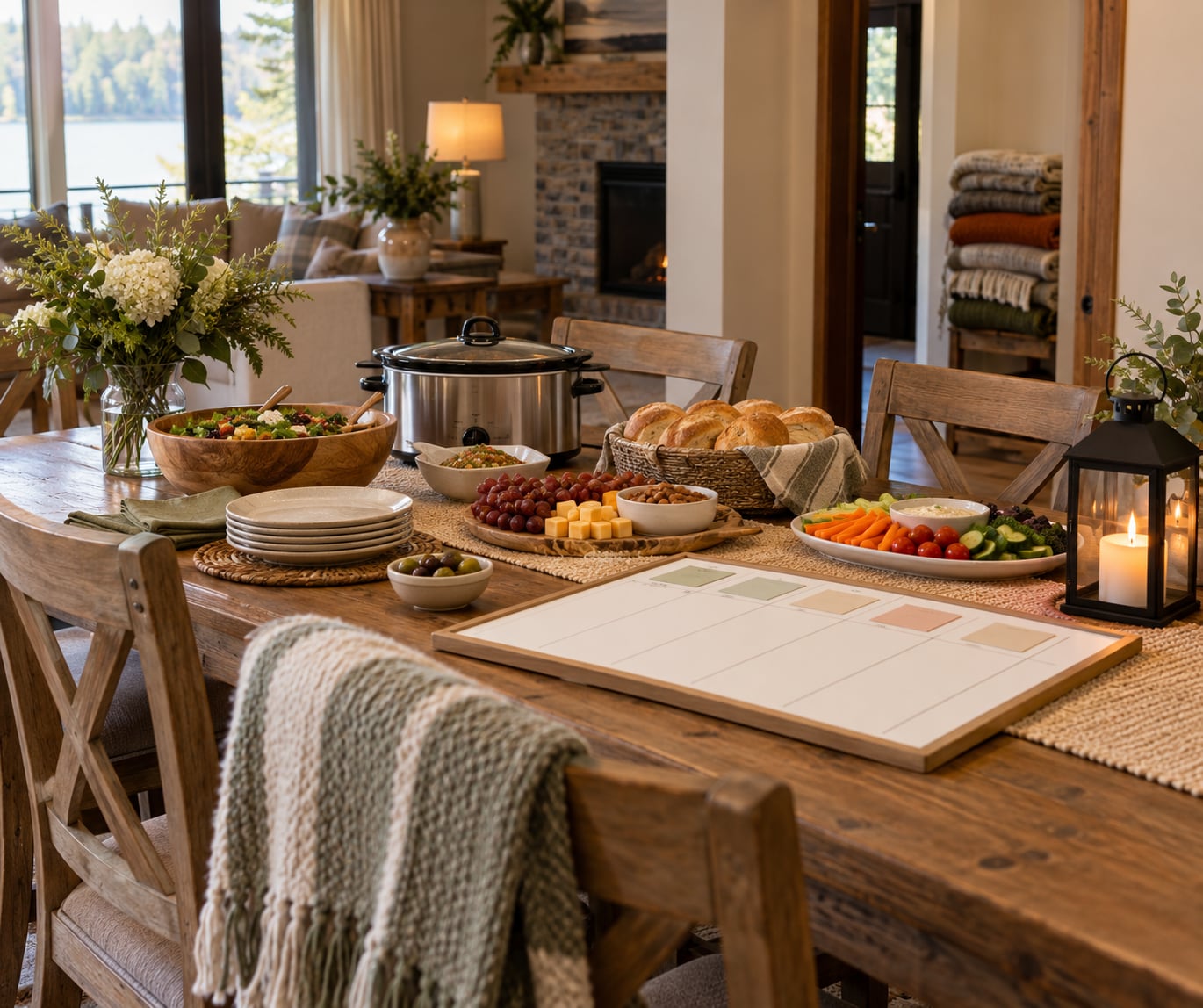
How to plan a family reunion weekend at a rental house comes down to three things in a fixed order: confirm the headcount, choose the house, then build the shared schedule. Start about four to six months ahead, book the rental before the guest list is final, and treat the group as one household with named jobs rather than a pile of individuals. Most of the weekend’s stress comes from capacity confusion and unclear money, not from the family.
A rental changes the shape of a reunion in ways a hotel cannot. Everyone shares one kitchen, one dining table and one set of house rules, so the good days are long and unhurried and the bad days are about bathroom logistics. Plan those logistics first and the rest tends to look after itself.
Table of Contents›
- What You Need
- Step-by-Step
- Step 1: Confirm the Reunion Group and Dates
- Step 2: Choose the Right Rental House
- Step 3: Build the Reunion Weekend Schedule
- Step 4: Plan Meals That Are Easy to Share
- Step 5: Assign Rooms, Costs, and Transportation
- Step 6: Share the Final Plan and Prepare for Problems
- Common Mistakes
- Frequently Asked Questions
- How many people can stay in a rental house for a family reunion?
- What is the easiest way to split costs for a family reunion rental?
- How do you organize relatives who arrive at different times?
- How can a rental house work for children and older relatives?
- Is a family reunion rental house cheaper than booking a hotel?
- Conclusion
What You Need
Most reunion disasters trace back to a decision made on incomplete information. Before you book anything, get these answers in writing from one person per household.
- A headcount. Adults, children and infants counted separately, plus a small buffer for the guest someone always adds at the last minute.
- Age and mobility details. Stairs, walking distance to a bathroom, whether anyone uses a walker or cane, and whether small children are involved.
- Trip dates. Two fixed weekend options that work for the most households, before you look at any property.
- A budget ceiling per household. A number everyone accepts, covering lodging, food, travel and activities.
- Travel constraints. Who drives, who flies, who needs a shuttle, who arrives late Sunday afternoon.
- Food needs. Allergies, dietary restrictions, vegetarian and vegan counts, and who cannot eat after 8 p.m.
- Activity preferences. Two or three things the group actually enjoys, not an ambitious list nobody wants.
- House rules from the host. Quiet hours, pet policy, smoking, parties, pool rules and any restrictions on children.
- One emergency contact per household. Name and mobile number, reachable during the weekend.
- A named planner. One person with final authority on dates, money and the house booking. Not a committee of six.
How far in advance should you plan? Four to six months is the sweet spot for most reunions. That gives families time to arrange time off work and school, and it lands before peak holiday and school-break weekends fill their rental inventory. Groups of 40 or more, or anyone targeting a popular lake, mountain or beach town for July, should start nine months out.
A simple countdown keeps the committee out of constant group-chat arguments:
- 6 months out: pick two weekends, name the planner, collect headcounts.
- 5 months out: shortlist three houses, confirm verified capacity with each host, send the cost sheet with the house totals.
- 4 months out: book, collect deposits, set the RSVP deadline and the cost-per-household figure.
- 2 months out: assign roles, build the weekend schedule, order anything that must be ordered.
- 2 weeks out: send the final packet with the address, entry details, itinerary and packing list.
- 48 hours out: confirm heating, hot water, appliances and hot tub, and restock the basics.
Step-by-Step
Step 1: Confirm the Reunion Group and Dates
Build one definitive guest list. Adults, children, couples, mobility needs, dietary requirements, arrival windows and departure times all belong on the same page, separated by household so you always know who to call.
Set a firm RSVP deadline about six weeks out and hold to it. A reply deadline that quietly moves is how organizers end up with a group that no longer fits the house they paid for. After the deadline, freeze the list and treat additions as a separate conversation.
Ask each household for one primary contact who is authorized to answer questions about their people. A group of 45 might involve 14 households, and you do not want to field 45 separate replies about cribs and drop-off times.
You will know this step worked when you can answer four questions without guessing: exact number of people, exact number of children, the earliest arrival, and the latest departure.
Step 2: Choose the Right Rental House
Size the house from the number of people, not the number of adults. A common mistake is booking on advertised “sleeps” figures, because those counts usually assume every bed holds a single adult and ignore bathrooms, stairs and closet space.
Ask the host directly for four things in writing: the number of bedrooms and the bed configuration in each, the number of bathrooms, the legal occupancy limit, and the number of parking spaces. Forum threads about reunion rentals come back to this constantly, since listing capacity is frequently optimistic. Treat any number you did not hear from the host as unverified.
A workable starting point for a full house rental:
| Guests | Bedrooms | Bathrooms | Notes |
|---|---|---|---|
| Up to 12 | 4 | 2 to 3 | Works for one generation of adults plus small children |
| 14 to 20 | 5 to 6 | 3 | Two living rooms help split the group into zones |
| 22 to 30 | 7 to 8 | 4 | Two refrigerators and two dishwashers save the evening |
| 32 to 45 | 9 or a base house plus cottages | 5 or more | One meal hub with satellites within walking distance |
Roughly one bathroom per six to eight guests is the number people feel comfortable with. Fewer bathrooms in a shared house is the single most common source of friction, especially when four generations share one floor.
Also check the kitchen honestly. Look at the number of burners, the size of the oven, whether there is more than one refrigerator, and whether a washer and dryer are on site. Photographs of a rental kitchen tell you the equipment but not the capacity, and a single oven cooks a Saturday dinner for 20 slowly.
For accessibility, ask about single-level layouts, walk-in showers, step-free access from the parking area, and bedroom placement on the same floor as a bathroom. Grandparents and toddlers pull in opposite directions, and a two-story rental with only one downstairs bath will not work for both.
Confirm the other numbers that quietly inflate the total: minimum night stay, cleaning fee, security deposit and its release timeline, cancellation terms, and any pet or smoking restrictions. Pool and hot tub rules deserve a plain-language answer, especially if small children are coming. Reunion forum threads about pool safety are some of the most read discussions on the topic, and no host will set rules for you.
For groups past roughly 30, test the one base house plus one or two cottages within walking distance model. The base house hosts the big dinner; the cottages give the grandparents and the young cousins a quiet option. Ask each owner about parking between properties, because shared parking across three homes is where the compromise starts.
You will know this step worked when the host has confirmed capacity, bathroom count and house rules in writing, and every guest is counted, not estimated.
Step 3: Build the Reunion Weekend Schedule
Three days is short, which is exactly why over-planning fails. Build a rhythm instead of a list of events: arrivals and a settle-in meal on Friday, one main group activity on Saturday, a loose Sunday brunch, and evenings left open.
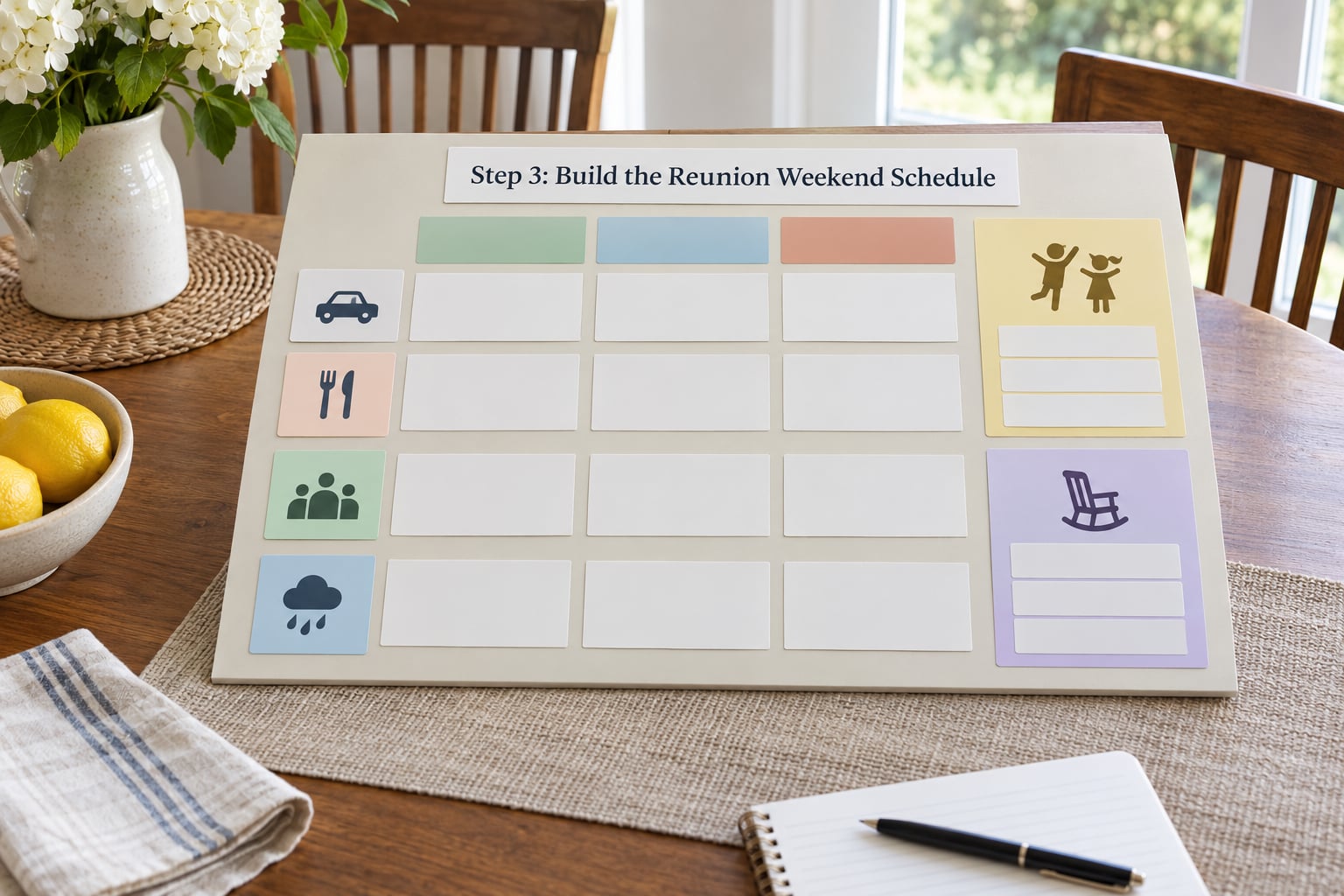
The version of this step that works in practice is simple: decide the meals, pick one Saturday outing, and leave the rest of the blocks empty. Empty blocks are what let a teenager go fishing and a grandparent nap in the same house without either feeling like the schedule is being run over them.
| Time | Friday | Saturday | Sunday |
|---|---|---|---|
| Morning | Arrivals, check-in, beds and bags sorted | Main group activity, or rainy-day backup | Slow breakfast, pack at a relaxed pace |
| Midday | Snacks, swim or walk, kids settle | Lunch, free time, quiet hour for older guests | Group photo, packing help for the overloaded |
| Evening | Easy potluck or ordered dinner | Takeout or a cook-together meal, music optional | Departures, leftover food packed, house walk-through |
Publish the schedule where everyone can see it, and pair it with RSVP choices. Let people opt into activities rather than being assigned to them. A visible schedule and a set of yes-or-no options remove most of the group-chat noise before it starts.
Always carry one indoor and one weather-proof backup. Rain that cancels a hike on a rental with a game room is a different weekend than rain at a house with a single living room and a wet deck.
You will know this step worked when everyone can state where they need to be on Saturday morning without re-reading the whole thread.
Step 4: Plan Meals That Are Easy to Share
Pick your food approach based on kitchen capacity and budget, not on tradition. Four options work well: self-catered breakfasts and lunches, a hosted dinner you cook, ordered meals delivered, or a rotation where each household brings a dish.
Self-catered mornings are the easiest win. Breakfast and lunch need no coordination, so the schedule stays loose and nobody is stuck in the kitchen. Put the effort into one or two dinners.
For the hosted dinner, cook dishes that hold well and travel well. A baked main, a large batch of chili or a sheet-pan meal can sit on the table while people arrive, which matters when arrival times span four hours. Keep at least one potluck-style dish gluten-free or nut-free so the person with the allergy can actually eat the same food as everyone else.
Three dishes that handle a large group in a home kitchen:
- Sheet-pan chicken and vegetables. One pan, one oven, minimal supervision while the group settles in.
- A slow-cooker chili or pulled pork. Started early, served from the counter, no last-minute timing.
- A large pasta or rice bowl. Assembled at the table so the group builds their own plate, which solves most dietary variation.
If you order meals, confirm the restaurant delivers to a rural or gated address, and order from two places so one delay does not stall dinner. If you use a potluck rotation, assign dishes to households rather than to individuals, and specify allergens on the sign-up sheet.
Handle the boring parts in advance: confirm refrigerator and freezer space, count plates and utensils against the guest list, and decide who cleans up. Keep perishables in a cooler for the drive home rather than loose in the car. For food safety, cook poultry to 165°F, ground meat to 160°F, and whole cuts and fish to 145°F.
You will know this step worked when every guest knows what they are bringing or ordering, and the host knows who washes dishes at the end of each meal.

Step 5: Assign Rooms, Costs, and Transportation
Assign sleeping zones rather than individual beds wherever possible. Bed inventory changes, but group composition rarely does, and zoning avoids constant mid-week reshuffling. Keep one bathroom reserved by priority, such as the downstairs one, for anyone who genuinely needs single-level access at night.
Split the money on a per-household basis, agreed before booking. Two structures work: an equal share per household, which is fair when some families have four people and others have one, or a per-person split with a cap so large households are not punished for showing up in force. Write the rule down and share it before the first payment is due.
Collect through a shared expense tracker or a payment link that shows the total, the due date and what it covers. Lodging, food and activity money kept in separate pots prevents the most common family friction, which is a household quietly paying for everyone else’s groceries.
Do the same with transportation. Count how many people arrive by rental car, by air and by rideshare, then check parking at the property against the number of cars actually coming. Airports and train stations need a shuttle plan, and the backup is a second shuttle driver rather than a hopeful group chat.
Publish the room assignments and the cost breakdown in the same document. When both are visible, arguments about fairness mostly disappear.
You will know this step worked when every guest knows their room, their share, and the amount already paid.
Step 6: Share the Final Plan and Prepare for Problems
Send one packet about two weeks out and stop adding to it afterwards. If you have followed how to plan a family reunion weekend at a rental house up to this point, the packet is mostly assembly. It should contain the address and host contact, entry and lockbox details, the itinerary, room assignments, meal plan and sign-ups, transportation notes, house rules, an emergency contact, and a short packing list.
The packing list is where reunion rentals quietly break. Ask for medications, chargers, swimwear, insect repellent, paper goods and a travel mug. Tell people what the house already provides so nobody buys a fourth cooler.
Prepare four backup plans on paper, because they will all get used:
- Travel delays. A late-arrival contact, a spare key holder, and instructions for entering after dark.
- Illness. The nearest urgent care, one person who holds the emergency numbers, and a spare room if someone needs to isolate.
- Weather. The indoor version of Saturday’s plan, decided before Saturday.
- Extra guests or early departures. A clear sentence about why the answer is no. The house has a legal occupancy limit and your host will enforce it, usually by phone.
Test the house yourself if you can, or ask the host to confirm heating, hot water, the washer and dryer, and any hot tub before the group arrives. Forum complaints about reunion rentals most often involve systems that failed on arrival and nobody knew how to report them.
You will know this step worked when you can hand the weekend to someone else for the final two days and nothing gets lost.
Common Mistakes
Almost every reunion rental problem traces to one of nine avoidable decisions.
- Booking before the headcount is firm. Fix: get household-level RSVPs with a hard deadline, then book for a small buffer above that number. Advertised sleeps figures are not capacity; ask the host for real numbers and the legal occupancy limit.
- Exceeding the legal occupancy limit. Fix: treat the host’s limit as absolute. Adding one person to a house you have already paid for is a cancellation risk, not a favor.
- Giving all logistics to one person. Fix: name four roles, food, activities, logistics and money, and give each one a named deputy. One planner still holds final authority, but four people do the work.
- Planning only for adults. Fix: plan the Saturday activity for two energy levels, and give children a supervised option. Set pool and hot tub rules in writing before anyone gets wet.
- Leaving no unscheduled time. Fix: keep two empty blocks per day. A reunion with nothing unscheduled is an event nobody enjoys.
- Assuming the kitchen has everything. Fix: ask for the burner, oven, refrigerator and dishwasher count, plus how much counter space there is. Bring a portable burner if dinner timing matters.
- Ignoring accessibility. Fix: verify single-level options, walk-in showers, step-free parking and where a grandparent can sleep without stairs at 2 a.m.
- Skipping check-in, parking and cleanup logistics. Fix: put entry instructions, parking rules, trash placement and a departure checklist in the same packet.
- Having no wet-weather alternative. Fix: pick the indoor plan at the same time you pick the outdoor one, not on Saturday morning.
Four habits cover most of the rest. Name roles in writing. Publish one schedule and stop adding to it. Keep money in separate, visible pots. And agree early, in plain language, how you handle a relative who brings an extra guest.
Frequently Asked Questions
How many people can stay in a rental house for a family reunion?
Plan on roughly one bedroom per two to three guests and one bathroom per six to eight people, then confirm both with the host in writing. Many listings advertise a sleeps figure that assumes one adult per bed and ignores bathrooms and closet space, so verify the bed configuration, the bathroom count and the legal occupancy limit before you pay a deposit.
What is the easiest way to split costs for a family reunion rental?
Agree on the rule before booking: either an equal amount per household, or a per-person split with a cap so larger families are not penalised. Keep lodging, food and activities in separate pots so nobody pays quietly for everyone else, and publish the total, the due date and what each payment covers.
How do you organize relatives who arrive at different times?
Build the first evening around arrival rather than a fixed event. Order dinner for a window instead of a time, plan a potluck where dishes arrive whenever people do, and keep late arrivals to self-check-in with a lockbox code and a named key holder. The schedule should state the latest useful arrival time so latecomers know not to expect an event.
How can a rental house work for children and older relatives?
Choose a single-level layout where possible, with a walk-in shower, step-free access from parking, and a bedroom near a downstairs bathroom for older guests. Set pool and hot tub rules in writing before arrival, plan one activity that suits low energy, and keep a quiet room available so small children and grandparents both have somewhere to retreat.
Is a family reunion rental house cheaper than booking a hotel?
A whole-house rental is usually cheaper per person once a group passes about 12 people, because you are not paying for separate rooms, lobby services and per-person resort fees. The trade-off is that you coordinate cleaning, dishes, food and parking yourself. Below that group size, a hotel block often wins on effort even when it costs more.
Conclusion
Confirm the headcount first, choose the house second, build the shared schedule third. Everything else in how to plan a family reunion weekend at a rental house hangs off that order, and reversing it is how groups end up with twenty-eight people, six bedrooms and a host who is already unhappy.
Then protect the thing you rented the house for: unplanned hours. One outing a day is plenty. The rest is meals that take all afternoon, a deck at dusk and a group that has nowhere to be until breakfast.