You ask twice. First, put a specific request in your booking notes or email the property before you arrive, naming the noise you need to avoid. Then say the same thing again at check-in, because that is where the room actually gets allocated. If you learn how to ask for a quiet hotel room and get one, you stop relying on luck and start naming the source: the lifts, the bar, the pool, the ballroom, the ice machine, the street.
Being specific is the whole trick. Staff cannot give you silence, but they can give you a room at the back of the block instead of the lift lobby. A vague note saying “quiet room please” often disappears into a booking system and reaches nobody.
Noise is consistently the complaint guests raise most often about a stay, and unlike a hard bed you cannot fix it with your own luggage. Placement is the only lever you have. This guide covers what to prepare, the exact words to use, and what to do when the room is still loud after you arrive.
Table of Contents›
- What You Need
- How to Ask for a Quiet Hotel Room and Get One: Step by Step
- Step 1: Choose the right room type
- Step 2: Contact the hotel before booking
- Step 3: Put the request in the booking notes
- Step 4: Ask for confirmation
- Step 5: Reconfirm shortly before arrival
- Step 6: Check the room before settling in
- Common Mistakes
- Frequently Asked Questions
- What is a quiet room in a hotel?
- Are hotel rooms typically soundproof?
- What time should you be quiet in a hotel?
- Does asking for a quiet hotel room actually work?
- How do I politely ask for a quieter room at check-in?
- What if the hotel will not move me to a quieter room?
- What to Do First
What You Need
Before you send anything, have five things ready. The whole ask takes about ten minutes once they are in front of you.
- Your booking details. Reservation number, arrival date, expected arrival time, and length of stay. Hotels will not hold notes against a booking they cannot find, and they allocate differently for a 2pm arrival than an 11pm one.
- The exact noise source. Not “noise”, but the lifts, the bar, the pool, a function room, a main road, a rooftop unit, or a connecting door. Name it in one sentence.
- How you booked. Direct with the hotel, or through an online travel agency. This changes who reads your request.
- How long you need quiet. A single night before a flight is not the same as a week of working from the room. Staff prioritise differently when they know.
- A fallback. Earplugs and a phone app for noise masking, packed in your bag before you leave home. Not a substitute for a good room, but it takes the edge off a bad one.
If noise affects your health or concentration — migraine, tinnitus, anxiety, a recovery period — say that plainly rather than vaguely. Staff handle it differently once they understand it is not a preference.
How to Ask for a Quiet Hotel Room and Get One: Step by Step
Step 1: Choose the right room type
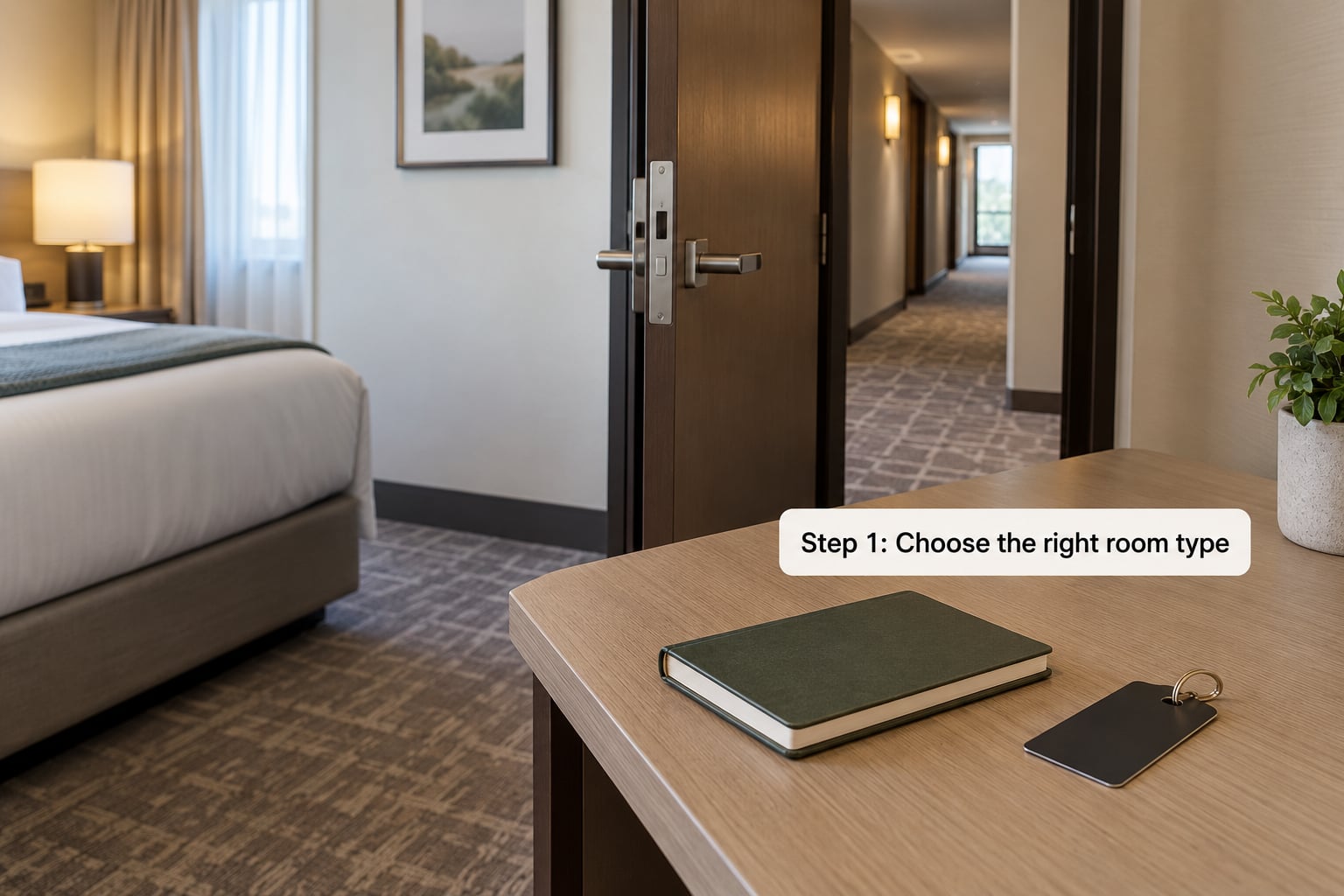
Ask for a position, not a feeling. The requests that consistently get honoured name a direction or a distance: at the end of the corridor furthest from the lifts, on a courtyard side rather than the street side, no adjoining door, away from the ice machine and housekeeping cupboards, and away from the bar, pool, kids’ club, or ballroom.
Every one of those choices has a trade-off, and pretending otherwise gets you a different problem. Top floors lose the footsteps overhead but sit closer to roof plant and lift machinery. Courtyard rooms dodge traffic but can face extract fans and late kitchen noise. Corner rooms have only one neighbour, which is excellent, and are often the first rooms sold.
Convention hotels tend to be at their quietest Friday and Saturday nights when the conference has gone home. Resorts run the opposite way, with the loudest stretch from Thursday through Sunday while the entertainment programme runs.
Step 2: Contact the hotel before booking
Email the property directly and ask a question rather than making a demand. Questions get answered; demands get filed. Keep it short and give them something easy to reply to.
Hello, I have a booking for [dates] under [name], reference [number]. I am a light sleeper and I would be grateful for a room away from the lifts and away from any bar or function space. Could you let me know whether you can place me in a quiet part of the hotel, and whether there is anything I should put in my booking notes? Many thanks.
Call works too, and in my experience it works better than email for one thing: you can hear how the desk sounds while you ask. A property that answers the phone at 9am on a Tuesday is a property that will still be awake at 1am when your room is noisy.
Booking direct gives you an email address and a person. Booking through an online travel agency usually gives you a case number and a queue. Neither is hopeless, but the direct route is shorter.
Step 3: Put the request in the booking notes
Every booking form has a special requests or notes field, and it is read far more reliably than people expect. Twenty words is plenty:
Light sleeper — please avoid lifts, bar, pool and connecting doors. Courtyard side preferred.
Where you put that note decides how much chance it has. Here is roughly what each channel can realistically do.
| Where you ask | What it can realistically achieve | Who reads it |
|---|---|---|
| Booking notes at checkout | Flags the request on your reservation; usually honoured when a suitable room is free | Whoever does room allocation |
| Notes on an online travel agency booking | Often passed through, sometimes dropped entirely | Uncertain — depends on the platform |
| Email to the property | Creates a record and usually gets a reply you can point at later | Front desk or reservations |
| Phone call before arrival | Fastest route to the person who assigns rooms that morning | Duty manager or night auditor |
| Asking at check-in | Last point where a room move is free and painless | The agent holding your keys |
Use two channels. The note protects you if someone else handles check-in, and the email gives you something to refer back to when you arrive.
Step 4: Ask for confirmation
Ask them to confirm the note is attached to the reservation rather than to promise you a specific room number. Nobody can guarantee a room assignment days ahead — occupancy changes, other guests have needs too, and maintenance moves rooms. What they can confirm is that the request is recorded and that allocation will take it into account.
If the reply is vague, one follow-up does most of the work: “So I understand — the request for a room away from the lifts and bar is attached to my booking?” Guests on hotel forums describe staff as helpful and amenable when the ask arrives before arrival, and this is the step where that habit is built.
Step 5: Reconfirm shortly before arrival
Send one short message the day before, or call in the morning you travel. Room allocation for that night happens close to check-in time, so a request made on arrival morning lands with the person holding the room list.
Keep it to three lines: your name and date, the request repeated in the same words, and one sentence giving them room to help. Something like: “Checking in this afternoon under [name]. Requesting a room away from the lifts, bar and pool, courtyard side if possible. Happy to take whatever fits best if that helps.” That last sentence matters — it turns a demand into a preference and makes you easier to accommodate.
Step 6: Check the room before settling in
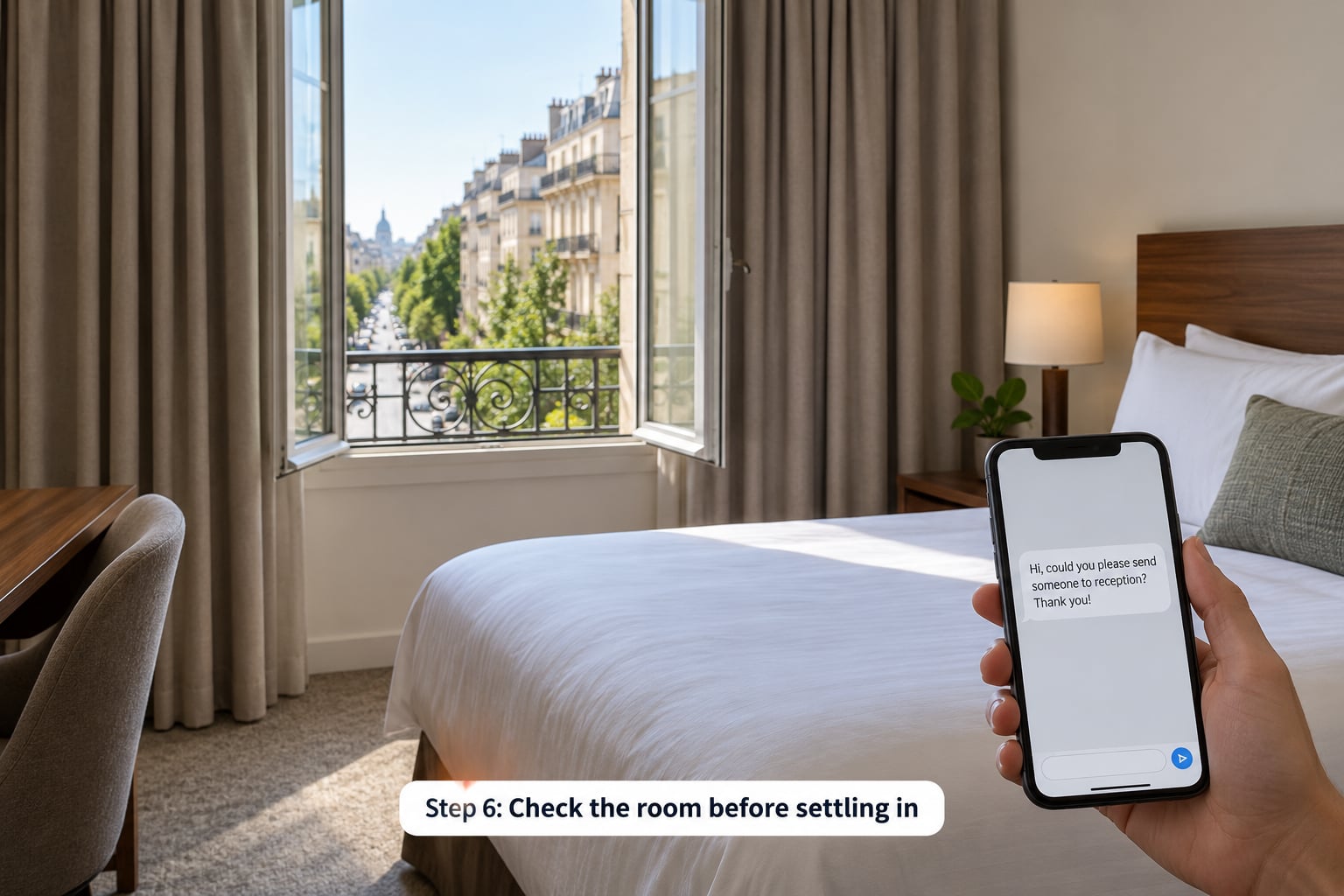
Stand in the room for two minutes before unpacking. Listen at the connecting door, at the window, and toward the corridor. A thumping bass or an audible conversation in the next room means you have a short window to fix it, while you still have bags in your hands and nobody has invested anything in the stay yet.
If it is loud, go back down. Say it as information, not accusation: “The room next to mine has music playing and I can hear it clearly. Is there another room available that faces the courtyard?” Most desks move you without argument, especially if you asked in advance and have a note to point at.
If the first answer is no, escalate in order:
- Duty manager at the front desk, same visit.
- Ask what they can do rather than what they cannot — a different floor, a different wing, earplugs, a late check-out the next day.
- Ask for compensation in the form of points or a partial refund, in the same conversation.
- At check-out, put the noise in writing in your review. Front-desk staff handle noise complaints daily, and reviews change how a property allocates rooms for the next guest.
If the noise is one specific guest rather than the building, the script is different: “I know it isn’t your staff’s fault, but could you pass a word along? It wakes me at 1am.” Housekeeping and the desk usually handle that quietly for you.
Common Mistakes
Writing “quiet room” with no detail. It reads as a preference nobody can act on. Fix: name the source — lifts, bar, pool, street, adjoining door.
Asking once, then assuming it was recorded. Half the disappointing stays come from a note that reached nobody. Fix: email as well as note, and ask for a reply confirming it is attached.
Requesting an exact room number weeks ahead. Staff cannot promise a room they have not allocated yet, and a rejected promise feels like a refusal. Fix: ask for a position and a side, not a number.
Leaving arrival time out. A 10pm arrival gets allocated late, often into whatever is left. Fix: state your expected arrival time and, if you know it, ask for early check-in so allocation happens in daylight hours.
Waiting until 2am to raise it. Fix: raise it within the first hour of arrival, while moving costs the hotel nothing.
Assuming a top floor is automatically quietest. You trade corridor footfall for roof plant and lift machinery. Fix: ask which side of the building the plant is on, then decide.
Two habits help more than anything else. Ask before you travel, and be specific when you do. Properties with fewer rooms per floor are often the easiest to accommodate, simply because the desk knows exactly which four rooms are the calm ones.
Frequently Asked Questions
What is a quiet room in a hotel?
A quiet room is one deliberately positioned away from the noise sources in that building: lifts, bar and restaurant, pool, function rooms, ice machines, housekeeping cupboards and rooftop plant. Ideally it sits on a side or floor with low corridor traffic, no adjoining door, and a quiet-hours policy that pauses housekeeping overnight. Ask for a position, not a feeling.
Are hotel rooms typically soundproof?
Rarely. Interior doors in most hotels are hollow-core and the building standard does not require heavy acoustic insulation between guest rooms, so conversations, bathroom noises and TV can travel through the wall. Double-glazed windows help most properties handle outside noise. That is why placement beats equipment: no earplug fixes a room built next to a lift motor.
What time should you be quiet in a hotel?
Most properties run quiet hours from around 10pm until 7am, sometimes extending later at weekends. Some quiet-floor programmes go further and suspend housekeeping and engineering work from 9pm to 10am. Ask for the quiet-floor option by name at booking, and expect enforcement to be uneven at busy times, such as Friday and Saturday in a convention hotel.
Does asking for a quiet hotel room actually work?
Often, yes, when the request arrives before arrival and names the noise source. Desks cannot promise silence, but they can steer allocation toward calmer rooms, especially in smaller properties with fewer rooms per floor. Reviews and hotel forums consistently report staff accommodating these requests readily. The request fails most often when it is vague, or arrives only at check-in with no prior note.
How do I politely ask for a quieter room at check-in?
Keep it short and factual rather than apologetic. Try: I am a light sleeper and was hoping for a room away from the lifts and bar, which I noted when booking. Is there anything available on a quieter side of the hotel? Stating what you already asked for reminds the desk that you planned ahead, and it avoids sounding like you are complaining about a room you chose yourself.
What if the hotel will not move me to a quieter room?
Ask what they can do rather than what they cannot: a room on another floor, earplugs, a late check-out to recover sleep, or points back on your loyalty account. If nothing works, put it in writing in your review at check-out. Ask before you unpack, since the first hour is when a move is easiest and costs the property least.
What to Do First
Open your booking, paste one specific sentence into the special requests field naming the noise source, and email the same sentence to the property so someone replies to it. Then repeat it at check-in and listen in the room before you unpack. That sequence gets you most of what is available, and it is the honest ceiling — a hotel can place you well away from the lifts, but it cannot rebuild the walls.