To email a small hotel with special requests, find the property’s own address, name your booking reference and arrival time, and ask for one or two specific things in under 150 words. That is the whole trick.
Independent hotels and boutique inns are usually run by a handful of people who answer their own email, often the same day. A message through a booking platform, by contrast, may sit in a shared inbox that no one at the desk ever opens.
The hard part is not the writing. It is deciding what to ask for and when to ask. Below is the process I use, including a template you can paste straight into your mail app.
Table of Contents›
- What You Need
- Step-by-Step: How to Email a Small Hotel With Special Requests
- How to research the hotel and confirm the right contact
- How to write a clear and polite email to a small hotel
- How to add the right details and ask for confirmation
- How to follow up without being pushy
- Common Mistakes
- Frequently Asked Questions
- What is the 15-5 rule in hotels?
- What can you special request at a small hotel?
- How can I increase my chances of early check-in?
- I booked on Airbnb or Booking.com. Should I still email the hotel directly?
- What should I do if the hotel never replies?
- How do I ask for a dietary or accessibility need in writing?
- Conclusion
What You Need
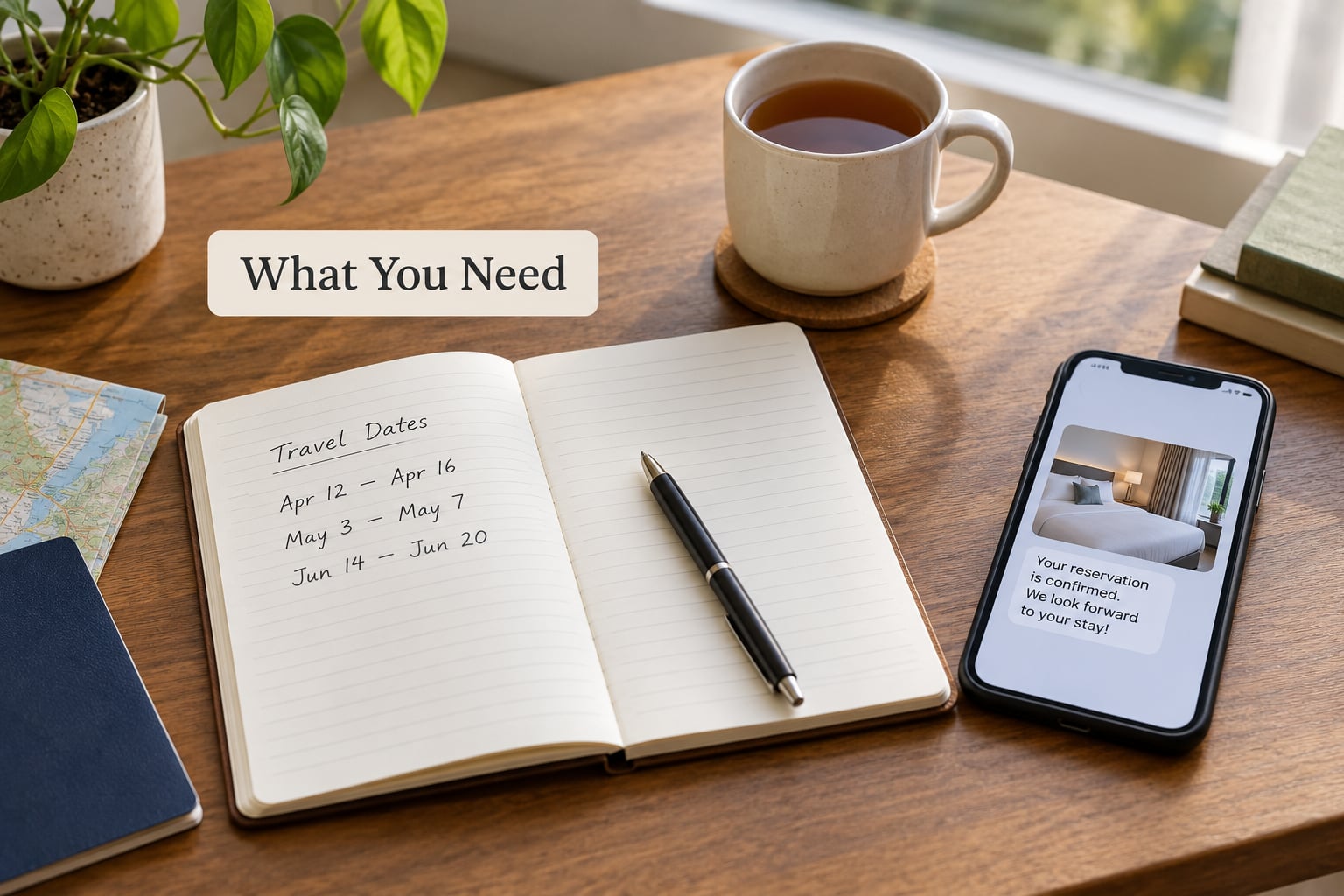
Gather these before you type, and the email writes itself:
- Your dates and length of stay. Write them out rather than relying on the hotel to remember which reservation you mean.
- The booking reference. This is the short code on your confirmation, sometimes labelled a reservation number or confirmation number.
- The room type you booked and how many nights you are staying.
- Your real arrival and departure times, plus the train or flight they come from. A 21:30 landing at an airport 90 minutes away means a 23:15 arrival, not “evening”.
- Your asks, ranked. Decide which one you would genuinely be disappointed without. That is the one you lead with.
- Dietary or accessibility detail, and how serious it is. “Vegetarian” and “anaphylactic, needs separate preparation” are completely different messages.
- A deadline for an answer, so the hotel knows when you need to hear back.
- A phone number in the signature, in case they would rather call.
One thing worth understanding before you write: a small hotel is usually owner-operated, and requests are granted by the people doing the work that day. Anything that needs a supplier, a booking system change, extra staffing or money needs lead time.
A late arrival, a quiet room or luggage storage costs them nothing and takes a minute to sort. A fresh room at 09:00 when the last guest leaves at 11:00 means someone cleaning a room twice.
Step-by-Step: How to Email a Small Hotel With Special Requests
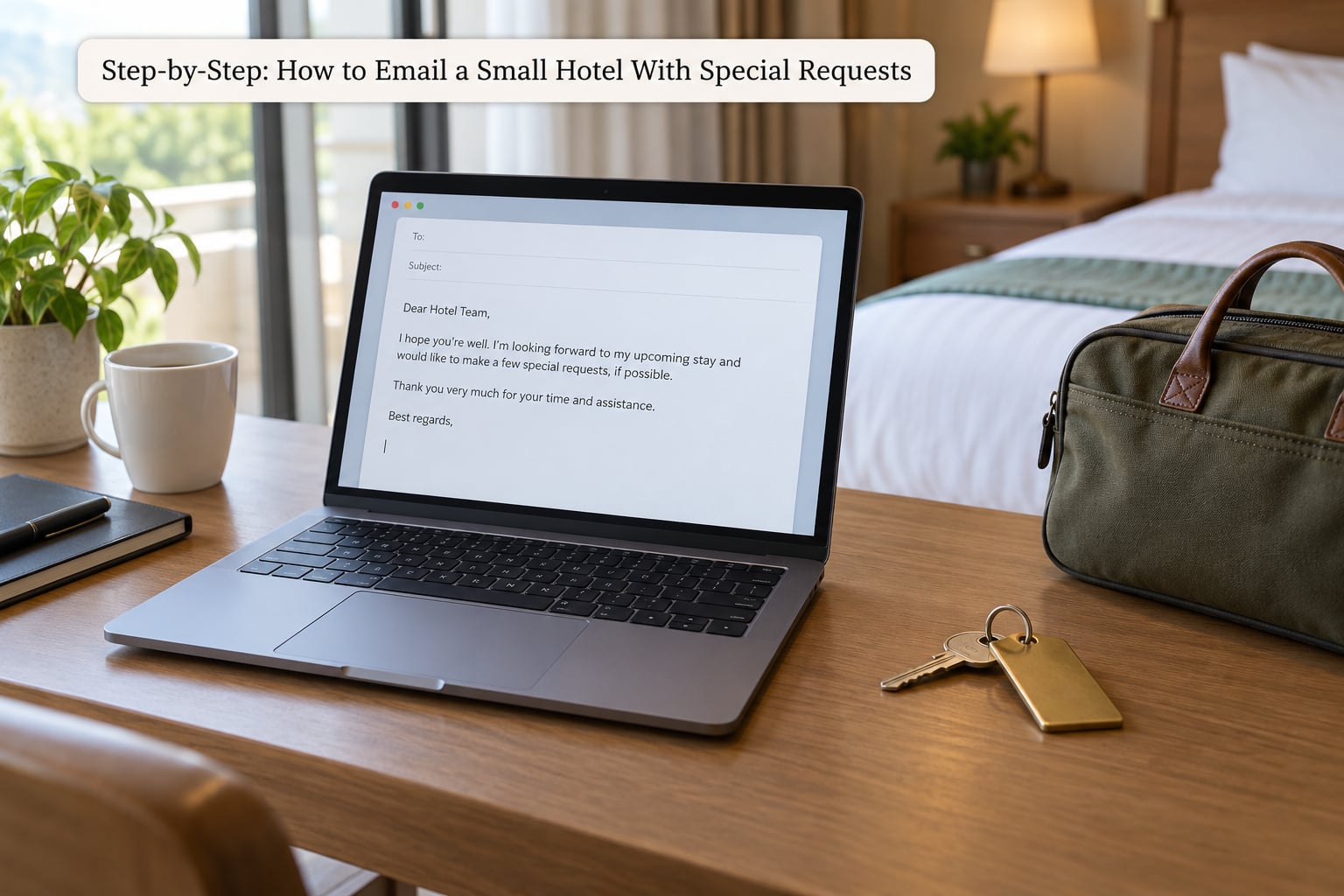
How to research the hotel and confirm the right contact
Before writing anything, spend five minutes on the hotel’s own website. Look at the booking policy for check-in times and cancellations, the room list, and the amenities page. If the website says “no arrivals before 15:00” or “no pets”, your email will read very differently from one that ignores it.
Then find out which channel your booking came through. Book direct and you are emailing the property. Book on a platform like Airbnb, Booking.com or Expedia and your message may be handled by platform support hours before it reaches anyone at the inn.
Travellers on travel forums describe the same thing repeatedly: message through the platform and you hear nothing, email the property and hear back within hours. The safe move is to do both. Message the platform so there is a record, then email the property’s own address.
If no address is published, work down the list. Try the contact form on the site. Try the obvious one, info@ or reservations@ plus the domain, and many small properties do use one of them. Check whether the property has a Facebook or Instagram page, where a short message usually gets answered by the person who runs it.
And if all of that fails, call and ask. Two minutes on the phone to get the correct address is faster than three lost emails.
How to write a clear and polite email to a small hotel
Keep it short, lead with your most important ask, and give the hotel permission to say no. A short email that asks one thing and gets a yes beats a long one that asks six things and gets a form reply.
Structure that works:
- Say who you are and that you have a booking.
- Give the reference number and the dates.
- State request one, plainly.
- State request two, plainly.
- Give a short reason if it is not obvious.
- Invite an honest no, and thank them.
Two habits make replies come faster. Put the ask in the subject line, so it is visible in a crowded inbox. And tell them how you booked, because the same property has different systems for different channels.
A subject line like “Booking 4A2X, arriving Thursday, two requests” will get opened. “URGENT!!! please read important request” tends to land in the junk folder, or be opened by nobody at all.
How to add the right details and ask for confirmation
This template works for most requests. Replace the bracketed parts and delete anything you are not asking for.
Subject: Booking [REF] - arriving [date], two requests

Dear [name],

I am [your name], checking in on [date] for [number] nights under
booking reference [REF], booked [directly / via platform].

If it works with what you have free, I would be grateful for two things:

1. [Most important request, in one sentence.]
2. [Second request, in one sentence.]

My train arrives at [station] at [time], so I expect to reach you
around [arrival time]. If you can tell me what happens with
check-in if I run late, that would help.

If either of those is not possible, just let me know so I can plan
around it. Thank you for reading.

Best wishes,
[Your name]
[Phone number]
A shorter version for one small ask: “Arriving [date] around [time], one guest, booking [REF]. Could I possibly have a quiet room away from the stairwell? Happy to take whatever is available.”
Two details do most of the work in the full version. The real arrival time means the desk can plan who is on duty. The sentence about late check-in invites them to give you the after-hours instructions, which is exactly what solo travellers want to have before they land.
For an allergy, a mobility need or anything medical, close your email with a direct question: “Could you confirm in writing that this is noted on the reservation?” A note in a booking box is easy to lose. An email reply is not.
Then give them a date. “Could you let me know by [date]?” tells a small property when the request stops being optional information and starts being something they have to act on.
How to follow up without being pushy
Timing is the part most people get wrong. Send too early and your request sits unread for weeks. Send too late and the room allocation is already done.
- At booking: right for anything that affects whether the booking works at all, such as a step-free room, a cot, or a severe dietary need. Send it the same day you book.
- Seven days before arrival: the useful default for arrival time, room preference, quiet-room requests and occasion touches.
- Forty-eight hours before: only for the things that must be settled now, like after-hours entry instructions or a confirmed allergy note.
Give a small property 48 to 72 hours. If nothing comes back, send a two-line follow-up rather than the full email again: “Hello, just following up on my note below about arriving Thursday with reference [REF]. Any idea whether the quiet room is possible? Many thanks either way.”
If there is still no reply and the arrival time is the issue, call. A ringing phone is easier to deal with than another email in a queue.
If the hotel cannot do something, reply well. A warm “no problem at all, thank you for checking” costs you nothing, and the same person is the one who decides your late check-out on departure day. That is a real trade at a small property.
Common Mistakes
Almost every ignored email has made at least one of these mistakes:
- Ten asks in one paragraph. The hotel reads it as a wish list and answers none of it. Fix: choose two, and rank them.
- Urgency with no reason. “I need confirmation immediately” tells the reader nothing. Fix: say why and when you need to know, for example “we leave on the 14th, so anything involving the room assignment needs settling before then”.
- No booking reference. The hotel cannot match you to a reservation in a system you have never seen. Fix: put it in the subject line as well as the first line.
- Assuming a request is guaranteed. A polite “we will do our best” is not agreement. Fix: ask them to confirm in writing, and keep a backup plan.
- Writing to the wrong inbox. Platform support is a different company from the property. Fix: email the property directly and copy the platform.
- Guessing addresses that bounce. Fix: use the site form, the social page, or call for the correct one.
- An essay. Nobody at the front desk reads 400 words. Fix: under 150, and cut any paragraph that does not contain a request or a fact.
- Ignoring what the hotel already told you. Asking for a pet-friendly room at a property that publishes “no pets” is a fast way to lose goodwill. Fix: read the policies first.
- Treating a soft no as an insult. Fix: thank them anyway. Reviews and repeat business follow from how you handle the no.
One etiquette rule that comes up constantly in guest forums: the 15-5 rule. Requests logged within 15 days of arrival tend to get reviewed and acted on about five days before you turn up. Send your email inside that window rather than weeks ahead, and keep it visible in the thread rather than letting it get buried in replies.
Frequently Asked Questions
What is the 15-5 rule in hotels?
It is an operations convention: special requests logged within 15 days of arrival tend to be reviewed and acted on around five days before the guest arrives. Practically, it means send your email inside a two-week window rather than months ahead, and expect the room allocation to firm up about a week out. Requests sent after that point often reach the property too late to change anything.
What can you special request at a small hotel?
Most small inns and boutique properties can usually manage a late arrival time, luggage storage before and after check-in, a quiet room away from stairs or lift shafts, extra pillows or a fan, a birthday or anniversary touch, a later check-out on departure day, and a firm answer on dietary requirements. Room upgrades, early check-in and anything requiring money or extra staffing are less certain.
How can I increase my chances of early check-in?
Ask early but politely, give a real reason such as a morning flight, and offer something in return, for example accepting a later check-out. Midweek and off-season arrivals are far easier to accommodate than a Saturday in peak season. If the hotel cannot promise, ask whether they can hold your luggage so you can wait nearby, and ask them to note the preference on the reservation.
I booked on Airbnb or Booking.com. Should I still email the hotel directly?
Yes, send both. Message through the platform so there is a record, then email the property’s own address if you can find it, mentioning that you booked through the platform and including your reference. Platform messages are often handled by support staff who relay only what they think matters, so anything involving allergies, accessibility or after-hours arrival is safer sent directly.
What should I do if the hotel never replies?
Wait 48 to 72 hours, then send a short follow-up referring to your original message and reference number. If silence continues and the arrival time matters, call the number on the property’s website or your confirmation email. If you booked through a platform, use its messaging or support line as a second route, and ask the platform to confirm the request was passed to the property.
How do I ask for a dietary or accessibility need in writing?
Describe the need precisely and say how serious it is, then ask for written confirmation. Something like: I have a severe nut allergy and need to avoid cross-contact; could you confirm the kitchen has this on the reservation and tell me what is safe to order? For mobility needs, state the specific limitation and whether you need a ground-floor room, a lift, or a step-free route from the car park.
Conclusion
Pick the one request you actually care about, write it in a few short lines with your booking reference and real arrival time, and ask whether it can be arranged rather than assuming it is guaranteed.
That last detail is what most people miss. An email that says “could you possibly hold a quiet room, and if not, just let me know” gets a real answer from a real person. Everything else is decoration around it.