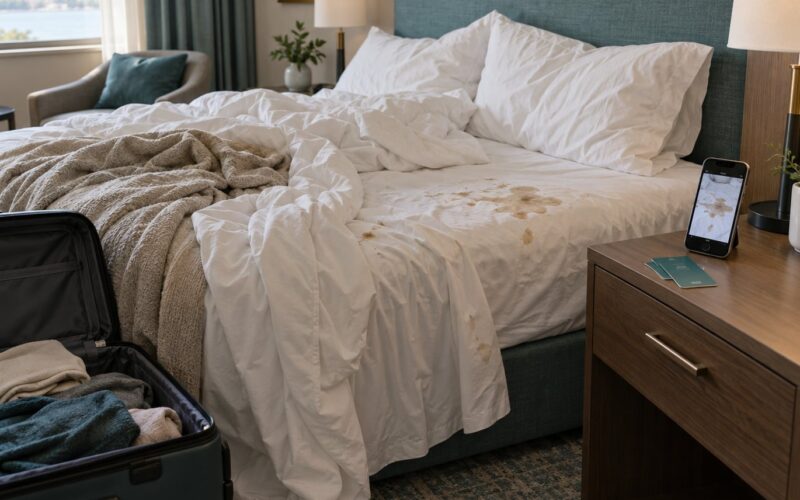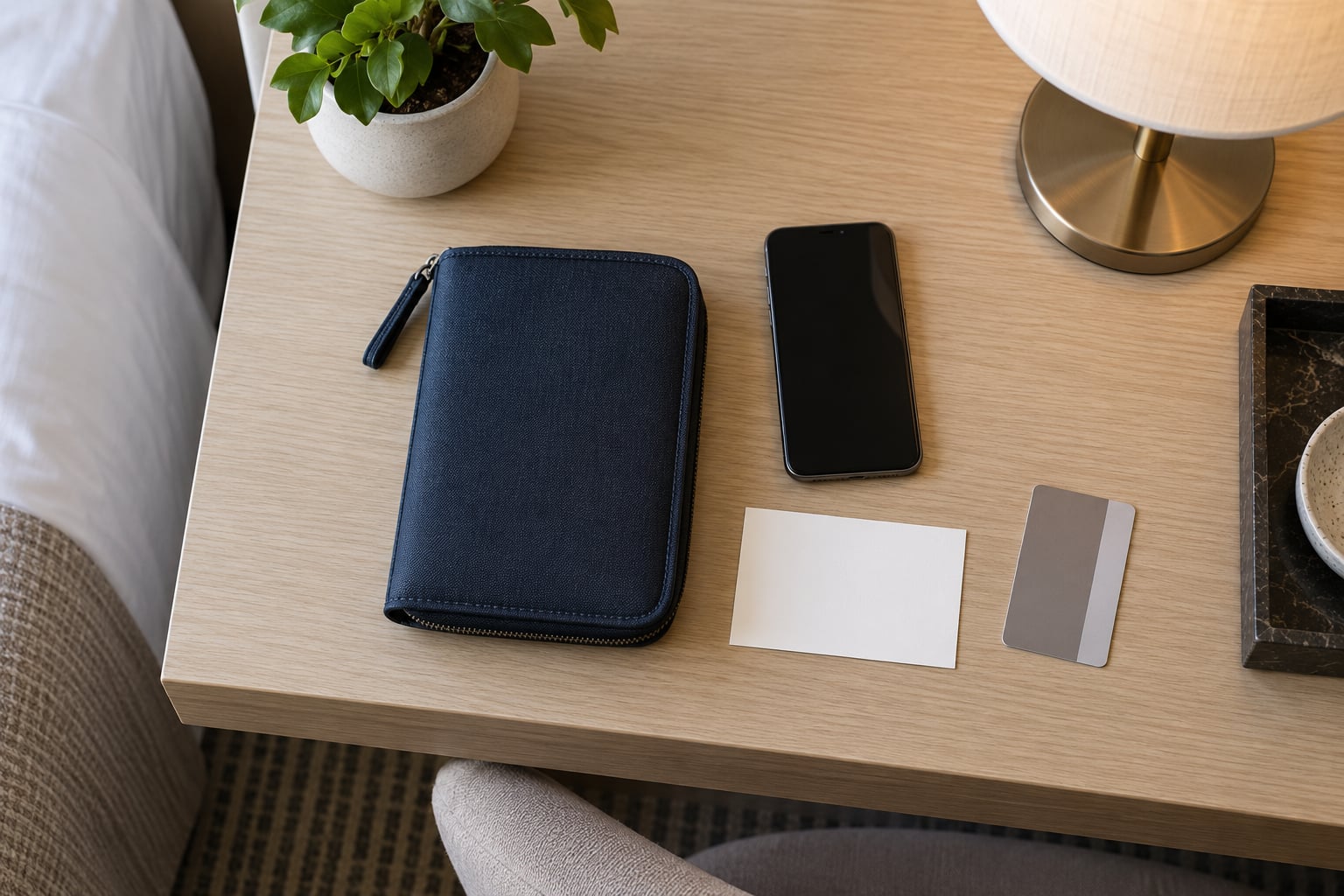
Most hotel room thefts are opportunities, not break-ins: somebody gets through a door briefly, or opens an in-room safe without effort. To learn how to keep valuables safe in a hotel room, spend fifteen minutes on arrival setting your own safe code, splitting cash and cards into two places, and clearing every visible surface. Then run a thirty-second check every time you step out. Last updated October 2026.
I travel solo, which makes this less theoretical. The room is not the weak point I worry about most; the ten seconds between opening the door and closing it again is. What follows is the routine I actually use, built around a small number of items you likely already own.
Table of Contents›
- What You Need
- Step-by-Step: How to Keep Valuables Safe in a Hotel Room
- 1. Make a quick valuables inventory
- 2. Check the room and its entry points
- 3. Confirm that the room safe works
- 4. Sort items by risk and storage method
- 5. Use layered storage rather than one weak spot
- 6. Distribute small valuables and backup payment methods
- 7. Reset the routine whenever you leave the room
- 8. Use a final sweep before checkout
- Common Mistakes
- Treating the room safe as the whole plan
- Leaving the code where the safe is
- Leaving valuables in the popular hiding places
- Carrying everything and treating that as safe
- Waiting to report a loss
- What to do in the first 60 minutes after a theft
- Frequently Asked Questions
- Is a hotel room safe actually secure?
- What should I do if I lose the code for a hotel room safe?
- Where should I keep my passport in a hotel room?
- How can I protect valuables when leaving my hotel room?
- What should I do if I think something has been stolen from my hotel room?
- Conclusion: Start With the Inventory and Room Safe
What You Need
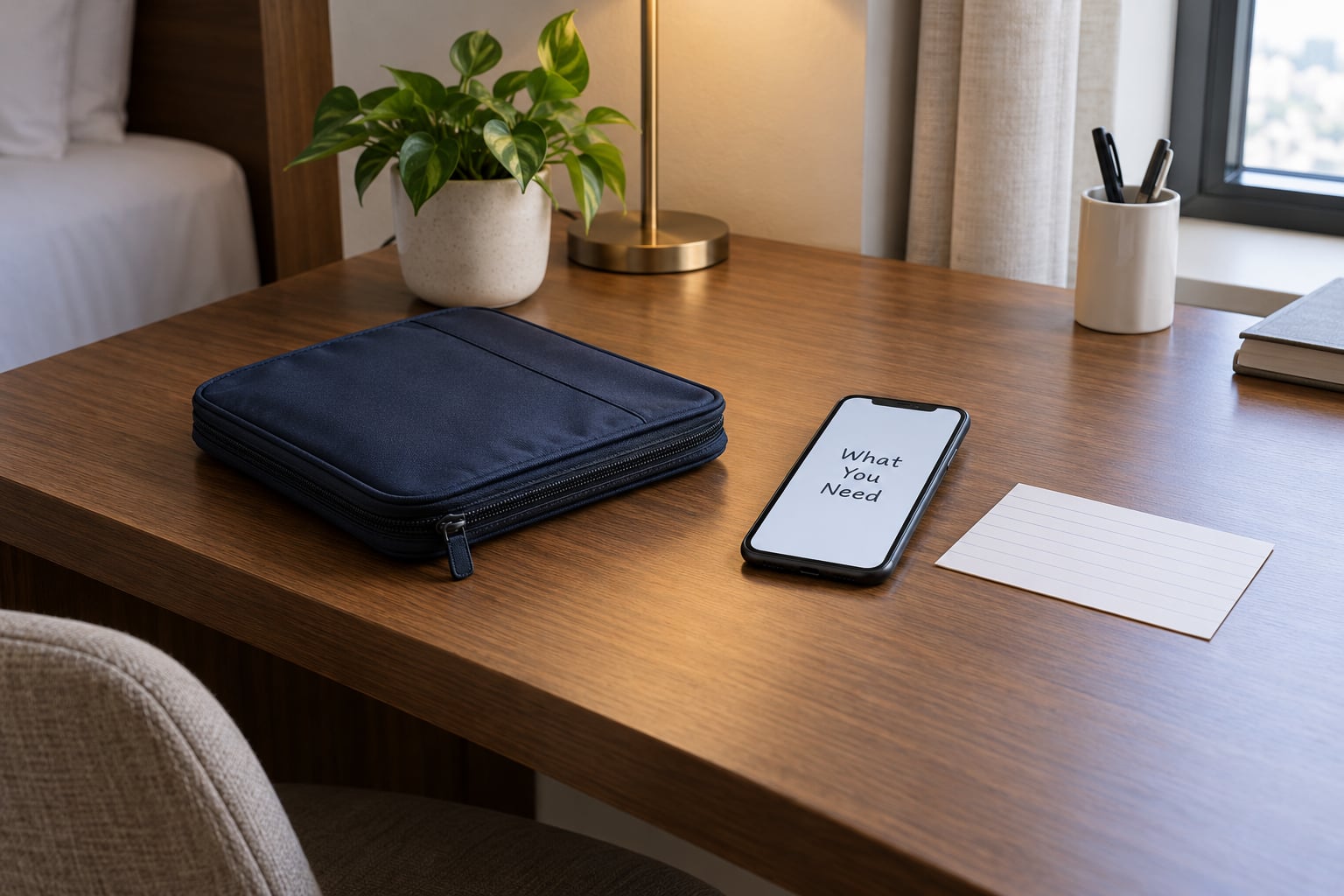
None of this needs to be bought the day you land. Most of it is already in your bag, and the rest you can create in the room with a pen and a piece of paper.
- A charged phone. You need it for the property’s address, the front desk number, your bank app and the emergency contacts you will want at 2am.
- A pen and a card or sheet of paper for the valuables inventory. Photographing the list works too, but paper survives a dead battery.
- A lockable pouch or small zip pouch for documents and cards. A toothbrush bag, a laundry pouch or a hard-shell eyeglass case all do the same job.
- Your luggage lock, if you use one. It matters as much as the safe in most rooms.
- A Do Not Disturb sign if the property supplies them.
- Your insurance details, including the policy number and the insurer’s 24-hour claims line, stored somewhere other than the hotel room.
Two things you do not need. You do not need to buy a portable travel safe, and you do not need to hide anything inside the building’s walls, under the carpet or behind a vent grate. Those suggestions show up constantly in older advice, and they make your belongings harder to find during a fire, a leak or a room change.
Step-by-Step: How to Keep Valuables Safe in a Hotel Room
1. Make a quick valuables inventory
Before you unpack, list or photograph what matters: passport, cards, cash, phone, laptop, camera, jewellery, prescription medication, keys. Write down one distinguishing detail for the harder-to-identify items, such as the patterned strap on your camera or the scratch on your laptop lid.
Keep the list accessible rather than locked away with the things it describes. A locked safe and a list in your daypack can be compared in about a minute. Without a list you will search a room twice and still not know.
You have done this step well when the number of items on the paper matches the number of items physically in your possession. That count is what makes checkout and departure useful later.
2. Check the room and its entry points
Walk the room once, quickly, before you settle in. Look at the door and frame for fresh marks or gaps, at the peephole cover, at the window latch and any balcony door, and at the bathroom ventilation grille. Check that the wardrobe or luggage rack has not been moved and that the room number on the inside door card matches yours.
Stay factual about what you are seeing. A bent latch or a door frame that does not sit flush is worth a call to the front desk. A stain on the carpet is not. Front desks take complaints about a damaged lock seriously and will move you; they hear nothing useful about a suspicious shadow.
The step is finished when any concern has been reported and, if you want it, a room change has been offered or accepted.
3. Confirm that the room safe works
Most in-room safes run on a four-digit code, a key card, or a master code the hotel holds. Ask the front desk which type yours is and whether the code resets at checkout, which is worth knowing before you pick one.
Set your own code and do not use your room number, a birthday, a year, or 1234. Those are the first four combinations anyone tries. Then open and close the safe twice, confirm the door latches, and make sure your code actually opens it after you have closed it. Plenty of travellers discover on checkout that they were pushing the panel buttons of a safe that had never locked.
Two checks people rarely make. Look at whether the unit is fixed to the wall or the furniture rather than resting loose. And put something inside, close it, then verify it is still there a few minutes later. A safe that will not hold a document will not hold a passport.
If the safe is missing, broken or too small for your documents, stop and ask the front desk what alternatives exist. That conversation itself is the safeguard, and it takes about two minutes.
4. Sort items by risk and storage method
Group your belongings before deciding where each one goes, because one location rarely suits everything. Sort into documents, electronics, jewellery, cash, cards, and prescription necessities.
Documents go in the safe if it is solid, otherwise they travel with you. Electronics usually travel, since they are wanted and hard to replace. Jewellery and cash are the two groups people most often try to store and least often think through. Cards need one deliberate decision rather than a hiding place.
Markers to prescriptions deserve their own line in this plan. Medication in a checked bag that gets delayed is a genuine problem, and a small quantity in your daypack costs almost nothing to carry.
This step is done when every item on your inventory has a named destination and a named person responsible for it: the safe, your bag, or your body.
5. Use layered storage rather than one weak spot
This is the part of the routine that actually decides whether a quick search of your room turns up nothing. Layering storage means the loss of one location costs you one item, not all of them.
- Highest risk first: passport, spare cards, most of the cash, jewellery, laptop. These go in the room safe, inside the lockable pouch so a working safe code is not the only barrier.
- Second layer: a second sum of cash and one backup card in your daypack or luggage, zipped, not loose.
- Third layer: everything else stays on you, in the money belt, neck pouch or inner pocket of the bag you close when you sit down.
- Bag layer: valuables you cannot carry go inside a locked suitcase with a luggage lock, placed at the bottom under clothing.
- Building layer: anything truly irreplaceable goes to the front desk safe, signed in and out with a receipt.
Keep two habits while you do this. Never display passports, boarding passes or jewellery on the desk or the bed while you are in the room, even for a photo, and never walk away from an open safe. Close it, and close your hand around the door.
Keep valuables safe in a hotel room is less about one clever hiding spot and more about this ladder. Experienced travellers on the Rick Steves forum skip the room safe more often than not and lock valuables inside a locked suitcase instead. Either end of the ladder is defensible. Relying on the middle one alone is what tends to go wrong.
6. Distribute small valuables and backup payment methods
Carry one low-value emergency card and a small amount of cash in a different pocket from your wallet. If you cannot get back into a room, or you cannot get into a country without your main card, that pocket gets you a taxi, a meal and a phone call.
Keep the primary wallet, spare cards and identity documents in the secured layer from step 5. The separation matters more than the amount: a single accessible item should never be the only route to all your money or any of your identification.
On the body-versus-bag question that comes up constantly on travel forums, the honest answer is that it depends on the crowd rather than the city. A money belt or neck pouch under clothing beats a backpack worn on your back in a packed queue, and it loses to a bag you control when you are moving between vehicles and platforms.
7. Reset the routine whenever you leave the room
This is the thirty-second departure check, and doing it the same way every time matters more than doing it perfectly. Close the safe and confirm the door has latched. Turn the lock, the latch or deadbolt, and the swing bar if the room has one. Confirm the window is shut. Clear the desk, the bedside table and any surface where a phone or a wallet would be obvious.
Take the valuables pouch and the emergency card with you. If the bag stays in the room, zip it closed and put the luggage lock on before you reach the door, not in the lift.
Bag on the floor in a hotel room is a common thread on travel forums, particularly in all-inclusive resorts where guests report items going missing during daytime housekeeping. The safe being locked has not always stopped that, which is why step 5 exists.
The routine is working when someone could walk into your room and find nothing worth taking on any visible surface.
8. Use a final sweep before checkout
Checkout sweeps are quick and complete. Drawers and the drawer under the desk, the bedside table, the bathroom, the wardrobe, behind the curtains, the television cabinet, the socket faces where a phone charger gets left, and the safe itself, which people routinely forget after changing the code. Then the luggage rack, the safe one more time, and your case.
Match the room against your inventory from step 1 and check the count. Do this before you hand back the key, while the room is still yours and while staff can act on a missing item.
One extra step on the way out: check the passage and the lift for a wall safe box or housekeeping trolley where a phone or a wallet may have been set down. It costs a glance and it solves a surprising share of lost-property cases.
Common Mistakes
Treating the room safe as the whole plan
The in-room safe is the first advice almost every guide gives, and it is also the first thing most readers have doubts about. Forum threads on r/AllInclusiveResorts and similar communities keep returning with items taken from locked in-room safes, and older units are the ones travellers single out. The honest position is that the safe helps against an untidy opportunistic search, and it helps very little against someone who has time and knows which model they are dealing with.
The correction is to keep the safe in the ladder from step 5, never as the only rung, and to use the front desk safe for anything you genuinely cannot replace.
Leaving the code where the safe is
Writing the code on a card beside the safe, on the inside of a notepad, or on your phone case defeats the entire exercise. Memorise four digits, which is easier than it sounds, or set a code you can reconstruct from a pattern rather than written down anywhere in the room.
Leaving valuables in the popular hiding places
Most published lists rank in the wrong order. The bathroom, the wardrobe, under the mattress, inside a drawer that is not locked, and the mini-bar are the first places searched, because everyone knows they are the first places hidden. The exception is a plain drawer with no rigid safe to move and no reason to think twice about. Obvious is the problem, not the location itself.
Lock the room instead of hiding in it. Ask the front desk to confirm the latch and deadbolt work, keep the Do Not Disturb sign on the door while you are inside, and treat any portable door lock, wedge or alarm you carry as a delay rather than a barrier. FlyerTalk users are blunt about it: staff can open most hotel doors whatever the latch is doing, so anything portable buys you an alarm, not an escape.
Carrying everything and treating that as safe
Wearing every card, all your cash and your passport on your body tells anyone paying attention exactly where your money is. A smaller carry load plus a secured room beats a full wallet plus an open door. Split the load instead of consolidating it.
Waiting to report a loss
Delay is what turns a recoverable theft into an unrecoverable one. Front desks can often resolve a missing item in minutes, while evidence and the police file get harder to build by the hour.
What to do in the first 60 minutes after a theft
Work through this in order, and keep your phone in your hand rather than hunting for it.
- Before the first 20 minutes: stop moving the room. Photograph what you found, note the exact time, and check the obvious places, including drawers, the wardrobe, the bathroom and the safe.
- Minutes 20 to 35: tell the front desk or the duty manager in person, and ask for the missing item to be recorded. Ask whether the room was serviced and when. Ask for a written copy of anything logged.
- Minutes 35 to 45: call your bank, freeze the affected cards and ask about a temporary replacement and a dispute process. Get the reference number.
- By 60 minutes: report to the local police if the loss is significant or if you need a report for your insurer. Insurers commonly ask for the report reference and a chain-of-custody record, so keep the report number and the receipts for anything you bought recently.
- Same day: contact your travel insurer, then your embassy or consulate if a passport is missing. Photograph the police report before you leave the station.
On the towel question that shows up in search results: a towel rolled against the inside of the door is a crude door-jamb intrusion alarm. It tells you a door was pushed open rather than closed quietly, and the deadbolt and swing bar matter far more. Use both if you want the margin.
A few smaller rules worth keeping. Turn the volume down on the television and leave the bathroom light or radio on, so silence at the door does not read as an empty room. Check that the room number is not written anywhere on the outside of your luggage. And if a room feels wrong after the walk-through, ask for a change before you unpack. That is the cheapest fix available, and it is available for the asking.
Frequently Asked Questions
Is a hotel room safe actually secure?
A hotel room safe helps against an untidy opportunistic search and helps little against someone patient who knows the model. Older units are the ones travellers single out in forum threads. Treat it as one rung: put documents inside a lockable pouch in the safe, keep a second sum of cash and a backup card elsewhere, and use the front desk safe for anything you cannot replace.
What should I do if I lose the code for a hotel room safe?
Call the front desk and give them your name, room number and booking reference. Staff can usually open a safe whose code you set, and some codes reset automatically at checkout. Anything genuinely inside a safe you cannot open is their liability problem to solve, so escalate to the duty manager if the first person cannot help.
Where should I keep my passport in a hotel room?
In the room safe, inside a lockable pouch, if the safe is fixed to the furniture and the code opens it reliably. Never leave a passport on the desk, on the bed or in an obvious drawer. If the safe is missing, loose or broken, ask the front desk to arrange a locked storage option, or carry the passport with you.
How can I protect valuables when leaving my hotel room?
Take the valuables pouch and one emergency card with you, or lock them in a zipped case inside a locked suitcase at the bottom under clothing. Before you step out, close and latch the safe, engage the lock and any swing bar, shut the window and clear the desk and bedside table of anything a passer-by could reach.
What should I do if I think something has been stolen from my hotel room?
Stop searching, photograph the scene and note the time. Tell the front desk or duty manager within the hour and ask for a record. Call your bank to freeze any affected cards, report to the police if the loss is serious or your insurer requires it, keep the report reference, and contact your travel insurer and your embassy if a passport is involved.
Conclusion: Start With the Inventory and Room Safe
Four things to do first, in order: write the inventory, test the room safe and change its code, decide the storage destination for each item on that list, then remove anything visible from the desk and the bedside table. Repeat the thirty-second lock-and-leave check every time the room is unattended, and run the sweep against your inventory before you hand back the key. That is the whole routine, and it costs about fifteen minutes of the first evening.