Late checkout turns the dead hours between your hotel’s checkout time and your flight into trip time you actually get to use. Ask the night before, confirm in writing what you have, drop your bags with the bell desk, and spend the morning as a local would instead of packing at 10 a.m. and waiting on a curb.
It takes about five minutes to arrange and costs nothing if the room turns out to be free. It also costs a modest fee at plenty of properties, and at airport-adjacent and resort hotels it is often not available at all, so the honest version of this guide includes the fallback plans. Budget ten minutes the night before your last night and the rest takes care of itself.
Table of Contents›
- What You Need
- Step-by-Step: How to Use Late Checkout to Make a Trip Feel Longer
- Use Late Checkout to Make a Trip Feel Longer
- Check the Hotel’s Rules Before You Ask
- Plan a Low-Stress Final Day
- Arrange Luggage Storage and a Clean Transition
- Use the Extra Hours Without Spending More
- Common Mistakes
- Frequently Asked Questions
- Can hotels extend checkout time?
- How do I ask for a late checkout?
- How late is a late check out?
- Will the hotel hold my luggage after I check out?
- Can I use the shower, pool or lounge after checking out?
- Should I tip hotel staff for a late checkout?
- Conclusion
What You Need
Before you can use late checkout well, you need four things settled. Skipping any one of them is how travellers end up standing at the front desk at 10:45 with bags packed and nowhere to sit.
- The official checkout time. It is printed on your confirmation and it varies: plenty of properties use 11 a.m., many use noon, and boutique and self-catering rentals often set their own window. Write yours down and work backwards from it.
- How the property handles extensions. Some are free and automatic for certain guests, some charge by the hour or for half the night, and some simply refuse. A fee is normal; a surprise fee is not.
- A luggage plan. Bell desks store bags after checkout with a claim ticket, usually at no charge. Confirm this before you ask for time, because an extension without somewhere to put your case is just more time to carry it.
- A final few hours that don’t cost money. A breakfast, a walk, a museum, a pool, a cafe. Decide roughly what you will do before you ask, because a specific plan is both better company and a better reason.
Add one practical constraint: your onward transport. Late checkout only extends the trip if you can still get to the airport, station or ferry in time. Build in a real margin, because the departure-day traffic is the same traffic that is slowing everyone else down.
Step-by-Step: How to Use Late Checkout to Make a Trip Feel Longer
Use Late Checkout to Make a Trip Feel Longer
Ask the night before your departure, not on the morning of it. This is the single habit that decides whether you get the hours: by the night before the front desk can see the arrival list, the housekeeping schedule and how tight the next few check-ins look. On departure morning they know none of that, they are short-staffed, and the answer is a quick no.
Ask for a specific time rather than an open-ended extension. “Could I have until 2 p.m.?” is a question with an answer. “Any chance of a late checkout?” hands the decision back to the desk and gets the standard 11 a.m. back in reply.
Frame it as flexible rather than urgent. Something like, “Any flexibility at all on checkout would help enormously, even an hour or two would be lovely” reads as easy to accommodate. Desperation does not.
- The ask, in one line: “I’m checking out tomorrow, and I have a late afternoon flight. Would there be any flexibility on the checkout time, even to 2 p.m.?”
- If it is in writing: reply to the pre-arrival email or message thread so there is a record.
- If it is verbal: ask for confirmation at check-in the next morning, while it is still the same conversation.
Two things worth doing before you book: join the property’s loyalty programme, and book direct where you can. Both change what the desk can offer you, because direct bookings and loyalty members sit in a different system than third-party reservations. Chain programmes have also tightened these benefits in recent years, so check what your specific tier currently includes rather than trusting advice written a while ago.
There is a version of this that works well for families and anyone on a tight schedule: ask for the room to be re-entered later in the day rather than held continuously. Parents wanting an afternoon nap back after checkout, and travellers who want to drop a case and come back for a last swim, both get what they need without asking for a night they are not paying for.
Check when your property is quiet. Mid-week stays, shoulder-season dates and properties with soft occupancy get yeses far more often than a sold-out weekend in peak season. If you have any choice over dates, choosing a quieter departure day is the cheapest lever in this entire guide.
Check the Hotel’s Rules Before You Ask
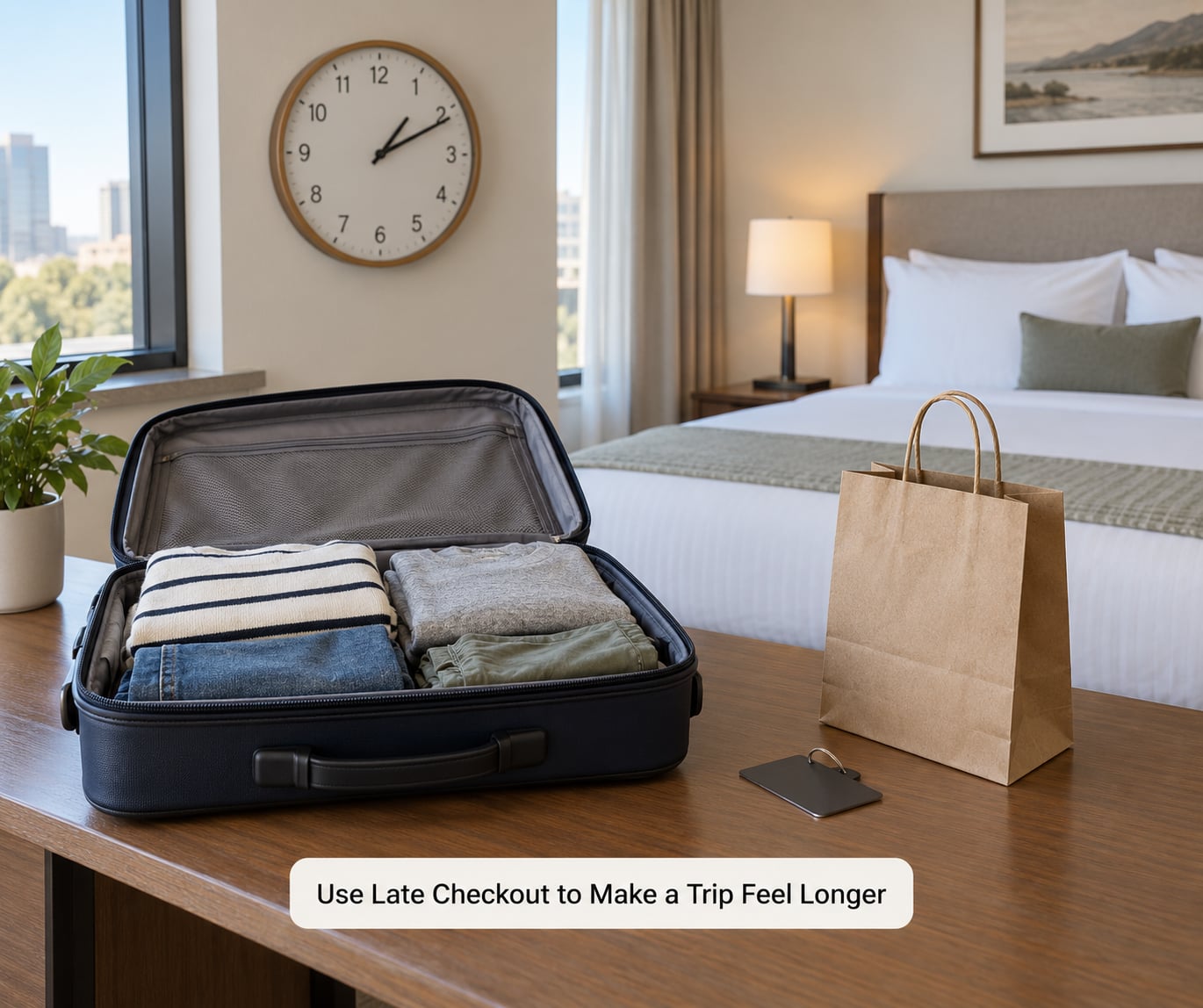
Know the rule before you open your mouth, because a request that contradicts the property’s own policy loses you goodwill for nothing. Find the checkout time on your confirmation, then check whether the property states anything about extensions. Most do, at least somewhere.
The mechanics matter. An extension usually depends on one thing: whether the next guest arriving that day can check in without that room being ready. Housekeeping has to turn the room over on a schedule, and a late checkout simply shifts that schedule. When the room is not going straight to an arrival, hotels are often relaxed. When it is, they rarely are.
How properties handle the charge varies widely, and the variation is worth understanding:
- Automatic and free for some loyalty tiers or long-stay guests. Rare, and it changes; confirm rather than assume.
- Free on request when the schedule allows. Common at independent and boutique properties that have a personal incentive to be flexible.
- Charged by the hour or as a share of the night rate at most mid-range and full-service properties. This is the normal case, not an insult.
- Structurally unavailable at airport hotels, at large resorts during a turnover crunch, and at properties with a function or group in house. Here the answer will be no regardless of how nicely you ask.
Ask about the room as well as the clock. Even when the desk cannot extend checkout, a late room change, a hold on your existing room, or a bag drop right at a convenient time often can be arranged. Same hours of use, different label, and the desk has an easy yes ready.
Plan a Low-Stress Final Day
The point of the extension is not the clock; it is what you do with it. Most people who win late checkout and then sit in the room waiting for noon have gained nothing, which is why this is the step people skip. Decide the shape of your last morning before you pack.
A rhythm that works: wake without an alarm, shower properly rather than in four minutes, eat a real breakfast somewhere other than the hotel if you have the time, then spend a few hours doing something ordinary. A market, a park bench, a museum that opens early, a neighbourhood you have not walked yet. Ordinary is the point. You are borrowing the time a local gets to have, so borrow ordinary local time.
Then build backwards from your transport. Pack the night before, entirely, and put the case by the door. Pack in the morning and the extension turns back into a scramble. Leave with a margin wide enough that a slow crossing or a long security queue is not a crisis.
Solo travellers tend to get more out of this than anyone, because the extension is usually granted to a single guest holding one room, and there is nobody to coordinate with. One room, one case, one morning. That is a genuinely relaxed last day if you arrange it in advance rather than improvising it in a hotel corridor.
Arrange Luggage Storage and a Clean Transition
Confirm luggage storage before you request time, not after. Bell desks are the most trusted fallback in travel, because storing bags with a claim ticket is routine work for them and normally free. Ask where your bags will go, get the ticket, and confirm the hours the desk is open for collection.
Two practical questions worth asking on departure morning. Can someone collect the bags for you if you are out when the desk is closing, and what is the latest collection time? Both are normal requests and both are easier to arrange before you need them than at 6 p.m. with a train to catch.
If the property has no bell desk, small hotels often store bags behind reception without a ticket. That is fine, but keep a note of the desk’s closing time and take a photo of your bag’s tag. Insurance policies and airline rules on unattended luggage are worth a quick check if you are travelling solo.
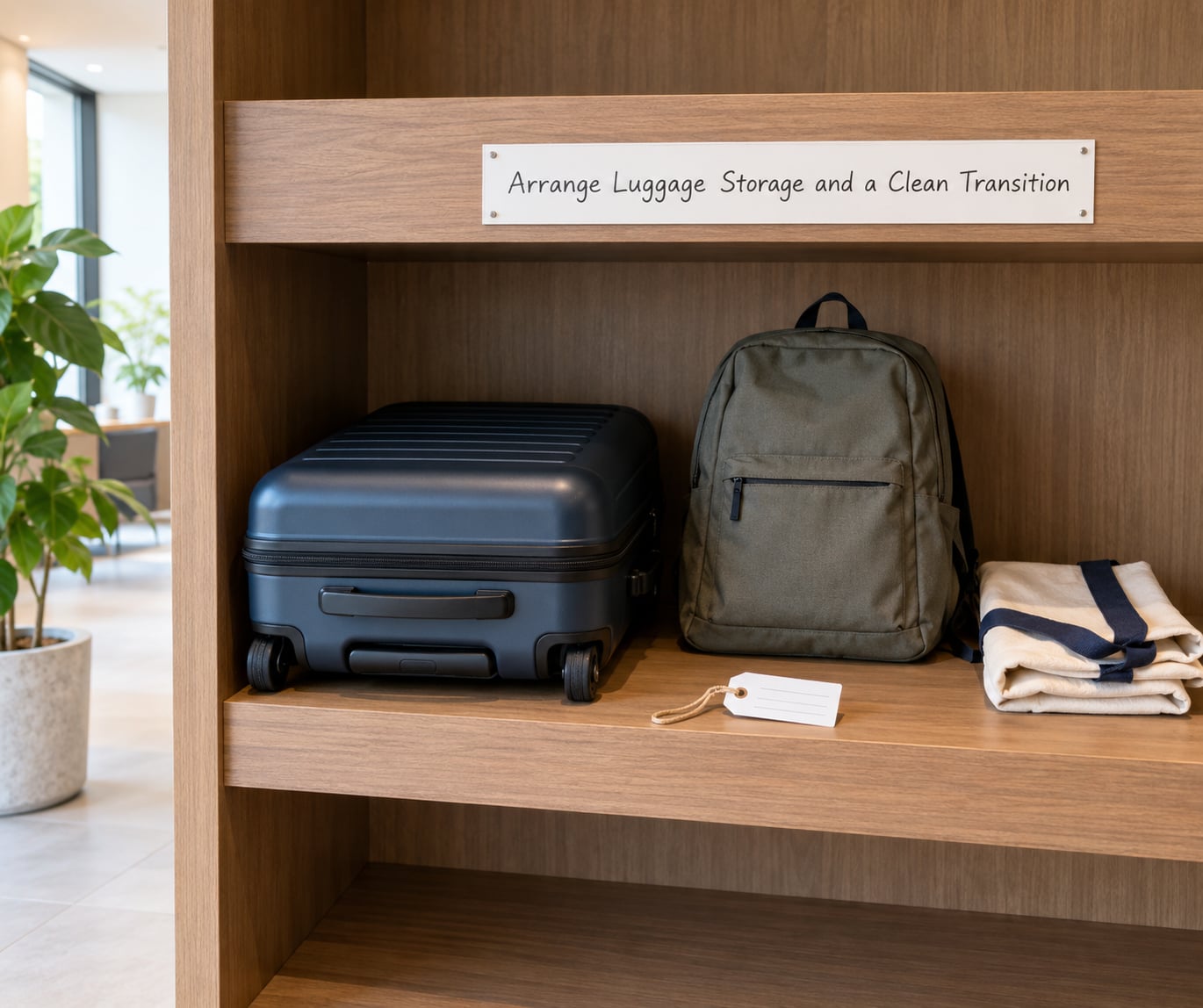
Keep the room key until you leave. Some properties will let you return to a bagged room or to a restroom after checkout, which is what makes the family nap and last-swim requests work. If that matters to you, ask for it explicitly, because it is not standard.
Use the Extra Hours Without Spending More
Late checkout has a hidden cost: whatever you do with the hours. The trick is to choose things that are free or nearly free, close by, and easy to leave. A cafe within walking distance, a public park, a gallery with a small entrance, a long lunch somewhere you were going to go anyway.
Three habits keep it cheap. Eat breakfast at the hotel if breakfast is included, since you have paid for it whether or not you use it. Keep the day’s plan within a short walk or one cheap fare from the hotel. And buy nothing you would have to carry, which is easier to remember before you leave than at the till.
Two more comparisons worth making. Late checkout is usually cheaper than rebooking a later flight, and often cheaper than paying for an extra night, because you only want the hours and not the night. But if you would be paying a full night’s rate to keep a room you are not sleeping in, and you genuinely want a swim and a long lunch, that may be the better buy. The question is whether you want the room or the morning.
Common Mistakes
Assuming it is guaranteed. It is a request, decided by occupancy and housekeeping. Treat any answer other than a clear yes as a no and move on with your day. Fix: ask early, plan for the fallback, enjoy the extension if it comes.
Asking on departure morning. The desk is busiest, the arrival list is fixed, and you have no leverage. Fix: ask at check-in on your last full day, or the evening before, and get the answer while staff have time to think about it.
Never confirming the cost. Agreeing to an extension without knowing the charge produces an unpleasant surprise at the final bill. Fix: ask what it costs before you accept, and ask whether it is charged per hour or as a share of the rate.
Overstaying the new time. Ten extra minutes past an agreed checkout can turn a free extension into a charge and leave a bad final impression. Fix: set an alarm for fifteen minutes before your new time, pack the night before, and be downstairs on time.
Skipping the luggage plan. An extension with no storage leaves you carrying a suitcase through a city. Fix: confirm the bag drop and the collection hours the day before you leave.
Burn the relationship. Pushiness, negotiating against an already-posted policy, or asking three staff members after two have said no turns a normal request into a problem. Fix: ask once, to the duty manager if the desk is unsure, accept the answer, and tip the staff who helped at the end.
Frequently Asked Questions
Can hotels extend checkout time?
Yes, most hotels can extend checkout, because the decision sits with the front desk and housekeeping rather than with a fixed rule. An extension is usually possible when the room is not due to go straight to an arriving guest that day. Fees, availability and how late an extension can run all vary by property and by date, so treat it as a request rather than an entitlement.
How do I ask for a late checkout?
Ask the night before your departure, and ask a named colleague rather than hoping it is noted somewhere. Say that you have a later flight and request a specific time, such as 2 p.m., rather than an open-ended extension. Flexible phrasing gets more yeses than urgency. If you booked direct or hold loyalty status, mention it casually at check-in rather than as a demand.
How late is a late check out?
It depends on the property. Common requests run to 1 p.m., 2 p.m. or 4 p.m., and the answer usually depends on the next arrival and on housekeeping. Four p.m. is often possible for a fee, particularly on an evening departure. Resorts and airport properties often cannot go past noon because the room has to be turned for the afternoon arrivals.
Will the hotel hold my luggage after I check out?
Almost always yes. Bell desks store bags after checkout, usually at no charge, and give you a claim ticket you bring back when you collect them. Confirm the desk’s closing time and latest collection time before you go out for the day, and ask whether someone can release the bags if you are delayed. Smaller properties often store bags behind reception instead.
Can I use the shower, pool or lounge after checking out?
It depends on the property, and you have to ask. Some will let you return to the room for a bagged stay, some will point you to a pool or spa that stays open, and some will offer a restroom or shower without the room. If re-entry matters to your plan, say so when you ask for the extension, because it is not a standard part of the arrangement.
Should I tip hotel staff for a late checkout?
Not specifically for the extension itself, since staff are usually following property policy rather than doing you a personal favour. What is appreciated is tipping the housekeeping and bell staff who handled your bags and made the departure easy, which is a normal practice at the end of a stay. A written note of thanks to the duty manager also travels well at independent properties.
Conclusion
Do two things tonight: find your hotel’s official checkout time and ask for a specific extension to 2 p.m. while the desk can still say yes easily. Then pick one thing within walking distance to do with the morning, and confirm where your bags will be in the meantime.
The rest is arithmetic. Late checkout is a request, not a right, and it costs a modest fee in many places and nothing in others. What it reliably buys is a last morning that belongs to the trip rather than to the packing, which is the whole point. Ask early, ask once, ask politely, and treat whatever you get as a bonus.