Museum tiredness has almost nothing to do with laziness. It comes from walking on hard floors for hours while your attention drains, and the fix is simple: pick a small theme, walk a short route, and sit down before you feel tired. Learning how to visit an art museum without getting tired takes about ten minutes of planning, and the payoff is a visit you remember instead of one you survived.
Museum fatigue is the physical and mental exhaustion that builds during a museum visit as attention drains, legs tire, and the sheer number of objects outpaces your ability to look at any of them. It usually shows up in the second or third hour, and visitors report going blank in a gallery while still physically able to keep walking.
Two things drive it. Your attention naturally fades the longer you hold it, and the average visitor spends only 15 to 30 seconds on a single artwork, dropping closer to 15 seconds by the end of a visit. Add 8,000 to 12,000 steps across a major museum, plus long stretches of standing still while reading wall labels, and you have a full afternoon of work with no rest built into it.
Threads on r/ArtHistory describe museum fatigue as a design problem that has been around for a century, with eye-level displays, repetitive room layouts, hard flooring and dim lighting doing much of the damage. That framing helps. The tiredness is not a verdict on your taste in art.
Table of Contents›
- What You Need
- Adapting the plan for limited stamina
- Step-by-Step: A Slower Museum Visit
- 1. Choose One Theme Instead of Every Gallery
- 2. Start With a Short Orientation
- 3. Alternate Looking With Sitting
- 4. Slow Down for a Few Works
- 5. Take a Real Break Before Fatigue Builds
- 6. Leave Before the Visit Feels Complete
- Common Mistakes
- Adjusting for who you are with
- Frequently Asked Questions
- What is museum fatigue?
- How long should you spend at an art museum?
- Is 2 hours at the Met enough?
- Is 3 hours enough for the British Museum?
- Do I need to know art history to enjoy a museum?
- What to do if you get tired halfway through a museum?
- A Short Conclusion
What You Need
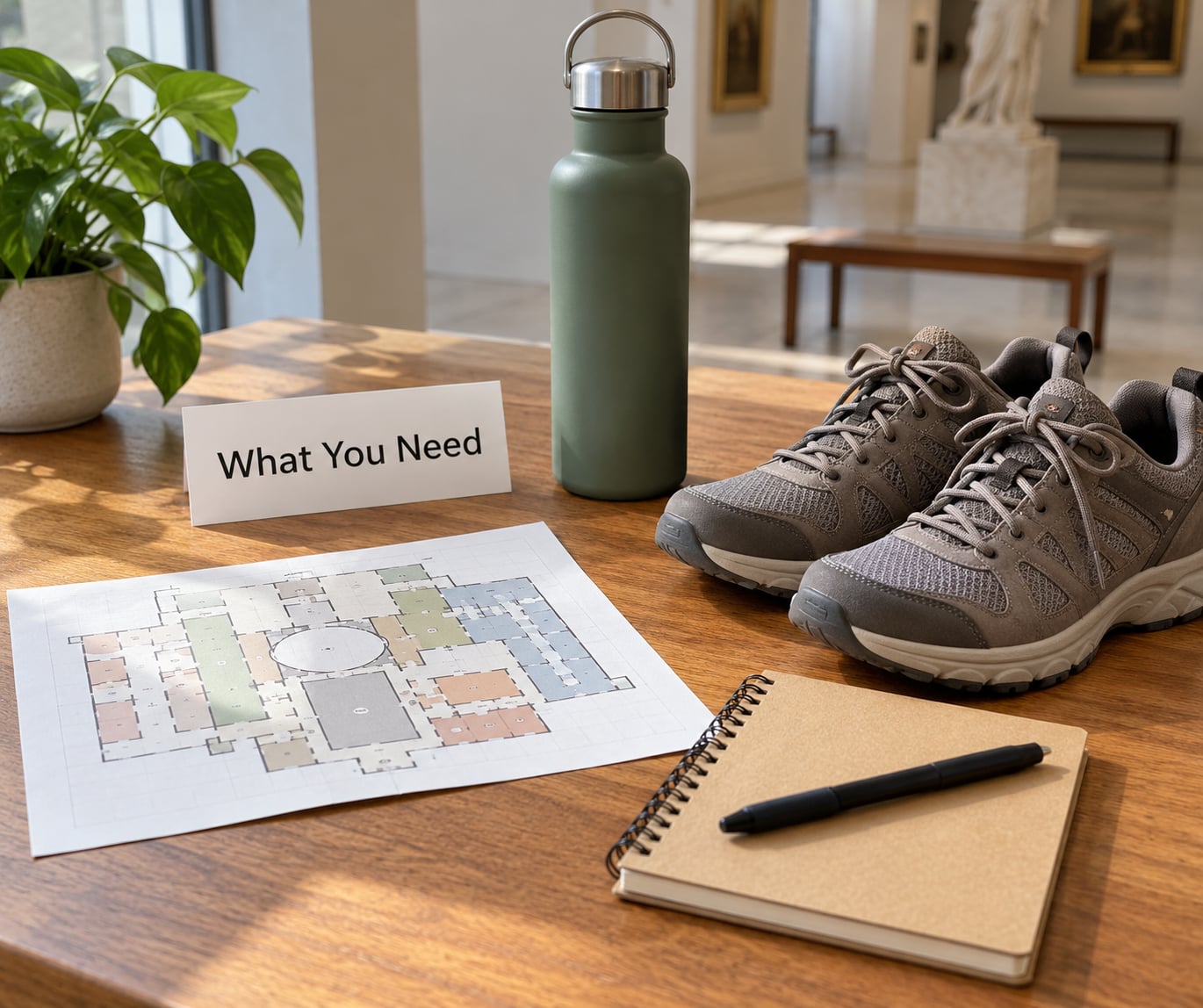
Four things, and none of them expensive. Shoes with real cushioning, a water bottle you can refill, a pocket-sized notebook, and a decision about your route made before you walk through the door.
The notebook matters more than it sounds. Writing three words about a work you liked gives your attention a landing point, and it rebuilds the visit later when you cannot remember which rooms you actually walked through.
Before you travel, spend ten minutes on the museum’s own website. Download the floor plan or the app, check which exhibition is temporary and closing, and read the gallery list. Then pick your theme.
Set expectations honestly, too. A major national collection can hold tens of thousands of objects on display, and seeing even a fraction of them properly takes days. A small local gallery might take an hour. Planning for the right size of visit is most of the work.
Adapting the plan for limited stamina
If you have low stamina, limited mobility or a condition that makes standing difficult, plan around the building rather than around the art. Every large museum publishes accessibility information that names step-free routes, wheelchairs and the rooms where seating is available.
Ask for a wheelchair at the desk if you want one. You are not required to walk to look at art, and the difference in how much you see is smaller than you would expect.
For sensory sensitivity, arrive early, stay on the ground floor where possible, and bring earplugs. Small, quiet, single-artist galleries are almost always easier than a blockbuster national museum.
Step-by-Step: A Slower Museum Visit
Six steps, in order. Each one has a signal that tells you it is working, so you can adjust mid-visit rather than guessing at the end.
1. Choose One Theme Instead of Every Gallery
Decide on one era, one medium, one artist or one country before you enter. Dutch still lifes, say, or twentieth-century photography, or a single named exhibition that is temporary this month.
Narrowing like this removes decision fatigue, which is a real drain and one people rarely name. Choosing between forty rooms and forty works is work in itself, and it happens over and over.
The signal it works: you arrive at a room and immediately know whether anything in it is for you. If you need to check the floor plan at every doorway, the theme is still too wide.
2. Start With a Short Orientation
Spend ten minutes at the entrance with the floor plan. Mark where your must-see works are, count how many rooms sit between them, and pick the one or two you would be sorry to miss.
Write those two names at the top of a page in your notebook. That page is your route for the day, and everything else is optional.
The signal it works: you know roughly how many rooms you will walk through before you start. Visitors who skip orientation tend to cover twice the distance and see half as much.
3. Alternate Looking With Sitting
Decide now that you will sit down after every two or three rooms, whether or not you feel tired. Benches, lobby sofas and the café are part of the route, not detours from it.
Sitting for five minutes resets more than it costs. Most people say the second half of a visit becomes noticeably better once they stop treating a bench as an indulgence.
The signal it works: when you stand back up, you feel a small lift. If you sit and still feel flat after ten minutes, you have probably been walking too far between seats, which means your next section should be smaller.
4. Slow Down for a Few Works
Pick two or three works for real attention. Read the wall label, look at the whole thing from across the room, then move closer and answer three questions: what is the subject, what is the material, and what does it make you feel.
Write one line about each. That is the entire method. It works even with zero art background, because nobody is marking your answers.
The signal it works: you can say something specific about those works afterwards. If you cannot, you were probably rushing, and slowing down for the next one usually fixes it.
Permission to move on matters here. Walking past a work that is not speaking to you is not rude and not disrespectful. It is triage, and every regular visitor does it.
5. Take a Real Break Before Fatigue Builds
Watch for the early signs rather than the late ones. Trouble reading a label you have read before, drifting feet, scanning a room without registering a single work, or the urge to check the time repeatedly.
Then take a real break. Water, restroom, café table, or step outside for five minutes if the museum has a door. Not a phone break in a dark corner, which keeps your attention switched on.
About every twenty minutes is a useful rhythm for a big museum. Longer if you are with children, older visitors, or anyone having a low-energy day.
The signal it works: your attention comes back rather than staying flat. Two breaks of five minutes beat one heroic hour of pushing through, and they cost less time than you think.
6. Leave Before the Visit Feels Complete
The strongest move in this whole guide is stopping early. Go while you still feel satisfied, name the two works you want to remember, and get out.
Most people do the opposite. They push to the last possible minute, hit the wall, and leave with a tired body and a blank mind.
The signal it works: you want to come back. If the thought of a second visit feels impossible, you stayed too long.
Common Mistakes
Five habits cause most of the tiredness I have seen in museum visits, and each one has a straightforward fix.
Trying to see the whole collection. It does not work and it never has. Choose a wing or a theme and accept that the rest can wait for a second trip.
Walking without a break for two hours. Your attention and your feet fade on their own schedule, which is why the back half of a visit feels worse than the front. Build sitting into the plan before you arrive.
Standing in every single gallery. Moving constantly feels productive and drains you faster. Standing still while reading a wall label upright is deceptively hard work, so alternate standing galleries with rooms where you can sit.
Researching too much in advance. Reading everything about a collection before you arrive raises expectations and leaves you with nothing to discover on the day. Ten minutes of orientation is plenty.
Ignoring what you need on the day. Arriving after a flight, a long walk or a late night is a reason to shorten the visit, not to push through it. A smaller museum beats a famous one you barely remember.
Adjusting for who you are with
With children, plan for half the time you think you need, build in a reset every thirty minutes, and agree in advance on one room you can leave early without anyone feeling cheated.
With a partner on a different pace, agree on a time limit and a meeting point before you start. Two hours and a cafe table beats three hours of one person waiting.
On your own, you have the easiest version of this problem. Your only job is to notice the early signs and act on them, and you can leave at any point without explaining to anyone.
Frequently Asked Questions
What is museum fatigue?
Museum fatigue is the exhaustion that builds during a museum visit, both physical and mental, as attention drains and the number of objects outpaces what you can absorb. It usually starts in the second or third hour. Visitors report feeling blank in a gallery while still being able to keep walking, which is a sign the tiredness is cognitive before it is physical.
How long should you spend at an art museum?
Two to three hours is the practical ceiling for most people in one sitting. Beyond that, attention drops sharply and the works you saved for last are the ones you can no longer really see. Ninety focused minutes usually feels better than three hours of coverage, and a large collection is genuinely worth splitting across two visits.
Is 2 hours at the Met enough?
Two hours at the Met is enough for a good visit if you plan it. Pick two wings rather than the whole building, look up where those wings sit on the floor plan, and allow most of the time for them. Trying to cover the Met in two hours leaves you exhausted and unable to enjoy any of it.
Is 3 hours enough for the British Museum?
Three hours covers a focused section of the British Museum, not the whole collection, and that is fine. Choose one theme such as Egypt, Greece or the Americas, pick two must-see rooms inside it, and plan a sitting break before you start. Any museum that dense becomes tiring well before the time is up.
Do I need to know art history to enjoy a museum?
You do not. Wall labels exist for exactly this, and most good visits start with reading two or three of them. The reason three works stand out to you is usually more interesting than the reason they are considered important. Curiosity gets you further than background knowledge ever does.
What to do if you get tired halfway through a museum?
Sit down properly for five minutes with water, away from the busiest room. Then decide whether to continue with a smaller plan or stop for the day. Roughly a quarter of your intended time is usually still available after a good break, so one rested hour beats two exhausted ones.
A Short Conclusion
Choose one theme, mark a short route on the floor plan, and decide where you will sit before you arrive. Those three decisions do more for how to visit an art museum without getting tired than anything you can do once you are already inside.
Keep the notebook small, give three works your full attention, and leave while you still want to come back. A smaller, more attentive visit is the whole goal.