You can meet people while traveling alone without a hostel by choosing places and activities that put you in front of the same people more than once. A private room removes the built-in social mix, so you replace it deliberately: a recurring class, a small tour, a communal breakfast, a coworking desk. Repetition does the work, not charm.
That is the honest version of the answer. A hostel hands you a common room, a notice board and a nightly event, and strangers fall into your lap before you have planned a thing. Skip it and you lose that accident. You also gain sleep, a locked door, and evenings that belong to you.
The travelers who do this well are rarely the loudest people in the room. They are the ones who stop moving every two days. Someone who stays six nights in one neighborhood and takes the same cooking class twice has more real conversations than someone who checks into a new city every morning and meets nobody. Both of those are solo trips. Only one of them is lonely.
Below is the method, in the order it works: what to pick, what to repeat, how to join a group, how to talk to someone, and what to do when it does not happen. It takes about ten minutes of planning before you land and a few hours a week once you are there.
Table of Contents›
- What You Need to Meet People While Traveling Alone Without a Hostel
- Step 1: Choose a social setting before you arrive
- Step 2: Start with a repeatable routine
- Step 3: Join a small group to meet people while traveling alone without a hostel
- Step 4: Use shared spaces without overstaying
- Step 5: Learn the art of an easy conversation
- Step 6: Turn one encounter into a repeat connection
- Step 7: Build a balanced solo social plan
- Common Mistakes
- Trying to meet everyone on day one
- Relying on loud nightlife when you do not want it
- Forcing conversation on strangers who gave nothing back
- Overbooking activities until nothing feels real
- Treating locals as a language problem
- Confusing attention with friendship
- Being unreachable, then blaming the silence
- Frequently Asked Questions
- Can you really meet people while traveling solo without a hostel?
- How do I eat meals alone without it feeling lonely?
- What are the best apps for meeting solo travelers?
- Is it safe to meet people alone when there is no hostel staff around?
- Do I need to drink alcohol to meet people while traveling solo?
- How do I make friends that last after I fly home?
- Conclusion
What You Need to Meet People While Traveling Alone Without a Hostel
You need very little. You need a schedule loose enough to be in the same place twice, a comfort with eating alone, four or five conversation openers, and an acceptance that a friendship takes three encounters, not one.
The wrong approach is treating every day as a fresh chance to meet someone. People you meet in passing are guests in your city, not residents. The ones who become friends are the ones you see again, and seeing again is something you have to schedule.
Step 1: Choose a social setting before you arrive
Pick the accommodation for its social habits, not its square footage. A small guesthouse or boutique stay with a shared breakfast table, a lounge that is used in the evening, and a host who knows the neighborhood by name gives you three built-in encounters a day without you doing anything.
Here is what to check in the listing and reviews before you book. Look for words like communal, sociable, family-run, or the owner knows everyone. Look for complaints in reverse: guests complaining that nobody talked to them in four nights means the opposite of what you want. Then look at the map, not the photos. Is there a cafe, a market, a park, a language school or a coworking space within a ten-minute walk?
A hotel lounge counts more than a hotel room. A guesthouse kitchen counts more than most hotel lounges. A serviced apartment with a kitchenette counts for nothing social, though it counts for a lot of rest.
Book the first two nights only. Stay there long enough to see whether the breakfast table has the same faces on it, and whether the neighborhood has a rhythm you can join rather than one you are watching.
Step 2: Start with a repeatable routine
Pick one time of day and make it yours for the whole stay. Breakfast at the same counter. The same thirty-minute walk at the same hour. A coffee by the window on Tuesdays. The market stall you visit every second morning until the vendor starts handing you the good bread without asking.
You are not building a social life yet. You are making the conditions for one, and the conditions are repetition in public. The first visit is you. The second is you again. The third is the moment a stranger says hello because you have become part of the furniture.
People notice regularity more than presence. Someone who passes through a cafe twice gets a nod. Someone who is there every morning for nine days gets asked whether they are working or living there, which is a real conversation starter in any language.
Step 3: Join a small group to meet people while traveling alone without a hostel
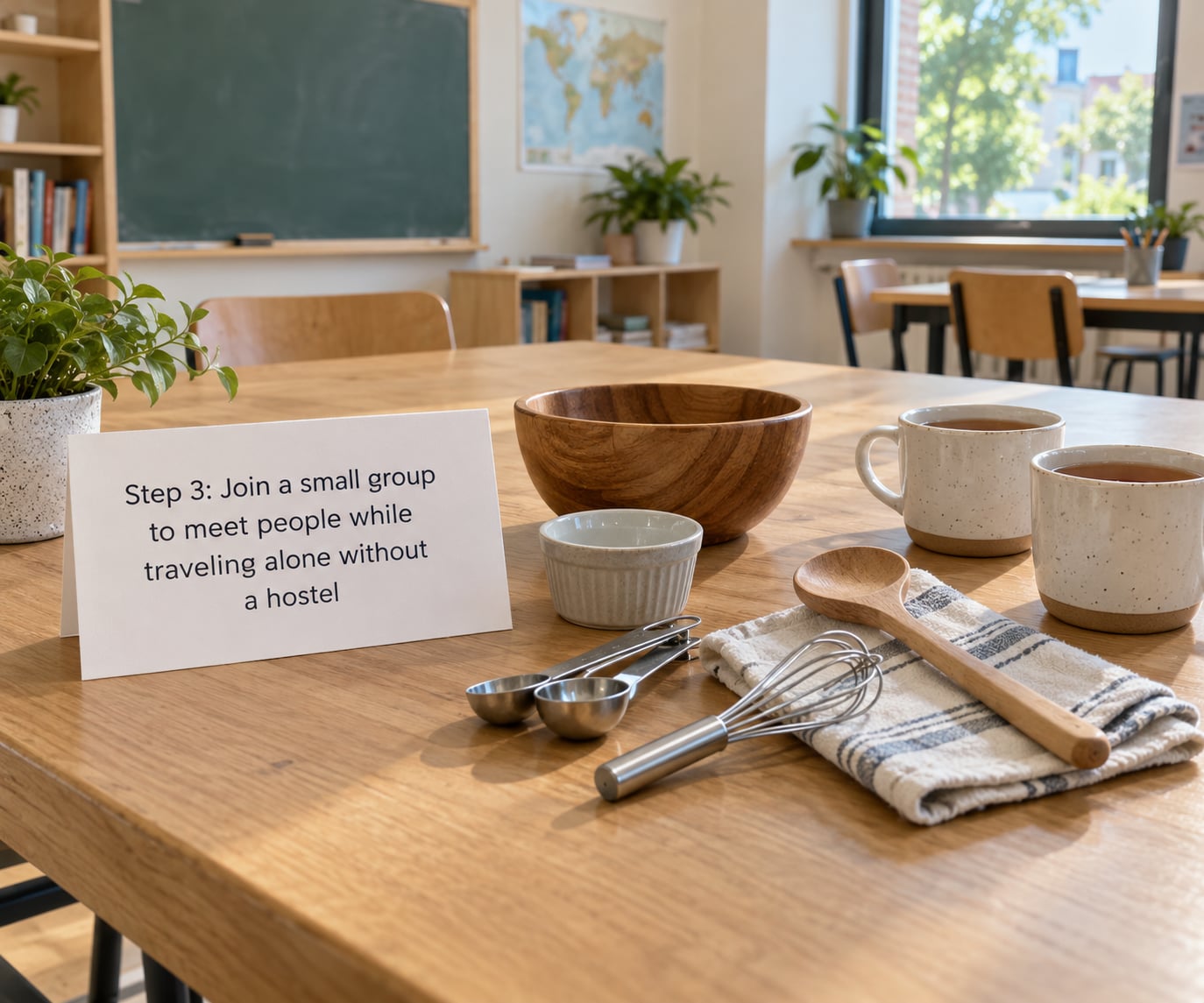
Structured activities work because they hand you a reason to talk. Nobody has to wonder why you are speaking to them. You are both doing the same thing, and the doing does the introduction.
The options that produce the most conversation per hour: a small cooking class, a free walking tour, a food market tour, a language exchange, a craft or photography workshop, a language school course, a community garden session, and short-term volunteer shifts. The worst: big bus tours with forty people, where you hear a commentary and never meet anyone.
Group size matters more than most listings admit. Under a dozen people and the guide hands out ingredients, everyone talks, and you can actually follow up. Fifteen is fine. Forty is a lecture with a vehicle.
Judge the fit before you pay. Look for a recurring session, not a one-off, because only the repeat gives you a second and third encounter. Check whether the guide talks more than the participants do. A guide who talks less and hands things out more is creating a group, not performing to one. And check who else is booking it, if the listing tells you: an evening ceramics class full of thirty-year-olds is a different evening from a rooftop party.
Volunteering and work exchange sit at the serious end. A four-hour shift in a community kitchen or a trail restoration project gives you the same eight people, the same jokes, and the same tired silence for three days running. It is slower and it is where the friendships that outlive the trip usually come from. Worldpackers and similar platforms list both short volunteering stints and longer work exchanges.
Step 4: Use shared spaces without overstaying
There are free social surfaces in every city, and most travelers ignore them because they look like places you are supposed to be doing something else in. A hotel lounge. A guesthouse common table. A public library reading room. A tea house. A coworking space with a coffee bar. They work because the people in them are already in conversation mode, and the only cost of entry is being mildly visible.
Overstaying is how you get removed from one. Sit down, acknowledge the people near you with a greeting, buy something if there is anything to buy, and occupy a normal-sized amount of table. A book, a notebook, a coffee, a laptop and a long stretch of silence is fine. Two hours of it is a problem if the room is small and nobody else is working.
Read the room, though. Some shared spaces are not social at all, and no amount of patience turns a silent reading room into a conversation. If nobody has spoken to anyone in an hour, take your book somewhere else. That is a signal about the space, not about you.
Hostels are worth one honest note here, because the advice online keeps sliding back into them. Many hostel events, free walking tours, and pub nights are open to anyone who walks in, and the notice board at the desk is public information. You can use a hostel’s social calendar as a guest, sleep somewhere quieter, and never pay the dorm price. The only thing you give up is the group that sleeps in your building, and the private-room cost in European cities is often high enough that most of these travelers would rather borrow the events than the bed.
Step 5: Learn the art of an easy conversation
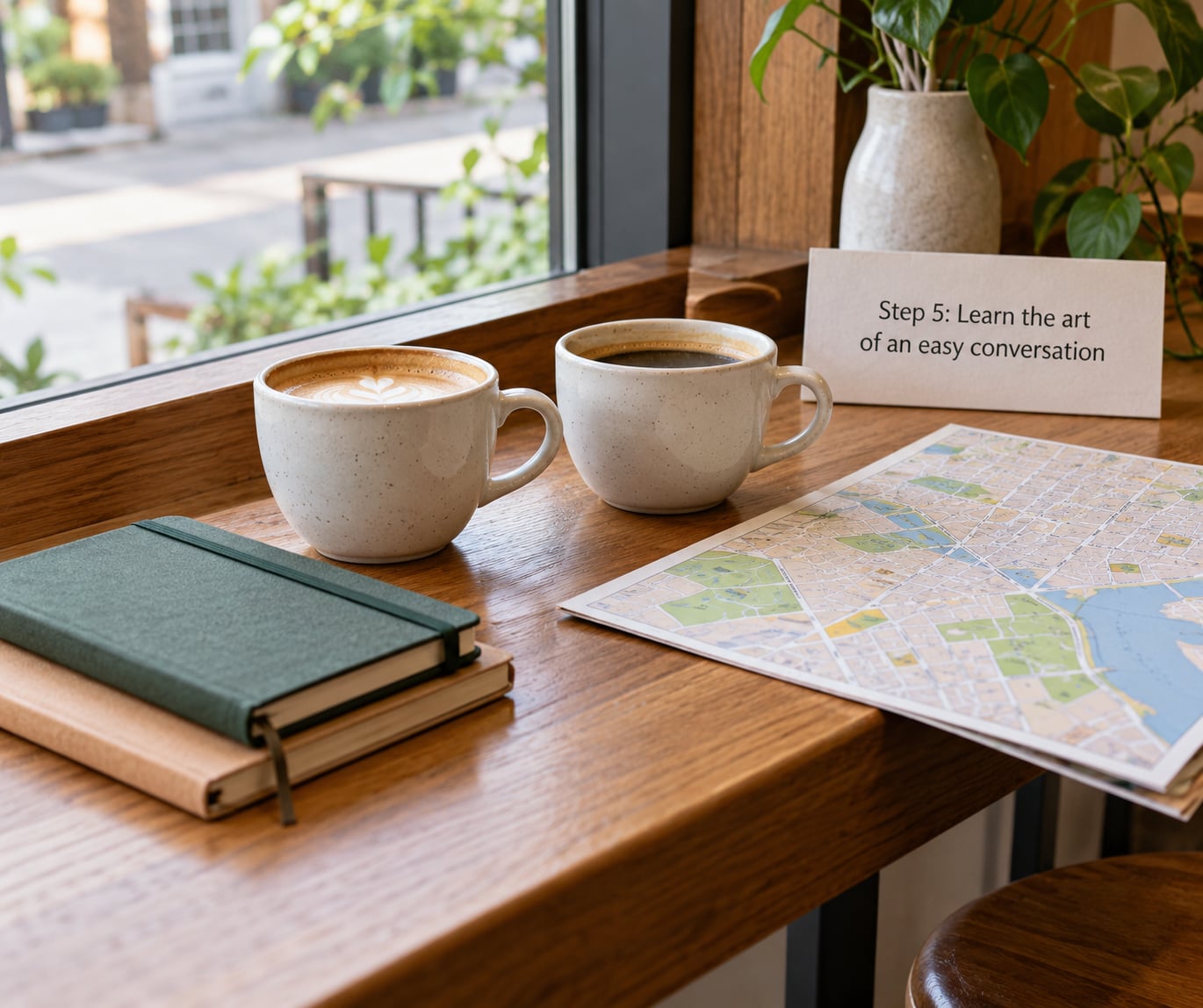
The barrier is not a language barrier. It is a permission barrier. Most solo travelers wait for someone to approach them, and then wonder why nothing happens.
Four openers that work in almost any city, and none of them requires you to be interesting:
- “Is this your first time in the city, or do you live here?”
- “Have you got a recommendation for somewhere cheap and good to eat?”
- “What do you do when you are not travelling?”
- “Do you know a good coffee here, or should I just go to the obvious place?”
The follow-up is the part that turns a sentence into a conversation. Ask about the answer rather than moving to the next topic. If someone says they have been here four months, ask what changed in those four months, or what they would do with a free Sunday. Specific beats broad. Everyone can answer what do you do here. Almost nobody has a rehearsed answer to what has been disappointing about it.
Then listen, which is the actual skill. Most conversation dies because people are preparing their next line instead of hearing the last one. A second question about something they mentioned thirty seconds ago will carry you further than three new subjects.
Culture matters too. How loudly you speak, how much you gesture, how direct you are about wanting to join them, how long a greeting takes before you can get to the point. When in doubt, mirror the person in front of you. Locals are usually easier to talk to than travelers think; the assumption that you are unwelcome is usually just a language and register problem, and a simple apology for interrupting with your English does most of the work.
When the conversation works, offer the small invitation. Coffee, a walk to the next thing on your list, ten more minutes. Low cost, easy to decline, and it is the only kind of invitation most people say yes to.
Step 6: Turn one encounter into a repeat connection
Meeting someone is cheap. Meeting them again is the whole skill. Exchange contact details yourself rather than waiting to be added, and keep the message short and specific: a reference to what you talked about, a time, a place.
Make the second meeting cost almost nothing. A coffee near both of your routes. Walking to the market you already planned to visit. That is easier to say yes to than dinner, and it keeps the pace somewhere comfortable.
Do not hand anyone the whole trip. The fastest way to lose a new acquaintance is to make them responsible for your evenings, your sightseeing, your loneliness. People have their own plans, and they will usually do one or two of them with you and then need space. Offer twice. If the second offer is declined, that is information, not rejection, and there are other people in the same room as you.
The part nobody writes about is the end. The top thread on the traveler forums is literally how you deal with friends you are about to leave behind, and the honest answer is that most of them end. Aim for a few that do not, and make that easier with two habits: put a date in the calendar before you fly, and be the one who sends the first message afterward. A photo of the cafe you both liked with a line about what you are eating now does more than a month of checking in.
Step 7: Build a balanced solo social plan
Two or three nights in a city is not long enough to build anything. On a short break, pick one anchor. One tour, one class, one regular cafe, and accept the rest as a day trip you take alone.
Four to seven nights supports two anchors: one activity in the morning or afternoon once or twice, and one repeated place for meals or coffee. That is also when work exchange and volunteering start to be realistic, because they want a block of days.
Two weeks or more is where slow travel pays. A weekly class, a league, a regular volunteering shift, a language exchange you attend twice. These are the arrangements that turn into a friend you still message in a year, because they run on the calendar rather than on your mood.
Whatever the length, keep some of the trip genuinely alone. The people who burn out on socializing are the ones who treat every free hour as a gap to fill. A morning walk with nobody, a museum on your own, an evening with the door shut and a book, and you will still have something to say to the people you did meet. Rest is part of the plan, not a failure of it.
Common Mistakes
Most failed solo social trips are not social failures. They are small, fixable things done in the wrong order.
Trying to meet everyone on day one
Fix: give yourself two days of no social obligation before you join anything. Familiarity with a neighborhood makes conversation easier, and a traveler who knows where the water fountain is relaxes visibly.
Relying on loud nightlife when you do not want it
Fix: never make alcohol the price of entry. It is not true that you have to drink to meet people, and the people who meet people without drinking are usually the ones you actually want to know. Daytime and early-evening options exist in almost every city, and they suit the non-drinker, the over-30s traveler, and anyone on a budget.
Forcing conversation on strangers who gave nothing back
Fix: two openers, then let it go. Most no’s are not about you. Move to the next person rather than escalating into a three-attempt pitch.
Overbooking activities until nothing feels real
Fix: one commitment a day, maximum two. A packed itinerary produces photos of tours, not conversations, because you are always leaving the room early. Keep the gaps for the thing that might actually happen.
Treating locals as a language problem
Fix: a greeting, an apology for your English, and a specific question about something local. Cafes, markets, bus stops and small shops are far more approachable than a table of other travelers who all speak your language and are busy ignoring you.
Confusing attention with friendship
Fix: watch for reciprocation. Does this person remember what you said, suggest things, introduce you to others? If the interest is one-directional, it is usually a drink, a conversation with a traveler passing through, or nothing. Move on without a scene.
Being unreachable, then blaming the silence
Fix: give every contact the same number you use yourself, answer when you can, and do not hand out a different channel each time. Half the fade-outs people complain about are logistics, not dislike.
A few practical tips that cover most of it. Tell one person at your accommodation where you are going when you meet someone new, and check in with someone at home. Choose the public place for the second meeting, the one with staff and a way out. Trust the discomfort that arrives with no explanation. And do not measure the trip by how many people you met. Measure it by how many times you went out alone without dreading it.
Frequently Asked Questions
Can you really meet people while traveling solo without a hostel?
Yes, but not by accident. A hostel supplies a common room, a notice board and a nightly event, and that automatic contact is what you are giving up. Replace it with planned repetition: a recurring class, a small tour, a communal breakfast table, a coworking desk. Travelers who stay longer in one place and join the same activity twice report real friendships, while those who move every two days and rely on chance report very few.
How do I eat meals alone without it feeling lonely?
Turn it into a fixed routine rather than a daily test. Eat at the same place at the same time, at the counter where the staff learn your order, and keep a book or notebook there. Regulars get greeted, and a greeting is the cheapest conversation opener in travel. Many travelers who solo dine well say the repetition is what makes it comfortable, not the food or the room.
What are the best apps for meeting solo travelers?
Meetup and city Facebook groups are the most useful because they show what is happening in your specific city this week. Couchsurfing and Worldpackers cover stays with locals and volunteering or work exchange. Eventbrite and Internations list classes and professional events. Bumble BFF works for friendship rather than dating. A useful filter: the best app for you is the one that puts you in a room with a shared activity, not the one with the best matching.
Is it safe to meet people alone when there is no hostel staff around?
Safer, mostly, because you control the setting. Tell your accommodation or a friend at home where you are going and when you expect to be back. Meet in a public, staffed place rather than a private home, keep your own transport if you can, and never hand over your phone or leave a drink unattended. If a situation feels wrong, you can leave with no explanation, and no one you have just met is entitled to an apology for that.
Do I need to drink alcohol to meet people while traveling solo?
No. The social scenes built around alcohol are loud and young, and plenty of travelers have found their people elsewhere entirely. Cooking classes, walking tours, board-game nights, language exchanges, running clubs and volunteering all work in the middle of the afternoon and cost little or nothing. The only cost of skipping the bar is that you meet fewer backpackers, which is not always the goal.
How do I make friends that last after I fly home?
Expect most to end and work on the few that do not. Repeat contact is the requirement, so favor recurring classes, leagues and volunteering shifts over one-off tours. Before you leave, put a specific date in both calendars rather than saying stay in touch. Afterward, send the first message within a week, with a photo or a small update rather than a check-in. People rarely drop a friendship by accident, but they do drop one by silence.
Conclusion
Start with two decisions. Pick one place you will return to every morning for the length of your stay, and one small group you will attend twice before you leave that neighborhood. Then make one low-pressure invitation, and let the second encounter do the work. Nobody meets everyone on a solo trip. A few people who remember your name is the whole point.