To stay safe walking alone at night in a new city, plan three things before you go out: the lit, populated route you will take, the ride home if you change your mind, and the name of one person who knows exactly where you are and when you expect to arrive. Ten minutes of setup removes most of the risk that an unfamiliar evening can create.
New cities are not more dangerous than familiar ones. What is missing is your read on the place: which streets fill up at 10pm, which ones go quiet, where the late bus stops running, which shopfronts stay lit until midnight. That read is what people lean on at night, and it takes a day or two to build. Until you have it, plan instead of improvising.
This guide runs as a checklist you can run in about ten minutes before stepping out, whether you have been in the city for one night or one year. It is written for anyone arriving alone, regardless of gender, and it assumes you would rather enjoy the evening than hide from it.
Table of Contents›
- What You Need
- Step-by-Step: How to Stay Safe Walking Alone at Night
- 1. Check the route and the neighborhood before you leave
- 2. Set realistic limits before you go out
- 3. Tell someone where you are going
- 4. Keep your phone and money ready without looking distracted
- 5. Walk with purpose and read the street
- 6. Switch to transportation when the situation changes
- 7. Know what to do in an emergency
- 8. Check in when you arrive and learn from it
- Common Mistakes
- Frequently Asked Questions
- What should I do if my phone dies while walking alone at night?
- Is it safe to wear headphones while walking alone in a new city?
- How do I choose a safe neighborhood for a night walk?
- What should I do if I think someone is following me?
- How can I report a safety incident while traveling abroad?
- Conclusion: Start With a Simple Night-Route Plan
What You Need
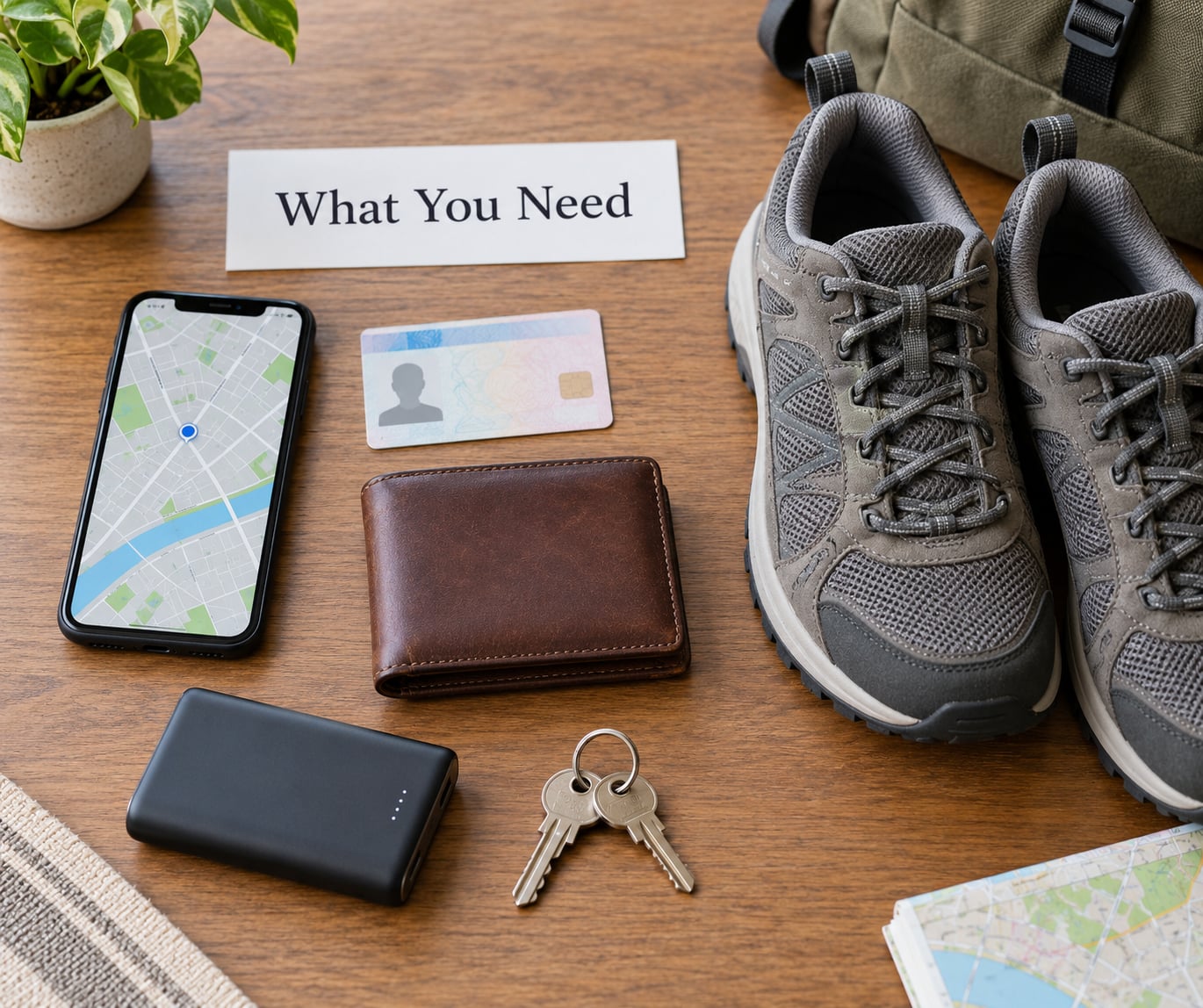
You need fewer things than most people assume, and most of them can be prepared once per city rather than every night. Setting these up takes about ten minutes the first evening you arrive.
- A charged phone with a power bank in your bag. Phone battery anxiety is the single most common worry people raise. A dead phone means no map, no ride, and no call for help.
- Offline maps. Download the city map before you need it. Signal drops in exactly the places you do not want it to, and a blank map app tells you nothing when you are unsure where you are.
- Your accommodation address in the local language. Type it out, save it as a screenshot, and write it on paper. Showing a local script is far more effective than spelling it out to a driver.
- Identification and a payment method you can reach quickly. A card in a front pocket or a money belt worn under clothing beats a bag that has to be opened.
- An emergency contact who is actually awake. Pick someone in your own time zone where possible, and agree in advance what happens if they do not hear from you.
- Comfortable shoes. You are far more likely to walk further than planned than you expect, and tired feet turn a ten-minute walk into a problem.
- A safe transportation option. Know which taxi stands exist, which ride-hailing apps work in this country, and whether your accommodation offers a late-night pickup.
On money specifically: experienced solo travelers tend to use ATMs inside banks or glassed-in foyers rather than on the street, and to split cash across more than one place. A crossbody bag worn across the body, or a money belt with cards and passport, removes the bag-snatching scenario entirely.
Step-by-Step: How to Stay Safe Walking Alone at Night
1. Check the route and the neighborhood before you leave
Compare the route in daylight and again after dark before trusting it. On a map app, look for continuous street lighting, open businesses, transit stops and late-opening venues along the way, and mark any stretch that goes more than a couple of blocks without one of those.
Save a screenshot of the route rather than relying on live navigation. Confirm your return option too: the last bus time, the taxi stand nearest to your accommodation, and whether the hotel or hostel has a night desk or a shuttle.
How to tell it worked: you can say the name of your destination, the street you will enter, and the time you plan to be back, without opening an app.
2. Set realistic limits before you go out
How to stay safe walking alone at night in a new city comes down to one decision made while your judgment is still sharp: when you turn around. Pick an arrival time, a walking duration, a destination and a firm turnaround point that match your energy, not your optimism.
Jet lag and long travel days dull judgment at exactly the wrong moment. If you landed that morning or walked fifteen hours, lower your limit on purpose rather than discovering it halfway home.
How to tell it worked: you know where you are going, when you are going back, and what you do if the route changes.
3. Tell someone where you are going
Send one message with the destination, your route, the name of your accommodation, your expected arrival time and a check-in time. Specify what should happen if that check-in message is missed, so the other person is not guessing at midnight.
Share it privately, not publicly. A live location link is a useful safety tool and a bad souvenir to leave on a public feed.
How to tell it worked: one person could find you right now, and knows what to do in twenty minutes if they cannot.
4. Keep your phone and money ready without looking distracted
Set your lock screen to show the emergency number and one contact. Keep the ride-hailing app logged in, the payment card to hand, and the phone in a pocket you can reach without stopping to rummage.
Awareness does not mean staring at your screen. It means your phone is ready when you want it and invisible when you do not. A power bank in the bag, charged before you leave, is the cheapest safety equipment you will ever own.
How to tell it worked: you can call for a ride or for help without opening a bag, digging through a coat, or finding a dead battery.
5. Walk with purpose and read the street
Keep your head up, your pace steady, and stay in public, well-lit areas. The principle experienced night walkers share is a plain one: stay where there are people and houses, and give a wide berth to parks, trails, empty lots and parking garages where nobody would hear you.
Give a street about thirty seconds. These are the signals I use:
| Safer signs | Risk signs |
|---|---|
| Open shopfronts with light spilling onto the pavement | Shut shutters and dark upper floors |
| Mixed age groups and people on phones or in groups | One or two people, far apart, no visible activity |
| Late-opening venues and lit transit stops | Long unbroken stretches between lights |
| Visible staff or security in a staffed building | Empty parking structures and unlit stairwells |
| Traffic on the road, even light traffic | Side streets, alleys and underpasses |
If something feels seriously wrong, stop walking the route and go into the nearest staffed business. A cafe, a hotel lobby or a shop with an open door is a temporary safe stop, and asking the staff to call you a taxi is completely normal.
How to tell it worked: you could name three places along your route where you would go inside if you needed to.
6. Switch to transportation when the situation changes
Have the decision rule ready before the night starts, because tired, tired-and-hungry travelers at 1am are not the right people to negotiate with a street. The rule below is the one I would set in advance.
| Situation | Best choice | Why |
|---|---|---|
| Lit main street, steady foot traffic, short distance | Walk | Cheapest, and the route is already read |
| More than about 20 minutes on foot, or unfamiliar side streets | Ride | Longer exposure, more unknowns |
| Last transit has already gone | Ride or wait inside a staffed venue | Waiting in the open is what creates risk, not the hour itself |
| After drinking, or a long day of travel | Ride | Judgment and reaction time are both reduced |
| Waiting for a ride after midnight in a quiet area | Move to a lit storefront | Pickup spots move; do not stand in the dark waiting |
| 3am, no familiar lit route | Stay inside and wait | Every option has a failure mode; doing nothing has fewer |
Whichever you pick, verify the vehicle before getting in. Compare the plate and the driver name against the app, say the name of your destination out loud so the driver knows you are tracking the trip, share the ride with a contact, and sit in the back seat with the door reachable from inside. On a licensed taxi, ask for the receipt or note the plate.
How to tell it worked: you never entered a vehicle you had not looked at properly first.
7. Know what to do in an emergency
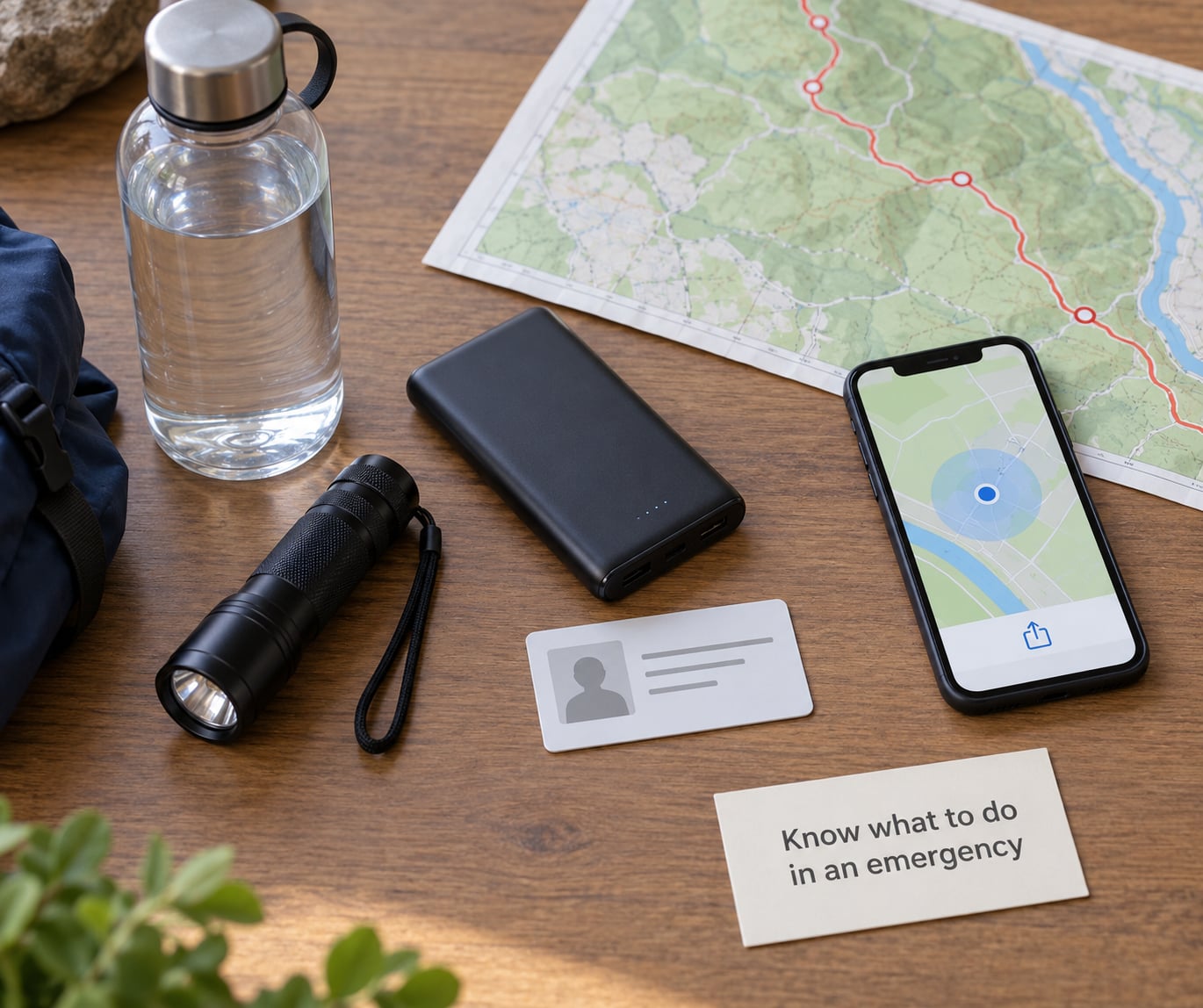
Memorize the local emergency number before you need it. It is 911 in the US and Canada, 112 across most of Europe, and 999 in the UK; check yours specifically, since the same city can have different numbers for police, ambulance and fire.
For lower-level situations, most countries also run a police non-emergency line. That is the right number for a lost person, a scraped knee from a fall, or a situation you want on record but that is not an active emergency. Your hotel or hostel front desk is another practical resource, and most desks will call a taxi, store a passport, or sit with you on the phone.
If you think you are being followed, do not run and do not confront anyone. Turn toward light and people, enter a staffed business, call someone, and request an escort or a taxi to take you somewhere busy. Walking calmly to a lit doorway is safer than sprinting down an alley.
If you are robbed, do not resist over property. Note descriptions afterwards, cancel cards, and report it. For anything medical, call the emergency number or get to a hospital; a hospital is always the right place after a fall, a drink you are unsure about, or a head injury.
This is planning, not a substitute for local law enforcement or trained responders. If you are in immediate danger, call the emergency number where you are.
How to tell it worked: you could dial the local emergency number from memory, right now.
8. Check in when you arrive and learn from it
Send the arrival message, confirm the next person receives it, and cancel any location sharing you no longer need. Then write down two things while the evening is fresh: which parts felt safe, and which parts felt wrong.
Personal discomfort counts as data, even on a street that is technically busy and technically safe. People who walk home through the same block for six weeks in a city report get a real feel for it that no article can hand them.
How to tell it worked: by your third night, your route has changed once based on something you noticed.
Common Mistakes
Almost every night-walking problem I hear about comes from one of these, and each has a simple fix. They matter most in the first few days, which is exactly when people ask how to stay safe walking alone at night in a new city and get advice written for a much more experienced traveler than they are.
Relying on a phone battery. The fix is boring and effective: full charge before you leave, power bank charged, and the accommodation address written down on paper.
Taking an unfamiliar shortcut. The distance you save is small and the information you lose is large. Walk the route you have read.
Walking while absorbed in a call. Keep calls short and save the long ones for indoors. You cannot hear an approaching bicycle or notice a car slowing behind you while watching a screen.
Wearing headphones in both ears. One earbud for audio you actually want, or none in unfamiliar areas. Cancelling the street out is not worth the trade.
Accepting an unmarked car. Use an official ride-hailing app or a licensed taxi rank. If a driver cannot produce a licence or a receipt, that is the end of the conversation.
Skipping the check-in because the evening is going well. That is exactly when you send it, because it costs ten seconds and you will be glad to have the record.
Pressing on after something is clearly wrong. The decision to get a ride is easiest in the first thirty seconds of unease and much harder after twenty minutes of talking yourself out of it.
Accepting advice written for someone else. Most published guidance is written for women and reads oddly if you are not. Male and non-binary travelers report the same underlying need: lit routes, verified rides, and someone who knows where you are. The mechanism does not change.
One more thing rarely mentioned: vigilance is tiring. Scanning a street for two hours straight makes people anxious, and anxious people either freeze or start ignoring the signals they have been taught to watch for. Take the walk in pieces, and accept that being briefly relaxed in a busy place is not carelessness.
Frequently Asked Questions
What should I do if my phone dies while walking alone at night?
A dead phone means no map, no ride and no way to call for help. Head somewhere lit and staffed, such as a cafe or hotel lobby, and ask to borrow a socket. Carry a power bank, and write your accommodation address in the local language on paper. Deciding your fallback before the battery dies is far easier than improvising in the dark.
Is it safe to wear headphones while walking alone in a new city?
One earbud is a reasonable compromise in busy, lit areas; both ears is a poor idea anywhere unfamiliar. Noise cancellation removes traffic, footsteps and someone approaching from behind, which are the cues you rely on most. If your phone is on audio, keep one ear free and drop the volume whenever you reach an unfamiliar stretch or a quieter block.
How do I choose a safe neighborhood for a night walk?
Look for the same signals you would on foot: continuous lighting, open shopfronts, late-opening venues, lit transit stops and steady foot traffic. Check how the street looks after dark rather than how it looks on a map at noon. Staying in the area where other visitors are staying for the first few nights is a reasonable default, especially before you know the city well.
What should I do if I think someone is following me?
Do not run or confront anyone. Cross the street and check whether they cross too, enter a staffed business and call someone while you are inside, and ask staff or the front desk for an escort or a taxi. Share your live location so the person on the other end can see where you are. Keeping moving toward light and people is far safer than retreating down a quiet side street.
How can I report a safety incident while traveling abroad?
Start with the local police, using the emergency number for anything urgent and the non-emergency line for a report you want on record. Most countries also have tourist police or a tourist assistance line, and your embassy or consulate can guide you and help with paperwork. Report early, keep copies of any reference number, and tell your insurer as soon as practical.
Conclusion: Start With a Simple Night-Route Plan
Choose a lit, public route you have already looked at in daylight. Tell one person where you are going and when you expect to be back. Keep a charged phone, a payment method you can reach instantly, and a ride option available for the whole evening, including the plan to go back early.
Run that same three-step plan every night for the first few days, and adjust it as you learn the city. The goal is not to avoid evenings, but to make each one predictable enough that you can enjoy it.