To secure a hotel room door at night, inspect the latch, strike plate, and hinges before you settle in, close the door until it latches on its own, then throw the deadbolt or swing bar. Everything else — the security chain, a towel under the door, a portable lock — is optional backup on top of that.
The whole routine takes about two minutes. Most of it is habit rather than gear, and the parts people skip are the parts that matter. I’ve spent enough nights in hotel rooms to know that the deadbolt is doing nearly all the work, and that guests routinely assume the chain is a lock when it is really just a privacy latch.
One thing worth saying up front: this is about the door and your own room, not about predicting who is in the hallway. If something feels wrong, the answer is a phone call to the front desk, not a confrontation.
Table of Contents›
- What You Need
- Step-by-Step
- 1. Inspect the Door and Frame Before Entering
- 2. Close the Door Fully and Test the Automatic Lock
- 3. Use the Deadbolt or Secondary Lock
- 4. Use the Security Chain Correctly
- 5. Secure the Room When You Leave or Go to Bed
- 6. Respond Safely to Signs of Tampering
- 7. Recheck the Door During the Night
- Common Mistakes
- Quick Security Tips for Overnight Guests
- Frequently Asked Questions
- How can I secure a hotel room door at night?
- Should I leave the hotel room security chain on all night?
- What should I do if the hotel door latch feels loose or damaged?
- Is it safe to wedge furniture against a hotel room door?
- How should a solo traveler respond to someone knocking on the room door?
- Can I use a portable door lock in a hotel room?
- Conclusion
What You Need
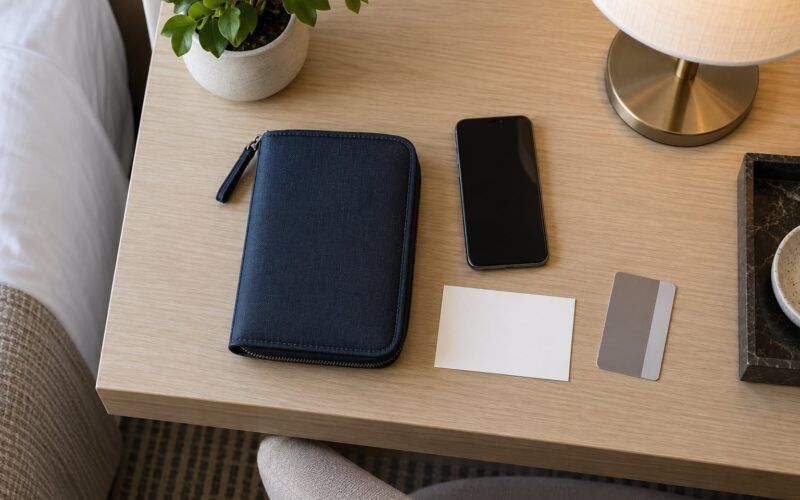
You need very little. Your room key card, a phone with a charged battery, and about two minutes of attention before you unpack.
Helpful but optional: your phone’s torch for looking at the latch in a dim entryway, and the room safe for passports, cash, and devices once you’ve checked the door is sound.
What you do not need is an improvised barricade. Wedge a hotel desk across the door, tie the handle to a doorknob with a belt, or hang a towel over the peephole and you’ve bought yourself a fire-code problem and possibly a charge on your card at checkout. Guests have been barred from properties for damaging doors, and hotel doors are frequently fire-rated, which means the hardware is rated to be opened from the inside in an emergency.
Also skip the habit of leaving a chair under the handle. On a standard hotel door it buys you almost nothing against anyone who pushes, and on a fire-rated door it can trap you.
Step-by-Step
1. Inspect the Door and Frame Before Entering
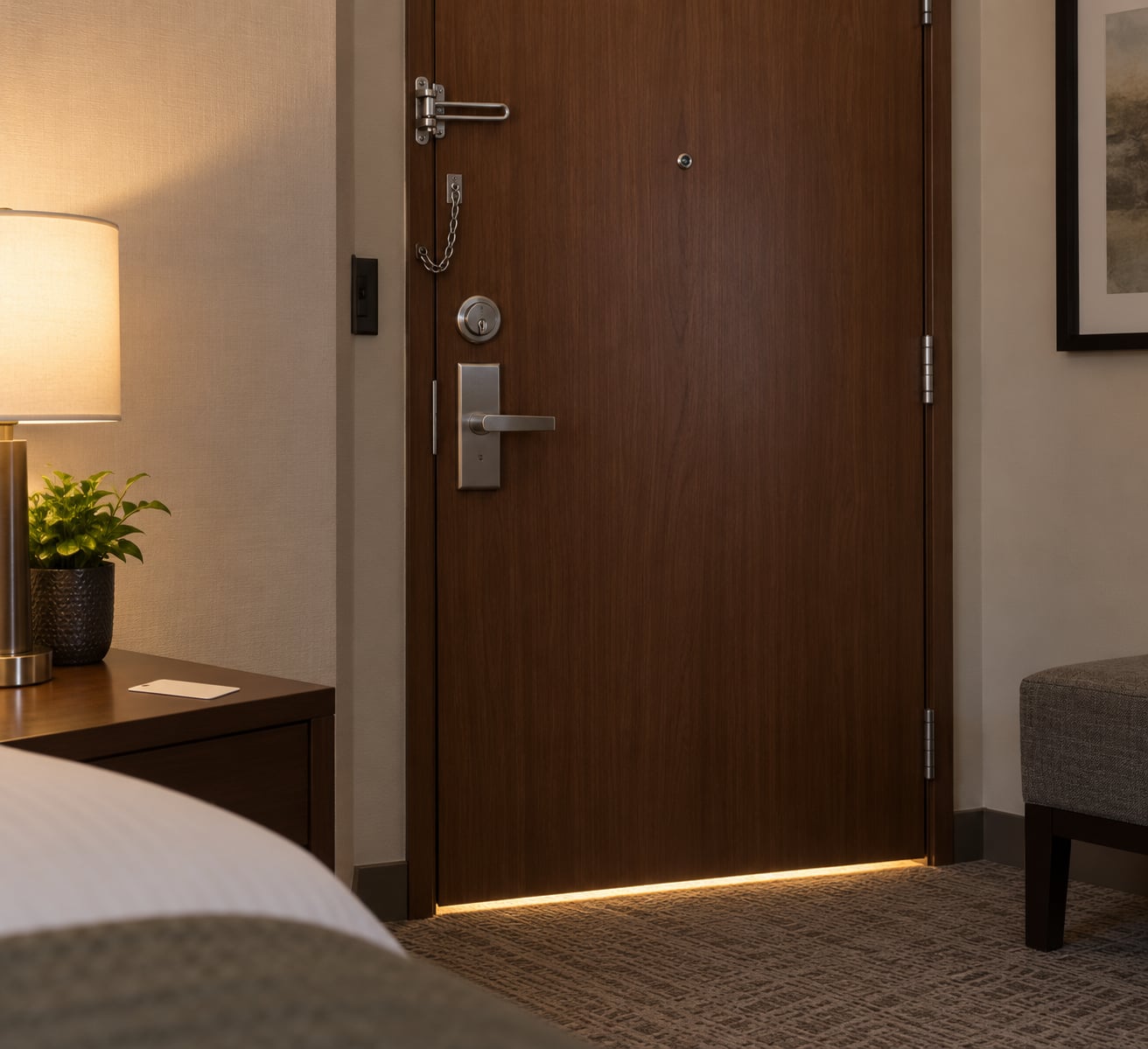
Stand in the hallway with the door open and look at the closing edge. You are checking four things: the latch bolt that should line up with the strike plate, the strike plate itself for a loose or widened screw hole, the hinges for screws that look pushed or lifted, and the peephole for anything bent or blocked.
A scuffed strike plate with a bright halo around the screw holes is the tell. So is a latch that sits loose in the door edge or catches halfway instead of clicking home. If you find any of that, do not enter the room — call the front desk from the hallway and ask for a different one.
Do not touch anything that looks taped, wedged, or wired into the latch. Step back, stay in the lit hallway, and ask staff to open it with a master key while you watch.
2. Close the Door Fully and Test the Automatic Lock
Most hotel doors are self-locking: they latch as soon as the door closes, and an electronic or magnetic lock re-secures itself automatically after the door has been open for a few seconds. If you leave a hotel door propped or barely shut, it may not latch at all.
Push the door closed until you hear the latch click, then pull the handle. It should stay put. Then step back and watch the lock indicator or the latch bolt from a few inches away — on many doors the bolt visibly extends into the strike plate.
If the door swings open with a normal pull, do not assume it is fine. Call the front desk, say the door is not latching, and ask for a repair or a move. A door that will not latch is the single most common real security problem in a hotel room.
3. Use the Deadbolt or Secondary Lock
The deadbolt is the only built-in feature that genuinely resists entry, because it cannot be operated from the corridor without a key. If your door has one — turn it fully until it stops and give it a shake to confirm it is seated.
Some doors instead have a swing bar: a flat metal plate inside the door that you slide under the handle and lean against, creating a rigid brace that stops the handle being pushed down. A variant uses a sliding bolt on a track. Both do the same job as a deadbolt when the deadbolt is missing, which is common in older motels and in student accommodation.
Some doors have a lever handle and no interior lock at all. In that case, a portable door lock or a door wedge is not a nicety — it is the barrier doing the job, so put one in place before you go to sleep.
4. Use the Security Chain Correctly
The chain on a hotel door is a privacy latch, not a security device. It is there so you can admit someone while the door stays mostly shut. A determined person can push a chained door open, and most chains can be popped off the screw studs with the door under pressure.
So use it, but use it for what it does. Slide it across before you open the door for a late room-service delivery, and slide it back once the door is shut and the deadbolt is thrown. Leaving it fully extended all night does nothing for you and it makes the door awkward to open in an emergency.
One genuinely useful by-product: covering the peephole with a folded card or a spare sheet of paper means nobody on the corridor can see your light on, and nobody can work out what time you are up.
5. Secure the Room When You Leave or Go to Bed
Run a short loop every time you leave the room and once more before you turn the lights off. Close curtains over any window that looks onto a walkway or a fire escape. Put passports, cash, spare cards, and your laptop in the room safe, and set the safe’s own code to something you will remember in daylight.
Hang the do-not-disturb sign if you are resting and want housekeeping to skip you. It is a courtesy, not a lock, but it does reduce the number of times someone tests your handle.
Keep your key card on the nightstand or in your hand as you lie down, not in a jacket pocket across the room. Charge your phone on the far side of the bed so you do not have to cross the room to reach it. Then take one last pull on the deadbolt from inside the room.
6. Respond Safely to Signs of Tampering
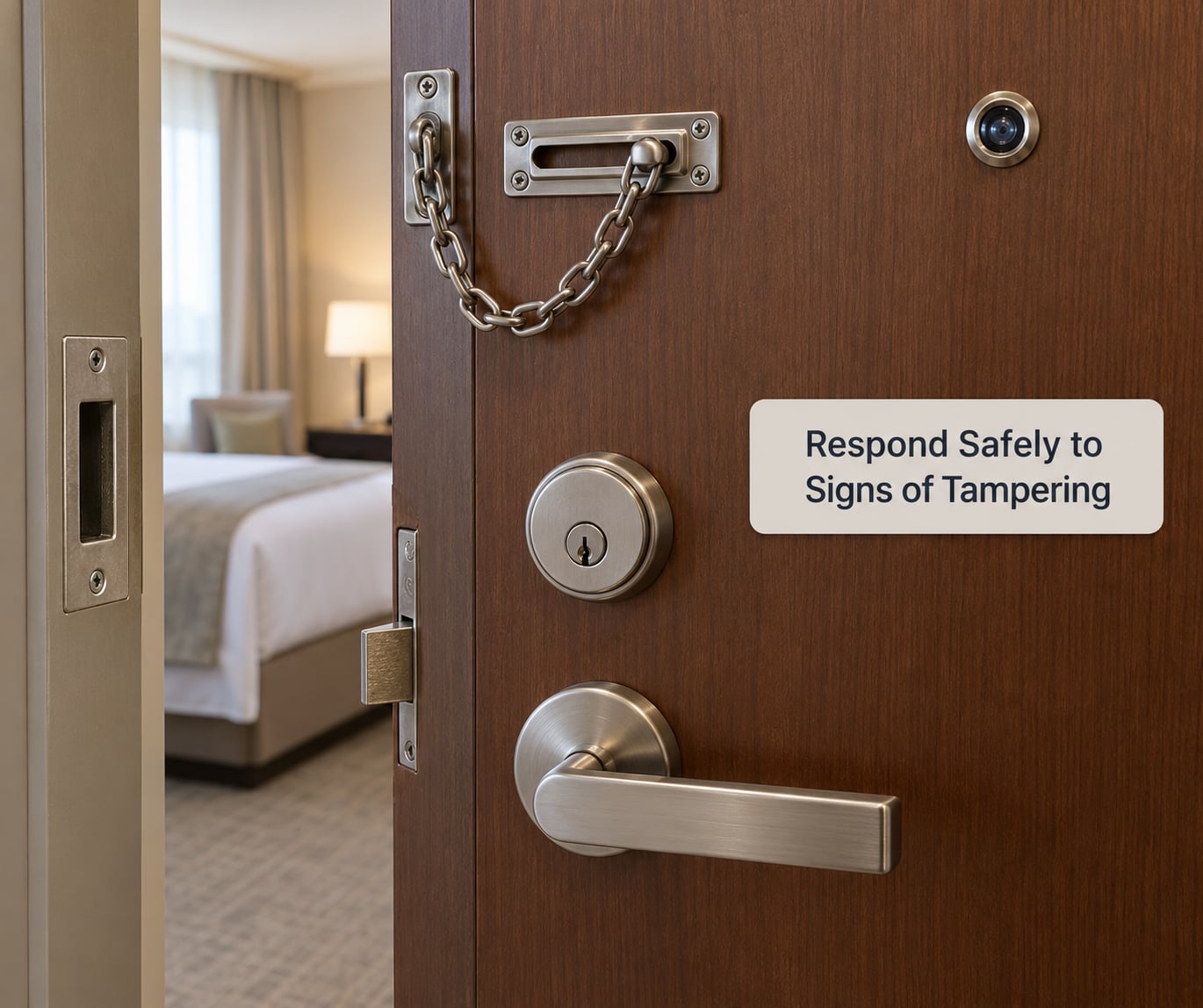
If you come back to a room and find the chain hanging loose, the deadbolt undone, the swing bar slid back, or the door standing slightly open when you left it shut, treat it as a real problem rather than a housekeeper’s shortcut.
Move to somewhere defensible first — another room, the lobby, or a hallway corner away from the door — and call the front desk. Say plainly that the room security features have been disturbed and you want someone to come with a master key while you wait outside.
If you hear someone testing the handle while you are inside, stay quiet, do not open the door, and call the front desk on your phone or your room’s phone. Call emergency services if you are in immediate danger or believe a crime is in progress. Do not go into the corridor to look for whoever it was, and do not try to hold the door yourself.
7. Recheck the Door During the Night
One quiet check is reasonable if you’re genuinely unsettled. Do it by looking at the door from inside rather than walking over and grabbing the handle, and see whether the deadbolt is still thrown, whether the chain is where you left it, and whether the latch is still seated.
Try not to make a habit of it. Repeatedly testing the door breeds the exact anxiety it is meant to manage, and it disturbs a building full of strangers at three in the morning.
Do step up and check if you hear specific cues: the chain swinging against the door, the deadbolt turning, a card being read at the lock, or footsteps that stop outside your door and stay there. Those are worth a call to the front desk at any hour. Housekeeping knocking at a normal hour is not.
Common Mistakes
Leaving the deadbolt unengaged. The single most common error. The latch is a spring-loaded catch, not a lock — a shoulder or a knee opens it. Throw the deadbolt or set the swing bar every time, including for a two-minute trip to the ice machine.
Trusting the security chain as a lock. It is a privacy latch. It slows conversation, not entry.
Wedging furniture against the door. On a fire-rated door it can stop you getting out, and hotel staff will treat damage to the door or frame as a chargeable problem.
Leaving valuables in sight. A laptop on the desk or a passport on the bedside table is the target, not the lock. The room safe exists for exactly this overnight.
Ignoring a faulty latch. A loose latch that catches halfway is an invitation. Get the room changed.
Using an emergency exit route as a security device. Propping or tampering with anything fire-related puts you at fault in a real emergency, and staff will involve the fire marshal.
Assuming room numbers are private. Say the number out loud in a hallway, gym, or lift and write it nowhere visible in public. Ask the front desk to note any security concern on your account in writing.
Quick Security Tips for Overnight Guests
Solo travelers and anyone staying alone get the most out of the basics: identify the nearest fire exit and the second exit on your floor the moment you walk in, note where the fire stairs are, and check whether your connecting door has a lock or just a chain — if it’s the latter, ask for a room without a connecting door.
Families should decide where the bathroom is the safest place to sleep if a room has a balcony or a window onto a walkway, and teach kids to answer the phone instead of the door. Remote workers with valuables in the room should use the safe and leave the curtains closed, so a passerby can’t tell whether the room is occupied.
Carry a portable door lock or a rubber wedge in your carry-on if your property has older lever-handle doors. Keep a charged phone and a small flashlight in the room rather than in your bag, and set up your room so you can reach both without crossing the floor.
If you need a room changed because of a lock, a balcony, or a connecting door, ask politely at check-in and follow up once you are settled. Front desks move people for security reasons routinely — it is a normal request, not an escalation.
Frequently Asked Questions
How can I secure a hotel room door at night?
Inspect the latch, strike plate, and hinges before you enter, close the door until it latches, then throw the deadbolt or set the swing bar. Most electronic hotel locks re-lock themselves within seconds of closing. Add a door wedge or portable lock if your door has no interior lock. Keep the chain as a privacy latch only, and store valuables in the room safe overnight.
Should I leave the hotel room security chain on all night?
No. The chain is a privacy latch, designed to let you open the door without fully exposing the room. It will not stop a determined person from pushing the door, and many chains can be pulled off their screw studs under pressure. Slide it across for a delivery or a visitor, then slide it back once the door is shut and the deadbolt is thrown, so the door stays easy to open in an emergency.
What should I do if the hotel door latch feels loose or damaged?
Do not enter the room, and do not try to fix it yourself. Call the front desk from the hallway and report a damaged latch, strike plate, or hinges, and ask to be moved to another room. A latch that catches halfway or a strike plate with a bright halo around the screw holes means the door is not holding properly. Get the problem logged at check-out time so it is documented.
Is it safe to wedge furniture against a hotel room door?
Usually not. Hotel doors are often fire-rated, and heavy furniture can stop you opening the door quickly in a fire or blocking staff from getting in. It also risks damage charges, because door and frame damage is billed to the guest. A rubber door wedge or a portable door lock gives you a barrier you can remove in one second, which is what you actually need in an emergency.
How should a solo traveler respond to someone knocking on the room door?
Do not open it. Look through the peephole, and if you cannot identify the person, call the front desk from your phone and ask whether they sent anyone up. For deliveries, use the chain so the door stays mostly shut. Never open the door to someone who cannot state your name and the hotel. If you feel unsafe, move to the lobby or another room and ask staff to accompany you.
Can I use a portable door lock in a hotel room?
Yes, and it is the sensible choice for a door with only a lever handle and no interior deadbolt, or with a deadbolt that will not throw. A portable door lock clamps to the door frame and the hinged side of the door itself, so it stops the door being pushed inward without touching the lock hardware. Check that your model suits the door’s thickness and gap before you travel, and remove it before check-out.
Conclusion
Start in this order, and the rest is detail. Look at the latch, strike plate, and hinges before you walk in, close the door until it clicks home, then throw the deadbolt or set the swing bar. Treat the chain as a courtesy for visitors, not as protection.
Put your valuables in the room safe, keep your key card and a charged phone within reach, and if the lock, frame, or peephole looks wrong — or something has been disturbed while you were out — call the front desk from somewhere safe and ask for a room change. That’s the whole routine.