An artist residency is a structured program that gives you dedicated time, workspace, and often housing so you can work on a project away from your usual environment. Finding one takes a mix of research, a clear portfolio, and a short, honest application. Most people spend three to four months of preparation on a shortlist of five to eight calls, then submit over a two-month window.
This guide walks through that whole process: what to have ready before you start searching, how to find artist residencies and apply to the ones that actually fit, how to spot a program that will waste your time, and what to send when the deadline hits. It is written for working artists, writers, choreographers, composers, and interdisciplinary makers at any career stage.
Table of Contents›
- What Is an Artist Residency?
- What You Need
- How to Find an Artist Residency and Apply: Step by Step
- Define what a residency should offer you
- Search official calls and trustworthy directories
- Check dates, eligibility, costs, and application requirements
- Read the brief for evidence of a strong fit
- Prepare a portfolio that shows the work behind your fit
- Tailor the statement, biography, and project proposal
- Submit early, proofread, and follow up once
- Common Mistakes
- Frequently Asked Questions
- How do I find artist residencies with funding?
- Do reputable artist residencies charge application fees?
- Can I apply to an artist residency with an AI-assisted portfolio?
- What should I include in an artist residency project proposal?
- How can I improve an artist residency application after being rejected?
- Conclusion
What Is an Artist Residency?
An artist residency is a structured program providing artists with dedicated time, space, and resources to focus on creative projects outside their regular environment. Programs typically last from two weeks to twelve months and usually include some combination of studio access, accommodation, a stipend, and some kind of public moment at the end, whether that is an exhibition, a reading, a screening, or a talk.
Three funding models cover almost everything you will find:
- Fully funded covers studio, housing, and usually a living stipend plus travel. These are the most competitive, and acceptance rates at well-known programs can sit in the low single digits.
- Self-funded means you pay a fee that covers your stay. You are buying space and time, not applying for a grant.
- Work exchange covers your costs in return for a defined contribution, usually assisting another artist, maintaining a site, or helping run a program.
That last model is badly under-promoted and it is the one most first-time applicants never look at. If money is the barrier, it is worth an afternoon of research.
One more term worth knowing early: an open call is a public invitation to apply, usually with a set deadline and stated criteria. Most residencies you will read about are open calls, which means the bar for entry is defined in advance rather than decided by who applies.
What You Need
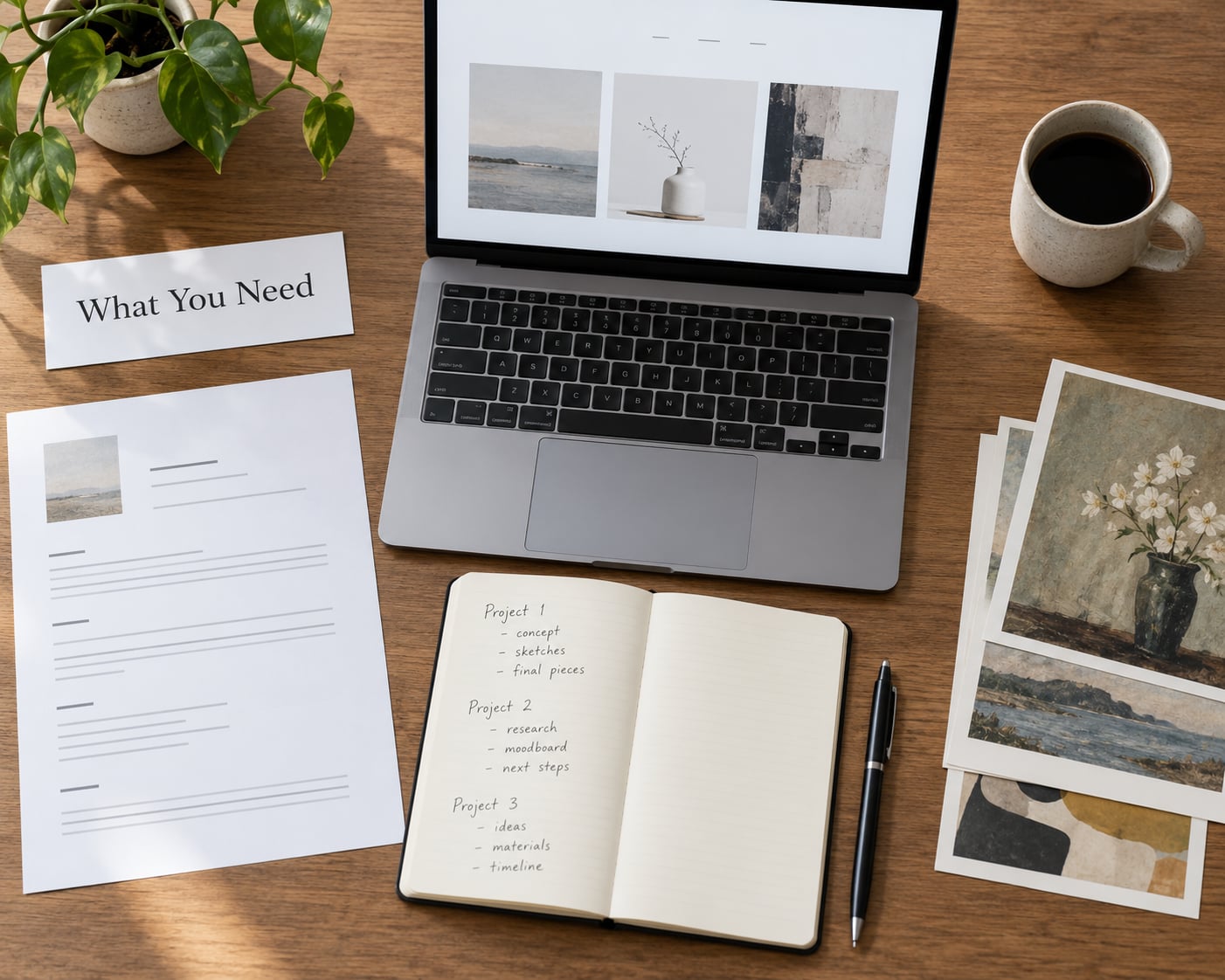
Before you search, get these six things out of the drawer. Applicants who assemble them once and reuse them across calls are the ones who actually submit.
- A current portfolio hosted somewhere with a working link. Even emerging artists are expected to have an online portfolio now.
- A short biography, 75 to 150 words, written in third person and readable in under a minute.
- A CV or resume with education, exhibitions, screenings, performances, publications, awards, and collections. Keep it to two pages unless a call asks for more.
- A project outline, one page at most, describing what you would actually do with the time.
- Work samples that match what the call asks for in number and format.
- A budget sketch even for fully funded calls, because some juries ask what you would do with a stipend.
Write the biography last. It is the easiest thing to over-edit and the one component reviewers spend the least time on, so get it out of the way and move on to the proposal.
You will also want a tracking system. A spreadsheet with columns for the program, deadline, fee, required materials, and status takes ten minutes to build and saves you from submitting something twice or missing a date entirely.
How to Find an Artist Residency and Apply: Step by Step
Search in layers. Directories get you a first pass, but the strongest applications usually come from calls you found through a host institution or a person who has been there before.
Define what a residency should offer you
Write down what your practice actually needs right now, in one sentence. “Two uninterrupted months, a private workroom, and access to a kiln” is a usable answer. “Somewhere inspiring” is not.
That sentence becomes your filter for everything else. It also tells you which funding model is realistic: a four-week retreat will not fix a body of work that needs equipment you do not own, and a twelve-month fellowship is overkill if your real problem is a dry patch of six weeks.
Here is the list of what programs typically offer, so you can match your needs against it:
- Private or shared studio space
- Accommodation on site or a housing stipend
- A living stipend or honorarium
- Travel funding, sometimes capped or reimbursed after the fact
- Materials or production budget
- Technical support and specialized equipment such as kilns, presses, darkrooms, or fabrication shops
- Curatorial or mentorship guidance, including crit groups
- Public programming, exhibition, or a reading at the end
- Community engagement or teaching expectations
Search official calls and trustworthy directories
Start with the host organizations themselves. Artist-run spaces, cultural institutions, universities with studio programs, foundations, and regional arts organizations post open calls on their own sites, and those pages carry the most accurate details.
Layer directories on top. Artist Communities Alliance and ResArtis both index programs and let you filter by discipline and funding type. ArtConnect lists open calls and residencies with deadlines attached, which makes it good for spotting windows rather than deep research. Open call platforms work the same way. Treat all of them as starting points, not as the application itself.
Then widen the search past search engines, because that is where the research says most artists actually find their residencies. Professors, former teachers, and studio mates know openings inside their own networks before anything is published. Alumni of a program are usually glad to answer questions. Instagram accounts run by individual residencies post calls and open studio days that never reach a directory.
Rural and remote programs draw noticeably fewer applicants than city ones, which matters if you are aiming somewhere competitive. A residency three hours from the nearest airport often has a much shorter applicant pool than a downtown program in a major arts city.
Check dates, eligibility, costs, and application requirements
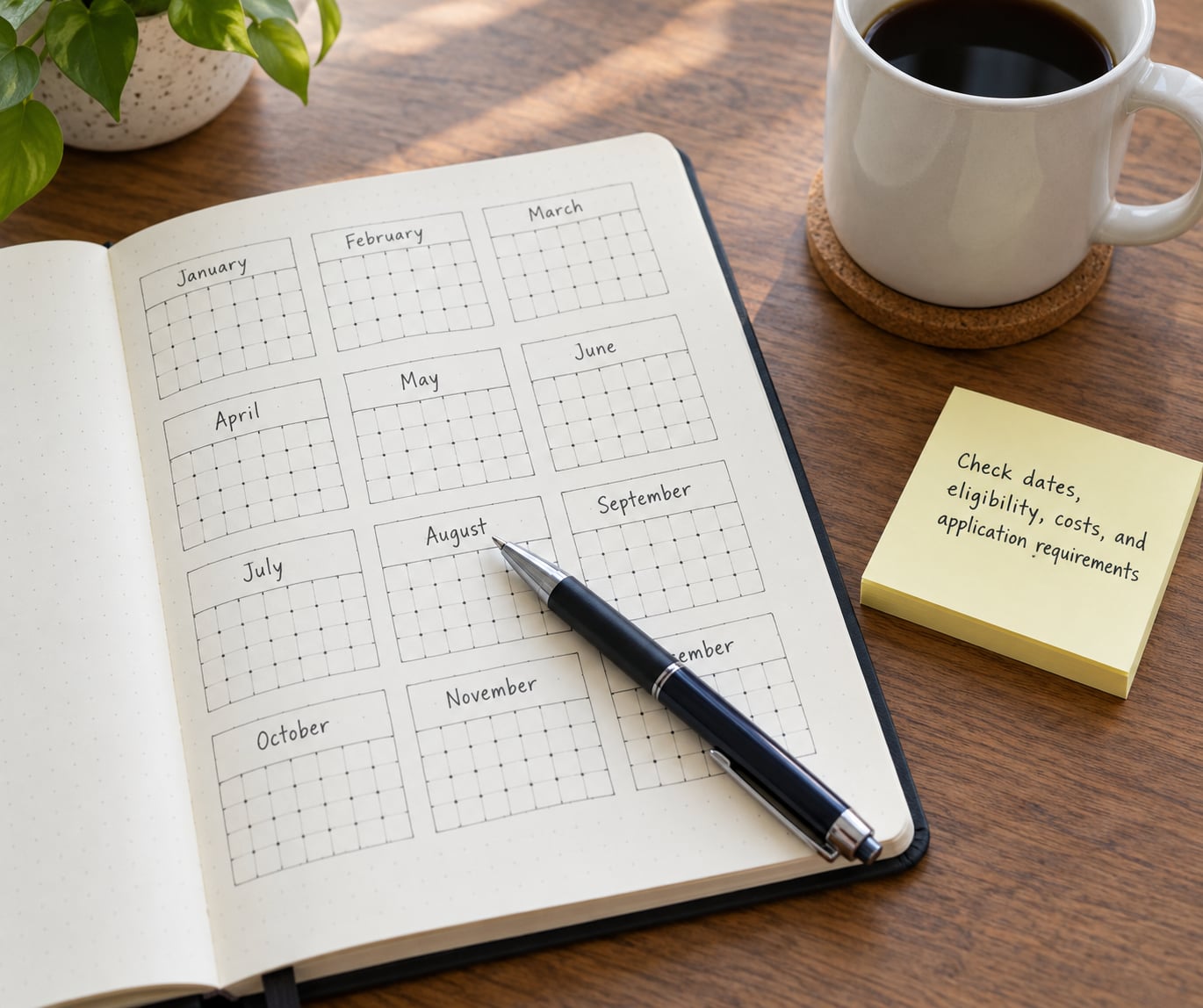
Run every call through this list before you spend an hour on it. Most wasted applications die at one of these checks.
- Length and dates. Note the residency period, the application deadline in your own time zone, and the notification date. A call that says results come on a rolling basis tells you nothing about urgency.
- Eligibility. Career stage, discipline, degree requirement, nationality or residency restrictions, exhibition history expectations, and any age limit.
- Cost and funding. Application fee, program fee, what the fee covers, what it does not, stipend amount and payment schedule, and whether travel is included.
- Living details. Private or shared room, meals, laundry, internet, cleaning expectations, and what happens if you need to leave for a few days.
- Insurance and health. Whether the program carries liability cover and whether you need your own policy.
- Format requirements. Image counts, file size, video links versus uploads, word limits, PDF naming conventions, and the platform being used.
Programs that publish real stipend numbers, name the selection committee, state exactly what is not provided, and give a firm notification date are the ones worth your evening. Vague programs usually cost you the fee and the week you spent preparing.
On fees: reputable programs either charge nothing or charge a modest amount and publish a waiver policy. Artists report that waivers are granted often and almost never advertised. When the fee is more than a coffee and a night of work, email the coordinator before you abandon the application, and say plainly that the fee is the barrier. Keep it to three sentences.
Read the brief for evidence of a strong fit
The call text tells you what the host organization values. Programs with a curatorial voice name the questions they are asking about your work. Programs with a community program mention teaching, workshops, or local collaboration. Programs with a fabrication facility name materials and equipment.
Read it twice. The first pass is for the facts in the previous checklist. The second is for tone: is the language about the site, about a community, about research, or about production? Match that language in your proposal. Jurors read hundreds of applications and a proposal that sounds like it was written for this specific place does stand out.
Also look for what they do not say. If they mention an exhibition but never mention studio access, ask yourself whether that matters to your project. If they list no stipend and no fee, the numbers may not be posted yet, which is worth a quick clarification email.
Prepare a portfolio that shows the work behind your fit
A portfolio is not a greatest-hits list. Pick a small, coherent body of work and explain why each piece is in it.
Six to fifteen strong pieces usually beat thirty that include everything you have ever made. Add short captions with title, year, materials, and dimensions. Where it helps, include a process note or two lines about why the work exists; juries read for intent, not just craft.
Match the count the call asks for. Requirements vary wildly between programs, and a portfolio with twenty images submitted where ten were requested is an easy rejection.
By discipline:
- Visual artists should show a sequence rather than unrelated pieces, and prepare both a full submission set and a shorter alternate set in case the call caps you at ten.
- Writers should send a writing sample within the page range given, usually 10 to 25 pages, plus a note on the project. Published work helps, but a strong manuscript sample carries an emerging writer further than a thin publication list.
- Performers and musicians should link to hosted video rather than uploading files, keep links unlisted or password-protected if you want to control access, and include two to three recent pieces plus a work in progress.
- Sound and interdisciplinary practices should include one short work, one longer work, and a paragraph describing how the new environment would change the work.
Test every link from a private browser window before you submit. Broken portfolio links are the most common preventable failure, and curators will not chase you down.
Tailor the statement, biography, and project proposal
Most calls ask three different things and applicants blur them into one essay. Keep them separate.
The artist statement is about your practice: what you work on, how, and why. Write it once, well, and adjust the emphasis per program rather than rewriting from scratch.
The biography is a factual summary. Third person, no aspirations, no “passionate about.” If you have no exhibitions yet, list your degree, grants, screenings, teaching, and residencies, and let the work speak.
The project proposal answers the actual question the call asked. It names the project, describes the process, connects your past work to it, and says what support you are asking for. State clearly what you need from the residency: studio access, technical help, materials, curatorial conversation. Jurors frequently fund clear requests better than vague ambition.
Stay inside the word limit. Staying under it is the better failure. If a call says 500 words, write 480 and stop.
Add a specific detail that only this residency could produce. The place has a particular kiln schedule, a particular archive, a particular community calendar. Mentioning it proves you read the brief and had a real idea.
Submit early, proofread, and follow up once
Do not aim for the deadline day. Portfolio systems slow down on the last afternoon, and file uploads fail.
Three days out, log in and upload one dummy file through the whole flow. That single test catches the format problems, the size limits, and the account issues while there is still time to fix them. Name files the way the call asks, and keep a record of your confirmation number or email.
On submit day, read your statement on screen rather than trusting the file. Then read the fee total, confirm the payment went through, and screenshot the confirmation.
If you hear nothing by the stated notification date plus a week, send one short email. Say who you are, which cycle you applied to, and ask for a status update. That is the whole email. One follow-up, no argument, no second plea. Applicants who report back say a single polite note gets answered often, and a second one gets you on a no-reply list.
Keep a record of what you sent, even after a decision. Reapplying the following year with genuinely stronger material is a normal strategy, and your old statement, framed as a draft, is a useful starting point.
Common Mistakes
These come up again and again, and each one has a straightforward fix.
- Sending a generic application. The proposal could have been sent to twenty other programs. Fix: rewrite the opening paragraph of the proposal for every single call, naming the place, the program, and one specific detail.
- Ignoring eligibility rules. Degree requirement, career stage, or nationality exclusions are checked before the work is read. Fix: screenshot the eligibility section into your tracking sheet so it stays visible.
- Overloading the portfolio. Thirty pieces with no thread reads as indecision. Fix: cut to the coherent set, and explain in one line why each piece is there.
- Missing deadlines. Deadlines are spread across a whole year and rarely in one place. Fix: use the tracking spreadsheet, set reminders at one week and one day before, and work backward from residency start dates so you know which cycle you are actually in.
- Asking questions the call already answers. Fix: read the eligibility and FAQ pages twice before emailing, and only ask about things specific to your situation.
- Making financial claims you cannot back. Statements about income, funding, or institutional backing get checked. Fix: describe what you have and what you are requesting, and keep estimates labelled as estimates.
- Applying to ten programs from one template. Artists report sending 15 to 30 applications per cycle, which is fine, but only if each one is adjusted. Fix: write one strong base and spend the saved time tailoring openings and closing lines.
- Treating a self-funded residency like a grant. You are buying something, so shop for it. Fix: ask what the fee includes and excludes, what past residents say about the space, and whether a shorter stay is offered. Skip it if nobody answers those questions.
- Assuming a rejection is a verdict. Fully funded programs with single-digit acceptance rates reject many working artists. Fix: ask for feedback once, politely, and reapply a year later with the same project and better materials.
Two habits tighten everything else. First, spend twenty minutes researching the host before you write a word; curators can tell instantly. Second, keep your materials in one folder you can duplicate in a click, so applying to three more good calls costs an evening rather than a weekend.
If rejection lands hard, the recovery is boring and works: write down which panel of your application felt weakest, fix exactly that, and send the next application. Nothing about a single decision changes the work itself.
Frequently Asked Questions
How do I find artist residencies with funding?
Filter every directory by funding type before you read a single program page. Most listings let you sort for fully funded, partially funded, or fee-based, and that filter removes half the noise. Then check that the program states an actual stipend figure rather than saying support is available. Government arts bodies and regional arts councils also publish grant databases for travel and project costs. Ask past residents what the money covered in practice.
Do reputable artist residencies charge application fees?
Many charge nothing. Those that charge usually keep it low, publish the amount, and offer a fee waiver. Artists report that waivers are granted fairly often and almost never advertised, so email the coordinator before giving up on a call. A large fee with no waiver process and no stated purpose is a warning sign about how the rest of the program is run.
Can I apply to an artist residency with an AI-assisted portfolio?
Use AI to tidy wording and formatting, not to invent work or inflate a biography. Jurors are experienced readers and generative filler in an artist statement reads as filler immediately. If a program publishes its own rules on AI, follow those. The safest line is that every image in the portfolio is yours, every claim in the CV is true, and every sentence sounds like you wrote it.
What should I include in an artist residency project proposal?
Name the project, describe the process in concrete steps, connect it to your past work, and say what you need from the residency. Specificity beats ambition. A proposal that mentions the site’s particular equipment, archive, or community program shows you read the brief. State your requests plainly, keep it inside the word limit, and stay a little under it.
How can I improve an artist residency application after being rejected?
Ask for feedback once, briefly and politely, then wait. Fully funded programs with single-digit acceptance rates reject plenty of established artists, so a single decision tells you little. Review the part of the application you felt weakest and fix that specifically. Reapplying the following cycle with genuinely improved material is a normal strategy, and your old statement makes a useful first draft.
Conclusion
Pick five calls you can genuinely attend, not ten you have heard of. Verify each one against the eligibility, cost, and dates checklist, then choose the strongest single fit and give it three full days of work.
Write the opening paragraph for that one residency specifically, test the upload flow early, and submit a day before the deadline. Improve one application properly and you have done more than most applicants do in a season.